


















Executive Summary
— Battlefield assessment. Ukraine announced that it had redeployed the 46th Airmobile Brigade to reinforce the defense of Kramatorsk and Sloviansk, key nodes in the country’s defensive fortress belt in the Donbas, where Russia continues to apply heavy pressure.
— New Ukrainian commanders. Ukraine elevated a new generation of tactical-level commanders who emphasize technological adaptation, decentralized leadership, and force preservation.
— Ukraine’s air defenses. Facing a growing ballistic-missile threat from Russia, Kyiv is developing its indigenous Koral air-defense interceptor while also working to obtain additional Western interceptors.
— Russian drones and missiles. Russia dispatched its combat-tested drones and missiles to Egypt to promote them for export.
1. Battlefield Assessment: The Fight for Kramatorsk and Sloviansk
Last week Ukraine quietly redeployed its 46th Airmobile Brigade from the stabilized southeastern front toward Kramatorsk and Sloviansk, the last two major cities of the Donbas that remain outside of Russian control. Ukraine began this movement in July and concealed it for at least two months.
The 46th is a formidable combat formation. In June 2024, paratroopers from the brigade repelled a Russian assault in the Mariinka sector, the largest assault since the beginning of the brigade’s deployment. In countering that push, Ukrainian forces struck the marching Russian formation with artillery, anti-tank guided missiles, and drones. They struck Russian tanks, infantry fighting vehicles, and armored personnel carriers.
The area has been under heavy aerial bombardment, particularly by FAB-500 aerial bombs, for some time. Ukraine faces a unique challenge in defending the two cities: it must concentrate scarce combat power at decisive points, while Russia can continue testing the front lines with weight, persistence, and attrition. Kramatorsk and Sloviansk, therefore, are more than just two cities that remain under Ukrainian control. Together, they form the center of gravity in Kyiv’s hold over the Donbas. Their loss would not end the war, but it would give Moscow a major territorial victory and strengthen the Kremlin’s claim that time is on Russia’s side.
Ukraine will task two of its most prominent commanders with defending these crucial flashpoints: Andrii Biletskyi of the 3rd Army Corps and Denys Prokopenko of the National Guard’s 1st Azov Corps. Both men have built disciplined, technologically sophisticated formations with tens of thousands of personnel. Earlier this year, Biletskyi’s corps stabilized the front near Sloviansk, the northern anchor of the fortress belt Ukraine has constructed in Donetsk Oblast. Prokopenko’s Azov forces demonstrated their combat effectiveness in 2025.
Air Assault Forces Colonel Emil Ishkulov, another well-regarded leader from Ukraine’s emerging generation of commanders, will support Biletskyi and Prokopenko. Ishkulov is respected among soldiers for emphasizing force preservation, an approach that remains too uncommon in modern warfare. His 11th Army Corps is responsible for defending Sloviansk and Kramatorsk.
Ukraine’s new command appointments, while tactically significant, also mark a broader institutional shift within the country’s military. General Oleksandr Syrskyi, the commander in chief of the Armed Forces of Ukraine before his recent replacement by General Mykhailo Drapatyi, faced criticism for a command style that several observers linked to Soviet-era micromanagement. Syrskyi also came under fire for his willingness to accept heavy losses, even in localized tactical engagements. Ukraine hopes that the appointments of Ishkulov, Biletskyi, and Prokopenko will help reverse these trends.
The 46th arrives with a record of battlefield effectiveness. The brigade may be tasked with covering the 24th Mechanized Brigade’s limited withdrawal from the exposed Chasiv Yar sector. If executed well, this maneuver could relieve pressure on Ukraine’s defensive lines, reduce the risk of encirclement, and preserve experienced forces for the battles ahead.
These are important considerations: in a war of exhaustion, preserving formations matters as much as holding ground. Yet Russia retains the manpower and firepower to exert pressure on Ukraine from several directions, as last week’s developments on the ground demonstrated. In addition to the deteriorating situation in and around Kramatorsk, the conflict’s operational tempo remained heightened across the battlespace, as Ukraine and Russia continued to wage more than 200 tactical engagements each day, with particularly consequential combat in Pokrovsk.
2. Ukraine Follows Two Air-Defense Imperatives: Build at Home, Buy Time Abroad
Ukraine is pursuing a two-track strategy for its air defenses. Kyiv is developing indigenous interceptors to build long-term air-defense autonomy, while securing Western missiles to counter the immediate Russian aerial threat.
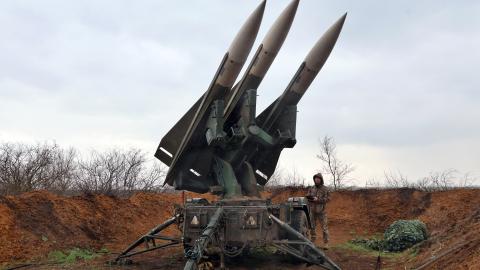
Ukraine has publicly revealed the Koral, a domestically developed surface-to-air missile (SAM) designed to intercept ballistic targets. The system made its first appearance at Poland’s recent International Defense Industry Exhibition (MSPO). An image released by Ukroboronprom, Ukraine’s largest state-owned defense conglomerate and arms manufacturer, depicts the missile launching from a mobile platform mounted on the chassis of a Czech-made Tatra truck. Nonetheless, the system’s effectiveness remains unknown against high-end Russian and North Korean ballistic and aero-ballistic missiles such as the air-launched Kinzhal.
The current Koral interceptor variant weighs approximately 992 pounds and carries a 79-pound warhead. Its guidance configuration combines inertial navigation, radio-command correction, and an active radar-homing seeker. Ukraine began developing the system in 2016, when it designed the projectile primarily as an interceptor for a shipborne air-defense system. In 2021, Ukraine’s Luch State Design Bureau displayed a full-scale mock-up of the weapon at the country’s Arms and Security exhibition. At that stage, the system’s designers presented the Koral as a unified modular missile capable of serving both land-based and naval air-defense systems, with the possibility of its eventual adaptation to an air-to-air role.
Another critical development in Ukraine’s air-defense evolution emerged last week: the country’s deepening defense ties with Germany. Berlin agreed to provide Kyiv with PAC-2 missiles from existing Bundeswehr reserves rather than wait for future production cycles. Germany’s Defense Minister, Boris Pistorius, acknowledged the difficulty of balancing Germany’s own national security requirements against Ukraine’s immediate needs, but urged allies to favor Kyiv. Ukrainian Defense Minister Yevhenii Khmara called on Kyiv and Berlin to finalize the necessary financing decisions for the missile’s transfer by November so that Ukraine could deploy the PAC-2 interceptors during the winter.
In another air-defense development, the European Union agreed to activate its €90 billion Ukraine Support Loan to allow Ukraine to use €3.2 billion—approximately $3.7 billion—for purchases that facilitate Kyiv’s use of Patriot SAM systems. This decision required Brussels to invoke an exemption from rules that direct most EU-financed procurement toward European suppliers and limit non-European components of any purchase to 35 percent of the total.
Battlefield necessity is forcing Europe to relax these restrictions. Easing the rules lets Ukraine buy necessary systems when European alternatives cannot meet Kyiv’s requirements for price, volume, or delivery speed. The United Kingdom separately announced a £100 million assistance package for Ukraine, including Patriot missiles and other air-defense equipment, to be delivered through the Prioritized Ukraine Requirements List mechanism established by the North Atlantic Treaty Organization.
Together, Kyiv’s indigenous Koral program and its expanded Patriot procurement efforts illustrate how battlefield necessity is reshaping Ukraine’s defense industry and Europe’s financing rules. The strategic test for Ukraine is whether domestic production and allied deliveries can scale quickly enough to outpace Russia’s missile campaign and limit further damage to Ukrainian cities.
3. Russian Drones and Missiles in the Middle Eastern Weapons Market
Russia is converting its industrial and operational experience gained in Ukraine—including mass-produced affordable munitions, cruise-missile-drone hybrids, and saturation attacks using mixed strike packages—into an increasingly competitive defense-export portfolio.
The first example is the export version of the Banderol cruise-missile-drone hybrid. Russia displayed the Dan-T loitering munition at the 2026 El Alamein International Airshow, held at Egypt’s El Alamein International Airport from September 8–10. A derivative of the Banderol missile, the turbojet-powered Dan-T weighs up to 600 pounds, has a range of approximately 280 miles, and can be launched from fixed-wing drones or rotary-wing manned aircraft—primarily Mi-28 variants. Kronstadt JSC, the manufacturer of the Orion reconnaissance-strike drone, produces Banderol. Russia began testing the system in secret in 2024. Its first documented use against Ukraine came in spring 2025, when Ukrainian intelligence reconstructed the hybrid from debris.
Banderol resembles a scaled-down Kh-101, with deployable wings and radar-signature-reducing shaping. Unlike the long-range, bomber-launched missile—which carries up to 1,980 pounds and uses sophisticated electronics, Russian components, optical guidance, and purpose-built engines—Banderol relies more heavily on commercial technology. It reaches some 370 miles per hour, travels 310 miles, and carries a 250-pound high-explosive fragmentation warhead. Its architecture combines a Chinese Swiwin turbojet and inertial-navigation system, American, European, and Japanese electronics, and Russia’s Kometa-8 controlled radiation pattern antenna. It costs an estimated $50,000–$150,000, compared with roughly $2 million for the Kh-101 and $1.5 million for the Iskander-K. The Ukrainian military is trying to find interception weapons to counter the Banderol, including products from the Shahed-hunter Wild Hornets drone technology group.
Russian defense industries also dispatched the export version of the Lancet drone, Lancet-E, to Egypt. The system comes with 6-pound and 10-pound warhead variants. The original baseline comes with a 25-mile operational range and carries many Western sub-components.
4. What to Look For in the Coming Weeks
A suspected Shahed-type drone entered Moldovan airspace on September 8 before crashing near the village of Stari Mihăileni, igniting dry vegetation but causing no casualties. Although Moldova is not NATO territory, Romania—a NATO member—scrambled two fighter aircraft later that day after a separate violation of its own airspace. These events underscore the widening geographical footprint of Russia’s drone campaign. Russia may conduct increasingly large-scale drone-probing operations against NATO nations to test air defenses, response times, and political cohesion. Over time, such activity could increase the risk of a broader confrontation between Russia and NATO in Europe.