






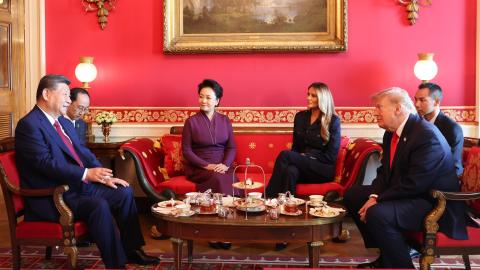








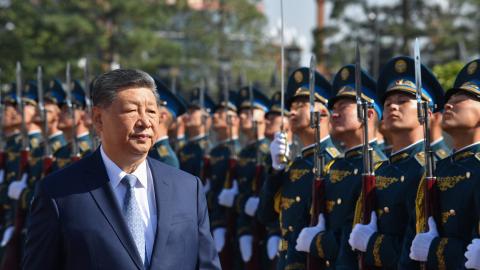




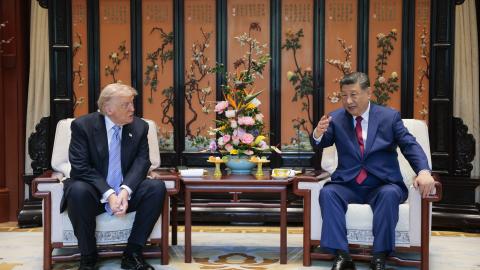
As Chinese President Xi Jinping prepares to visit Washington next week, much of the commentary has focused on a familiar set of questions. Will he and US President Donald Trump stabilize relations? Can they reduce tensions over Taiwan? Will trade disputes ease? Will military-to-military contacts improve?
These questions matter. But they miss the most important strategic point.
The real audience for a summit between President Xi and President Trump is not in Beijing or Washington. It is in Tokyo, Manila, Canberra, Seoul, and, increasingly, NATO capitals. The meeting’s strategic significance will be determined less by what it means for the bilateral US-China relationship than by what it signals to America’s allies.
This reflects a fundamental shift in the international security environment. For most of the post-Cold War period, US-China relations could largely be understood through a bilateral lens. Today, they cannot. Coalitions, rather than individual states, are increasingly shaping the balance of power in the Indo-Pacific.
The evidence is visible across the region. Japan is undertaking the most significant military capability buildup in decades. The Philippines has expanded military access for US forces under the Enhanced Defense Cooperation Agreement. South Korea and Japan have deepened security cooperation despite longstanding political tensions. AUKUS has deepened defense cooperation between Australia, the United Kingdom and the United States. Meanwhile, European allies have become more active in the Indo-Pacific through naval deployments, defense industrial cooperation and strategic coordination.
From Beijing’s perspective, these developments are more consequential than any individual summit. China’s challenge is no longer the United States alone but an increasingly integrated network of allies and partners. The United States and Japan are improving command integration and operational planning. Washington, Tokyo, and Manila have expanded trilateral cooperation. Across the region, allies are investing in air and missile defense, maritime surveillance, and logistics resilience and autonomous systems. Together, these efforts are creating a coalition-based deterrence architecture.
This reality should shape how we measure success if Xi visits Washington. A successful summit is not one that generates the warmest headlines or the most optimistic-sounding communiqué. Instead, we should judge its value by three questions.
First, will the summit reduce the risk of miscalculation without weakening deterrence? The United States and China have good reasons to maintain communication channels. Strategic competition will endure regardless of diplomatic atmospherics, and the danger of accidents or unintended escalation is real. Communication can reduce those risks. But stability rests on credible deterrence. Diplomacy works best when both sides understand the costs of coercion and military adventurism.
Second, does the summit reassure allies rather than marginalize them? This question matters because US allies have long worried about major-power accommodation reached at their expense. Allied capitals watch every high-level engagement between Washington and Beijing closely. Allied policymakers will pay less attention to ceremonial symbolism than to whether the meeting reinforces confidence that their interests remain central to US strategy.
This concern is not hypothetical. The credibility of American leadership depends not only on military capabilities but also on allied confidence that Washington will consult with them, take their interests seriously, and resist any temptation to pursue short-term stabilization with China at the expense of long-term coalition cohesion. In today’s Indo-Pacific, alliance reassurance is itself a strategic asset.
Third, does the summit preserve momentum in allied defense cooperation? This may ultimately be the most important question. The most significant strategic development in the Indo-Pacific is not a single weapons platform, military exercise, or diplomatic initiative. It is the growing integration of allied capabilities across multiple domains. This includes intelligence sharing, logistics arrangements, and defense industrial cooperation. Through intelligence sharing, logistics cooperation, defense industrial ties, maritime domain awareness, and emerging technologies, allies are building practical links that are becoming deeper and more institutionalized.
Importantly, many of the initiatives are developing momentum of their own. They increasingly transcend individual governments and administrations. They are becoming embedded in military planning processes, bureaucratic structures and industrial partnerships.
From Beijing’s perspective, this trend presents a difficult challenge. China can negotiate with one American administration. It is far more difficult to negotiate away a dense network of security relationships among states that increasingly perceive similar security risks and share common interests in maintaining regional stability.
That is why the success of a Xi summit should not be measured solely by whether US-China relations improve in the short term. The more consequential question is whether the meeting strengthens confidence among the countries whose cooperation will shape the future balance of power.
A visit by Xi Jinping could help establish guardrails for competition and reduce the danger of crisis escalation. Those are worthwhile objectives. But policymakers should resist the temptation to treat dialogue itself as a strategic outcome. The long-term stability of the Indo-Pacific will depend less on summit diplomacy than on whether allies continue to strengthen the collective capabilities needed to deter conflict. In an era of strategic competition, alliance confidence is not a peripheral concern. It is the foundation of deterrence.