














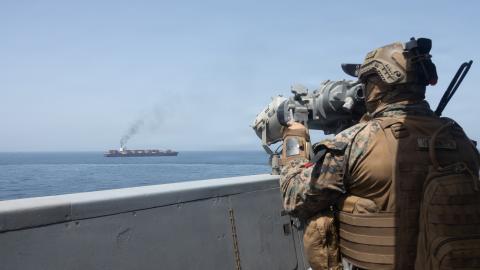
"The Strait of Hormuz," Secretary of State Marco Rubio told Fox News this week, "is an economic nuclear weapon."
He was describing the IRGC's core strategic intention, to hold the world's most critical oil chokepoint as leverage over global markets and Washington itself, but Iran never got to pull that trigger.
The US Navy's blockade of the Strait denied the IRGC that instrument before it could be used, and Operation Economic Fury now ensures the failure compounds, turning against Tehran the same economic pressure Iran spent decades positioning itself to inflict on the world.
What most ceasefire commentary has missed is that the military campaign pausing does not mean the conflict has paused, because the economic campaign is running at full force, its targets extending from Tehran's financial network to the Chinese industrial architecture that kept it alive.
That architecture took decades to build.
For years, the IRGC sustained itself through shell companies, rotating vessel identities, and shadow banking corridors that kept oil revenue flowing far from formal financial channels, turning every prior sanctions round into a temporary inconvenience absorbed and rerouted within months.
Washington kept targeting individual nodes while leaving the broader network intact, which gave Tehran reasonable confidence that Epic Fury's ceasefire, like every pause before it, would open another recovery window.
That calculation is wrong this time, because the cost of each passing week compounds rather than eases, with Treasury's action targeting the evasion architecture itself rather than its individual components, ensuring that what Tehran reads as time purchased is in fact institutional capacity being permanently stripped away.
That architecture survived as long as it did for one reason: China built the infrastructure to sustain it, and Xi Jinping made that a deliberate strategic choice on three levels.
First, Beijing built the financial plumbing, developing methods for shadow banking, obscuring Iranian crude origins, rotating ship identities, and layering payments through third-country intermediaries.
Second, its teapot refinery sector absorbed most of Iran's total oil exports to China, conducting those transactions through the US financial system in dollar-denominated deals and providing the IRGC the hard currency needed to fund missiles, drones, and weapons transfers to regional proxies.
Third, and most critically, Xi used Iran as a rehearsal space, refining evasion techniques he intended to deploy at far greater scale if Washington's pressure ever turned toward Chinese core interests directly.
The volumes document exactly how deeply that relationship ran.
The IRGC operated a rotating fleet of tankers under falsified identities to conceal Iranian crude shipments to Chinese buyers, while Hengli Petrochemical, China's second-largest independent refinery, received more than five million barrels of IRGC-affiliated crude through that same network.
The arrangement served Beijing on both ends, with Chinese refiners purchasing Iranian crude at steep discounts unavailable on open markets, while every successful evasion transaction simultaneously stress-tested the financial infrastructure Xi intended to activate over Taiwan.
However, the US Treasury's latest action forecloses that confidence by sanctioning 35 entities and individuals running Iran's shadow banking architecture, hitting 19 shadow fleet vessels simultaneously, and putting every firm paying IRGC tolls for Strait of Hormuz passage on notice.
The Strait carries roughly 20 per cent of global oil supply, giving Tokyo, Seoul, and every European capital with energy exposure to Gulf shipping a direct stake in whether the IRGC retains the capacity to weaponise that chokepoint, which means Washington is acting on behalf of the entire alliance system, not just its own strategic interests.
The stated objective of Operation Economic Fury is to coerce the IRGC into surrendering its nuclear program and abandoning its revolutionary ambitions across the region, an objective whose outcome remains uncertain.
What is already underway, as a direct consequence of pursuing it, is the dismantlement of the laboratory Xi spent two decades building, with Washington systematically mapping, documenting, and countering the instruments produced there.
What looks like a pressure campaign against the IRGC and a pressure campaign against Beijing's financial architecture is in fact a single operation.