


















View Full PDF
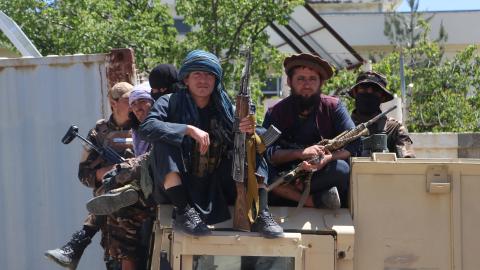
Five years after the Taliban captured Kabul on August 15, 2021, Afghanistan has largely fallen off Western policymakers’ radar. Yet recent developments in northeastern Afghanistan, particularly in the province of Badakhshan, merit closer attention. Armed anti-Taliban resistance organizations have been active in the province in recent weeks. The two main actors are the National Resistance Front of Afghanistan (NRF), led by Ahmad Massoud, the son of the late commander of the Northern Alliance, Ahmad Shah Massoud, and the Afghanistan Freedom Front (AFF), led by former Afghan Army Chief of General Staff Yasin Zia. In addition, more localized resistance groups have appeared, and the ebb and flow of local allegiances are adding to what is a fast-changing and complicated situation on the ground.
This policy memo does not seek to provide a deep dive into the human terrain of Badakhshan or the different groups and personalities involved in recent operations. Events are evolving too quickly for such analysis to be useful. Instead, it explains why Badakhshan matters, why the province has become a center of armed anti-Taliban resistance, what the geopolitical implications could be, why the United States should care, and what Washington can do about it.
The conflict in Badakhshan remains limited in scale, but it could represent the early stages of a more coordinated and sustained armed resistance against Taliban rule. History shows that what happens in Afghanistan rarely stays within the country and often spills over into the region. Events in Afghanistan should be of particular interest to US and Western policymakers, as the country becomes involved in broader geopolitical shifts. In particular, the Taliban is growing closer to Russia and India; conflict is increasing between the Taliban and Pakistan; uncertainty surrounds the situation in Iran; and China is always present in the region.
Badakhshan Province
Badakhshan Province is one of the most remote regions of Afghanistan, and is known for its mountainous and unforgiving terrain and its famous lapis lazuli mines. At just over 17,000 square miles, it is roughly twice the size of New Jersey and has an estimated population of about one million people.
The population predominantly consists of ethnic Tajiks and Sunni Muslims, although there is a smaller, geographically concentrated population of Ismaili Shia Muslims in some of the province’s higher and more remote valleys. Badakhshan is also home to smaller Pamiri ethnic and linguistic communities, as well as small pockets of Uzbeks and Pashtuns.
Its landscape includes some of the highest and most formidable terrain in the world, including the Pamir Mountains in the far northeast. Regional infrastructure is limited. Relatively few roads are reliable year-round, and the weather and climate often restrict local travel, commerce, and access between communities. As a result, mountain valleys and the limited routes connecting them serve as economic arteries, political links, and, during times of conflict, strategically important lines of movement, control, and refuge.
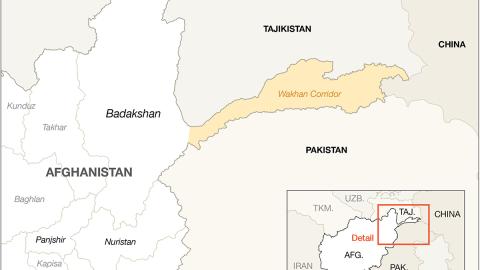
Badakhshan also occupies a unique position on Afghanistan’s map. The province shares international borders with Tajikistan to the north, Pakistan to the southeast, and China to the east. The Wakhan Corridor, the narrow sliver of Afghan territory extending from the country’s northeastern frontier, is recognizable even to many people unfamiliar with Afghanistan’s geography (see map 1). At the corridor’s eastern tip, Afghanistan shares its only border with China. This frontier stretches for roughly 50 miles across some of the most remote and inhospitable terrain in the world. As the British diplomat William Habberton wrote in 1937, Wakhan is “the long, attenuated arm of Afghanistan reaching out to touch China with the tips of its fingers.”
Map 1. Badakhshan Province and Surrounding Region
Source: Hudson Institute
In recent weeks, the NRF and AFF have turned particular attention toward Badakhshan. The AFF has conducted attacks against Taliban positions around Zebak District, while the NRF has operated farther south in Kuran wa Munjan District. The NRF has also claimed responsibility for the successful assassination of the Taliban mayor of Faizabad, Badakhshan’s provincial capital.
Why Events in Badakhshan Matter
In the early days of the anti-Taliban resistance during the 1990s, some of the same valleys, villages, and mountainous districts of Badakhshan became important centers of opposition to Taliban rule. Their remoteness, difficult terrain, cross-border geography, and longstanding political and social networks made them unusually difficult for governments in Kabul to dominate.
Not coincidentally, Badakhshan is therefore once again emerging as a focus of armed anti-Taliban resistance. The recent armed opposition activity in Badakhshan matters for several reasons:
- The geography of geopolitics. Badakhshan occupies Afghanistan’s northeastern extremity, wedged between countries whose relationships with the Taliban have become increasingly complicated. Pakistan’s relations with the Taliban authorities in Kabul have deteriorated considerably in recent years. Islamabad has demonstrated growing hostility toward the Taliban over issues such as cross-border terrorism and the activities of the Pakistani Taliban. This has led to at least a degree of de facto sympathy toward some Afghan groups opposing the Taliban. Tajikistan, meanwhile, has maintained close ties with elements associated with the NRF and has remained notably wary and distrustful of the Taliban.
This external geography matters. Unlike resistance operations taking place deep inside Afghanistan, armed activity in Badakhshan is active next to international borders with states that have their own serious concerns about Taliban rule. At a minimum, this creates the possibility of greater strategic depth and a comparatively safer environment in which opposition groups can operate, especially given the region’s terrain. - The China factor. For now, the Afghanistan-China border has little practical significance for trade or transportation. Strategically and symbolically, however, it is significant as China’s only border with Afghanistan. If anti-Taliban forces were to dominate the eastern reaches of Badakhshan and the approaches to the Wakhan Corridor, they could effectively deny Beijing direct overland access to Taliban-controlled Afghanistan.
This would have greater regional significance. China has invested considerable diplomatic effort in maintaining relations with the Taliban and has strategic and economic interests in Afghanistan and the wider region. An armed opposition presence capable of dominating the Wakhan Corridor would therefore introduce a new geopolitical dimension to the conflict. - The topography protects the resistance. Badakhshan’s steep valleys, high mountain passes, narrow roads, isolated settlements, and the formidable terrain of the Pamirs make conventional military operations difficult while providing natural advantages to small guerrilla forces familiar with the terrain.
Three Areas to Watch
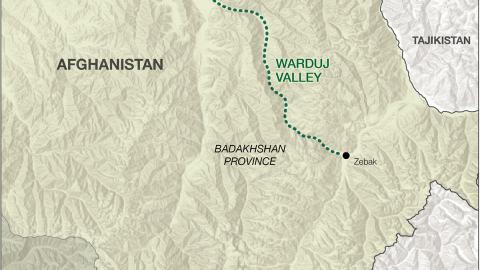
Three tactical areas in Badakhshan with active armed resistance are worth keeping an eye on (see map 2). The capture of these regions from the Taliban could indicate a shift in local security dynamics.
Map 2. Badakhshan Province and the Warduj Valley
Source: Hudson Institute
1. Zebak District. The AFF has been particularly active here in recent weeks. The city of Zebak serves as the district’s center of government and sits at a strategically important intersection where several valleys and routes converge.
Three principal road approaches converge on or around Zebak. In addition, various seasonal mountain routes and passes provide connections to Tajikistan to the north and Pakistan to the south—both borders are just 20 miles from Zebak. This combination makes the district much more important than its small population or remote location might suggest.
Zebak District also serves as one of the principal gateways into the Wakhan Corridor. Whoever controls this location can exert considerable influence over access to Ishkashim (the gateway to the Tajikistan border) and the Wakhan. For an armed opposition movement, establishing control over Zebak would therefore carry tactical importance inside Badakhshan as well as broader geopolitical significance.
2. Kuran wa Munjan District. This region is located in southwestern Badakhshan. The NRF has recently operated there, and its geography makes it particularly important. Kuran wa Munjan occupies rugged terrain that connects approaches from Panjshir and Nuristan to southern Badakhshan. From there, valleys and routes lead farther north into central and northeastern Badakhshan.
For the NRF, Kuran wa Munjan therefore offers something Zebak cannot: a potential connection between Badakhshan and the movement’s traditional operating areas in Panjshir. A sustained NRF presence there could provide an entry point into Badakhshan while creating a geographical bridge between the resistance base in Panjshir and the increasingly active northeastern parts of the country, eventually linking to Tajikistan.
3. The Warduj Valley. This valley occupies extraordinarily rugged terrain between the areas of resistance activity farther south and the routes leading toward Zebak and northeastern Badakhshan. Its geography gives it considerable defensive value. Narrow valleys, steep mountains, and limited approaches make Warduj the sort of terrain in which a relatively small force can complicate the operations of a numerically superior opponent. Ahmad Shah Massoud—who fought against the Soviets in the 1980s, and then, as the Northern Alliance’s military leader, against the Taliban until 2001—recognized the valley’s strategic value. According to Ali Maisam Nazary, the NRF’s head of external affairs, the late Massoud wrote in his diary that if Panjshir ever fell, Warduj would be the next option for the resistance because of the valley’s strategic position and its formidable geography.
Warduj also possesses an important historical dimension. Afghanistan’s Ismailis have strong reasons to distrust Taliban rule because of the movement’s history of religious persecution against minority Muslim communities. These concerns have again become particularly relevant since the Taliban returned to power in 2021. Elements of the Warduj Ismaili population had documented connections with Massoud’s network during conflicts in the 1980s and 1990s. This distinguishes Warduj from some neighboring Ismaili areas of Badakhshan where relations with Massoud’s movement were historically more complicated.
If the NRF were able to leverage some of these historical relationships and establish a durable presence, Warduj could provide an important link between resistance activity in Kuran wa Munjan to the south and Zebak and the approaches to the Wakhan farther east.
Opposition forces could begin to transform the strategic picture in northeastern Afghanistan if they maintain a durable presence in Kuran wa Munjan, establish themselves in Warduj, and eventually challenge Taliban control of Zebak. Together, these areas could create a connected zone of resistance stretching from the approaches to Panjshir and Nuristan through southern and central Badakhshan toward the gateway to the Wakhan Corridor. In the 1990s, resistance to the Taliban survived in precisely this sort of terrain. The fact that some of the same places are once again witnessing armed opposition today merits closer attention.
America’s Interests in the Current Situation
More than a year and a half after entering office, the second Trump administration does not appear to have developed a comprehensive policy toward Afghanistan. The primary driver of US policy seems to be the important issue of securing the release of Americans held by the Taliban. This is a worthy objective, but it does not address the broader geopolitical and security issues at play.
The recent developments in Badakhshan matter to the US for several reasons.
First, neither the Biden administration nor, so far, the second Trump administration has made a meaningful effort to engage with Afghanistan’s armed anti-Taliban resistance. During the Biden administration, the State Department explicitly stated that the US did not support armed resistance against the Taliban. There has been no meaningful indication that the second Trump administration has changed this approach.
This creates a potential blind spot for Washington. If local security dynamics begin changing at the tactical level and eventually produce strategic consequences, the US could find itself poorly positioned to understand events as they unfold, much less influence them.
Second, events in Badakhshan could have geopolitical consequences well beyond Afghanistan, especially due to its borders with Central and South Asian countries. Instability there would unfold against a complicated regional backdrop that includes competition for influence among the US, China, and Russia; the difficult relationship between India and Pakistan; the increasingly contentious relationship between Pakistan and the Taliban; the growing relationship between India and the Taliban; continuing uncertainty inside Iran, which shares roughly 575 miles of border with Afghanistan; and the Trump administration’s push to deepen US engagement with Central Asia.
History repeatedly demonstrates that what happens inside Afghanistan rarely stays inside Afghanistan. Policymakers need to understand developments at the granular level in places such as Badakhshan so that they can gauge the broader region’s direction.
Third, there is the perennial concern of transnational terrorism. The first Trump administration’s agreement with the Taliban stated that the group would take steps to “prevent any group or individual, including [al-Qaeda], from using the soil of Afghanistan to threaten the security of the United States and its allies.” Yet the Taliban has done nothing to prevent terrorist groups, including al-Qaeda and the so-called Islamic State Khorasan Province (ISIS-K), from growing stronger in Afghanistan. Other militant organizations with regional ambitions also continue to operate in the country, including in northern Afghanistan and Badakhshan.
As a recent United Nations report stated, “The terrorist threat emanating from Afghanistan remained largely unchanged. The ability of numerous terrorist groups to operate in Afghanistan constituted an enduring threat to neighboring countries and the Central Asian region.” Regarding al-Qaeda specifically, the same report stated, “Al-Qaida’s status and strength in Afghanistan remained unchanged. On 28 April, Al-Qaida’s official media outlet, the As-Sahab Media Foundation, published a statement supporting the Taliban and, for the first time, TTP in operations against Pakistan.”[1]
Recommendations
Right now, developments in Badakhshan have primarily tactical and local implications. Under certain circumstances and in the longer term, however, those implications could become strategic, regional, and possibly even global. Policy options available to the US remain limited, but Washington can take several modest steps now to better understand what is happening, improve its situational awareness, and prepare for the possibility that Afghanistan’s political and security landscape begins to change.
- Establish formal contact with armed anti-Taliban groups in Afghanistan. The most realistic option lies with the political leadership of the National Resistance Front. The US government should engage with Tajikistan-based representatives of the NRF to better understand the organization, its objectives, capabilities, and needs. A sensible first step would be for US Central Command, in coordination with the State Department, to assign a liaison officer based at the US embassy in Dushanbe to maintain regular contact with the NRF. If the US is willing to engage directly with the Taliban, there is little reason why it cannot also maintain channels of communication with armed groups opposing Taliban rule.
- Consider moving America’s diplomatic mission to Afghanistan from Qatar to Tajikistan. In the aftermath of the Taliban takeover in August 2021, the US relocated its Afghanistan diplomatic presence from Kabul to Doha, Qatar. This was an overly Taliban-centric approach to Afghanistan that does not necessarily align with America’s longer-term interests in the country or in Central Asia. If the political and security center of gravity in Afghanistan continues to shift northward, Washington should consult with Tajikistan about the possibility of relocating its Afghanistan diplomatic mission to Dushanbe. At a minimum, the US should consider establishing a second Afghanistan-focused diplomatic presence in Dushanbe while maintaining the existing mission in Doha.
- Continue to refuse to recognize the Taliban as the legitimate government of Afghanistan. International legitimacy would provide the Taliban with an important diplomatic victory, and the US should do everything it can to prevent the group from receiving it without fundamental changes in its behavior and system of government. So far, Russia is the only country to have formally recognized the Taliban government. This is not an example the US should follow. Maintaining nonrecognition also preserves Washington’s political flexibility if Afghanistan’s internal dynamics change significantly in the years ahead.
- Consider ways armed opposition groups can advance America’s counterterrorism goals in Afghanistan. America’s ability to gather intelligence and act directly against terrorist threats inside Afghanistan is far more limited than it was before 2021. Washington should therefore explore whether organizations such as the NRF and the AFF could contribute to US counterterrorism objectives through intelligence collection, early warning, identification of terrorist networks, and improved situational awareness in areas where al-Qaeda, ISIS-K, and other transnational terrorist organizations operate.
- Consult with Tajikistan and Pakistan about developments in Badakhshan. Of the Central Asian states, Tajikistan has been the most critical of Taliban rule and the most sympathetic to the NRF cause. Pakistan’s relationship with the Taliban, meanwhile, has deteriorated dramatically and has even resulted in open conflict. Because both countries border Badakhshan and both have direct national security interests in Afghanistan, Washington should establish regular consultations with Dushanbe and Islamabad, specifically focused on developments in northeastern Afghanistan. Understanding how Tajikistan and Pakistan assess the armed opposition—and what each might be prepared to do if Taliban control in Badakhshan weakens—will be essential for anticipating how a local resistance could develop into a wider regional conflict.
Conclusion
For the past five years, many Afghan opposition groups, armed or otherwise, have called for a comprehensive political settlement and a more inclusive government that represents the country’s diverse ethnic, religious, and political communities. The Taliban has shown no willingness to pursue such an approach. In the absence of a meaningful political process, Afghanistan could gradually return to the type of armed competition and fragmentation that characterized the civil war of the 1990s. The developments now taking place in Badakhshan could represent an early stage of such a process.
This is why Washington should not assume that Afghanistan’s present political order is permanent. A shift in control over a handful of seemingly obscure valleys could affect the Taliban’s hold over northeastern Afghanistan, access to the Wakhan Corridor, relations with Pakistan and Tajikistan, China’s only land frontier with Afghanistan, and the operating environment for transnational terrorist groups. What begins at the tactical level can quickly become strategic.
Badakhshan may feel remote and distant to US policymakers. But they should understand the actors, geography, and regional interests involved before events overtake American policy.
- Thirty-Eighth Report of the Analytical Support and Sanctions Monitoring Team, para. 100. ↑