


















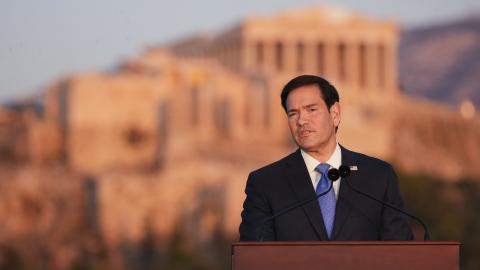
Secretary of State Marco Rubio’s Athens speech delivered last week in the shadow of the Acropolis deserves a serious European response. The secretary of state went to Greece to make an argument about inheritance, deeply shared with Europe. America’s history, he told his hosts, “is covered with the fingerprints of antiquity.”
Classical Antiquity’s Inheritance for the United States and Europe
Americans know the standard inventory of Athens’ and Ancient Greece’s gifts: democracy, philosophy, law, even the word “politics.” Rubio’s claim was that the debt runs deeper. Those institutions and ideas, he argued, were the outward expression of qualities first fully realized in Athens: fierce individuality, relentless ambition, daring exploration, insatiable curiosity, and impatience with limits. These were not the precepts of a philosophical school but the character of a people, visible in what they demanded of their citizens and in what they lived, fought, and died for. “To know them is to know ourselves,” he said.
Rubio’s speech is more than a tribute. He presented America as heir to a patrimony that Europe gave it, and offered Europeans something they have grown unaccustomed to hearing: an admiring account of their own civilization, coupled with an invitation to recover its ambition. But beneath that generous tone there is a strong demand: Europe must become powerful enough to remain a credible ally.
The comparison with Vice President JD Vance’s Munich speech from 2025 is unavoidable. Vance’s tone conveyed contempt for a Europe he appeared to consider unworthy of its inheritance. Rubio invoked admiration to urge Europeans to recover it. The difference matters: an invitation is easier to accept than a rebuke. But the underlying demand is much the same. Europe must stop treating decline as an unavoidable condition and become powerful enough to remain a credible ally.
For a European reader, the most striking feature of the speech was this almost lyrical celebration of Western inheritance. Rubio’s evocation of ancient grandeur, exploration, excellence, and courage contrasts with the language of guilt that so often dominates Europe’s discussion of its past. His argument concerned the foundations of a society’s willingness to defend itself: what it believes it is, what it values, and what it intends to pass on.
Europe needs to recognize the strategic question it raises beyond the historical claim. Can societies sustain the sacrifices required for their defense if they have lost confidence in what they are defending? Rubio linked that loss of confidence to industrial, military, and political decline. He called for a recovery of the will and means to exercise power.
How the US Is Assessing Its Alliances
This also helps explain how Washington increasingly evaluates its allies. Shared institutions and democratic credentials remain important, but partners are being judged by what they contribute to the balance of power: usable forces, industrial production, infrastructure, and the political willingness to act. Dismissing this as merely transactional diplomacy misses the deeper conception of power behind it. Resources alone are insufficient if governments cannot mobilize them or accept the risks of defending their interests.
That conception echoes the “warrior ethos” Defense Secretary Pete Hegseth has promoted at the Pentagon: power resides not only in equipment and resources but in the combination of capability, preparation, will, and the readiness to accept risk. For both men, weakness is a deficit of will before it is a deficit of means.
Europe should acknowledge the force of that criticism. A troubling gap remains between the existential language many European leaders use to describe the Russian threat and the urgency of their response. Rearmament is under way, but procurement, production, and political decision-making still move too slowly.
Europe’s Willpower Gap
Two strategic cultures are at work here. American security thinking leans on individual and collective responsibility, the capacity to defend oneself, and acceptance of the risks inherent in exercising power. Europe’s history produced a different relationship to force. The devastation of two world wars and the achievement of European integration encouraged a political culture centered on restraint, negotiation, and conflict prevention. These were substantial accomplishments. Yet habits that helped reconcile former enemies can become liabilities when confronting an adversary prepared to exploit restraint. Deterrence requires the adversary to believe that governments can decide and act under pressure.
This does not mean embracing recklessness. It means preserving freedom of action. If every Russian threat causes Europeans to rule out options in advance, Moscow gains influence over both escalation and de-escalation. Europe needs credible responses across a range of contingencies so Russia cannot set the terms of confrontation alone.
How Moscow reads the speech also matters. At the time of writing, the Russian foreign ministry has not commented, and early commentary in Russian media looks ambivalent. Rubio’s lament over Western decline can feed the Kremlin’s story of a disoriented West. But his call to restore Western strength and transatlantic cohesion runs counter to the hypothesis of American disengagement from Europe. In the end, Moscow will weigh not declarations but available capabilities, the political and military cohesion of the allies, and the continuity of the American commitment.
Europe Must Translate Defense Spending to Hard Power
Europe should not accept the caricature that it has no serious military power. Its armed forces include experienced units, its defense industries produce advanced systems, and France and Britain maintain nuclear deterrents. The problem is whether these assets add up to the collective capacity to sustain a prolonged, high-intensity war. Officially identified gaps lie in air defense, strategic enablers, military mobility, long-range fires, and digital capabilities.
The financial effort is real. NATO reports that defense spending by European allies and Canada rose by nearly 20 percent in real terms in 2025. The European Union’s SAFE instrument provides up to €150 billion in loans to support defense investment through common procurement. NATO’s Hague commitment sets a target of 5 percent of GDP by 2035, including at least 3.5 percent for core defense requirements. But financing is a means, and a spending trajectory is a promise. Neither should be confused with equipment delivered, integrated, and ready for combat.
A more useful measure of European progress would ask how many formations can deploy, how quickly, with what air defenses and ammunition stocks, and for how long. It would also assess the intelligence, communications, transport, and command systems that allow those formations to fight together. Buying more platforms without strengthening these enabling capabilities will yield less combat power than the expenditure suggests.
Europe must also learn to adapt faster. For instance, purchasing a drone achieves little if procedures prevent updating its software, integrating it into command networks, or replacing it when enemy countermeasures render it ineffective. Procurement and industry must support repeated changes during a conflict. Adaptation itself must become a military capability.
The Dangers of a Poorly Managed US-Europe Defense Transition
Here, Rubio’s message offers an opening. He paired his call for renewed European strength with a commitment to cooperation. Europeans should take both elements seriously and use them to negotiate a predictable transfer of responsibilities within the alliance.
The central danger is a poorly managed transition. If the United States reduces critical contributions before Europeans can replace them, higher European spending could coexist with weaker deterrence. Moscow would have reason to focus on that vulnerability window rather than the capabilities promised for the following decade. A responsible shift should therefore follow demonstrated readiness, with agreed milestones for replacing specific capabilities.
Washington should also recognize that its presence in Europe cannot be measured simply by troop numbers. Headquarters, exercises, common procedures, communications networks, and years of cooperation are operational assets. They enable national forces to function as an alliance. Preserving that capacity while redistributing responsibilities serves American interests as much as European ones.
European autonomy should be assessed in similarly practical terms: the ability to undertake a mission, sustain it, and retain political freedom of decision when Washington is unwilling to engage or is committed elsewhere. Developing that ability is compatible with a stronger NATO. It would give the United States more capable partners and Europe greater responsibility for its own security.
France has a particular contribution to make. Its nuclear deterrent, defense industrial base, operational experience, and capacity for independent political decision-making provide a foundation for leadership. But its credibility will depend on the conventional forces, stockpiles, and readiness it can bring to common missions. French proposals must start from the security concerns of partners on Europe’s eastern flank. Leadership will be earned less by defining a vision for Europe on its own, and more through contributions and workable coalitions, the ability to bring different countries around the table, generate capabilities, and turn them into collective action.
The Limits and Risks of Marco Rubio’s Civilizational Vision
There are limits to the convergence Rubio proposes. Vance faulted Europeans for losing confidence in their heritage; Rubio asks them to recover the qualities that made it: ambition, sovereignty, courage, and the readiness to take risks. His account of Western renewal carries assumptions about national sovereignty, supranational institutions, political freedom, and the relationship between state and society that many Europeans will contest. Greater military strength will not erase these differences; it may make them more visible. Strategic solidarity must survive political disagreement, and allies must be able to disagree politically without their protection seeming in question. Otherwise, adversaries will have another division to exploit.
The same distinction applies to unpredictability. Uncertainty can complicate an adversary’s calculations, but uncertainty about American commitments can also disorient allies and obstruct their planning. Governments making long-term investments need a reasonably clear understanding of the forces and guarantees on which their defense will depend. Credibility requires dependable cooperation among allies and resolve toward opponents.
Friday’s news illustrates the point. To ease fuel price rises, Washington temporarily eased sanctions to let Russian diesel reach world markets. Whatever its merits as price relief, the decision tests the message from Athens. Moscow will notice whether American calls for Western strength are matched by sustained pressure on Russian revenues. Rubio asked Europe to be credible; credibility also depends on Washington’s own policy. Finally, the pursuit of power must remain tied to defined political objectives. It demands an assessment of costs, escalation risks, and conditions for ending a crisis. Rubio himself stressed the need to combine power with diplomacy.
Europe should therefore respond to Athens with neither wounded pride nor passive gratitude. Rubio has invited it to recover the confidence, ambition, and capacity to shape its own security. If one idea is to be retained from the speech, it may be this: the message is less “Europe, become autonomous” than “Europe, become powerful enough to remain a credible ally.” Europeans should accept that challenge and insist that its implementation strengthen deterrence throughout the transition. A more powerful Europe would be a strategic gain for the United States. Building it requires European action and an American commitment to making the alliance stronger at every stage.