















China tested a nuclear-capable long-range ballistic missile launched from a nuclear- powered submarine over the Pacific this week. It was clearly a warning, but for what purpose and to achieve what strategic effect?
When something is done to issue a warning, the clues cannot be too obscure or difficult for others to piece together. That is the point of a warning. Additionally, there is a Chinese strategy behind it and reasons for the missile test being performed this week. We can’t prevent China from doing this. What we can do is ensure the action does not achieve the strategic effect that Beijing is after.
China’s claim the test was “routine” is a half-truth, or a convenient falsehood depending on how one wants to frame it. These tests are rare. China last tested a genuine intercontinental ballistic missile in September 2024. To be fair, the preparation to test a long-range missile takes some time. One PLA Navy vessels departed China in early May for the Pacific and two left in late June. These vessels carry satellite dishes to track missile launches and other space activities and are used to collect testing data.
In this sense, the missile test had been planned for some time. But the precise date of it coming shortly after Australia and Fiji signed the Ocean of Peace Alliance is hardly coincidental. Describing the test as “routine” is therefore more falsehood than half-truth.
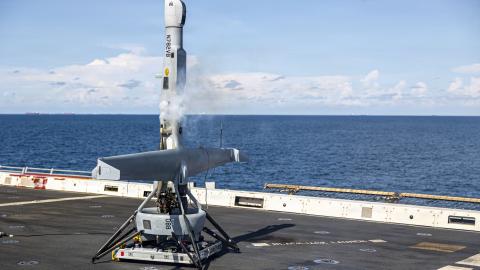
Now for the easy-to-follow clues. The missile was launched from a nuclear-powered submarine which means it has a long operational range and is difficult to detect. The missile is also a long-range missile. In other words, the missile can travel a long distance if required and can be launched from virtually anywhere in our maritime region.
The missile tested was also dual capable. Due to the PLA’s rapid conventional buildup over several decades, less attention has been paid to its nuclear arsenal. Yet, since the middle of the previous decade, China has abandoned its decades’ long minimal deterrent approach to nuclear weapons which means having only sufficient nuclear weapons capability to deter others from attacking China with non-conventional weapons. The PLA is now embarking on a nuclear weapons program which sees not only exponential growth in the numbers of strategic and tactical nuclear weapons but also the ability to launch such weapons from air, sea and land.
In this case, the test missile was apparently a nuclear capable “strategic” weapon. Unlike tactical missiles that might be used in battle against an adversary’s forces, strategic weapons are deployed to influence the political and policy decisions of adversaries beyond the battlefield. In other words, they are designed to achieved strategic effects beyond simply wreaking destruction against an adversary’s battlefield assets.
Now the part about China’s strategy. In this context, Plan A is to eventually establish a military base in the Pacific. This would allow China to directly project power in Australia’s northern approaches or even threaten our mainland itself. This would undermine the assumptions of a secure Pacific on which our current military posture is based. China made good progress on this front in Pacific Island countries such as the Solomons when Manasseh Sogavare was prime minister. Current leader Matthew Wale is less welcoming of China’s security advances.
China’s Plan B is to simplify the strategic environment in its favour. This means isolating America and its allies by seducing or else coercing other countries to remain neutral or lending any future strategic assistance to the former. If that occurs, a distant America will have difficulty remaining present in the region and allies will be left vulnerable and isolated. This is how China wins without a shot being fired in anger.
This is how we should understand the warning being issued by the firing of the test missile. It is indicating to Australia and any willing partners such as Fiji that China can hit it anytime, anywhere, and with devastating consequences. It is the use of conventional and nuclear threats to influence the strategic decisions of regional countries during this current period of so-called “peacetime” to Beijing’s liking.
It is so-called because China does not distinguish between periods of war and peace. All conflict exists along a continuum from the psychological to kinetic. For Beijing, now is the optimal time to compel regional nations to remain strategically and militarily passive rather than proactive. The additional use of nuclear weapons to coerce is a recent phenomenon. But Beijing’s purpose and strategy remain the same.
All one can do is the opposite of what Beijing is trying to achieve. As China is preparing for war, deterrence is the primary objective and the more we complicate Beijing’s plans and calculation, the better the chance that deterrence succeeds. Which means it is better to ignore China’s warning and fast-track what plans we have with other countries in the region.