














Executive Summary
- Battlefield assessment. Russia’s operational tempo remained heightened across Ukraine, with Pokrovsk absorbing the heaviest pressure and Moscow conducting large-scale missile and drone strikes against Kyiv, Dnipro, and other urban targets.
- Kyiv Strikes St. Petersburg. Ukraine continued its long-range drone warfare campaign with a strike on a St. Petersburg oil refinery ahead of Russian President Vladimir Putin’s high-profile economic forum.
- Intensifying drone activity. Russia expanded its drone campaign, while Ukraine responded with deeper strikes, decoy drones, interceptor-drone concepts, and growing unmanned ground operations.
- Swedish aircraft for Ukraine. Swedish Prime Minister Ulf Kristersson and Ukrainian President Volodymyr Zelenskyy announced plans to transfer Swedish Gripen aircraft to Ukraine.
1. Battlefield Assessment
The Ukrainian battlespace saw intense combat last week. On some days, Russia and Ukraine fought over 300 tactical engagements, the highest operational tempo reported in several months. Sloviansk, Kramatorsk, Kostiantynivka, Orikhiv, and Huliaipole again saw fierce fighting, while Pokrovsk absorbed the brunt of a growing Russian push.
Russia also conducted an intensive aerial bombardment of Ukraine. Russian strikes involved a dangerous mix of Shahed-Geran drones as well as Russian Iskander and North Korean KN-23 ballistic missiles. Moscow hit Ukraine with Zircon nuclear-capable, scramjet-powered anti-ship cruise missiles, and S-400 interceptors modified for land-attack roles on quasi-ballistic trajectories.
Both sides traded long-range salvo exchanges at a heightened tempo. Ukraine’s Air Force reported that on the nights of June 1 and 2, Russian forces launched Kalibr cruise missiles from the Caspian Sea, prompting air-raid warnings across Kyiv and several Ukrainian oblasts. Russian forces struck Kyiv with a combined drone and missile attack, causing fires and structural damage across extensive areas of the capital. Russian strikes hit residential buildings, a medical clinic, and high-rise apartment blocks, underscoring Moscow’s continued reliance on large-scale strikes against urban infrastructure.
A separate Russian missile strike hit the city of Dnipro on June 2, in an attack that caused many civilian casualties, including children. The mayor of Dnipro declared June 3 a day of mourning, and Russian forces continued to attack the city during the day on Tuesday. Ukrainian officials have only just completed the search-and-rescue operation.
Ukraine conducted its own strikes, too. On May 29–30, Ukraine’s Unmanned Systems Forces destroyed a launcher for an Iskander missile system and two Tu-142 aircraft at a military airfield in the Russian city of Taganrog. The Tu-142 is a long-range maritime-reconnaissance and anti-submarine-warfare aircraft operated by the Russian Navy. It is based on Russia’s Tu-95 turboprop strategic-bomber platform, which Moscow has often used in mass cruise-missile attacks against Ukraine.
2. Kyiv Turns Drone Warfare into Political Warfare at the High-Profile St. Petersburg Forum
Ukraine has taken its long-range strike campaign to St. Petersburg.
On the night of June 2–3, Ukrainian Special Operations Forces, alongside other elements of the country’s defense forces, targeted the St. Petersburg Oil Terminal, located hundreds of miles from Ukraine’s border in Russia’s Leningrad Oblast. Ukrainian President Volodymyr Zelenskyy confirmed that “important facilities on Russian territory” had been hit in the strikes.
Zelenskyy further framed the operation as another successful episode in Ukraine’s campaign of “long-range sanctions” against Russia. Visuals from the area surrounding the oil terminal at the time of the attack revealed low-flying drone activity over the nearby Gulf of Finland, likely a Ukrainian FP-1 drone approaching its target. Satellite imagery dated June 3 showed a major fire at the terminal site.
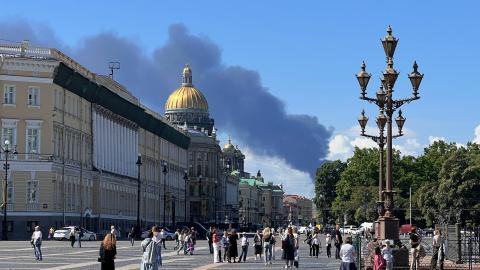
Ukraine timed its strikes to carry a clear political message. Thick black smoke was visible from miles away and hung over St. Petersburg on the morning of June 3, just as the first delegations were arriving for the 2026 St. Petersburg International Economic Forum. The event is one of Russia’s flagship international business gatherings and is closely associated with Russian President Vladimir Putin’s efforts to signal the country’s economic resilience. Ukraine’s attack, therefore, did not only target Russia’s hydrocarbon industry and the revenues it produces. Kyiv also damaged the political and economic narratives the Kremlin is attempting to craft.
The St. Petersburg Oil Terminal occupies part of the Great Port of St. Petersburg, a major seaport that serves the famous city and northwest Russia. The oil terminal is among the Baltic Sea region’s most prominent bulk-cargo and petroleum-transshipment facilities, and receives and ships fuel and other liquid cargo by sea, river, rail, and road links. Open-source reporting indicates that the facility boasts an annual throughput capacity of about 12.5 million tons, while Ukrainian military reporting reveals that the site holds dozens of storage tanks. The terminal has a large total storage capacity for petroleum products and other liquid cargo.
By hitting a major fuel-storage and export node in St. Petersburg during a high-profile economic forum, Kyiv has demonstrated its prowess in drone combat, deep-strike operations, and political warfare all in one salvo. The attack on Russia’s fabled gateway to the West also underscores a central trend of the war: Ukraine is increasingly using long-range unmanned systems to impose real costs on the Kremlin’s energy economy, logistics architecture, and carefully cultivated image of firm control over a nation at war.
3. Russia’s Momentum on the Ground Has Stalled, but the Drone War Is Intensifying
Open-source monitoring of the conflict’s battlefield geometry suggests that a promising trend is emerging for Kyiv.
In May 2026, Russia gained roughly five square miles of sovereign Ukrainian territory, its smallest gain since 2023. Despite worrying signs in Kostiantynivka, the Ukrainian military likely gained more territory than it lost in May, producing a net territorial loss for Russia during the month.
As it lost territory, however, the Russian military increased its use of attack drones. In May 2026, Russia used more than 7,400 loitering munitions, most of them Iran-designed, Shahed-derivative Geran drones. To counter these munitions, the Ukrainian defense-industrial complex is now test-running the Clear Sky project, which aims to arm light-attack aircraft with interceptor drones.
In a related move, the Defense Intelligence of Ukraine is now reportedly using more decoy drones to saturate Russian air defenses. The Armed Forces of Ukraine also continued to use unmanned ground vehicles in combat operations, including in urban warfare.
4. Sweden’s Gripen Aircraft to Augment Ukraine’s Air-Warfare Deterrent
Sweden is moving to make its Gripen aircraft Ukraine’s next major Western fighter platform. Stockholm plans to transfer up to 16 used JAS 39 Gripen C/D aircraft from the Swedish Air Force to Kyiv, and support Ukraine’s procurement of up to 20 newer Gripen E/F fighters. Swedish Prime Minister Ulf Kristersson announced the countries’ new plan on May 28, alongside Zelenskyy, in the Swedish city of Uppsala.
Kyiv has identified the Gripen as its long-term fighter of choice. As a result, Ukraine’s first C/D aircraft could arrive in early 2027, with Gripen E/F deliveries expected before 2030. Ukraine plans to finance the acquisition of newer Gripen E/F aircraft with €2.5 billion from the European Union’s Ukraine Support Loan mechanism.
The transfer remains subject to final purchase arrangements and Swedish export approvals. The broader package also includes advanced weapons, training, maintenance, electronic-warfare assets, ammunition support, long-range capabilities, and defense-industrial cooperation.
The Gripen largely fits Ukraine’s battlefield needs, as it is designed for dispersed wartime operations, including road-based use, rapid turnaround, and maintenance from small ground crews under harsh conditions. These qualities are important to an air force operating under constant Russian missile and drone pressure against fixed air bases.
The Gripen can also carry weapons aligned to North Atlantic Treaty Organization standards, including IRIS-T, AMRAAM, and METEOR air-to-air missiles. The latter munition is particularly important due to its range and high-end power pack. Accordingly, Zelenskyy hinted that Meteor missiles could be added to Ukraine’s Gripen deterrent.