












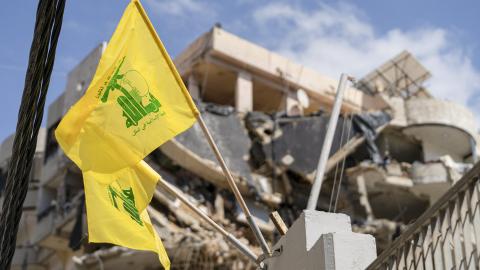
Hizballah is doomed but not defeated. The group today is weaker than at any point in decades, yet it remains armed. The Lebanese government hopes to gradually displace and disarm it, but this plan is far from certain to succeed before Israel loses patience and decides to try to finish Hizballah by force. To hasten its end, the United States’ best non-war option is a tool it has never fully wielded: the sanctions authority that comes with designating it a foreign terrorist organization and publishing Hizballah’s known membership.
Hizballah Is Doomed in the Long Run . . .
American national security strategists today, and for the foreseeable future, should evaluate all US policies and activities in the Middle East according to how they help or hinder the war effort against the Iranian regime and its “axis of resistance.” In Lebanon, the overwhelming concern should be to prevent the country from serving as a base from which Tehran can project power and exercise influence through Hizballah. All other American interests in Lebanon pale in comparison.
This task is simpler than it once was, because Hizballah is not the threat it once was. Since October 2023, the Israeli military has eviscerated the terror group’s leadership and driven it from its most important bases on the Israeli border. Meanwhile, Bashar al-Assad’s fall in late 2024 cost Hizballah strategic depth in Syria and a vital line of communication with Iran. Once the centerpiece of the Islamic Revolutionary Guard Corps’ regional empire, the group is now marooned.
Hizballah is also no longer as potent an international terrorist organization as it once was. For years, the group’s reach was virtually global, with outposts in Africa, Latin America, and parts of the Middle East. But with Venezuela and Syria having flipped from the Iranian to the American side, Hizballah’s influence is greatly curtailed. Its international financier network survives but is under enormous pressure from Treasury Secretary Scott Bessent’s economic offensive against Tehran and its proxies.
Most importantly, back home in the Levant, the group has lost its strategic deterrent against Israel. For many years, the world assumed that if Israel initiated military action against Hizballah, the group or Iran could respond by threatening Israeli population centers with missiles, rockets, and drones, akin to the threat North Korea poses to Seoul. But after three years of warfare, Hizballah can no longer threaten Israel this way. If Israeli leaders wished it, the Israeli military could take decisive action against Hizballah on the ground and in the air, and neither Hizballah nor Iran could stop it. Only political constraints kept Israel from mounting military thrusts earlier this year all the way to Hizballah’s strongholds in south Beirut and the Bekaa Valley.
. . . But Alive in the Short Run
In the longer term, these factors will doom Hizballah as a strategic threat to US, Israeli, and allied interests. In the immediate term, however, Lebanon’s disarmament of Hizballah does not yet appear to be working. To forestall an Israeli offensive, the Lebanese government has committed to a more indirect approach. It has directed the Lebanese army to gradually displace Hizballah from its strongholds on the ground without the Israelis—or anyone else—using a large-scale bombing campaign or pitched battles.
Reports from southern Lebanon cast doubt on whether that phased approach is working. During a recent Hudson Institute event, for example, Lebanon expert Hussain Abdul Hussain noted that, according to anecdotal reports, the Lebanese army, like the United Nations Interim Force in Lebanon before it, lacks the capacity or authority to truly rout Hizballah from some of its southern strongholds such as Nabatiyah. At the same event, Lebanon expert Hagar Chemali also mentioned that in Beirut, Lebanese leaders remain loath to escalate into an armed showdown with Hizballah, despite the terrorist group’s unprecedented weakness.[1]
If the Lebanese government’s preferred gradual approach does not yield Hizballah’s disarmament in the near term, pressure will likely grow, especially in Israel’s domestic politics, for Israel to return to the military option and finish Hizballah by force.
Ramping Up Economic Pressure
What should the United States do in the meantime? Some US allies, especially French President Emmanuel Macron, argue for reconvening the 2006 US-French-Gulf coalition that tried to support Hizballah's gradual disarmament by funding Lebanese government institutions and winning Lebanese hearts and minds away from Hizballah. That approach failed to make a dent in Hizballah’s power for almost 20 years, and there is no reason to think it would succeed now. Among other reasons, the Gulf countries have little bandwidth left for Lebanon.
The US has a better instrument at hand: economic warfare and political pressure. Hizballah is a designated foreign terrorist organization. Anything it touches, and anyone or anything that materially aids it, is sanctionable under US law and should be sanctioned. Washington has refrained from fully enforcing its sanctions laws in Lebanon, even though Hizballah participates in the country’s public and political life: the group has members in parliament and other official government positions, operates media outlets, and much more. This state of affairs exists because for more than two decades the US—as well as France and other key states—had a policy of accommodating successive Lebanese governments that urged Washington to refrain from fully enforcing sanctions so as not to disrupt Beirut’s preference for gradually administering chemotherapy to shrink the Hizballah tumor.
There is now little logic for Washington to refrain from pressuring the group, especially when Hizballah is at war with US allies and when the US is at war with Hizballah’s Iranian patrons. It is hard to envision America tolerating Hizballah or Hizballah-sponsored ministers in the next Lebanese government, for example.
Why Not Name All of Hizballah?
One straightforward, low-cost step the US government could take to ramp up pressure on Hizballah has to do with the group’s designation as a foreign terrorist organization. This designation means the US government does not have to prove that Hizballah members have committed or materially supported terrorist activities to proscribe them. The US merely has to prove they are Hizballah members—a matter of status rather than behavior. The US has not yet taken this step.
The US government could, in short order, publish a list of every known Hizballah member, along with references to open-source evidence. There are many thousands of known Hizballah members. The Treasury Department has the authority to publish such a roster together with a reiteration that anyone in the world—an individual, a private business, a government agency, etc.—doing business with or otherwise materially supporting anyone on Hizballah’s roster is committing a sanctionable act. The department could also simply add these Hizballah members to its Specially Designated Nationals and Blocked Persons list.
Publishing Hizballah’s known membership could change the dynamics inside Lebanon. It would isolate the group by raising the cost for anyone engaging with its members. The Lebanese would be forced to make a choice they haven’t really been forced to make in the past. This policy would create an external motivation that, for many Lebanese, would probably be quite welcome. Lebanese who are in some distasteful arrangement with Hizballah on the ground would suddenly have top cover to say they cannot continue, because the word is out from the Americans that association with the group is off limits: no electing its members to parliament, no giving them any government contract, no entering into political or electoral agreements with the group, none of its members or ministers in local government, in national government, on any Lebanese government payroll, and on and on. For those like Parliament Speaker Nabih Berri, a Hizballah ally who is watching which way the wind is blowing and hedging, that would be quite a signal, one that would force many in Lebanon to hedge away from the group. The ground might very well erode under Hizballah’s feet.
Conclusion
The US has not yet decided to fully enforce its sanctions pressure inside Lebanon, but if the Lebanese government’s phased, gradual approach does not work, the pressure to reignite a full-scale military campaign in Lebanon will be immense. Perhaps the US will decide before that point to enforce its best non-war option in lieu of—or if necessary, in conjunction with—a renewed Israeli military campaign.
- “Contested Lebanon: Israel, Iran, and US Strategy in a Fractured State,” Hudson Institute, September 15, 2026, https://www.hudson.org/events/contested-lebanon-israel-iran-us-strategy-fractured-state. ↑