










Introduction
United States Ambassador Chas. W. Freeman Jr. in The Diplomat’s Dictionary defines alliance as “a relatively stable coalition of two or more states sharing common national security interests which has been formalized in a treaty or treaties. An alliance may be defensive (committed to upholding the status quo) or offensive (directed at changing the status quo).”
Freeman also defines entente as “informal but often very close cooperation between two or more states to secure limited common objectives vis-à-vis other states or regions . . . a form of ‘coalition.’” He defines coalition as “a partnership between two or more states sharing common national security interests . . . created out of fear.”
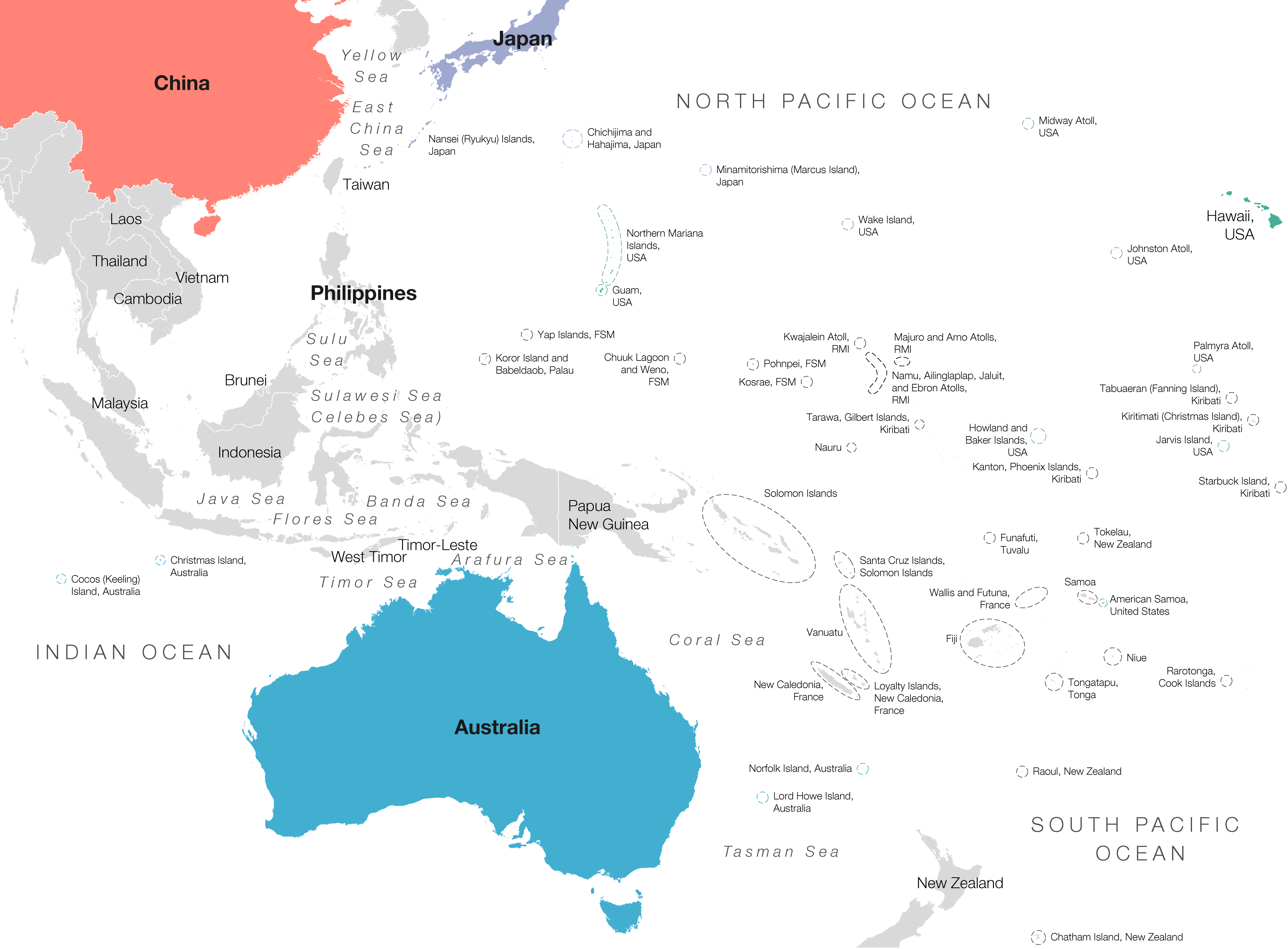
On December 7, 2025, the defense ministers of Australia and Japan released a joint statement announcing “the establishment of the Framework for Strategic Defense Coordination,” in effect formalizing an informal alliance. This report focuses on the evolution of this informal alliance and is based on the foreign policy, defense, and strategic documents of Australia and Japan over the past two decades. The documents reflect a converging perspective on the evolving international and Indo-Pacific regional order (see map 1), emerging threats, shared national interests, and, on an operational level, concrete steps the two countries have taken to advance this informal alliance.
Map 1. Islands and Countries in the Central and Western Pacific Ocean
Source: Hudson Institute.
Note: FSM = Federated States of Micronesia, RMI = Republic of the Marshall Islands
Australia
In 2017, the government of Prime Minister Malcolm Turnbull released Australia’s Foreign Policy White Paper, the first such document since the John Howard government’s 1997 and 2003 white papers. In his introduction, the prime minister observes that “change, unprecedented in its scale and pace” defines the international environment, presenting “the times of greatest opportunity but . . . also times of uncertainty, of risk, indeed of danger.”[2]
Looking at the evolving international order, the white paper judged that the United States’ “long dominance . . . is being challenged by other powers” and that a “post–Cold War lull in major power rivalry has ended,” with Australia facing “an uncertain outlook.”[3] The paper assessed the Indo-Pacific as a region in “strategic transition.”[4] China’s dynamic economy was “accelerating shifts in relative economic and strategic weight,” giving the People’s Republic of China (PRC) in some parts of the region “power and influence . . . to match, and in some cases exceed, that of the United States.” It noted Beijing’s ongoing military modernization and the increasing capabilities of its armed forces.[5]
The document observed that in the Indo-Pacific, “competition is intensifying, over both power and the principles and values on which the regional order should be based” and that China, as a great power, would seek “to influence the region to suit its own interests” and present Australia with “an increasingly complex and contested Indo-Pacific.” At the same time, the white paper assessed that the United States’ economic and security interests in the Indo-Pacific would continue to underpin engagement with the region. “For the foreseeable future,” the US would remain the foremost military and economic power, and its alliances with Australia, Japan, and the Republic of Korea would “remain strong.”[6]
Among Australia’s Indo-Pacific partnerships, the document cited Japan as a special strategic partner with which Australia shared values and interests, including an alliance with the United States. Australia supported Japan’s efforts to increase security capabilities and play a “more active role in the security of the region.” Canberra would work to “boost defence engagement with Japan, including in maritime security and in research and development.”[7]
The white paper defined Australia’s national interest as support for the rules-based international order and the norms and values it embodies.[8]
Commenting on the white paper’s judgments a year later, in 2018, a senior Australian intelligence official remarked, “What has surprised us is the pace of change,” observing that China represented “the greatest security challenge Australia has faced since the Coral Sea.”[9] Of increasing concern were PRC activities in waters surrounding Australia, in Vanuatu, and among the South Pacific Islands, as well as Beijing’s militarization of artificial islands in the South China Sea and its expanding presence in the Indian Ocean and Africa.
A series of defense policy documents followed: the Defense Strategic Update in 2020, the Defense Strategic Review in 2023, and the National Defense Strategy in 2024 and 2026.
In remarks announcing the release of the 2020 Defense Strategic Update, Prime Minister Scott Morrison observed that Australia had not seen “the conflation of global, economic and strategic uncertainty . . . since the existential threat we faced when the global and regional order collapsed in the 1930s and 1940s.”[10] The document noted that strategic change was advancing at an unanticipated speed and was marked by accelerating military modernization; growing challenges to the rules-based order; increasing gray-zone activities in the South China Sea; intensified major power competition, including the potential for high-intensity military conflict between the United States and China; and a greater risk of military miscalculation. The update defined Australia’s strategic focus as extending from the northeastern Indian Ocean through maritime and mainland Southeast Asia to Papua New Guinea and the southwest Pacific.[11]
Addressing accelerating strategic change in the region, the 2023 Defense Strategic Review called attention to a “radically different” strategic environment, one in which the United States is “no longer . . . the unipolar leader of the Indo-Pacific. Intense China–United States competition is the defining feature of our region and our time.” As for China, the review found that Beijing’s military modernization “is occurring without transparency or reassurance to the Indo-Pacific region of China’s strategic intent.” It also judged that “China’s assertion of sovereignty over the South China Sea threatens the global rules-based order in the Indo-Pacific in a way that adversely impacts Australia’s national interests.” Of similar concern, the document found China to be “engaged in strategic competition in Australia’s near neighborhood.”[12]
The 2024 National Defense Strategy assessed that the strategic environment surrounding Australia had “continued to deteriorate” in the year since the 2023 strategic review. Alongside China-US strategic competition, it noted an “unprecedented conventional and non-conventional military build-up in our region, taking place without strategic reassurance or transparency.” The document judged that China “will continue to seek to play a more prominent role in the region . . . leveraging all elements of its power as it pursues its strategic objectives, including to change the current regional balance in its favour.”
Further, it noted that China “has employed coercive tactics in pursuit of its strategic objectives, including forceful handling of territorial disputes and unsafe intercepts of vessels and aircraft operating in international waters and airspace.” At the same time, “the risk of a crisis or conflict in the Taiwan Strait is increasing, as well as at other flashpoints, including disputes in the South and East China Seas and on the border with India.”
As a result, Australia faced “its most complex and challenging strategic environment since the Second World War.”[13]
Canberra recognized that the strategic competition between the United States and China in the Indo-Pacific was intensifying, that China’s power and influence in some areas were growing and now exceeding that of the United States, and that Australia’s strategic competition with China in the Southwest Pacific was building Multiple Australian governments therefore moved to enhance Australia’s defense capabilities, strengthen the alliance with the United States, and build defense ties with other Indo-Pacific democracies, with Japan in particular.
The National Defense Strategy defined Japan as an “indispensable partner for achieving regional peace and prosperity.” Australia would focus on strengthening “strategic alignment and coordination . . . on regional contingencies and increasing collaboration on defence innovation, science and technology,” and aim to “enhance high-end interoperability” with Japanese defense forces.[14]
Japan
On December 17, 2013, the government of Prime Minister Shinzo Abe released Japan’s first-ever National Security Strategy (NSS). The document judged that “the balance of power in the international community has been changing on an unprecedented scale,” driven by the emergence of China and India. In this context, it assessed that while the United States remained “the world’s largest power as a whole,” its “relative influence” was changing.[15]
Looking at the Indo-Pacific region, the NSS noted the growing risks of gray zone tensions, North Korea’s large-scale conventional military buildup and ongoing nuclear and missile programs, and China’s rapidly advancing military capabilities.[16] At the same time, the NSS observed that “China has taken actions that can be regarded as attempts to change the status quo by coercion based on their own assertions, which are incompatible with the existing order of international law, in the maritime and aerial domains, including the East China Sea and the South China Sea.” Moreover, Beijing “has rapidly expanded and intensified its activities in the seas and airspace around Japan, including intrusion into Japan’s territorial waters and airspace around the Senkaku Islands.”[17] The NSS found that Japan faced “an increasingly severe security environment.”[18]
On December 12, 2022, the government of Prime Minister Fumio Kishida published an updated NSS. The document found that the decade following the 2013 NSS had only intensified the challenges facing Japan—the security environment had become “as severe and complex as it has ever been since the end of World War II.”[19] The accompanying National Defense Strategy stated that, in the special strategic partnership with Australia, Japan “will build the closest cooperative relationship second only to the Japan-US defense cooperation and deepen consultations at all levels,” including defense equipment and technology and rotational deployments of the Japan Self-Defense Forces (JSDF) for exercises in Australia.[20]
Adversaries’ threatening actions have served to underscore to the Japanese public the importance of strengthening the country’s defense capabilities. On October 22, 2022, North Korea test-fired an intermediate-range ballistic missile that overflew Japan. This was the first such test since the Hwasong-12 missile tests of 2017. And over the past decade, China’s actions have presented Japan with unabated security challenges. These include the PRC’s continuing expansion of conventional, missile, and nuclear forces, for which Beijing has not explained its rational; its ongoing unilateral efforts to change the status quo in the East and South China Seas, and its increasing violation of Japan’s sovereignty in the Senkaku Islands.
The NSS also noted China’s stepped-up military activities in the waters and airspace around Taiwan and the August 4, 2022, firing of ballistic missiles into waters around Japan during live-fire military exercises focusing on Taiwan.[21] The NSS defined Taiwan as “an extremely important partner and a precious friend of Japan, with whom Japan shares fundamental values.” Peace and stability in the Taiwan Strait were “indispensable” to global prosperity, it stated.[22]
The document assessed that China represented “an unprecedented and the greatest strategic challenge” to Japan’s peace and security, to the peace and stability of the international community, and to the rules-based international order.[23]
Meanwhile, Russia’s February 2022 invasion of Ukraine called attention to the possible spillover effects of a European crisis for the Indo-Pacific. Speaking after a March 3, 2022, meeting of the Quadrilateral Security Dialogue (the Quad, which includes Japan, Australia, India, and the United States), Prime Minister Kishida added that leaders of the group agreed that “unilateral changes to the status quo with force like this [Russia’s invasion of Ukraine] should not be allowed in the Indo-Pacific region.” Though Kishida did not explicitly state it, Australian Prime Minister Morrison confirmed this was a clear reference to China’s aspirations in the Taiwan Strait.[24]
Putting It Together: Formalizing an Informal Alliance
At the turn of the century, on September 29, 2003, Canberra and Tokyo took initial steps to institutionalize defense cooperation with the signing of the Memorandum on Defense Exchange. The memorandum provided for increases in defense-related engagements and for joint defense and counterterrorism exercises.
Four years later, on March 13, 2007, the governments of Australia and Japan released the Japan-Australia Joint Declaration on Security Cooperation. The document affirmed a strategic partnership between the two countries based on “democratic values, a commitment to human rights, freedom and the rule of law, as well as shared security interests,” and a commitment to work together to address security challenges in the Indo-Pacific and beyond. The two governments agreed on “increasing practical cooperation between the defence forces and other security related agencies.” These efforts would include exchanges of defense force personnel, joint exercises and training, the development of an action plan to advance security cooperation, an annual strategic dialogue between foreign ministries, an annual defense ministers dialogue, and an annual joint dialogue involving foreign and defense ministries.[25]
The first foreign and defense ministerial followed shortly on June 6, 2007, in Tokyo.[26] The ministers welcomed the joint declaration as reflecting a commitment to “even closer security cooperation” and progress in developing a joint action plan for security cooperation. The plan would focus on disaster relief, peacekeeping and peace-building, counterterrorism, and proliferation and stability of Pacific island countries.
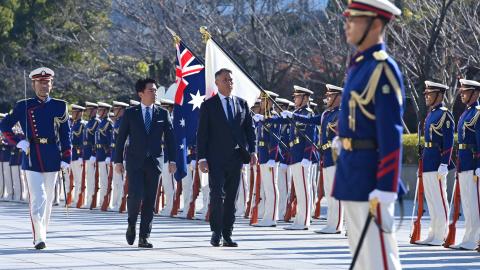
At the ministerial, Australia also invited Japan to participate in the Australia-US Talisman Sabre exercise. In 2007 and 2009, Japan sent observers to the exercise but did not participate.[27] Japan joined the exercise as a participant in 2015 with a deployment of 40 JSDF members. Underscoring Japan’s expanding defense engagement, in 2019 Tokyo deployed the helicopter carrier Ise and 500 JSDF personnel to participate in the exercise. In 2025, over 1,500 members of the JSDF participated in the Talisman Sabre exercise. During the 2025 exercise, Japan’s Ground Self-Defense Force successfully test-fired a Type-12 surface-to-ship missile. Meanwhile, the Japan Maritime Self-Defense Force and Royal Australian Navy conducted the 2025 Nichi-Gou Trident bilateral maritime exercise, which dates from 2009. As of September 2025, over 40 exercises focused on operational cooperation have taken place under the reciprocal access agreement. In 2026, Japan’s Ground Self-Defense Force participated in the Southern Jackaroo exercise in Australia.[28]
Since 2007, Japanese and Australian foreign and defense ministers have met, with few exceptions, annually to set the strategic direction of the relationship and to open the doors to enhanced operational cooperation. In 2008, they welcomed the decision by Prime Ministers Kevin Rudd and Takeo Fukuda to upgrade relations to a comprehensive strategic, security, and economic partnership.
Joint statements from subsequent meetings underscore the strategic focus of the relationship and the steps the two countries have taken to enhance defense and security cooperation. The statements reveal a consistent set of focal points, including Chinese and North Korean military expansion, developments in the East and South China Seas, China’s ongoing buildup of conventional military and nuclear forces, and opposition to the use of force or coercion to change the status quo. The documents also express support for a rules-based maritime order and resolution of disputes based on the United Nations Convention on the Law of the Sea, for the centrality of the Association of Southeast Asian Nations, for stability and development of Pacific island countries, and for a free and open Indo-Pacific.[29]
In terms of bilateral defense cooperation, in 2009, Canberra and Tokyo agreed on an action plan to implement the Japan-Australia Joint Declaration on Security Cooperation. Subsequent agreements include an acquisition and cross-servicing agreement in 2010, an agreement on the transfer of defense equipment and technology in 2014, and a reciprocal access agreement in 2022.[30] In 2022, Prime Ministers Kishida and Morrison updated their countries’ 2007 joint declaration on security cooperation.
At the operational level, the JSDF and Australia’s military have continued to enhance cooperation through increasingly complex joint training and exercises aimed at capacity-building and interoperability. Facing an increasingly challenging security environment, they have agreed to cooperate on evacuating each other’s citizens during a crisis in a third country (read: Taiwan), to advance cooperation on the use of Japan’s counterstrike capabilities and Australia’s long-range strike capabilities, and to network their air and missile defenses. The two countries have also sent liaison officers to each other’s joint operations command, which underscores their close and increasing security cooperation.
At the same time, Canberra and Tokyo have moved to increase defense industry and technology cooperation. For example, Australia announced on August 5, 2025, that it would procure an upgraded version of Japan’s Mogami-class frigate for Australia’s navy. Mitsubishi Heavy Industries in Japan will build the first three boats of the 11-boat procurement and deliver them in 2029 with a target operational date of 2030. Western Australia’s Henderson shipyard will build the remaining eight. Additionally, the countries’ Economic Security Dialogue addresses broader economic issues, focusing on critical infrastructure, supply chain resilience, critical minerals, cybersecurity, energy transition in the Indo-Pacific region, and the coordination of respective government policies.[31]
Reflecting shared concerns about China’s expanding activities in the South Pacific, Canberra and Tokyo are coordinating development initiatives in Pacific island countries. The China–Solomon Islands agreement of April 2022 served as an unexpected wake-up call to the emerging strategic challenges ahead. It allowed Chinese police and security officials to deploy to the Solomon Islands and permitted port calls by the People’s Liberation Army Navy (PLAN). Underscoring China’s expanding strategic reach, in February 2025, three PLAN warships conducted live-fire drills in international waters off Australia’s east coast.
In response to these challenges, Canberra and Tokyo’s statement following the Twelfth Foreign and Defence Ministerial Dialogue committed the two countries to advancing “shared strategic infrastructure priorities across the Indo-Pacific . . . including through transformative digital infrastructure . . . energy transition. . . . [and] secure undersea cables.”[32]
On December 7, 2025, Defense Ministers Richard Marles and Shinjiro Koizumi announced the establishment of the Framework for Strategic Defence Coordination “to elevate our ‘Special Strategic Partnership’ and enhance collective deterrence amid a deteriorating and increasingly complex regional security environment.” The document committed the parties to increasing defense activities with a focus on “deepening interoperability and aligning shared strategic objectives.”
The framework advances “greater consultation on a range of matters relating to defence policy, intelligence, bilateral and multilateral activities, industry and technology, and capabilities, including space, cyber and integrated air and missile defence, with a view to ensure effective collaboration at all levels and in all situations from peacetime to contingencies, in support of stable and secure Indo-Pacific.” Under the framework, defense ministers will meet annually or as required.
The document reaffirms the importance of trilateral alliance-based cooperation with the United States, peace and stability across the Taiwan Strait, defense cooperation with the Philippines and like-minded countries in the South China Sea, and opposition to the use of force or coercion to change the status quo in the South and East China Seas.[33]
In May 2026, Prime Minister Sanae Takaichi visited Australia. The documents issued during her visit—the Leaders Statement on Enhanced Defence and Security Cooperation and the Japan-Australia Joint Declaration on Economic Security Cooperation—underscore the expanding breadth and depth of the relationship.
The defense and security document explains that the enhanced defense and security cooperation represents “a natural evolution of our close relationship” and reflects “our unprecedented strategic alignment.” Under the reciprocal access agreement, Japan and Australia have “expanded the scope and sophistication of our joint activities” and “helped to build greater interoperability between our two defence forces . . . as well as trilaterally with the United States . . . a crucial ally to both countries in sustaining a peaceful and stable Indo-Pacific.” The document concludes, “As reflected in . . . the signing of the Mogami Memorandum, Australia and Japan are committed to assisting each other to build our respective capability to be able to collectively meet future challenges.”[34]
The economic security document aims to provide “strategic guidance to advance our bilateral cooperation on economic security . . . that enhances both strategic autonomy and indispensability, and strengthens economic resilience in the Indo-Pacific region as well as the international economic order.”[35] The document sets out an agenda of policy alignment through bilateral consultations; bilateral trade and investment in strategically significant sectors; stronger public-private partnerships; cooperation on energy, critical minerals, food, and metals processing; innovation and protection of critical and emerging technologies; enhanced joint engagement in the Indo-Pacific; and strengthening of the rules-based international order.
Commenting on the document, Prime Minister Anthony Albanese observed that “in a complex strategic environment, cooperation between Australia and Japan is essential to maintaining a peaceful, stable and prosperous region.” Foreign Minister Penny Wong explained that “as special strategic partners, Australia and Japan are stepping up our defence and security cooperation . . . to ensure a peaceful, stable and prosperous region. In these uncertain times, middle powers must keep working together for a free and open Indo-Pacific, and a world where no country dominates and no country is dominated.”[36]
On August 18, Ministers of Defense Richard Marles and Shinjiro Koiszumi met in Canberra to review progress in the defense relationship. Talks focused on the construction of the updated Mogami-class frigate, the success of Project Boobook (which will develop a high-energy laser that can deploy on land- and sea-based platforms), and on arrangements that would allow Japan to conduct missile tests in Australia. An Australian subsidiary of Mitsubishi Electric will manage the laser project.
Marles hailed the success of Project Boobook as a “significant milestone” in the defense relationship.[37] The Canberra meeting was the seventh Marles–Koizumi engagement over the past 12 months, reflecting increasing defense and security ties.
Trilateral Defense Relations
In their national security documents, Australia and Japan both recognize the singular importance of their bilateral alliance with the United States as the core of their respective national security and foreign policies. At the turn of the century, the three allies moved to expand alliance-based cooperation, initiating the Trilateral Security Dialogue at the senior officials’ level in 2002. The dialogue was raised to the ministerial level in 2006.
The Fifteenth Trilateral Defense Ministerial Meeting took place in Singapore on the sidelines of the Shangri-La Dialogue on May 31, 2025. The joint statement that the three allies released afterward referenced their efforts “to advance trilateral interoperability and operational coordination.” Recognizing the “severe and complex security environment in the Indo-Pacific,” the allies committed to “reinforce the defense and deterrence capabilities” of their respective countries. For example, they agreed to “increase bilateral and trilateral joint capabilities.” The joint statement cited the inaugural trilateral F-35 training Exercise Cope North 2025, Exercise Bushido Guardian, and the first trilateral F-35 training in Australia, Exercise Southern Cross, scheduled for July 2026 in northern Australia. The document went on to highlight defense cooperation work “to leverage . . . Australia’s long-range strike capabilities, Japan’s stand-off defense capabilities, and US systems to increase trilateral deterrence and response capabilities.” The statement also celebrated progress toward a “networked air and missile defense architecture to counter regional air and missile threats,” and toward advanced trilateral research and development and defense industry partnerships.[38]
June 2026: Going Forward
At the time of writing, the war in Ukraine has entered its fifth year; the US and Israeli war against Iran continues, and the nuclear future of Iran remains unresolved.
At the same time, for Japan and Australia, challenges to stability and security in the Indo-Pacific region have continued to intensify. The primary challenges are North Korea’s expanding missile and nuclear weapons programs as well as China’s increasingly assertive posture in the East and South China Seas, in the waters around Taiwan, and in the South Pacific. Shared concerns about the challenges to a rules-based order—reflected in their support for a free and open Indo-Pacific—have also moved both Tokyo and Canberra to enhance across-the-board economic, diplomatic, and security cooperation. Prime Minister Takaichi’s aforementioned May 2026 visit to Australia underscored the decades-long efforts to strengthen bilateral ties.
The Australia-Japan Framework for Strategic Defense Coordination, the Takaichi–Albanese Leaders Statement on Enhanced Defence and Security Cooperation, and the Joint Declaration on Economic Security Cooperation represent the formalization of an informal alliance. They speak to the coming together of a defense relationship that is functionally an alliance in everything but an Article V–style mutual-defense commitment. The Australia-Japan defense relationship represents a unique construct, a bilateral alliance that is now forming within a trilateral alliance structure.
At one level, the integration of defense ties reflects the evolution in the Indo-Pacific’s historic hub-and-spokes alliance structure. While the US-centered bilateral alliance structure remains foundational, the Biden years also witnessed an expansion of bilateral defense cooperation between US allies—Australia and Japan, Japan and South Korea, Japan and the Philippines. Today, Australia and Japan are aligning with the Trump administration’s policy of having allies assume greater defense and security responsibilities. In doing so, they are enhancing Indo-Pacific stability and security.[39]
Is there an element of hedging?
Unquestionably. Given the transactional nature of the White House’s transactional approach to diplomacy and alliance management, prudence points policy in this direction.[40] But putting aside issues related to hedging, strategic coordination serves the national interests of both Australia and Japan. It represents not only their shared values of democracy and rule of law but also their hard security interests: freedom of navigation and opposition to the use of force or coercion to change the status quo.
Implementation Is Everything
Canberra and Tokyo have advanced an ambitious, forward-looking agenda for defense and economic cooperation and coordination.
On the defense side, the two allies need to complement their focus on deepening interoperability and alignment of shared strategic objectives with genuine scenario planning to inform their capabilities, responsibilities, and force postures. They should do so trilaterally with the United States as well. And to enhance trilateral alliance–based coordination, Japan should move to adopt an intelligence protection structure that would open the door to participation in the Five Eyes (an intelligence alliance that includes the United States, United Kingdom, Australia, New Zealand, and Canada).
On the economic side, the two countries should underscore to their publics the critical importance of economic security. They should engage their private sectors and make long-term commitments to the development of their technology and defense sectors. A focus on sustainability, resilience, and supply chain diversification needs to drive government and private-sector investment decisions.
As for an Article V–style commitment, “There are more things in heaven and earth, Horatio, than are dreamt of in your philosophy” (William Shakespeare, Hamlet, 1.5).
Acknowledgment
Thanks to Samuel Bullard, Hudson Institute intern, for his research support.
Dedication
For Ashton Calvert, Australia’s Ambassador to Japan (1998–2005) and Secretary, Department of Foreign Affairs and Trade (1998–2005); and Yukio Satoh, Japan’s Ambassador to Australia (1996–98) and former President Japan Institute of International Affairs.
Appendix
Chart of Australia–Japan Prime Ministers’ Visits
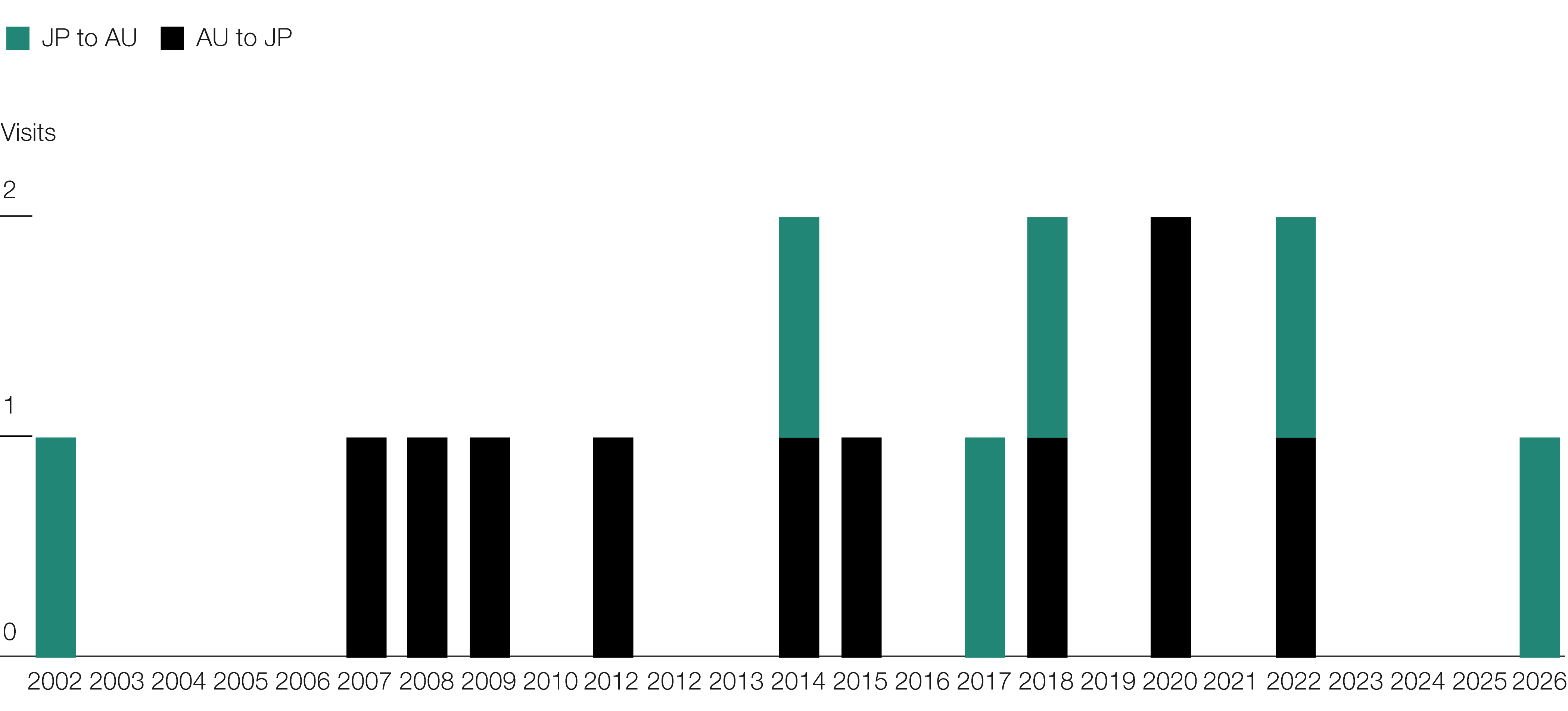
Source: Compiled by Samuel Bullard on March 26, 2026.
- Chas. W. Freeman Freeman Jr., The Diplomat’s Dictionary (National Defense University Press, 1994). ↑
- 2017 Foreign Policy White Paper (Commonwealth of Australia, 2017), iii, https://www.dfat.gov.au/publications/minisite/2017-foreign-policy-white-paper. ↑
- 2017 Foreign Policy White Paper, 21. ↑
- 2017 Foreign Policy White Paper, 37. ↑
- 2017 Foreign Policy White Paper, 25. ↑
- 2017 Foreign Policy White Paper, 26. ↑
- 2017 Foreign Policy White Paper, 40–41. The 2016 Defense White Paper had noted that “the framework of the rules-based global order is under increasing pressure and has shown signs of fragility . . . newly powerful countries want greater influence and to challenge some of the rules in the global architecture.” 2016 Defence White Paper (Department of Defence, 2016), 45, https://www.defence.gov.au/about/strategic-planning/defence-white-paper. ↑
- 2017 Foreign Policy White Paper, 79. ↑
- Interview notes from September 2018 research work in Australia. The Battle of the Coral Sea was a naval engagement fought on May 4–8, 1942, between Japan’s Imperial Navy and the United States Navy as a prelude to Japan’s planned invasion of Papua New Guinea and Australia. ↑
- Scott Morrison, “Address – Launch of the 2020 Defence Strategic Update” (transcript), Department of the Prime Minister and Cabinet, July 1, 2020, https://pmtranscripts.pmc.gov.au/release/transcript-42881. ↑
- Department of Defence, 2020 Defence Strategic Update (Commonwealth of Australia, 2020), 11–14, https://www.defence.gov.au/about/strategic-planning/2020-defence-strategic-update. ↑
- Department of Defence, Defence Strategic Review (Commonwealth of Australia, 2023), 23, https://www.defence.gov.au/about/reviews-inquiries/defence-strategic-review. ↑
- Department of Defence, National Defence Strategy (Commonwealth of Australia, 2024), 11–12, https://www.defence.gov.au/about/strategic-planning/2024-national-defence-strategy-2024-integrated-investment-program. ↑
- Department of Defence, National Defence Strategy (2024), 49. The 2026 National Defense Strategy notes that “the deteriorating trends in our strategic environment that were identified in the 2024 National Defence Strategy have broadened and intensified” (p. 5). Specifically, it cites a weakening of international norms against the use of force or coercion, revolutionary technological breakthroughs, intensifying cooperation among revisionist states, China’s growing national and military capabilities as “the primary driver of changes in Indo-Pacific security dynamics,” and flashpoints in the East and South China Seas and on the China-India border (p. 11–12). The document finds that “the international system is under greater strain than at any time since the end of the Cold War, with a trend away from rules towards the exercise of power”(p. 11). In this environment, Australia “will deepen trilateral cooperation with the United States and Japan to advance interoperability and strengthen deterrence” (p. 60). Department of Defence, National Defense Strategy (Commonwealth of Australia, 2026), https://www.defence.gov.au/about/strategic-planning/2026-national-defence-strategy-2026-integrated-investment-program. ↑
- Ministry of Foreign Affairs, National Security Strategy (provisional translation), (Government of Japan, 2013), 6, https://www.cas.go.jp/jp/siryou/131217anzenhoshou/nss-e.pdf. ↑
- Ministry of Foreign Affairs, National Security Strategy (2013), 11–12. ↑
- Ministry of Foreign Affairs, National Security Strategy (2013), 12. ↑
- Ministry of Foreign Affairs, National Security Strategy (2013), 3. ↑
- Ministry of Foreign Affairs, National Security Strategy of Japan (provisional translation), (Government of Japan, 2022), 2, https://www.mofa.go.jp/fp/nsp/page1we_000081.html. ↑
- Ministry of Foreign Affairs, National Defense Strategy (provisional translation), (Government of Japan, 2022), 21, https://www.mofa.go.jp/fp/nsp/page1we_000082.html. ↑
- Ministry of Foreign Affairs, National Defense Strategy (2022), 8. ↑
- Ministry of Foreign Affairs, National Defense Strategy (2022), 14. ↑
- Ministry of Foreign Affairs, National Defense Strategy (2022), 9. Indicative of Japan’s increasing concern with respect to Taiwan, the joint statement of the 2021US–Japan Security Consultative Committee included the first-ever reference to the importance of peace and stability in the Taiwan Strait. ↑
- Kiyoshi Takenaka, David Brunnstrom, and Michael Martina, “Quad Leaders Agree Ukraine Experience Should Not Be Allowed in Indo-Pacific – Japan, Australia,” Reuters, March 3, 2022, https://reuters.com/world/biden-quad-leaders-discuss-ukraine-thursday-white-house-2022-03-03. The Quad joint statement reaffirmed support for a free and open Indo-Pacific region and called for the respect of sovereignty and territorial integrity of all states “free from military, economic, and political coercion.” ↑
- Shinzo Abe and John Howard, “Japan-Australia Joint Declaration on Security Cooperation,” Ministry of Foreign Affairs of Japan, March 13, 2007, https://www.mofa.go.jp/region/asia-paci/australia/joint0703.html. Visits between prime ministers indicate expanding bilateral engagement (see the appendix). ↑
- “Japan-Australia Joint Declaration on Security Cooperation,” Database of Japanese Politics and International Relations, March 13, 2007, https://worldjpn.net/documents/texts/JPSC/20070313.D1E.html. ↑
- “Appendix: Important Policy Documents for Security Cooperation between Australia and Japan,” in Beyond the Hub and Spokes: Australia-Japan Security Cooperation (National Institute for Defense Studies, 2014), ed. William Tow and Tomonori Yoshizaki, https://www.nids.mod.go.jp/english/publication/joint_research/series10/pdf/08.pdf; “Australia, Japan Pledge More Cooperation at Talks,” ABC News, June 5, 2007, https://www.abc.net.au/news/2007-06-05/australia-japan-pledge-more-cooperation-at-talks/59780. ↑
- Chase Fortier, “US, Australia, Japan Begin Exercise Southern Jackaroo 2026,” US Marine Corps, June 3, 2026, https://www.marines.mil/News/News-Display/Article/4507273/us-australia-japan-begin-exercise-southern-jackaroo-2026/. ↑
- Joint statements in 2015, 2017, and 2018 reaffirmed the importance of a “constructive and mutually beneficial relationship with China.” That reference has not appeared in subsequent joint statements. The 2021 statement first voiced concerns about peace and stability in the Taiwan Strait. ↑
- For Japan, the Australia-Japan Reciprocal Access Agreement is the first of its kind involving a foreign military since the 1960 Status of Forces Agreement with the United States. ↑
- For Japan, the Mogami sale represents a significant step in the development of its defense industrial base; for Australia, it reflects a strengthening commitment to the relationship. ↑
- Penny Wong, Richard Marles, Iwaya Takeshi, and Nakatani Gen, “Joint Statement on the Twelfth Japan–Australia 2+2 Foreign and Defence Ministerial Consultations,” September 6, 2025, https://www.foreignminister.gov.au/minister/penny-wong/media-release/joint-statement-twelfth-japan-australia-22-foreign-and-defence-ministerial-consultations. ↑
- Marles and Koizumi, “Japan-Australia Defence Ministers’ Joint Statement – Establishment of the Framework for Strategic Defence Coordination,” Government of Australia, December 7, 2025, https://www.minister.defence.gov.au/statements/2025-12-07/japan-australia-defence-ministers-joint-statement-establishment-framework-strategic-defence-coordination. ↑
- Anthony Albanese and Sanae Takaichi, “Leaders Statement on Enhanced Defence and Security Cooperation,” Department of the Prime Minister and Cabinet, Government of Australia, May 4, 2026, https://www.pmc.gov.au/resources/australia-japan-leaders-statement-on-enhanced-defence-cooperation. ↑
- Anthony Albanese and Sanae Takaichi, “Australia-Japan Joint Declaration on Economic Security Cooperation,” Department of the Prime Minister and Cabinet, Government of Australia, May 4, 2026, https://www.pmc.gov.au/resources/australia-japan-joint-declaration-economic-security-cooperation. ↑
- “Enhanced Defence and Security Cooperation with Japan,” AnthonyAlbanese.com.au, May 4, 2026, https://anthonyalbanese.com.au/media-centre/enhanced-defence-and-security-cooperation-with-japan. ↑
- Jesse Johnson, “Japan and Australia Tout Progress on High-Energy Laser and Missile Range Test,” Japan Times, August 18, 2026, https://www.japantimes.co.jp/news/2026/08/18/japan/politics/japan-australia-koizumi-marles/. ↑
- “Trilateral Defense Consultations Ministerial Meeting Joint Statement on Efforts to Deepen Our Defense Cooperation,” press release, US Department of War, May 31, 2025, https://www.war.gov/News/Releases/Release/Article/4202592/trilateral-defense-consultations-ministerial-meeting-joint-statement-on-efforts. ↑
- Australia’s 2026 National Defence Strategy notes, “Any effective balance of military power in the Indo-Pacific will require the continued presence and role of the United States. However . . . the United States increasingly expects its allies and partners to invest more in their own defence, reduce their reliance on the United States military and contribute more to collective defence. This includes in defence industrial, economic and diplomatic capabilities.” Department of Defence, National Defence Strategy (2026), 13. ↑
-
Following the Trump-Xi summit, President Trump’s announcement that he is now considering the pending US arms sales package to Taiwan as a bargaining chip with Beijing has unsettled allies. The transactional nature of Trump’s approach to China-Taiwan issues has raised concerns among allies about the strength of the US security commitment.
Commenting on the Trump-Xi Summit, Hitoshi Tanaka, former deputy foreign minister, noted that “Historically, Beijing has calibrated its actions towards Tokyo by factoring in the robust US–Japan alliance. . . . The Trump administration is far removed from Washington’s traditional willingness to risk conflict with China solely for the sake of its ally, Japan.” Hitoshi Tanaka, “Trump-Xi Summit Spells Uneasy News for Japan,” East Asia Forum, May 20, 2026, https://eastasiaforum.org/2026/05/20/trump-xi-summit-spells-uneasy-news-for-japan.
Similarly, former Foreign Minister Takeshi Iwaya observed, “What worries us most is that trust in, respect for, and expectations toward the United States—the core partner in the alliance Japan values most—have been shrinking.” Accordingly, Yasutoshi Nishimura, former METI Minister called on the government to respond by building closer ties with “like-minded middle powers” including the UK, Australia, Canada, and the EU. Matt Spetalnick and Andrea Shalal, “Trump’s Feuds and Tensions with Allies Likely to Outlast Iran War,” The Japan Times, May 9, 2026, https://www.japantimes.co.jp/news/2026/05/09/world/politics/trump-allies-feud-iran-war-legacy.
Hugh White, former senor Australian defense and intelligence official, commented that “the sense that U.S. allies have to look to one another because they can no longer look to America is very real.” While leadership has maintained an official line of confidence in the US, White asserted that underlying concerns reflected an unease deeper than, “the cautious public language.” Damien Cave, “What Middle Powers Fear About the Trump-Xi Summit,” New York Times, May 15, 2026, https://www.nytimes.com/2026/05/11/world/asia/trump-xi-china-summit-iran.html. ↑