













This translation was generated using AI and edited lightly. Read the original in French here.
In proposing to withdraw from NATO’s integrated military command, La France Insoumise (LFI, or France Unbowed) invokes General Charles de Gaulle’s strategic legacy of 1966. Yet the ideologically driven break with Washington advocated today differs fundamentally from Gaullist realism and would expose France’s armed forces, defense industry, and credibility in Europe to major risks.
Atlantico: LFI proposes withdrawing from NATO’s integrated military command, as de Gaulle did in 1966. What justified the general’s decision at the time?
Olivier Passot: To understand that decision, we need to recall the context. Even outside the integrated command, France had to coordinate with NATO against the Soviet threat, notably through the Ailleret–Lemnitzer agreements. But several defining events led General de Gaulle to take that step. During the Suez campaign in 1956, and then during the Algerian War, which absorbed all our forces until 1962, the general felt that the United States and NATO were not sufficiently supportive of French interests.
The decisive factor, however, was the evolution of American nuclear doctrine. Before the 1960s, the doctrine was “massive retaliation”: in the event of a Soviet attack in Europe, the United States was to respond with a nuclear strike against the USSR. This provided a powerful deterrent. Then, faced with Soviet nuclear parity, the Americans shifted to “flexible response.” This doctrine provided for several levels of response, first conventional and then nuclear, before any potential strategic escalation. In General de Gaulle’s eyes, this shift raised doubts about America’s willingness to put its own territory at risk to defend Europe. The credibility of the American nuclear umbrella therefore seemed less certain to him. Faced with the prospect of a conventional confrontation in which the Warsaw Pact would have the advantage, de Gaulle decided to develop an independent nuclear capability and withdraw from the integrated military structure.
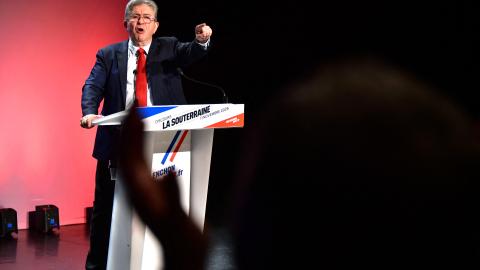
Tsiporah Fried: First, we need to correct the historical parallel suggested by the question. LFI’s proposal is not simply to repeat General de Gaulle’s decision of 1966. Resolution No. 2354, introduced on January 20, 2026, by Clémence Guetté, Bastien Lachaud, and Arnaud Le Gall, whose approach is reflected in LFI’s presidential platform, called on the government to arrange France’s withdrawal from NATO, “beginning with its integrated command.” It also called for France to “cease considering the United States an ally, both politically and militarily.” The platform also provides for closing NATO’s space center in Toulouse. This extends its anti-American stance and confirms that the objective is withdrawal from the Alliance itself, with departure from the integrated command as the first step.
De Gaulle’s decision in 1966 was of a different nature. He did not leave the Atlantic Alliance. He withdrew France from NATO’s military structure to restore full national control over its forces and the country’s freedom to make strategic decisions. France remained a party to the Washington Treaty.
There were two sets of reasons. The first was political: in 1958, his memorandum to Eisenhower sought an equal role for France in the leadership of the Alliance. Washington rejected it. The second was strategic, rooted in the Cold War context and, in particular, the changing nuclear balance. The Soviet Union now possessed nuclear capabilities that enabled it to strike American territory directly. De Gaulle therefore believed that the American guarantee was no longer as nearly automatic as it might once have been: Washington could hesitate to risk its own destruction to defend Europe. For de Gaulle, France, which was building its own nuclear deterrent, could not allow integrated commands to commit it to a conflict without a decision from Paris. He refused to accept a US monopoly over nuclear decision-making within the Alliance.
His decision was abrupt in its execution: Allied structures had to leave French territory. In substance, however, it was not a rupture. It would be a mistake to interpret it as a desire to break with the United States or the Atlantic Alliance. Raymond Aron offers a particularly illuminating interpretation in Chapter XVI of his Memoirs, “The General’s Grand Design.” He recalls André Siegfried’s prediction that de Gaulle’s return to power would mean the end of the Atlantic Alliance. Aron replied that the general was “too intelligent, too mindful of the balance of power” to break with the Alliance or the United States and drive the Americans out of Europe. He knew that Moscow’s precise objective was to separate the Europeans from the Americans. Could he pursue the same goal?
This is essential. De Gaulle wanted France to make its decisions independently, but he did not believe that independence should be built in opposition to the Alliance or at the expense of European security. Military cooperation did not disappear after 1966. The Ailleret–Lemnitzer agreements of 1967 established the conditions for operational cooperation between French and Allied forces in the event of conflict, while preserving French national authority.
I would therefore distinguish between two approaches. De Gaulle clearly had a firmly held political vision of France’s place in the world, but his decision stemmed from an analysis of the balance of power and an assessment of French strategic interests.
LFI’s approach seems different to me. It rests on a fundamental distrust of the Atlantic Alliance and a political determination to break with the United States, rooted in an ideological conception of nonalignment. That does not mean that every criticism of Washington is unfounded. Greenland, the 5 percent of GDP target, and our dependence on American equipment are real concerns, and the transatlantic relationship deserves reassessment. But the question is whether that reassessment proceeds from an analysis of France’s security interests or is subordinated to a predetermined political objective of rupture. Ultimately, this is a question of strategic method: do we begin by assessing threats, the balance of power, available military capabilities, and the partnerships we need in order to determine our relationship with Washington? Or do we make a break with Washington a prior objective and then try to adapt French strategy to it?
Would leaving the integrated command have more serious consequences than it did in 1966?
Tsiporah Fried: Yes, but not necessarily for the reasons one might imagine. The greatest cost could be in Europe.
The first difference is the depth of military integration. In 1966, NATO’s command structures were much less developed than they are today. France was able to establish arrangements for military cooperation with its allies, notably through the Ailleret–Lemnitzer agreements of 1967.
Today, NATO rests on a much more integrated architecture: regional planning, command, intelligence, exercises, force interoperability, and operational coordination. France would obviously not lose its military capabilities by leaving the integrated command. It would, however, risk losing influence over the Alliance’s plans and priorities, and would have to renegotiate access to certain planning, coordination, and command mechanisms or rebuild cooperation arrangements.
But I believe the most important consequence would be political and would concern our European partners.
A French withdrawal would be interpreted not only in Washington, but also in Warsaw, Tallinn, Berlin, Bucharest, and other European capitals. We might present it as an act of strategic autonomy; our partners might see it as a source of uncertainty about our commitment to their defense. For the countries of Central and Eastern Europe in particular, NATO is not simply a military organization. It is the institutional framework for their security guarantee, in which American solidarity plays a central role.
There is a paradox here: France risks making its vision of European strategic autonomy less convincing if it distances itself from the organization to which its partners entrust their security. We cannot build a credible European defense without taking those countries’ threat perceptions and security needs into account. European strategic autonomy cannot rest on an exclusively French conception of the continent’s security.
Finally, there is an essential question that is often absent from the debate: the transition and the alternative. What capabilities, defense plans, operational agreements, and funding would be in place at the moment of withdrawal? How would we preserve military coordination and credible deterrence during that transition?
I would not say that withdrawal would inevitably lead to American disengagement or an automatic loss of French capabilities. That would be too categorical. The problem, rather, is the possible absence of a credible, operational, and funded alternative.
One can advocate a profound transformation of European security and greater European responsibility for defense. But one must explain how to achieve that without creating a strategic vacuum or weakening trust among Europeans. Ultimately, that is the test any proposal to reform our relationship with NATO should have to meet.
Olivier Passot: The major difference from 1966, and from the decades that followed until the 1990s, is that the French military was then deployed extensively in Africa and the Middle East. France operated independently, with its own sphere of influence and its own military and commercial partners. Today, we have almost no presence there anymore. Our military presence in Africa has shrunk considerably, and we have refocused heavily on Europe and our allies. The framework for our engagement is therefore very different: we have made extensive commitments within NATO. Most of our exercises and operations take place within that framework.
Our brigade and division headquarters are NATO-certified. This ensures full interoperability: a French headquarters can command German, Belgian, or Italian brigades. Our service members have done an enormous amount of work to master these complex doctrines and make our equipment compatible, for example through Link 16 for aircraft. In 1966, de Gaulle did not cut the defense budget; he invested in nuclear capabilities. Today, if we left the integrated command amid severe pressure on public finances and without the African theater, we would probably have to redirect part of our military effort and rebuild certain national capabilities that are now deeply integrated into the Alliance.
We should also remember our spending commitment: the allies have pledged to devote 3.5 percent of GDP to defense, rising to 5 percent when infrastructure and cyber are included, by 2035. Even if that target is out of reach, countries close to Russia are already at 3 percent. NATO’s framework exerts strong political pressure to continue the increases provided for in France’s multiyear military programming laws, known as LPMs.
LFI argues that leaving the integrated command would make it easier to sell French military equipment in Europe. Is that a realistic argument?
Olivier Passot: It is not realistic, because our European partners want interoperable equipment in any case. NATO standards are often drafted under American influence. The Americans impose technical specifications, some of which may favor US manufacturers or be easier for them to meet, potentially complicating market access for certain European competitors.
Yet it is precisely our participation in the integrated command and in exercises, along with the certification of our units, that helps demonstrate to our allies that our equipment meets their requirements. For a long time, France exported extensively to Asia and the Middle East, but very little to Europe. Today, thanks to this integration, we are finally succeeding in exporting to our European partners, including Estonia, Romania, Sweden, and Denmark. Membership in the integrated command, and the interoperability it fosters, probably contribute to this momentum. Withdrawal could therefore weaken it.
Tsiporah Fried: No, I do not think it is a realistic argument. It confuses NATO membership with dependence on American industry.
NATO is not a captive market in which member states are required to buy American. Countries retain sovereignty over their procurement decisions. The Alliance sets capability targets and promotes equipment standardization and interoperability, but it does not require states to choose one supplier over another.
We need to distinguish interoperability, which allows different systems to operate together, from technological dependence, which can arise from external control over components, software, data, or maintenance supply chains. The two are not synonymous.
Participation in the Alliance also enables France to understand its partners’ operational needs, help develop standards, and advocate for its own technological and industrial solutions. This serves both strategic and industrial interests. I would qualify one point, however: leaving the integrated command alone would not, in my view, automatically mean losing all ability to influence NATO standards. A complete withdrawal from the Alliance would have far more serious consequences in that respect.
Above all, there is a dimension that is often overlooked: an arms purchase is also a choice of strategic relationship. When a country buys American, it is not simply choosing a piece of equipment. It is also strengthening its relationship with Washington, along with the political assurances, technology transfers, maintenance, and operational support that may accompany it. These contracts commit countries for decades.
Convincing a European partner to buy French therefore requires a competitive industrial offering, production capacity, credible delivery schedules, and guaranteed long-term support. It also requires a political relationship that inspires confidence.
Denmark provides an interesting example. In September 2025, it chose the Franco-Italian SAMP/T NG over the American Patriot for its long-range air defense. This shows that a NATO member can readily choose a European system. Alliance membership is therefore no obstacle to French exports.
That is also the rationale behind the incentives in ReArm Europe 2030: using Europe’s rearmament effort to develop European defense industrial and technological capabilities, encourage joint procurement, and strengthen the European defense technological and industrial base. It is entirely possible to give greater preference to European procurement while remaining fully committed to the Atlantic Alliance.
Leaving the integrated command would not make our equipment more competitive, shorten our delivery schedules, or resolve our production capacity problems. NATO membership does not guarantee French sales; leaving would not make them easier. A defense industry’s competitiveness depends on the quality of its equipment, its ability to produce at scale and on time, its technological autonomy, and the trust of its customers.
Supporters of remaining in NATO emphasize that membership allows France to influence strategic decisions. In practice, do we really have that power?
Olivier Passot: We regained some of it following the decision to return under Nicolas Sarkozy. Today, we hold an important position at SHAPE, the Allied operational headquarters, where France holds a deputy chief of staff post.
However, it is true that we do not command any of the major headquarters, partly because de Gaulle insisted that no NATO bases remain in France. Unlike Italy or Germany, we host only one or two centers of excellence, one focused on space and another on AI that is being established. This may limit our institutional influence compared with allies that host major NATO structures on their territory. Nevertheless, we take on significant responsibilities, such as commanding NATO Mission Iraq, which we did for a year, until May 2026. Moreover, our officers embedded throughout the Alliance’s headquarters defend our interests from within. Leaving the integrated command would mean relinquishing many of these posts and would reduce our ability to influence the Alliance’s military structures.
Tsiporah Fried: Yes, we have a real capacity to influence decisions, but we need to be precise about its nature and avoid overstating it.
Since 2009, France has participated fully in the integrated command structures. It has held the leadership of Allied Command Transformation in Norfolk, a position previously reserved for an American general, from Stéphane Abrial in 2009 to Admiral Pierre Vandier today. This is not a symbolic post: it involves work on doctrine, operational concepts, interoperability, and the Alliance’s future capabilities. It is therefore a place where part of NATO’s military thinking is developed and the Alliance’s military future is shaped.
We must nevertheless be clear-eyed about the limits. The Supreme Allied Commander Europe, or SACEUR, who commands operations, remains American, and France remains outside the Nuclear Planning Group.
We need to distinguish two levels. In the North Atlantic Council, decisions are made by consensus: France retains its independence of judgment and can refuse to endorse what it does not support. At the military and doctrinal level, participation in the integrated structures enables France to contribute early to plans, concepts, and capabilities, and thus to shape the options presented to decision-makers. That does not mean we can impose our views: American influence is considerable, and allies’ interests diverge. But being unable to decide alone does not mean giving up a role in shaping collective decisions.
Influence is also exercised below the level of generals and admirals. Those who draft the initial papers help shape the eventual decision. Yet in 2023, France filled only 79 percent of the posts allocated to it. This shortfall is not unique to France; many countries do not fill all their positions. It is nevertheless real: we prioritize prominent senior posts while underinvesting in the middle ranks and the offices where the substantive work is done. The same observation applies to European institutions. The question, therefore, is whether we are prepared to make these assignments a career priority. Influence cannot simply be decreed from Paris. It requires a sustained presence, credible capabilities, an industrial base, concrete proposals, and the ability to build coalitions.
That is why I would not equate sovereignty with withdrawal. Sovereignty is not only the ability to say no; it is also the ability to advance one’s interests. Leaving the integrated command would cost us part of our ability to influence the Alliance’s military transformation from within, and therefore to shape European collective security.
The essential issue remains our relationship with Washington. We must honestly acknowledge that, given our capability dependencies and the balance of power with Russia, we still need the United States. This relationship, almost 250 years old, was forged through fighting side by side. That does not relieve us of the task of building a Europe capable of taking greater responsibility for its security. But we must do so without destroying the alliances on which that security still depends.
The challenge, therefore, is not to choose between French sovereignty, European defense, and the American alliance, but to strengthen the first two without sacrificing the third. At its core, that means remaining faithful to the Gaullist method: starting with the balance of power and national interests, rather than a preconceived framework.