








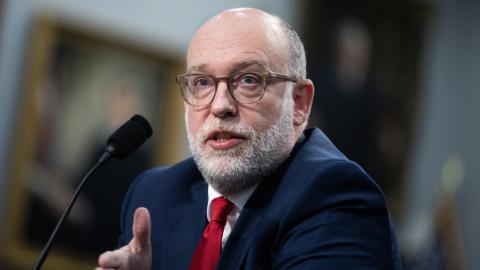







In a 2025 discussion at Vanderbilt University about emerging threats to America, former FBI Director Christopher Wray gave a chilling description of the Chinese regime’s hacking program aimed at the United States. He said American water treatment facilities, energy grids, and transportation and information technology are vulnerable to Chinese attack and warned that China is “using that mass, those numbers, to give itself the ability to physically wreak havoc on our critical infrastructure at a time of its choosing.”
Some Americans may feel like foreign challenges take up too much of the U.S. government’s time. “Can’t we simply leave these challenges to other countries?” some may wonder. After all, polls show time and again that Americans are dissatisfied with the cost and quality of life, and no amount of telling them that things are going well will change their minds.
The list of problems is extensive: Yes, U.S. healthcare is among the highest quality in the world, but it remains the most expensive. Unemployment is low, but illegal immigration crowds the workforce, increases crime, and strains an already stressed social-welfare system. Fewer drugs may be pouring across the southern border, but opioids kill tens of thousands of Americans annually. It’s illegal to discriminate based on race and sex, but universities and companies still do. And the home of the free feels like the land of the licentious, as pornography, gambling, abortion, and recreational drug use expand.
There is much work to do to restore the 250-year-old republic to better health, but Wray’s talk should serve as a warning. Intense work required at home cannot come at the expense of intense work required in foreign affairs.
But amid the need for this work, many on the far right are critical of President Trump’s kinetic (and now mostly economic) war against Iran and, Secretary Rubio’s exhortation to make European alliances strong and pro-West, and they lament that Israel is an important and powerful American ally. They routinely castigate conservatives who disagree with them as “neoconservatives,” employing the term as a pejorative associated with Bush-era attempts to impose democracies on unwilling Islamist nations. It is an entirely inaccurate smear meant to discredit those who appreciate the importance of an active and muscular U.S. role in the world, many of whom agree that we also have mounting challenges at home.
Throughout history, populist movements impatient for redress at home have often called for retrenchment from international affairs (or yes, outright isolationism). It is happening again. But foreign affairs are important even during normal times, and, as Jeane Kirkpatrick famously argued in a 1990 essay at the close of the Cold War, they become exceedingly important when the United States faces the threat of aggression. We now face a threat of aggression that could determine whether the next century is one led by the United States or dominated by China and its partners. This is not a time of normalcy.
You may not feel that eerie sense you get just before a storm, but dark clouds are gathering, and the storm will not hold off while we tackle our challenges at home. Our adversaries are taking advantage of our challenges. On social media, adversary accounts seek to divide us, distract us, and weaken us further. They interfere with our elections and try to divide our alliances to isolate and demoralize us.
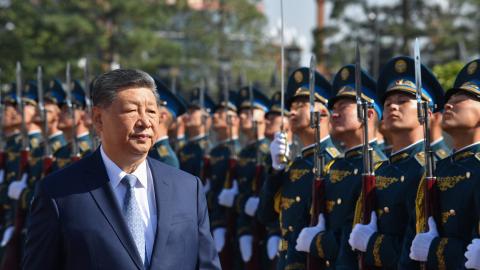
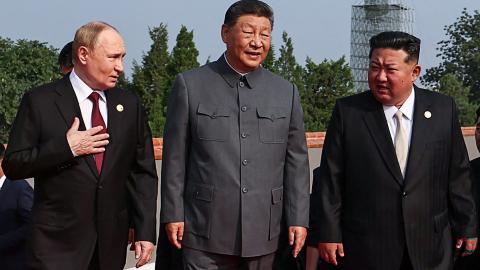
Communist China under Xi Jinping, a committed Marxist-Leninist, is determined to replace the United States as the most influential country in the world and to carry out policies that empower the Chinese Communist Party. To implement his plan, China has built a navy that is larger (though not better) than ours and engaged in the most rapid expansion of a nuclear weapons program in history. And China is working with Russia, Iran, and North Korea in ways that threaten and undermine the United States and its democratic allies.
This is the first time in American history that the United States must deter two major nuclear powers—China and Russia—and their proxies simultaneously. It is a cold war, with frequent bursts of provocation and aggression, and the United States cannot win it without the collective economies and militaries of our allies.
But populist wings in both political parties have grown frustrated with unresponsive government and failing civic institutions, which tempts them towards disbelief in the gravity of these threats to Americans. We can see this expressed today by those who say that Operations Midnight Hammer and Epic Fury to take out Iran’s nuclear and missile programs are mistakes like the Iraq war, never mind that Trump’s war against Iran has defanged the world’s leading sponsor of Islamist terrorism and that it involves neither nation-building nor the imposition of democracy.
Just as during the early 1940s, there are those clamoring to pull up the drawbridge and turn inward in the name of “America First.” But the idea of a fortress America is fanciful in an age of drones and spy balloons, hypersonic missiles, sabotage, and anti-space weapons. History shows that if our government ignores those threats or seeks to appease adversaries who wish us harm, the threats will only grow worse.
America’s leaders should instead heed the warnings and embrace a clear and confident role in shaping world affairs. At times, that will require the use of military force, strengthening and arming our allies, and imposing economic costs on adversaries. The nation has difficult work to do at home, but we stand no chance of finishing that work if we lose this cold war, or worse, lose a cold war that gets hot.