








At 8:46 a.m. on September 11, 2001, I was standing on the platform at Canal Street in lower Manhattan, awaiting the downtown express train. A loud boom sounded through the tunnels, causing other straphangers to look up quizzically before returning to their newspapers. I later realized the noise was American Airlines Flight 11 crashing into the North Tower.
At about 8:55 a.m., I walked up and out of the Wall Street subway station. High above me, papers fluttered in the clear sky. I initially thought it was a publicity stunt associated with an initial public offering at the New York Stock Exchange.
At 9:03 a.m., I stepped out of my usual bagel shop and looked west. At that moment, I heard a loud roar and then saw a flash of orange on an airplane, United Airlines Flight 175, right before it crashed into the upper floors of the South Tower. Seconds later, scores of people came running toward me, and I stepped back into the shop.
By 9:15 a.m., I was standing about a block away from the World Trade Center, looking up at the two towers. The impact sites were so high up that it was hard to comprehend the size of the fires. People around me speculated that radar issues caused two Cessnas to fly into the towers. More grimly, others talked about people jumping out of the North Tower.
By about 9:30 a.m., I grew concerned that I couldn’t reach my brother on his cell phone. He typically used the World Trade Center subway stop to commute to his office nearby. Nearly all cell networks were overloaded.
At about 9:42 a.m., people around me said the Pentagon had been hit and that other New York City sites might be under attack. I started to walk to my office on Exchange Place.
By 9:58 a.m., I was in my 34th-floor office at 20 Exchange Place. My brother, with whom I had finally spoken, came out of the elevator and joined me in the common area.
At 9:59 a.m., a colleague yelled, “The tower’s collapsing!” We ran to the window. Thirty stories beneath us, a massive cloud of dust rushed toward the foot of the building and then raced up toward us. Within seconds, it reached our floor, and the blue sky disappeared.
At about 10:20 a.m., we walked out of the building into the gently swirling dust. Someone in the lobby had ripped up a shirt, and we covered our faces with the strips of cloth. My brother and I started to walk toward the South Street Seaport.
At 10:28 a.m., we heard a distant roar and, after a minute, the dust around us became more intense. The North Tower had collapsed.
My brother and I then spent the next hour or so walking up the side of the FDR Drive. We were too spooked to head back into the heart of downtown, given reports of additional attacks. I recall bumming cigarettes from strangers along the way—our hands were shaking.
My main recollection from that day and the days that followed is a sense of both sadness and togetherness. I had lived in Manhattan for much of the prior decade—I loved the city. The murder of 3,000 people was unfathomable. At the same time, New York City residents and commuters had a common bond—you felt the solidarity everywhere in those early weeks.
The nihilistic ideology that led to the September 11 attacks persists. It has killed thousands of people in suicide bombings, terrorist attacks, and wars in countries across Africa, the Middle East, and Asia. America exhausted itself trying to fight it. Some Middle Eastern governments understand the dire threat this ideology poses, but it feels like many Western politicians do not or will not, out of fear of being offensive. I look at the foreign policy priorities of New York City’s mayor and the United Kingdom’s new prime minister, for example, and I can only shake my head in disbelief.
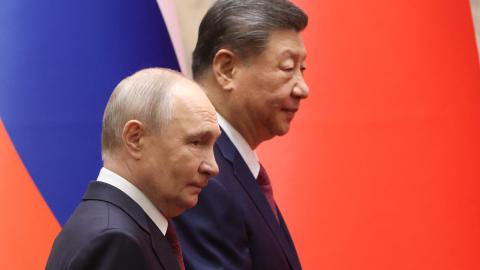
Caption
Russian President Vladimir Putin and Chinese President Xi Jinping enter the hall during a signing ceremony on May 20, 2026, in Beijing, China. (Getty Images)