















Executive Summary
- Battlefield assessment. Combat activity remained intense last week, with key pressure points emerging in Huliaipole and Pokrovsk and dangerous urban combat in Kostiantynivka.
- Russia targets cultural landmarks. To target the cultural foundations of Ukrainian statehood, Russia’s strike campaign continued to hit Ukrainian population centers and targets of symbolic value, including Kyiv’s Dormition Cathedral.
- Ukraine deepens its defense ties with Europe. Ukraine responded to Russian attacks by conducting long-range strikes of its own, and by forging deeper defense ties with its European partners for missile defenses and for strike, propulsion, and counter-drone systems.
1. Battlefield Assessment
Last week the Ukrainian battlespace continued to witness over two hundred tactical engagements each day. Russian offensives again targeted Huliaipole, Pokrovsk, and Kostyantynivka, while Lyman, Sloviansk, Kramatorsk, Orikhiv, Oleksandrivka, and Kupiansk also saw increased combat. Additionally, the Ukrainian General Staff noted that Russia used thousands of attack drones to target Ukrainian positions, rear areas, and population centers.
Russian forces reached the outskirts of Kostiantynivka from multiple directions and continued to infiltrate the city. Infantry activity emerged from the east of the city through Novodmytrivka, with additional pressure from the Berestok and Illinivka axes. Kostiantynivka is quickly becoming another attritional flashpoint in Donetsk Oblast. Russian forces appear to hold a manpower advantage around the city and are shifting focus to a longer campaign to capture it.
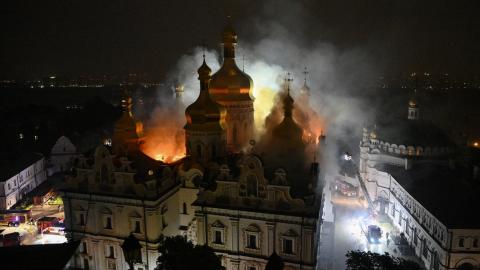
In addition to their strikes against military infrastructure, Russian forces targeted the cultural symbols of Ukrainian statehood. On June 15, Russian strikes badly damaged the Dormition Cathedral at Kyiv’s historic Pechersk Lavra monastery, a vital symbol of Ukraine’s Orthodox Christian heritage and national identity. The attack set fire to the roof of one of Ukraine’s key religious sites and formed part of a larger barrage of missiles and drones that killed at least 11 people nationwide.
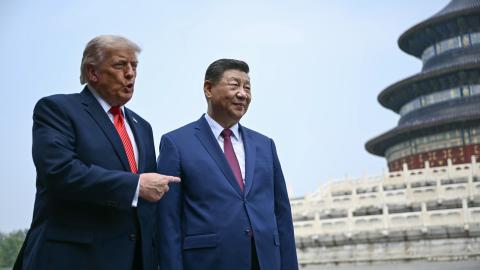
The Security Service of Ukraine stated that a Shahed-type drone hit the Dormition Cathedral, which had previously suffered war damage, including during a January strike that hit monastery buildings and caves. The latest attack coincided with increased diplomacy around the Group of Seven summit in France, where President Donald Trump spoke separately with Ukrainian and Russian leaders about ending the war.
Ukraine, for its part, conducted a drone strike that forced a major refinery in southeastern Moscow to suspend operations after a fire damaged its main processing unit. The refinery is a key fuel supplier for Moscow Oblast. Though a second processing unit at the installation may recover, the attack supports Ukraine’s expanding campaign against Russia’s refining and fuel distribution network.
2. Ukraine Deepens Its Strategic Defense Ties with Europe
Ukraine continued to deepen its ties with the most prominent European defense companies. The relationship between Ukraine and its private-sector European partners now reaches beyond arms deliveries to strategic systems, including missiles, turbojet and turboprop propulsion, joint production, and deep-strike and counter-drone systems.
MBDA, a multinational European defense corporation, is among the firms moving deeper into Ukraine’s long-range strike ecosystem. The European missile manufacturer signed a memorandum of understanding with LUCH, a Ukrainian designer of components for the defense industry, to support further development of the Neptune cruise missile, including the NEPTUNE2 with deep-strike capability.
This agreement matters for two reasons. First, it links Ukraine’s wartime missile experience with one of Europe’s most important weapons developers. Second, it signals that Ukraine’s long-range strike program is moving beyond wartime emergency adaptation and toward structured industrial cooperation with European partners.
MBDA also agreed to partner with Ukrainian Armor, a defense company located in Kyiv, on deep-strike and counter-drone solutions, with a focus on technology exchange, joint production, and other possible joint ventures. Additionally, Ukrainian Armor signed a separate agreement with a Czech firm, AviaNera Technologies. This partnership covers turbojet and turboprop engines for Ukrainian missile and drone platforms, and aims to expand production, localize technologies, and explore joint ventures. This agreement will likely improve Ukraine’s propulsion capabilities, which have been a critical bottleneck for Kyiv.
Collectively, Ukraine’s agreements with its European defense partners mark a shift from arms delivery to coproduction. Kyiv is securing technology and production transfers with Europe to enable scalable defense growth. In addition to seeking weapons, Ukraine is building a European-integrated industrial base for missiles, drones, air defenses, and counter-drones.
Another Ukrainian defense technology firm, Fire Point, signed a memorandum of understanding with the German radar manufacturer Hensoldt at Eurosatory 2026, the world’s largest land and air-land defense and security trade show held last week in Paris. The agreement supports the development of the Freyja air-defense system, a mobile radar designed to detect and track more than 1,500 targets at ranges of up to 155 miles.
Under the terms of the deal, Hensoldt commits to producing, testing, and supplying the Freyja ground-based missile-defense architecture. Hensoldt’sTRML-4D radar is the most important sensor in the Freyja system. Fire Point, for its part, will have overall design authority over the system. The company will produce, test, and deliver its Fire Point FP-7 missiles and integrate the main components into the system. The Ukrainian company’s FP-7.x interceptor concept is designed for high speeds and recently passed a controlled maneuvering flight test.
This deal marks Ukraine’s attempt to move from improvised wartime air-defense adaptations to a structured missile-defense industrial program. The cooperation between Fire Point and Hensoldt demonstrates tangible progress in Kyiv’s effort to add a proven European radar layer to its defense-industrial architecture. Progress in this arena may offer Ukraine a pathway to counter Russia’s missile threat using systems built to Ukrainian requirements.
3. What to Monitor in the Coming Weeks
While Kostiantynivka has turned into a meat grinder for Russia’s invading forces, Ukraine’s hold on the city is weakening. The coming weeks will determine whether Ukrainian forces can hold critical terrain and deny Russian assaults further tactical gains.