
















Executive Summary
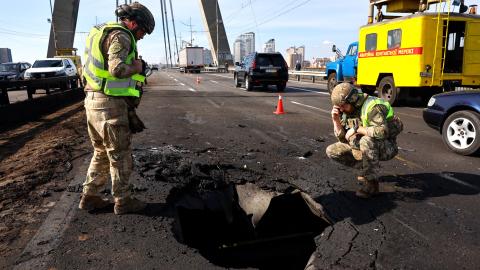
- Battlefield assessment. Persistent Russian strikes on Ukraine’s bridge infrastructure and cities suggest that Russian aerial activity will likely increase in the coming weeks.
- Irkutsk lab incident. The unexplained death of a technician at Russia’s anti-plague lab in the city of Irkutsk raised serious biosecurity concerns, compounded by opaque responses from Moscow and silence from Beijing.
- Drone warfare innovations. Ukrainian unmanned ground vehicles began using nets against attacking drones, strengthening their ability to conduct frontline logistics and casualty evacuation tasks.
1. Battlefield Assessment
Last week the aerial campaign in the Russia-Ukraine War continued to accelerate. Russia launched persistent attacks employing jet-powered drones and Banderol missiles in deliberate, asymmetric attempts to target Kyiv, other major Ukrainian cities, and the nation’s bridge infrastructure. While Ukraine’s interceptor drones showed some success against Russia’s Banderol drone-missile hybrid weapons, no data yet indicates high interception rates.
Russia also intensified missile and drone strikes aimed at overwhelming Ukraine’s defenses. Ukrainian President Volodymyr Zelenskyy warned of forthcoming aerial attacks and called for heightened precautions. These developments suggest that Russian aerial activity against Ukraine’s critical infrastructure and population centers will increase in the coming weeks.
In the land warfare domain, the battlespace maintained a heightened operational tempo, with approximately 200 tactical engagements per day. The Pokrovsk, Kostiantynivka, Kramatorsk, and Sloviansk axes remained the principal flashpoints. This intense combat, once again, produced no strategic-level changes to the battlefield geometry.
2. The Irkutsk Lab Mystery: A Russian Biosecurity Crisis in the Making?
Daria Shipilova, 28, a technician at the anti-plague laboratory in the Siberian city of Irkutsk, reportedly died last week after a suspected incident at the lab. Reports suggest that the episode involved a broken test tube containing live biological material, raising concerns about exposure to Yersinia pestis, the bacterium that causes plague. Reportedly hospitalized on September 29 in the nearby city of Shelekhov with severe pneumonia, Shipilova may have died on October 1, though accounts of her passing have differed.
In the episode’s aftermath, Russian authorities put nearly 200 people who came into contact with the deceased lab worker in isolation or under observation, placed the district hospital under quarantine, and canceled local events. Anna Popova, the chief of the Russian national public health agency Rospotrebnadzor, also traveled to the area. On October 4, spokespeople from the agency reported that Shipilova’s death had been caused by pneumonia of unknown origin, and denied any connection to the lab in Irkutsk or the presence of any pathogenic microorganism.
On October 6, Moscow reported to the World Health Organization (WHO) that Irkutsk had recorded no cases of plague. Russian authorities further announced that Shipilova’s contacts had tested negative for dangerous pathogens, and that most of those quarantined had been released. News outlets could not confirm whether investigators had definitively ruled out plague as the cause of Shipilova’s illness.
The United States Department of State and Centers for Disease Control (CDC) announced that they were monitoring developments in Russia and urged Moscow to be transparent.
Plague can be treated successfully with antibiotics, but the pneumonic plague caused by Yersinia pestis can spread quickly via respiratory particles and often progresses rapidly. Symptoms of plague include fever, headache, weakness, chest pain, breathing difficulties, and potentially bloody sputum; treatment of the disease within 24 hours can be critical. Traces of the pathogen, which caused the devastating Black Death pandemic that swept across Europe between 1347 and 1351, persist in some animals, including in wild rodent populations.
The testimony of defectors who were once involved in the Soviet Union’s clandestine biological weapons program suggests that last week’s incident in Irkutsk warrants particular scrutiny. The most notable of these defectors is Ken Alibek, born Kanatjan Alibekov. Before defecting to the United States in 1992, he served as the first deputy chief of Biopreparat, the Soviet agency established in 1974 that covertly operated the world’s largest offensive bioweapons program.
After his defection, Alibek briefed US officials on Russian capabilities, describing the country’s efforts to weaponize plague and produce antibiotic-resistant strains of the disease. Some of his allegations remain contested, underscoring the need for independent corroboration. Nonetheless, the existence of the program and its extraordinary scale have been firmly documented, despite the Soviet Union’s 1975 ratification of the Biological Weapons Convention, which prohibits such activities.
Spokespeople from the People’s Republic of China, Russia’s close ally, have yet to comment on the events in Irkutsk. This silence is notable, as Russia and China have collaborated closely on pandemic preparedness. In August 2026, over 300 officials from China’s People’s Liberation Army (PLA) Northern Theater Command Disease Control Center joined several Russian specialists, including Sergey Balakhonov, the director of the Irkutsk anti-plague lab, to rehearse responses to plague outbreaks, including pathogen identification, joint risk assessment, and cross-border containment. Officials from the two countries discussed infectious disease prevention and disaster medicine as recently as September 29 this year.
Yet as of October 4, Beijing had issued no public health warnings or travel advisories for Russia, and China’s consulate in Irkutsk had not published an epidemic notice. On October 2, six commercial flights departed Irkutsk for major cities in China, including Beijing, Shanghai, Guangzhou, Manzhouli, and Harbin. Chinese disease-control and customs agencies coordinate regularly with Russia’s Rospotrebnadzor, and the countries’ defense institutions collaborate on military medicine and chemical, biological, radiological, and nuclear weapons (CBRN) preparedness. Given these connections, Beijing’s silence on the Irkutsk incident remains notable.
3. Ukraine’s Ground Robots Fight Back: The Next Phase of Drone-on-Drone Warfare
Ukraine’s ground robots are fast acquiring the ability to fight back against the Russian aerial drones that hunt them. Recently released footage from the front lines depicts Ukrainian unmanned ground vehicles (UGVs) using mounted net launchers to intercept approaching Russian first-person-view (FPV) drones. As the Russian attackers close in, the Ukrainian platforms discharge nets that entangle the enemy drones before impact.
These encounters illustrate how ground robots equipped with active defenses can contest the final moments of an attack and defeat the systems sent to destroy them. For Ukraine, UGV survivability carries implications beyond merely preserving materiel. Kyiv is increasingly tasking its automated platforms with frontline resupply and casualty evacuation missions. As a result, equipping these platforms to survive enemy contact is essential to sustaining Ukraine’s combat formations and recovering its wounded personnel without exposing additional troops to attack.
Protecting a ground robot requires protecting the ammunition it carries and the soldier it evacuates—and sustaining a mission that would otherwise require a human crew. In this context, net-based interception offers a glimpse of how drone-on-drone warfare may evolve across the air and ground domains. As robotic systems assume greater battlefield responsibilities, the effectiveness of these platforms will increasingly depend on their capacity to defeat other unmanned systems. Ukraine’s recent unmanned aerial vehicle encounters suggest a future in which robotic logistics and evacuation platforms carry their own defenses through battlespaces patrolled by other robotic predators.
4. What to Monitor in the Coming Weeks
All eyes are on Irkutsk. Any forthcoming information on events at the city’s anti-plague laboratory and possible related infections could clarify the cause of last week’s biosecurity incident. Any signs of increased transparency from Moscow, or a response from Beijing, will also be important to watch.