

















Executive Summary
— Battlefield assessment. A Ukrainian counteroffensive made gains north of Lyman, but Russian forces retained the offensive initiative across the battlespace.
— A watershed naval drone duel. In what Kyiv described as the first known combat engagement between two unmanned surface vessels, a Ukrainian Sargan-3000 destroyed a Russian attack drone.
— A shift in Russian drone usage. In August, Russia increased its use of jet-powered drones and conducted more attacks during both daylight and nighttime hours, shortening Ukraine’s air-defense engagement windows.
1. Battlefield Assessment
Ukrainian forces, under the 3rd Army Corps, have launched a counteroffensive north of Lyman in Donetsk Oblast that targeted Russian positions and infiltration networks along the approaches to the Sloviansk–Kramatorsk fortress belt. On September 15, the corps commander, Brigadier General Andrii Biletskyi, confirmed that Operation Vivaldi had cleared Russian infiltration groups from approximately 29 square miles of territory and had recaptured an additional four square miles. Ukrainian forces reportedly secured three villages and the area around a fourth. The town of Serednie is now under Ukrainian control.
Russian military bloggers and other open sources indicate that Ukrainian units may have advanced farther east toward the Zherebets River near the border of Luhansk Oblast. General Biletskyi reported that his unit’s operation has degraded elements of Russia’s 20th and 25th Combined Arms Armies. Additionally, Ukrainian drone strikes have pushed Russian logistics and supply nodes farther from the immediate battlespace.
Ukraine’s counteroffensive north of Lyman is operationally significant. The effort directly affects the northern approaches to the Sloviansk–Kramatorsk defensive ring. Seizing these defenses is a key objective in Russia’s campaign to capture the parts of Donetsk Oblast still under Ukrainian control.
To that end, Russian forces have continued to apply pressure south of the fortress belt while also penetrating deeper into Kostiantynivka. These moves have laid the groundwork for a broader converging effort against Ukraine’s principal defensive positions in the region. The Vivaldi operation, therefore, appears intended not only to recover territory Ukraine has lost, but also to disrupt Russia’s efforts to concentrate its forces, maintain its logistics integrity, and pressure the northern Donetsk defensive system.
Ukraine’s reported gains follow an earlier counteroffensive in the southeast. Kyiv claims that this effort retook more than 270 square miles of territory from Russian forces. This indicates that Ukrainian units retain a limited but meaningful capacity to generate localized operational reversals despite Russia’s broader advantages in manpower and materiel.
Last week Ukraine also continued to sustain a long-range strike campaign against Russia, targeting the country’s military infrastructure, its defense-industrial facilities, and the command-and-control architecture supporting Moscow’s strike complex. On September 9, units from Ukraine’s Unmanned Systems Forces, including the 1st Separate Unmanned Systems Center, struck the Novorossiysk Naval Base in Russia. The drone army’s commander, Robert “Magyar” Brovdi, reported that the attack damaged or destroyed several Russian military vessels, including missile-capable platforms. Ukrainian unmanned systems operators also reportedly struck aviation and sensor infrastructure supporting the naval base, destroying a Russian Su-33 fighter, an Mi-8 helicopter, and two radar systems near Anapa and Gelendzhik.
Additionally, on September 12, Ukrainian forces conducted a deep strike 560 miles inside Russia. This attack targeted the KuibyshevAzot chemical complex in Tolyatti, a facility that supplies Russia’s defense-industrial base. Ukraine confirmed another strike in the same city against a Tolyattikauchuk facility, part of a large petrochemical enterprise.
On September 12 and overnight into September 13, Ukrainian forces also targeted an important depot in occupied Donetsk. Russia uses this facility to store, prepare, and launch attack drones and to host ground-based relay stations that support its Geran/Gerbera drone operations in occupied Kherson Oblast and occupied Crimea. Ukrainian forces also struck an antenna station in Russia’s Bryansk Oblast.
Kyiv hit Russia’s petroleum infrastructure as well. Overnight on September 12–13, Ukrainian forces struck the Slavyansky Oil Refinery in Krasnodar Krai and the TANECO refinery in Tatarstan. The Ukrainian General Staff also confirmed it had damaged the Saratov refinery during strikes on September 11. Ukrainian military intelligence reported that the attack on the Slavyansky Refinery hit a key oil-processing unit and the facility’s tank farm. The pattern of Ukraine’s September strikes suggests that Kyiv is conducting a campaign against the architecture supporting Russia’s war machine: naval vessels and missile carriers, tactical aviation platforms, radar and communications systems, basing and control infrastructure for long-range unmanned aerial vehicles (UAVs), defense-industrial facilities, and refineries.
These efforts underscore the intensity of the battlespace: last week Ukraine and Russia waged more than 250 tactical engagements per day. Despite Ukrainian counteroffensives and heavy casualties—on one day last week Russia suffered 1,700 personnel killed or wounded in action—the Armed Forces of the Russian Federation maintained an overall offensive footing. Pokrovsk, Kostiantynivka, and Huliaipole remained the most important flashpoints to monitor.
2. Ukraine and Russia Fight the First-Ever Robotic Naval Duel
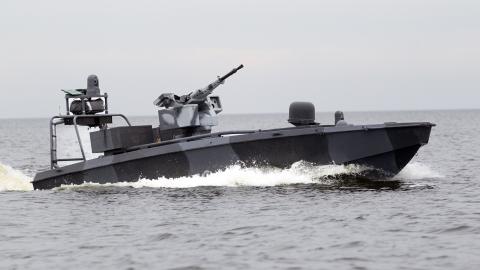
In what the Ukrainian Navy described as the first known combat engagement between two unmanned surface vessels (USVs), a Ukrainian Sargan-3000 intercepted and destroyed a Russian attack USV in the Black Sea. Operating on targeting intelligence supplied by Ukraine’s Main Intelligence Directorate, the Sargan engaged the Russian craft from roughly 1,000 yards with a 12.7 mm machine gun mounted on a remote weapon station. Published footage indicates that the drone’s operator initially concentrated fire on the Russian vessel’s communications antennas, apparently seeking to sever the craft’s command link. The Ukrainian operator then closed the distance and destroyed the vessel at short range.
Open-source intelligence has identified the Russian target as an improved Orcan, a compact and agile waterjet-powered attack USV broadly comparable in concept to Ukraine’s early Magura designs. Russian forces have increasingly employed such systems against Ukrainian ports and naval targets, often in coordination with Geran-type UAVs that can provide surveillance and serve as airborne communications relays. According to open-source assessments, Russia has established dedicated infrastructure in northwestern Crimea to support its use of USVs, including protected launch positions around Chornomorske and Lake Donuzlav.
The Sargan-3000, which the Ukrainian Navy adopted in April 2026, boasts a reported operational range of up to 860 nautical miles. It can operate at 40 to 55 knots and carries a payload capacity of up to 990 pounds. The platform demonstrated its offensive capacity in July, when Ukrainian naval personnel used a Sargan-3000 to sink Russia’s Project 22460 Izumrud patrol vessel near Novorossiysk. This latest engagement suggests that Ukraine is evolving from employing naval drones primarily as one-way strike weapons to using them as reusable combat systems capable of hunting and destroying other unmanned platforms.
Ukraine’s tactical destruction of an expendable Russian USV is less important than the combat architecture the engagement demonstrates. Ukraine combined real-time intelligence, an armed unmanned interceptor, remote precision fire, and deliberate attacks against Russian communications systems to create a prototype unmanned maritime counter-USV capability. If Kyiv can replicate this effort at scale, systems such as the Sargan could signal a shift toward distributed unmanned hunter-killer platforms in naval warfare around the world.
3. What to Monitor in the Coming Weeks
According to open-source reporting, Russian drone operations in August 2026 shifted toward sustained day-and-night attacks and greater use of jet-powered systems. An estimated 57–62 percent of the Shahed/Geran drones that Russia used during August were jet-powered, up from roughly 10 percent in June. Their higher speed compress Ukraine’s engagement windows and force Kyiv to rely more heavily on faster, more expensive air-defense assets. September’s data will show whether this shift in Russian drone operations is becoming a sustained pattern. Subscribe to Hudson’s Re: Ukraine Newsletter Here