



















Executive Summary
—Battlefield assessment. Kyiv sustained pressure on Moscow’s war-support infrastructure, striking refineries, air-defense systems, radar sites, and drone-production facilities, while Russian ground forces maintained a high-intensity operational tempo across multiple eastern sectors.
— Ukrainian interceptor drones. The counter-Shahed contest is entering a new phase, as Russian jet-powered Geran variants push Ukraine to produce faster, lower-cost interceptor drones and more integrated counter-drone systems.
— Russian drone production. Russia is expanding and hardening the subterranean infrastructure at its drone-production facility in Alabuga, as the Kremlin seeks to make drone-manufacturing more resilient against Ukrainian strikes.
1. Battlefield Assessment
Last week Ukraine continued to target the infrastructure that supports Russia’s military. According to the Ukrainian General Staff, on the night of September 19–20, Kyiv struck the Moscow Oil Refinery in Kapotnya, causing a major fire. The conflagration damaged several critical refinery components, including an AVT-6 crude-distillation unit, an integrated oil-processing unit, and an isomerization plant.
These facilities are key components of Russia’s war machine. The refinery’s AVT-6 distillation unit can process roughly 53 percent of its total crude throughput. The refinery can process as much as 12 million tons of oil annually and, according to the Ukrainian General Staff, supplies fuel to the Russian military.
Ukrainian forces also hit targets in occupied Ukraine. Kyiv reportedly struck a Buk-M3 air-defense system near Ukrainka in Zaporizhzhia Oblast, a Nebo-U radar near Balka in Donetsk Oblast, and a Russian drone-production facility near Siverskodonetsk in Luhansk Oblast. These attacks targeted Russia’s fuel infrastructure, air-defense assets, and drone-production capacity.
Meanwhile, legislative elections held in Russia from September 18–20 to elect all 450 seats of the State Duma marked an important political threshold. The electoral calendar no longer gives the Kremlin reason to delay potentially disruptive force-generation measures. It is possible, therefore, that Moscow may order a partial mobilization that could further shift the force-on-force balance against Ukraine.
Finally, Russia and Ukraine continued to contest the battlespace at a high operational tempo. Pokrovsk, Huliaipole, Kostiantynivka, Sloviansk, the Kramatorsk axis, and Ukraine’s eastern fortress belt defenses all saw heavy combat. Despite mounting casualties and limited territorial gains, Russian forces maintained an offensive posture on the ground.
2. Ukraine Introduces High-Speed Interceptors into the Counter-Shahed Battle
Static platforms once dominated drone warfare, but Russia and Ukraine now engage in a rapid cycle of offensive adaptation and defensive counteradaptation. Russia has expanded its use of faster, jet-powered Shahed derivatives. Ukraine is responding by accelerating the development of its own low-cost interceptor drones.
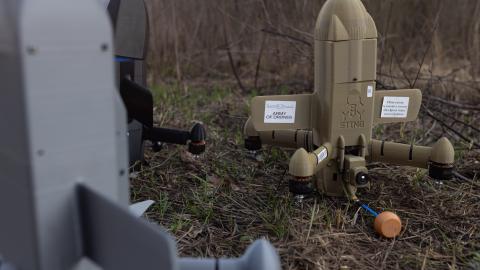
On September 19, Ukrainian President Volodymyr Zelenskyy announced that the Security Service of Ukraine had successfully employed a new interceptor against Russia’s jet-powered Shahed/Geran-type drones, releasing footage of the system in action. On the same day, additional footage emerged depicting Ukrainian forces using jet-powered unmanned aerial vehicles (UAVs) to intercept Russian jet-powered Geran-5 attack drones. Officials documented three separate Russian Geran-5 platform interceptions on September 19. They attributed two to unidentified jet-powered interceptors, and a third to Ukraine’s new STING S interceptor, a drone-hunting drone developed by the country’s Wild Hornets group.
These interceptions are notable. The Geran-5 is harder to target than earlier variants because of its higher speed and larger explosive payload. These features require faster interceptors that can close on the target before the attacking drone reaches its destination.
The Ukrainian Air Force has often dispatched manned combat aircraft, including the F-16, to intercept jet-powered Gerans. The appearance of the STING S interceptor alongside other unnamed jet-powered drone-hunting drones suggests that Ukraine is beginning to field multiple purpose-built high-speed counter-UAV systems. Kyiv is adapting in real time, as Russia’s expanded use of jet-powered one-way attack drones forces Ukrainian air defenses to respond with faster, cheaper, and more widely distributed interceptor platforms.
The Ukrainian manufacturer Vluchnyk is one company driving these innovations. The firm has completed internal testing of the Zorelit v5, or Starship, an interceptor designed specifically for high-speed reconnaissance and attack UAVs. The company says the system is ready for military use. Following codification, the Zorelit v5 is expected to become available through Ukraine’s ePoints procurement mechanism, which rewards military units for the confirmed destruction of Russian personnel and equipment.
The Zorelit v5 reportedly reaches 260 miles per hour and has a maximum range of approximately 29 miles. At a cruising speed of roughly 124 miles per hour, the system can carry a warhead and remain airborne for approximately 17 minutes. Its intended targets range from Russian reconnaissance UAVs and Gerbera decoys to Geran-2 attack drones and the faster, jet-powered Geran-3 and Geran-4 variants.
The interceptor can incorporate artificial intelligence–enabled target detection and tracking, including automated terminal guidance during the final phase of an engagement. The system can also integrate with SkyMap, which fuses air-target data from multiple detection layers, including radar and acoustic sensors, into a common picture that operators can access on a tablet.
Where less advanced systems would require individual interceptor teams to locate targets independently, SkyMap can provide operators with updated target tracks and cue them toward the relevant engagement area. This level of sensor fusion can help coordinate mobile fire groups, interceptor-drone crews, and other short-range air-defense elements against large, geographically dispersed UAV raids. In effect, Ukraine’s combination of inexpensive interceptors, distributed sensors, and digital command-and-control capabilities is turning the country’s counter-drone network into an increasingly integrated sensor-to-shooter architecture.
The Zorelit v5 builds on the already-produced Zorelit v4. Vluchnyk representatives say this earlier model has already entered combat service and has even received a North Atlantic Treaty Organization stock number, a unique numeric code used by NATO and allied countries to identify standardized supply items. The newer v5 incorporates combat-proven design features from the v4 system.
At a listed price of roughly $2,000 per interceptor, the v5 system illustrates a central feature of Ukraine’s emerging air-defense model. Against numerous and increasingly capable Russian one-way attack drones, Ukraine is attempting to match mass with a defensive architecture that is both scalable and economically sustainable. This exchange ratio matters as much as, if not more than, the v5 interceptor’s performance.
3. What to Monitor in the Coming Weeks
The Kremlin is reportedly expanding the underground production infrastructure at its drone-manufacturing facility at Alabuga in the Russian Republic of Tatarstan. Officials have built roughly 10 acres of underground space, providing Moscow with additional capacity for future production. Russia appears to have accelerated its construction effort following the first Ukrainian strikes against the facility and is increasingly dispersing its production of Geran drones and hardening supporting infrastructure. This suggests that Moscow is working to reduce the vulnerability of its manufacturing network to Ukrainian long-range strikes. This report will continue to track the open-source intelligence reporting on the Alabuga facility’s expanding subterranean footprint.
in August 2026 shifted toward sustained day-and-night attacks and greater use of jet-powered systems. An estimated 57–62 percent of the Shahed/Geran drones that Russia used during August were jet-powered, up from roughly 10 percent in June. Their higher speed compress Ukraine’s engagement windows and force Kyiv to rely more heavily on faster, more expensive air-defense assets. September’s data will show whether this shift in Russian drone operations is becoming a sustained pattern. Subscribe to Hudson’s Re: Ukraine Newsletter Here