
















The United States is eight months into its war against Iran, and the only certain result is that the US military is less ready to confront China.
According to a Reuters report, US forces have expended between one-third and one-half of the sophisticated strike missiles they would use against Chinese forces; other reports say they have expended nearly all of the high-end air defence weapons they would need to counter Beijing’s world-leading rocket arsenal.
Vulnerable on the surface and unable to strike from the air, the US military will depend even more on its submarine force to defend America’s allies and interests abroad. The question for supporters of AUKUS agreement is whether the US government will be willing to part with three or more submarines after they become one of Washington’s few remaining tools for conventional deterrence?
If the US Department of Defence continues to recapitalise and modernise using its traditional systems, the AUKUS submarine sale would be in doubt.
The US defence industry will reportedly take at least three years to refill magazines with the munitions expended against Iran.
Expanding US stocks to weather a war against China will take several more. In the early 2030s, when Australia would receive its first submarines, the US military’s munition inventory is likely to be back to pre-Iran levels but short of what it needs to fight an air and surface war against China.
The US Navy’s fleet is in even worse shape. The war extended deployments for half the carrier fleet and a third of the destroyer force, creating a maintenance debt the Navy will need years to work off.
US submarine readiness is so low that the Navy chose to retire the USS Boise a decade early so its shipyards could focus on newer subs. This comes as the US submarine fleet reaches its smallest size in nearly 100 years due to slow construction and the retirements of Reagan-era Los Angeles-class boats.
The shift that could save AUKUS
These trends would not seem to bode well for AUKUS. But the Pentagon is also pursuing an alternative path to rebuilding its arsenal. With more than $US150bn ($212bn) in additional defence procurement, the Department of War is rebalancing US forces away from manned, multimission ships and aircraft, and towards large numbers of unmanned systems on, over and below the water.
The new direction and additional funding would help AUKUS in two ways. By reducing its dependence on traditional platforms, the US military would be more willing to part with nuclear-powered submarines under AUKUS Pillar 1. And by injecting billions of dollars into autonomous systems, hypersonic weapons and other new technologies, the Pentagon can revitalise AUKUS Pillar 2.
The defence industry is responding to the US military’s belated interest in unconventional solutions. Defence start-ups including Castelion and Destinus are applying commercial technology and production methods to build air defence and hypersonic strike missile quickly and at scale that would fill launchers left empty by the war in Iran.
Facing new competitive pressure, established defence firms like Lockheed Martin and MBDA that build the now-depleted weapons are also pursuing their own low-cost alternatives.
Although not as exquisite as the Pentagon’s preferred weapons, this new generation of munitions is good enough to counter nearly all the threats US forces face. If the Defence Department expands its reliance on these capabilities, it could have the capacity by the early 2030s to push back on Chinese aggression.
The Navy is also using new technology to address its readiness crisis and submarine shortage. For most militaries, the shift to autonomous systems is a necessity. Some, like Ukraine, lack a traditional fleet. Others, like the Royal Navy, are short of funding needed to build, operate and maintain a larger force. And nations with an ageing population such as Japan need to head off future personnel shortfalls.
Until recently, the US Navy has enjoyed growing budgets and improved recruiting and retention.
Like China’s People’s Liberation Army Navy, it has been slow to embrace autonomous systems as an alternative to manned ships and aircraft. Instead, it has used them as adjuncts to traditional naval forces.
But depleted magazines and a fleet stretched to breaking point are changing the attitudes of US Navy leaders towards autonomous systems. The US Navy’s new force design relies on tailored forces comprised mostly of unmanned systems to tackle commanders’ most challenging operational problems. It is already fielding versions of these tailored forces, such as the unmanned systems and divers clearing mines in the Strait of Hormuz or the “Hellscape” of drones intended to protect Taiwan from Chinese invasion.
Like their counterparts in the weapons sector, start-ups such as Saronic, Anduril and BlackSea are fielding a wide array of surface and undersea drones to support the Navy’s current and future tailored forces.
These unmanned vehicles can conduct some traditional submarine missions, like searching for enemy submarines, attacking ships in narrow chokepoints and conducting clandestine surveillance along adversary coasts. Ukrainian troops pioneered the use of maritime drones for sea denial and US drones have attacked Iranian forces around the Persian Gulf.
The Navy could use tailored forces of these rapidly maturing systems to fill gaps across its shrinking fleet. For example, groups of unmanned surface vehicles and undersea sensors could monitor the Greenland-Iceland-UK gap and reduce the level of submarine presence needed in the high north. The Royal Navy is already pursuing this approach under its Atlantic Bastion concept.
Surface and airborne drones are helping enforce the blockade against Iran and defend shipping around the Strait of Hormuz.
The US Navy could expand the use of these vehicles, including new medium unmanned surface vessels, to reduce the number of destroyers it needs to maintain in its Middle East armada. It recently purchased 30 of these 30 metre-long autonomous ships, which could carry counter-drone and other defensive systems to protect ships transiting through hazardous chokepoints.
No turning back
The question for AUKUS is whether the US military’s shift to alternative approaches will continue. The Trump administration’s initial plan to address the Navy’s shortfalls has been to build more ships, as evidenced by its requests for more than $100bn ($143bn) in Navy ship construction funding during the past two years. If the government sustained these funding levels, the Navy could try to grow its manned fleet and continue treating autonomous systems and low-cost weapons as gap-fillers.
But shipbuilding budgets do not govern the US Navy’s size or shape. The US fleet shrank during the last decade despite large and growing ship construction spending across Biden and Trump administrations because the cost to crew, maintain, and operate the fleet became unsustainable. During the past 40 years, the Navy dropped from nearly 600 to less than 300 combat ships, yet it costs about the same to support in inflation-adjusted terms because people, repairs and fuel are all more expensive.
Autonomous systems do not eliminate personnel and maintenance costs, but they reduce how these expenses scale. An unmanned system crew can train on simulators, manage multiple vehicles during operations and place vehicles in storage when they are not needed. In contrast, militaries need to use scarce manned ships and aircraft for current operations and keep them active between deployments to qualify operations and maintain their proficiency.
US defence budgets are likely to flatten or fall starting in 2027 when the US congress shifts all or in part to Democratic Party control. Moreover, US government deficits and debt are rising to potentially unsustainable levels given recent increases in US interest rates.
The US military, especially the Navy, will need to adopt more autonomous systems, hypersonic and lower-cost munitions and other emerging technologies to address improving threats within tight fiscal constraints. Both of AUKUS’s pillars will look better in the more austere environment of the early 2030s. In addition to contributions from Pillar 2’s unmanned system and weapons technologies, the multibillion-dollar sale of US nuclear submarines will bring much-needed funding into the Navy and the US shipbuilding base after the sugar high of today’s Trump-era defence budgets wears off.
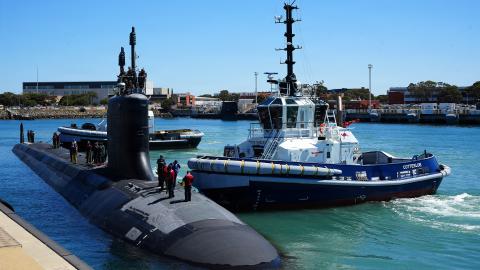
US defence and congressional leaders will still need to approve the sale, but AUKUS’s most cost-effective element will soften the impact. Starting in 2027, the Submarine Rotational Force-West will operate one to five US and UK submarines out of HMAS Stirling on a near-continuous basis. The SRF-West will stretch the presence, reach, and readiness of a smaller US submarine fleet as well as provide Australia additional undersea forces to defend its shipping lanes and northern approaches.
The road ahead for AUKUS is not easy. Even with the large injection of US funding, all three militaries will need to create new ways of integrating and fielding forces comprised mainly of unmanned systems, embrace the different performance associated with new families of scalable munitions, and accept smaller manned fleets to control costs. But AUKUS offers solutions for some of the fundamental challenges facing allied militaries in the 2030s and national leaders cannot afford to go it alone.