





It’s a pretty good time to be on the Latin American right. Before Flavio Bolsonaro’s defeat last Sunday, right-of-center candidates had won all seven presidential elections held in the region since 2025.
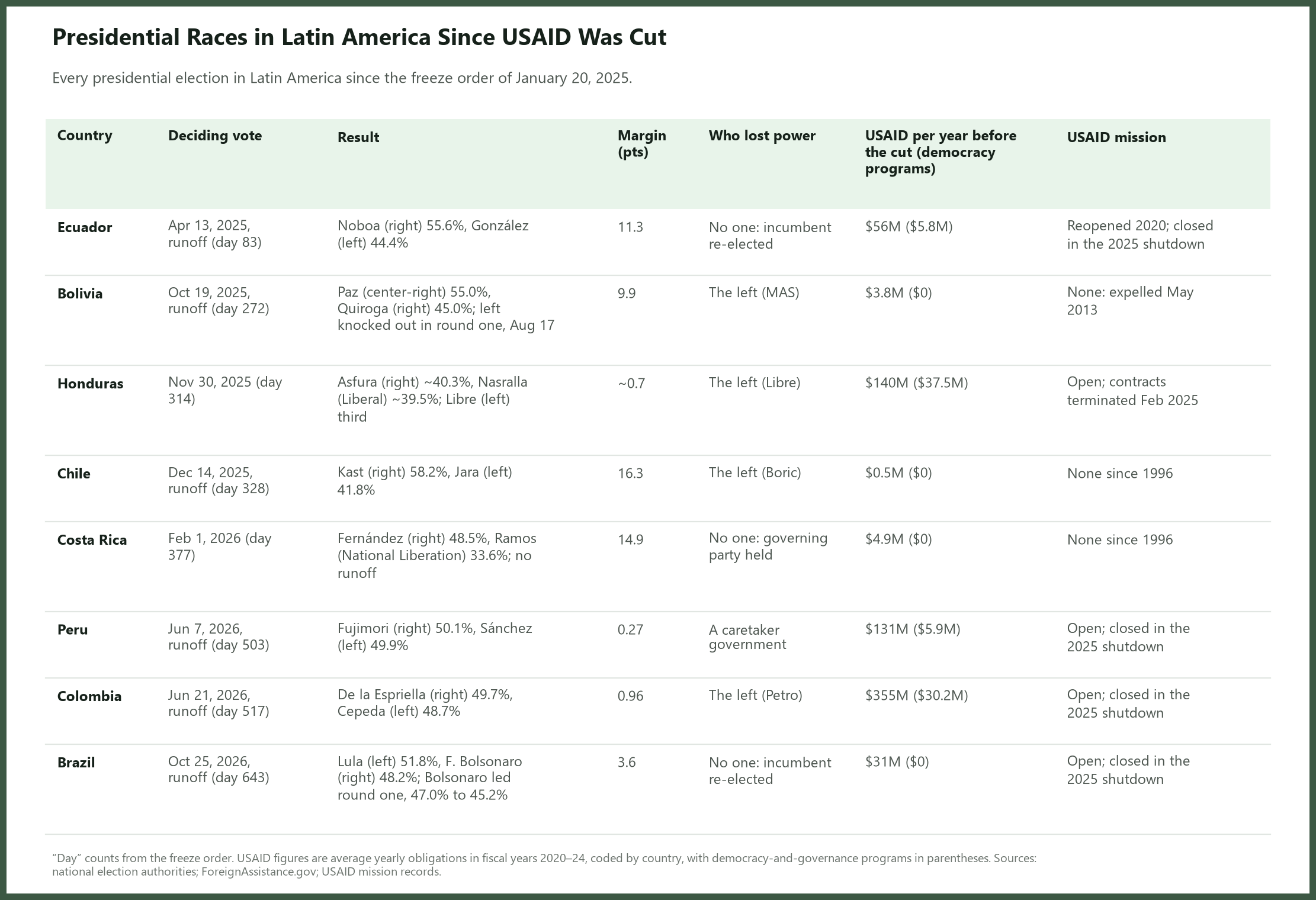
Buoyed by their seemingly sudden reversal of fortunes, many on the right began to speculate on why their candidates were winning now after being largely shut out of government during the second “Pink Tide” of the early 2020s.
A popular theory is that these regional wins can be directly traced to the Trump administration’s decision to defund USAID. This theory gained virality when the prominent X account End Wokeness floated it in June shortly after Abelardo de la Espriella’s victory in the Colombian presidential election.
Since then, a number of mainstream Republican figures, including some whose policies towards the region I usually align with, have endorsed or echoed the USAID theory. A number of friends and colleagues have also privately asked me whether the theory holds any weight, so even though the theory has lost considerable steam following Flavio’s defeat, I set out to attempt a serious study of whether there could actually be something to it.
To put my cards on the table, I am a conservative. In the seven elections mentioned above, my reaction to the outcome ranged from relief to enthusiasm. While I am dispositionally more open to USAID than many on the right are these days, it also seems undeniable to me that the American taxpayer has underwritten wasteful initiatives in the region. Despite these biases, I did my best to keep an open mind as I carried out my research. Here’s how I went about it and what I found.
Operating Assumptions
Having a basic understanding of how USAID works and how it has changed is necessary for understanding whether this theory could have merit. USAID was America’s primary agency for foreign aid until the Trump administration froze its spending on January 20, 2025, canceled 83% of its programs on March 10, and transferred its remaining operations to the State Department on July 1.
USAID usually carried out its mandate by “obligating” money to implementers, who were typically American contractors, American nonprofits, or UN agencies. These implementers would then use the money on their programs, and sometimes they would pass the funds down to local groups.
This money leaves a paper trail, which you can check and validate yourself by looking up awards on USAspending.gov and ForeignAssistance.gov, the federal government’s public spending databases.
The USAID theory itself relies on a simple, inferred cause-and-effect mechanism. The Trump administration effectively ended USAID in March 2025, the Latin American conservative winning streak began in April 2025 and continued unabated until recently, so ergo USAID must have been undermining conservative candidates or helping leftist ones in the region somehow.
While some writers have offered a more detailed elaboration of the theory (more on that later), its proponents have generally been vague about exactly how it works. This in turn required me to make subjective decisions about how to measure it.
It seemed to me that USAID theory advocates could reasonably interpret any measurement as support of their theory regardless of the outcome. For example, if a country receiving USAID funding swung more to the right than expected in the first election after the cuts, they could argue it was because USAID was propping up the left in that country all along, while if it swung less to the right, they could argue that it was due to the stronger residual nature of the left in that country after USAID funding.
The fairest test for the USAID theory should be whether countries receiving higher shares of USAID swung more to the right after funding was cut. Since the theory operates on a straightforward causal chain of USAID cut → conservatives start to win, and since its proponents begin their streak of claimed victories in April 2025, it seems to me that if the theory is true in the way its proponents believe, more USAID funding should equal more support for the left, and taking more of it away should lead to a more noticeable collapse in support of the left.
With this in mind, I set out to determine three things:
- Who received USAID funds in the countries with relevant elections.
- Whether the left saw a more significant electoral downturn in countries where more USAID money got cut off.
- Which races were close enough that a modest effect could have changed the electoral outcome.
Who was USAID paying?
Of the eight countries that have voted for president since the USAID freeze, five still hosted USAID missions: Colombia, Honduras, Peru, Ecuador, and Brazil. The other three hadn’t hosted a USAID mission in years: Bolivia expelled USAID in 2013, and the agency closed its missions in Chile and Costa Rica in 1996. USAID obligated $2.9 billion to these five countries in fiscal years 2020 to 2024, which can be traced award by award on USAspending.gov.
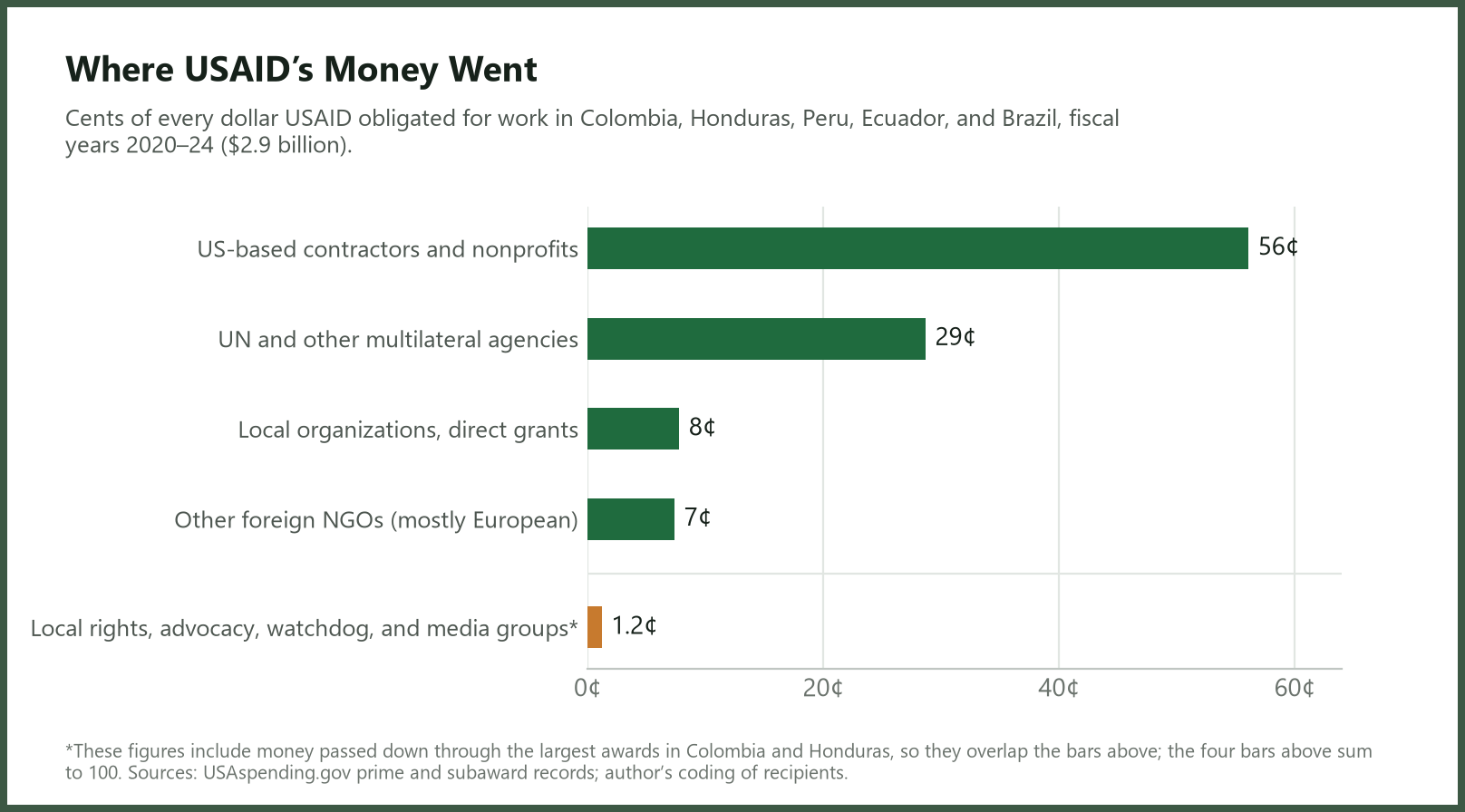
About fifty-six cents of every dollar went to American contractors and nonprofits. Twenty-nine cents went to the UN and other multilateral agencies, much of it to Venezuelan migrants via the World Food Programme. About eight cents went directly to local organizations, and seven went to mostly European NGOs.
The categories most likely to touch on election interference, like rights, advocacy, watchdog, and media groups, received about a penny on the dollar, even if we count money that was passed down from the largest awards in Colombia and Honduras.
Of course, the small portion of funding that went to “democracy” groups does not necessarily preclude them from having carried out electoral influence for the left. But it would also be a mistake to assume that all of this funding inherently benefited the left. In Colombia, USAID’s largest media subrecipient was Semana, whose editor Vicky Dávila became a fierce critic of the leftist president Gustavo Petro and later supported De la Espriella in the runoff after running for president on a right-of-center platform herself and losing the right’s March primary.
In Brazil, USAID records don’t show any Brazil-specific spending on democracy, elections, or media from 2015 to 2025. Spending also peaked under Jair Bolsonaro, and much of it operated alongside his government in the form of projects like an Amazon fund that was announced with his foreign minister and ventilators that were distributed by his health ministry. A 2013 USAID-funded study by two American democracy groups, paid for through a worldwide elections grant rather than Brazil’s own budget, even made Bolsonaro’s own case against Brazil’s voting machines by noting concerns over their lack of voter-verified paper trails.
In sum, the theory is off to a bad start. USAID was not a relevant factor in three of the eight countries that held elections since its freeze, and the left won in another one (Brazil), so the theory can explain at most four of the eight cases during the relevant time period.
Did ending USAID have any measurable electoral effects?
Even if most USAID spending could not have directly benefited the regional left, some proponents of the theory, such as Alexander Muse, have argued that it nevertheless played a role in sustaining leftist political infrastructure since the causes it funded, like climate, gender, migration, indigenous rights, and the policing of “misinformation,” “sit comfortably inside progressive coalitions.”
This struck me as plausible and also validated my decision of how to test the theory. If Muse is correct, then the left’s vote share should have dropped harder in countries where the most USAID money stopped. But if anything, the opposite seems to be true:
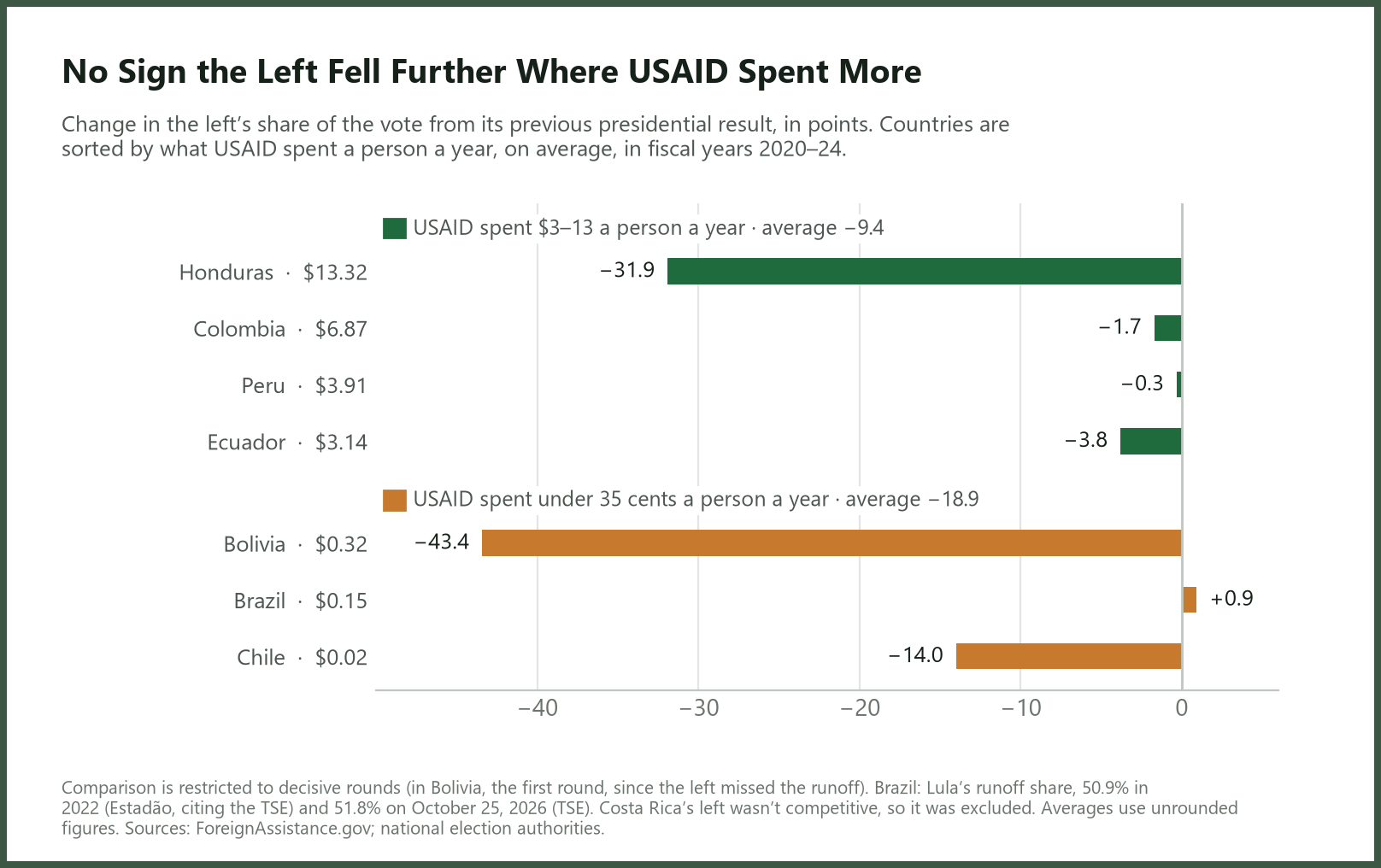
In countries where USAID spent $3 to $13 a person each year (Honduras, Colombia, Peru, and Ecuador), the left’s vote share fell by an average of nine points compared to its previous presidential result (most of that was Honduras, where the left’s 2021 coalition broke up; without it, the average drop is about two points). In countries where it spent under 35 cents (Bolivia, Brazil, Chile), the left’s share fell by an average of 19 points.
Bolivia, which expelled USAID in 2013, saw the left’s share fall by the greatest margin of any country. Colombia and Ecuador lost the most US aid per person of any of these countries once every agency is counted, and the vote shares of their leftist candidates declined by only 1.7 and 3.8 points.
Could USAID have made a difference in close elections?
It seems increasingly clear to me that USAID did not have a detectable aggregate effect in favor of the left in the region. However, it still seemed possible that it could have had an effect in specific races, and given that the margins in some recent elections have been razor thin, this could have been enough to change the result.
Two of the eight relevant races were highly competitive between the left and the right. In Peru, the right won by only 0.27 points, and in Colombia they won by 0.96. (The right won by 11 or more points in every other election that it won, lost in Brazil by almost 4 points, or otherwise faced a non-leftist opponent as in Honduras and Bolivia.) The theory’s strongest case thus rests on these two countries.
Here again, the evidence doesn’t support the USAID theory. In Colombia, I took the roughly one-fifth of USAID funding that can be pinned to a department, measured it per voter, compared it against the change in the left’s vote share, and found virtually no correlation. If USAID funding was actually having a local effect, we would expect to see something more compelling.
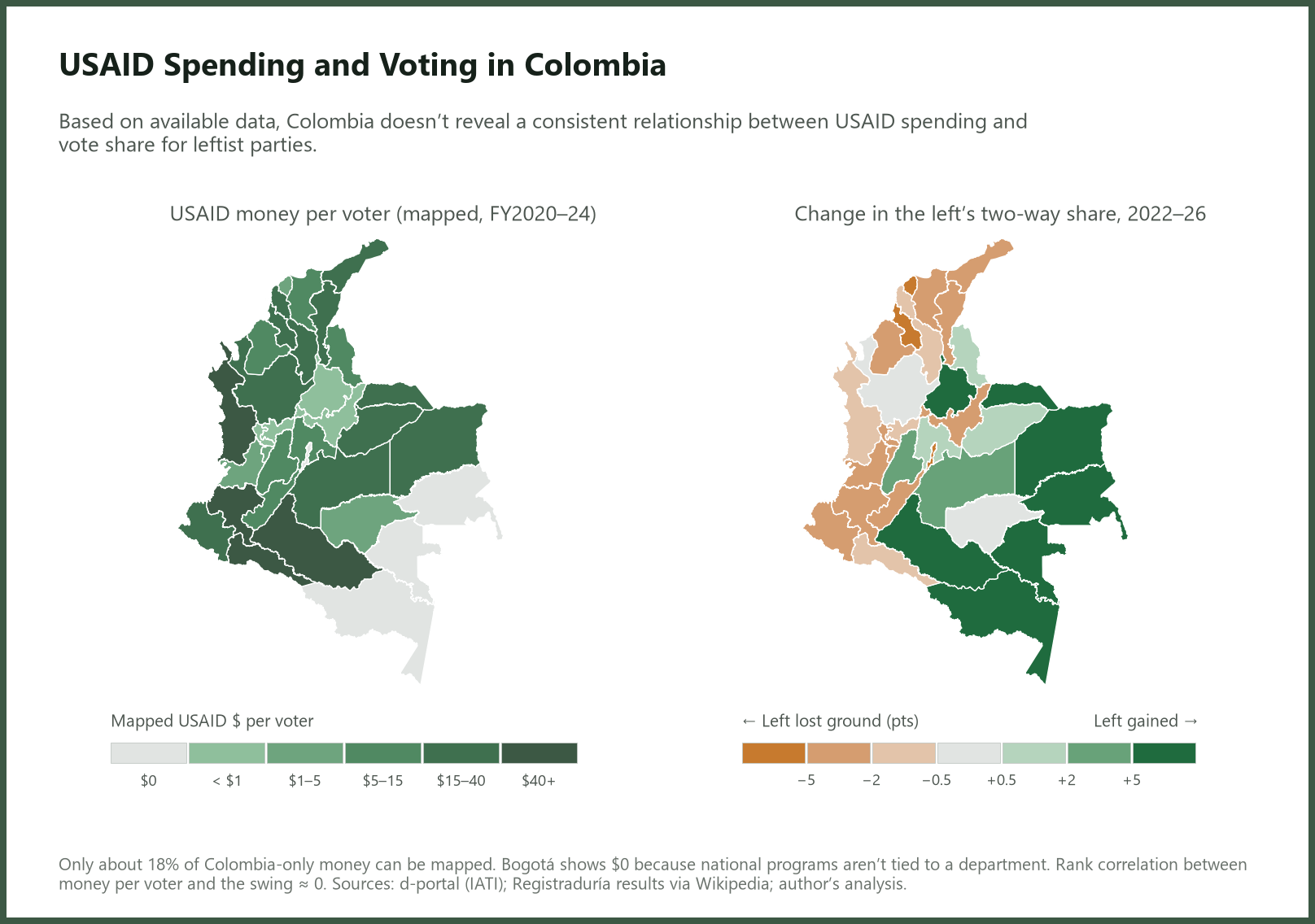
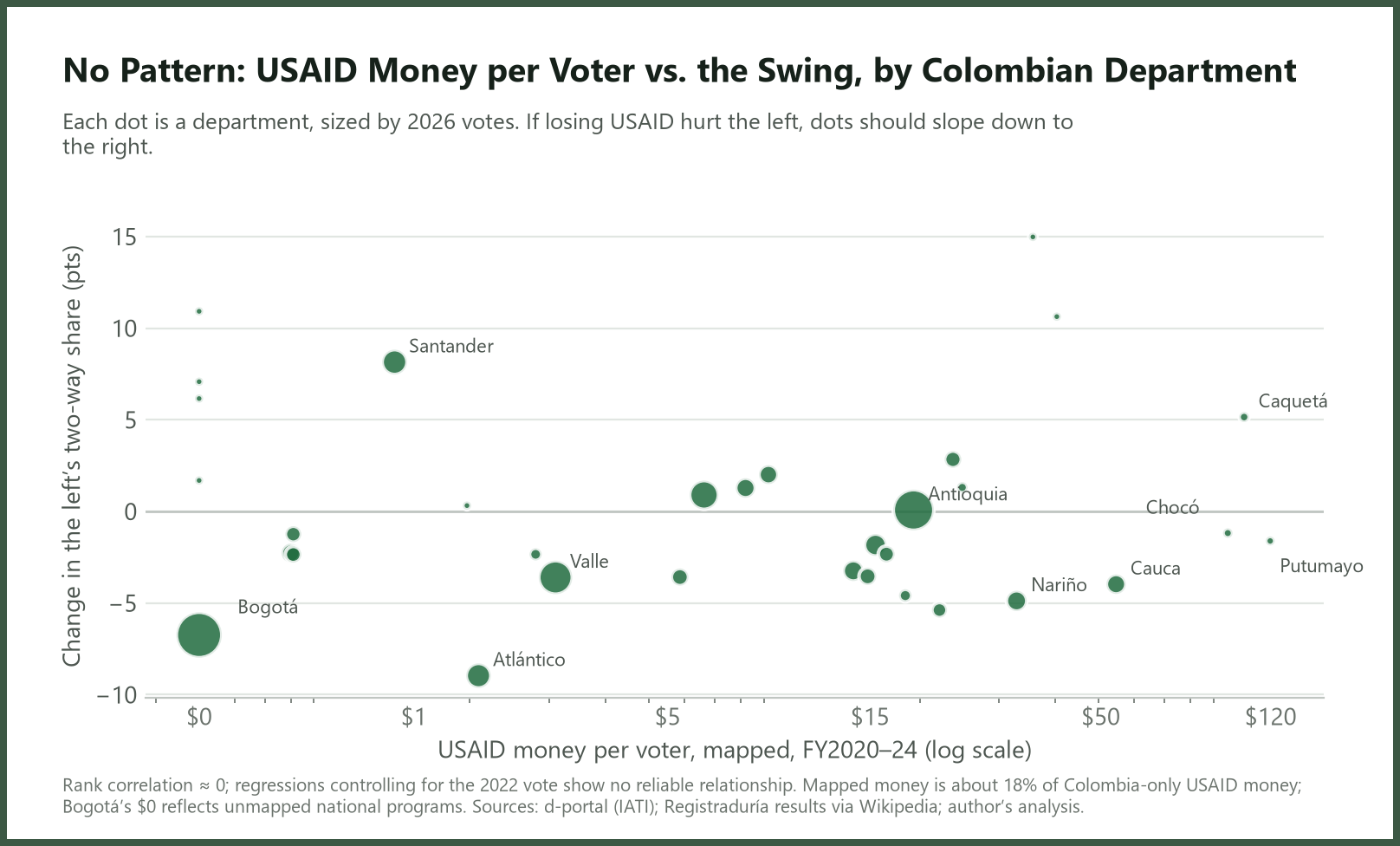
If USAID actually had been propping up the left, its vote share should have fallen harder in places where more of the money was cut.
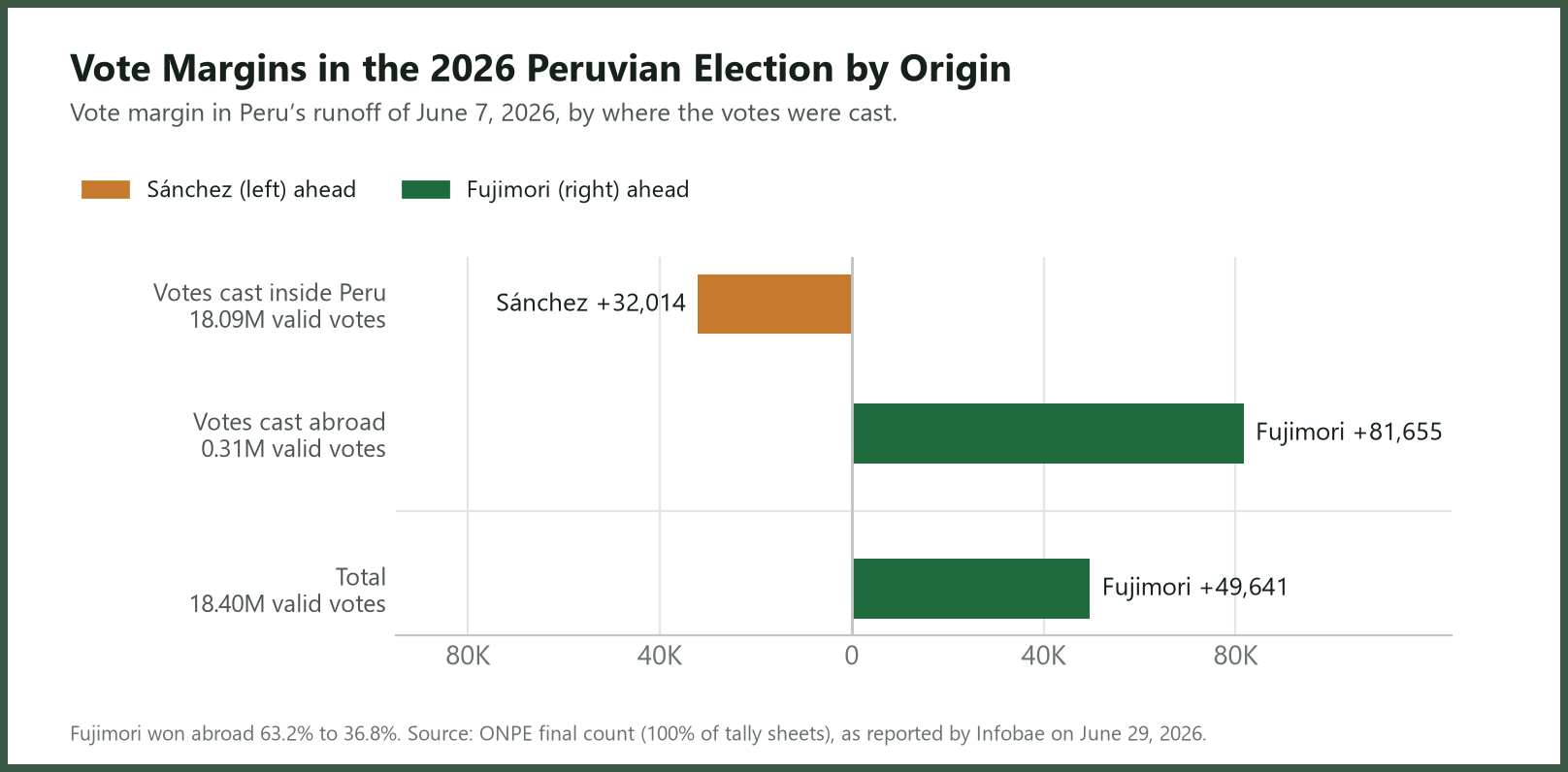
In Peru, Keiko Fujimori actually lost the domestic vote but won thanks to votes cast by Peruvians living abroad. In other words, the population supposedly being held back or influenced by USAID narrowly voted against the right-wing candidate in USAID’s absence, while the population most removed from the loss of USAID voted heavily for Fujimori. It’s theoretically possible that the left’s margin inside Peru could have been even higher if the USAID theory is correct, but there’s no reason to believe that this is the case.
While it remains impossible to determine with absolute certainty whether USAID had any effect on these elections at all (including a possible positive effect for the right given the case of Semana outlined above), it seems to me that if USAID had a significant effect, it would likely have been detectable, and it simply isn’t.
What else could explain the right’s newfound success?
If USAID did not directly fund the Latin American left or indirectly sustain its infrastructure, are there other ways it could have tilted elections to the left? Muse proposes an additional possibility. According to him, while left-wing and establishment governments “had failed on the things people live with every day,” he argues USAID projects dedicated to areas like relief and dialogue “absorbed that anger before it reached the ballot box.”
This argument strikes me as weak. It asks us to accept the questionable premise that USAID-funded projects were effective enough to defuse voter anger over a lack of progress on various issues, but not effective enough to materially address those issues themselves. This gives USAID just enough credit to blame it for electoral outcomes but not enough to concede that some of its projects worked as intended, and therefore may have been worth continuing.
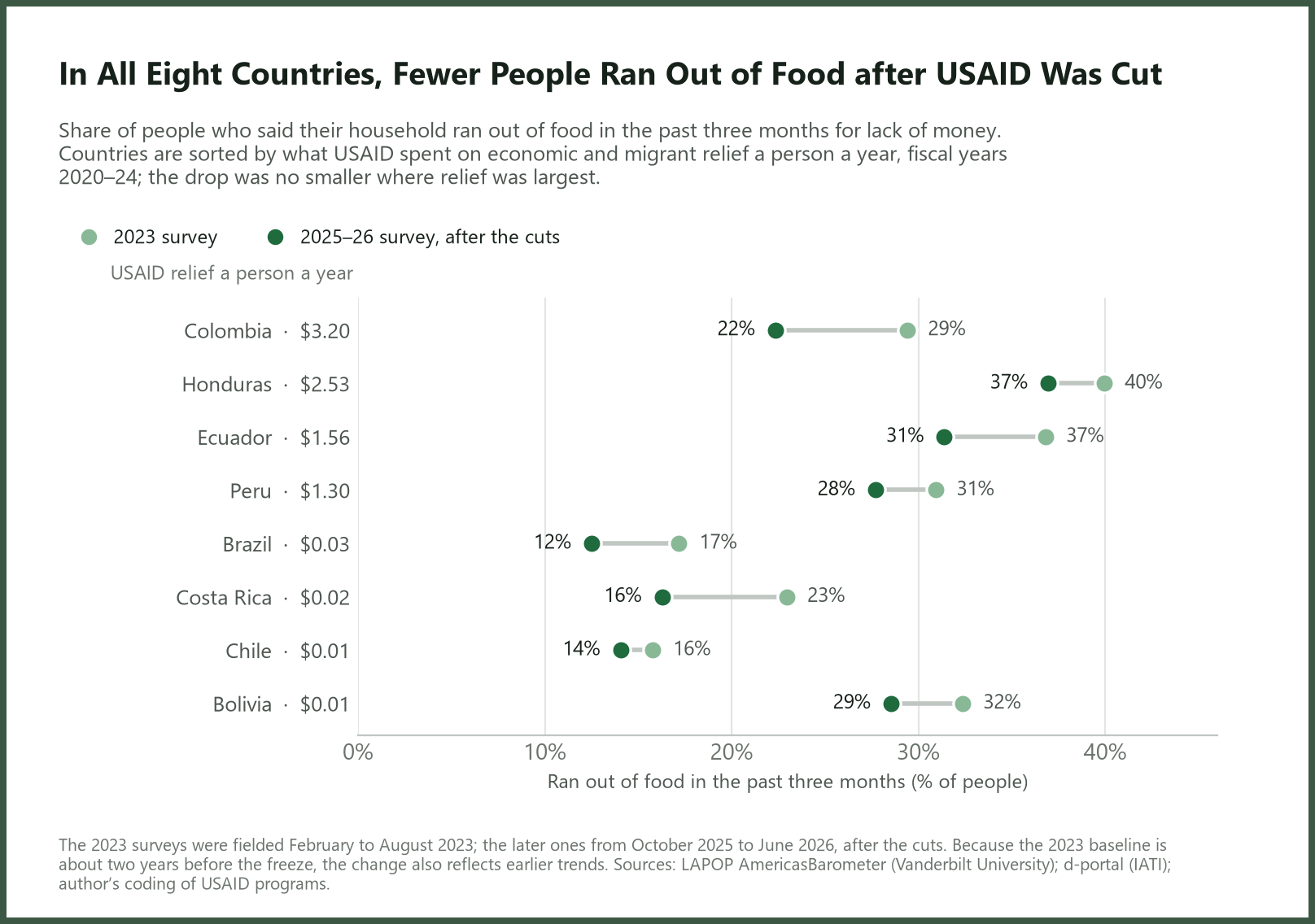
The empirical evidence also cuts against this argument. As just one example, in all eight countries that held presidential elections in 2025—2026, fewer people reported running out of food after the USAID cuts than they did in 2023. USAID does not seem to have been keeping Latin American voters fat, happy, and duped.
Finally, the USAID theory might still be interesting if there were not a plethora of stronger explanations for the right’s string of victories in Latin America. Of these, the most consistent one is simply that Latin American voters have a tendency to fire whoever is in charge.
From 2018 to 2022, incumbent parties lost 16 of 18 presidential contests. At the time, most of the losers were on the right. But voters proved to be largely dissatisfied with their left-wing replacements as well, and voted them out during the next wave of elections, which coincided with the USAID freeze.
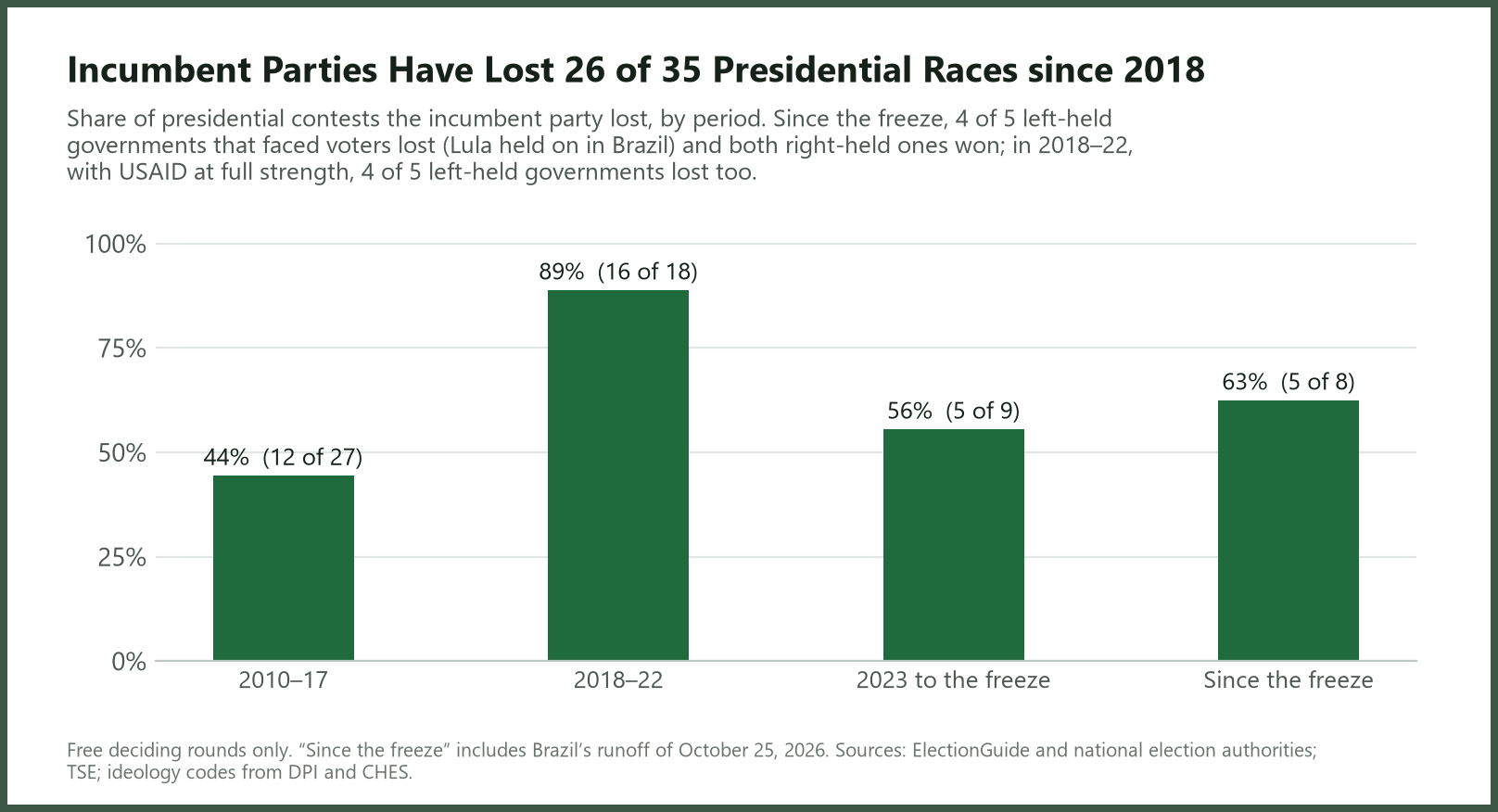
Anti-incumbent sentiment is not a perfect or universal explanation either. Some incumbents were sufficiently popular to hold onto power, while others have had the benefit of running against flawed opponents who were themselves tied to unpopular movements from the past.
What’s so bad about the USAID theory?
At this point, I suspect some of my friends on the right will admit that the evidence for the USAID theory is thin, but will be tempted to shrug it off as harmless fun that undermines a program they see as having inappropriately funded left-leaning causes for decades.
I found several dubious projects during my research, but I still think the USAID theory does more harm than good. First and foremost, it is clearly unsupported by any empirical evidence even under the most generous assumptions, and no one should be in the business of disseminating poorly reasoned ideas.
Second, it is underpinned by a tacit and inaccurate assumption that Washington is somehow omnipotent in Latin America and has the power to unilaterally decide political outcomes in the region. This skews how Americans think of the region, and leads to misconceptions at both the popular and elite levels that make our Latin America policy less astute.
Third, the theory echoes old anti-American talking points. Evo Morales expelled USAID in 2013, saying it acted “for political, not social, ends,” and Andrés Manuel López Obrador called its funding of an anti-corruption group “injerencia” (interference) and “golpismo” (coup-mongering). Claudia Sheinbaum, the leftist president of Mexico, has also criticized the role of USAID in investigating corruption in Mexico, and in 2025, Russia’s foreign ministry called USAID “a machine for interfering in internal affairs.” Russia’s Spanish-language propaganda outlet, RT en Español, has amplified the USAID theory as part of its broader project to portray the US as puppeteering politics in the region.
Finally, the USAID theory has drawn attention away from more detailed analyses of what fueled the recent string of victories on the right. If conservatives in Latin America and their supporters want to replicate these victories in the future, it would help to understand what actually led to them in the past.