









A new proposal circulating in Washington – the Silk Seven Plus (S7+) initiative – aims to reshape Central Asia by linking its five post-Soviet states with Afghanistan and Pakistan into an integrated economic region. Azerbaijan is also seen as a potential addition.
The idea, advanced by the New Lines Institute for Strategy and Policy, is straightforward: connect landlocked Central Asia to the Black Sea and Arabian Sea through new trade corridors.
On paper, the bloc looks compelling. The seven countries form a contiguous zone in the heart of Eurasia, potentially turning geography from a constraint to an advantage.
“Central Asia needs an organization built by Central Asian states and for Central Asian states,” said Justin Burke, a resident senior fellow at the New Lines Institute, at a recent event in Washington. “If Central Asia can speak with one voice rather than five different voices, that will make it a more reliable investment destination.”
There are signs of momentum. Kazakhstan’s President Kassym-Jomart Tokayev and Uzbekistan’s President Shavkat Mirziyoyev made back-to-back visits to Pakistan earlier this year, highlighting regional connectivity. Proponents argue that if Afghanistan stabilizes, the Silk Seven could become a formidable cluster.
But that is a big “if.” It also raises a deeper question: why construct a new, geographically convenient bloc when an existing organization – the Organization of Turkic States (OTS)—already offers something deeper: shared language, history, and identity?
While the Silk Seven spans broadly Muslim-majority countries, it is linguistically and culturally diverse. The grouping spans Turkic-speaking Central Asia, Persian-speaking Tajikistan, and Indo-Aryan Pakistan.
ASEAN offers a cautionary example. Despite decades of cooperation, its religious, linguistic, and geopolitical diversity – combined with consensus-based decision-making – has often prevented it from speaking with one voice, particularly on China. In The Clash of Civilizations, Samuel Huntington wrote that when ASEAN was created in 1967 by Indonesia, Malaysia, the Philippines, Singapore, and Thailand, it was an organization of “one Sinic, one Buddhist, one Christian, and two Muslim member states.” Such multicivilizational regional organizations have limits, he said.
The Silk Seven risks similar limitations.
The OTS, by contrast, rests on a narrower but deeper foundation: its core members—Azerbaijan, Kazakhstan, Kyrgyzstan, Turkey, and Uzbekistan—share closely related languages and overlapping historical experiences.
Tucked away in the eight-page document issued after the informal OTS summit earlier this month was a revealing signal of intent: clauses dedicated to cataloguing Turkic cultural heritage, promoting youth engagement through Khiva’s designation as the 2026 Youth Capital, and launching a “Turkic Heritage” digital platform. Together, they show that the OTS is actively building a shared cultural space.
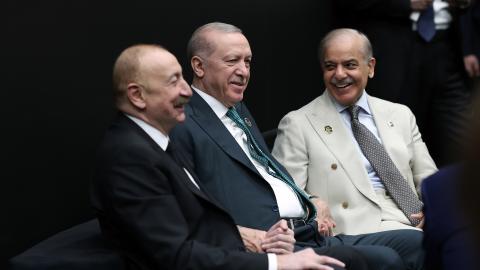
Yet even as members emphasize common heritage, differences remain over how far the organization should evolve politically. Kazakhstan’s President Kassym-Jomart Tokayev, the summit host, stressed in his remarks that “the Organization of Turkic States is neither a geopolitical project nor a military organization,” but rather “a unique platform” for cooperation across trade, technology, culture, and humanitarian ties.
Azerbaijan’s President Ilham Aliyev struck a more ambitious note, saying that “the Turkic world must grow into one of the influential geopolitical centers of the 21st century,” and pledging that Baku would spare no effort to strengthen the organization.
The question of OTS surfaced at a recent New Lines Institute seminar in Washington.
Asked why the OTS could not be sufficient, Kamran Bokhari of New Lines argued that it is shaped by Turkey’s leadership, reflects Ankara’s aspirations, and, as a Turkic-focused organization, would struggle to incorporate Afghanistan, Pakistan, or Iran. The Silk Seven, by contrast, is designed to define a “core Central Asia” while remaining flexible enough to expand.
Azeem Ibrahim warned that the global system is weakening, leaving smaller states more vulnerable. “The assumption that great powers will uphold open trade and security can no longer be taken for granted,” he said, arguing that regional cooperation is becoming essential for resilience.
Bokhari said the time is ripe for Central Asian countries to engage with the United States and that the U.S.-proposed Silk Seven could serve as a roadmap. “The Russian footprint is receding. The Chinese are taking up that space as much as they can,” but Central Asian nations do not want to move away from an overbearing Russia to be dominated by China. “Who do you reach out to? Well, you reach out to the United States,” Bokhari said.
These competing visions – one rooted in connectivity, the other in shared identity – highlight the central dilemma facing the region.
The appeal of the Silk Seven lies in geography and connectivity. But the strength of OTS lies in a shared civilizational identity. In an era of geopolitical fragmentation, Central Asia may find that infrastructure enables growth–but identity anchors political cohesion.
For centuries, Central Asia’s nomadic societies thrived not by choosing fixed alignments, but by remaining fluid—adapting to shifting trade routes, political currents, and external powers. Mobility and flexibility were not weaknesses, but survival strategies.
In that sense, the Silk Seven and the Organization of Turkic States need not be competing visions. Central Asia’s strength may lie precisely in its ability to straddle both—building multiple connections without being bound by any single framework.