








On March 25, 2026, Spanish and Moroccan authorities announced the arrest of a small Islamic State cell operating in both countries. Based between Tangiers in Morrocco and Mallorca in Spain, the three-person cell seems to have had a dual role, according to readouts from authorities in both countries. First, it provided logistical and financial support to two key Islamic State affiliates, the Islamic State’s Sahel Province (ISSP) and the Islamic State in Somalia (IS-S). In addition, the leader of the cell, whom authorities apprehended in Mallorca, was reportedly planning lone-actor-style attacks in Spain. The Spanish police believed the whole cell was part of a coordinated structure dedicated to financing, logistics, and operational planning.[1]
The existence of the Spanish-Moroccan cell with multiple roles fits a consistent pattern that has emerged in recent years. The Islamic State on the African continent is divided into multiple provincial affiliates overseen by a few overarching bureaucratic structures that advise and/or administer major affairs in designated zones.[2] It has apparently been using the Maghreb to support its wings in West and East Africa. This fits into a broader pattern in which provincial African affiliates support far-flung operations of the Islamic State via financing or logistics despite operating principally in rural areas,[3] and smaller cells on the continent (officially unconnected to the larger provincial insurgencies) likewise facilitate international plots.[4] As we argue in this article, the ISSP risks becoming a more important node in the global Islamic State architecture. It may even develop its own capacity for external operations as a result of its growing integration with a regional Islamic State office (al-Furqan), coordination with neighboring provinces, and repurposing of historical trans-Saharan militant and smuggling networks for global operations.[5]
The ISSP has evolved through multiple stages since 2016. Having now consolidated a degree of territory and manpower in the Sahel, the province may directly support the global ambitions of the organization. The Islamic State’s overall leadership, for its part, hasn’t been able to launch any major international operations since 2024, when the Islamic State Khorasan Province (ISKP), based in Afghanistan and Pakistan, facilitated and planned several attacks in the West.[6] The group’s leadership may therefore be looking for new provinces to serve as launchpads for external attacks. With this background in mind, observers should not downplay the arrests of cells in Spain and Morocco, even if they still lack more specific details about the nature of the plots those cells were involved in.
This article aims to assess ISSP’s historical trajectory up to the present day in light of an emerging pattern in other Islamic State affiliates in Africa and Asia. The pattern suggests the evolution ISSP is undergoing creates a risk of increasing transnationalization. Europe, in particular, will likely be at greater risk of violence directed, facilitated, or inspired by ISSP in the coming years. While ISSP’s present role in external operations remains uncertain, we argue that it would be risky to assume this group will remain a localized jihadist insurgency. In the following sections, we provide an overview of ISSP’s historical evolution and analyze the available evidence, incomplete as it may be, of the group’s growing external ambitions.
Origins, History, Background
ISSP’s beginnings can be traced to former al-Qaeda affiliated groups that operated in Algeria, Libya, and Mali in the early and mid-2010s, specifically the Movement for Oneness and Jihad in West Africa (MUJAO), which was connected to al-Qaeda in Islamic Maghreb (AQIM).[7] These groups were themselves descended from the remnants of groups that had fought in the Algerian civil war in the 1990s.
The founding leader of ISSP was Abu Adnan Walid al-Sahrawi. First a member of the secular Western Saharan rebel movement Polisario Front, al-Sahrawi joined MUJAO in the early 2010s and then joined al-Mourabitoune, a merger group consisting of MUJAO and another AQIM-linked jihadist group. In May 2015, as the Islamic State was at its height in the Middle East and was attracting defections from al-Qaeda–aligned jihadists the world over, al-Sahrawi pledged an oath of allegiance (bay’ah) to then-Caliph of the Islamic State Abu Bakr al-Baghdadi. The Islamic State accepted the pledge in October 2016, releasing the video of Sahrawi’s bay’ah as he stood among a small group of militants, signifying the Islamic State’s humble beginnings in the Sahel.[8]
ISSP’s lineage connects the present movement to longstanding trans-Saharan networks and relationships, particularly involving Arabs and Tuaregs in northern Mali and Niger. The group’s current operational zones coincide with old pastoral and smuggling networks, and al-Sahrawi reserved most of its leadership spots for Sahrawis and Arabs.[9] ISSP formed in 2015 as a splinter of these existing jihadist networks and subsequently began operating in parts of Gao and Menaka provinces in Mali. At this time, it was already operating in familiar terrain. The group knew many of the clan networks and smuggling structures that AQIM and MUJAO had long invested in, though it took several years of hard-fought gains to win over many of these recruiting and logistical networks from the more entrenched al-Qaeda affiliates.[10] The logistical infrastructure of the current ISSP threat therefore predates the organization by decades.
Initially known as the Islamic State in Greater Sahara (ISGS), the group quickly established itself in border areas of Mali, Niger, and Burkina Faso, the so-called Liptako-Gourma triangle. Its first major attempted operation was a failed prison break in Koutoukale outside the Nigerien capital of Niamey on October 17, 2016.[11] A year later, in October 2017, the group gained greater international notoriety after its fighters ambushed a patrol of U.S. and Nigerien special forces in Niger’s remote region of Tongo-Tongo, resulting in the death of four U.S. soldiers. The Islamic State’s media outlets heavily publicized that attack and published footage from a body camera worn by one of the deceased American soldiers.[12] The attack prompted the U.S. military to revise the posture of its troops in Niger to confine them to training and drone operation rather than patrols and combat operations.[13]
ISGS continued to grow in the late 2010s and eventually came into conflict with its al-Qaeda rivals in the Sahel, who had reorganized under the umbrella group JNIM in 2017. The Armed Conflict Location & Event Data Project (ACLED) noted a significant uptick of armed incidents involving ISGS, from a handful of incidents in 2017 to dozens in 2018 and 2019 to over 100 from 2020 onward. The latter correlated with the start of the group’s protracted conflict with JNIM.[14] Yet in the first few years of ISSP’s existence, the Sahel had witnessed an uneasy truce between al-Qaeda/JNIM-affiliated forces and the small Islamic State splinter, which researchers called “the Sahelian exception” to distinguish it from the broader global trend of conflict between al-Qaeda and Islamic State affiliates across Syria, Somalia, Yemen, and Afghanistan at the time.[15] This exception ended when ISGS became too strong for JNIM to ignore and forced JNIM to push back.[16]
The Islamic State subordinated ISGS in 2019 under the umbrella of the Islamic State West Africa Province (ISWAP), the powerful affiliate based in northeastern Nigeria, to facilitate its own expansion across West Africa. While ISGS maintained its autonomy, it benefited from resources and coordination with ISWAP under this organizational restructuring.[17]
As early as 2019, United Nations (UN) experts reported that ISWAP and ISGS may have coordinated in a joint assault in Tongo-Tongo in May of that year. They also mentioned unverified reports that the two provincial affiliates were establishing a coordination cell in Sokoto state in northwestern Nigeria, presaging increased coordination in northwestern Nigeria in the 2020s.[18] Access to commercial routes from northern Nigeria enabled the group to supply its fighters in Mali and Niger with motorcycles and other vital supplies, circumventing motorcycle bans in parts of the Sahel and providing cheap mobile transport as it sought to overrun remote security outposts and expand its footprint across the two countries.[19]
ISGS was at this time trying to develop multiple avenues to expand beyond the Sahel. In February 2022, UN experts first reported claims of possible ISGS warehouses in Ghana, Togo, and Benin that were used to supply the group’s fighters further north in the Sahel. They also reported supposed sightings of ISGS fighters in Benin, where JNIM was increasingly active at the time (and has been since).[20] In March of that year, the Islamic State administratively renamed its Sahelian affiliate ISSP, distinguishing it from ISWAP and “elevating” the Sahel to provincial status. Then, in July, ISSP claimed its first attacks in Benin, following in JNIM’s footsteps.[21]
However, a combination of Western counterterrorism efforts and jihadist infighting checked the extent to which ISGS could expand its territory. U.S. forces regularly monitored and bombed the Islamic State’s affiliate in Libya, which was an important logistics hub for both ISWAP and ISSP.[22] The French military had deployed several thousand soldiers to Mali since 2013 and helped check the advance of the ISGS through an offensive launched in 2020, though it could not eliminate the group altogether. JNIM, meanwhile, was also a major factor in preventing ISGS from gaining ground, and both groups suffered hundreds of casualties in factional clashes from 2020 onward.[23]
The Coup Belt and Consequences of Armed Takeovers
Any progress against ISGS proved short-lived, however. Political and geopolitical changes between 2020 and 2023 allowed ISGS and JNIM not only to survive the onslaught of foreign and local military pressure but also to expand in different directions. Successive coups in Mali in 2020 and 2021, Burkina Faso in early and late 2022, and, finally, in Niger in July 2023 contributed to a security vacuum that JNIM and ISGS were quick to exploit.[24]
Malian junta leader Assimi Goïta’s most consequential decision was to expel French forces operating in the country and invite the Russian Wagner Group in their stead. This expulsion had military as well as political effects on Mali’s internal security. The Russian mercenaries began arriving in 2021, quickly proving themselves a violent force willing to conduct mass executions of civilians.[25] Their arrival has significantly changed how local forces operate against various communities, particularly minority groups such as Tuaregs and Peul, whom authorities had long suspected of being infiltrated by jihadists. No longer constrained by French oversight but instead emboldened by Wagner, Malian forces engaged in indiscriminate violence against these communities, worsening popular grievances against the state.[26] In Burkina Faso, the new military regime from late 2022 onward took a similar approach (albeit without direct Wagner support), engaging in widespread violence against ethnic Peul that resulted in hundreds of civilian casualties.[27]
When the French withdrew from Mali in 2022, they left behind major bases and took important intelligence, surveillance, and reconnaissance (ISR) capabilities with them that Wagner could not replace. Goïta also asked MINUSMA, a UN peacekeeping force, to leave in 2023, which undermined a fragile truce in the north between the Malian state and Tuareg rebels (albeit a truce that was deeply unpopular among many Malians).[28]
The military regime in Burkina Faso ordered the French to leave soon after Paris left Mali, and when the final coup occurred in Niger in July 2023, the new junta in Niamey followed the other two military governments in asking French and U.S. forces to withdraw. All three juntas withdrew from the G5-Sahel, a regional military alliance supported by the EU and France, effectively dissolving the organization.[29] The withdrawal of U.S. forces from Niger was particularly significant given the extensive ISR capabilities they took with them, leaving the new Nigerien junta lacking good coverage of its borders and key smuggling zones, especially the tri-border region with Libya and Chad known as the Salvador Triangle.[30] Moreover, the palace coup that overthrew President Bazoum in Niger in July 2023 ended one of the few relatively calibrated and effective strategies at containing violence in the Sahel: Bazoum had balanced hard power with limited dialogue with jihadists as well as Western-supported demobilization and development programs. These efforts had helped to make Niger the only Sahelian state in which violence was on the decline in the first half of 2023.[31] The military junta that replaced Bazoum, by contrast, embraced the same militaristic and dragnet approach to the conflict as the military regimes in Mali and Burkina Faso.
ISSP Expands Geographically
These changing political conditions across the Sahel facilitated an expansion by both JNIM and ISSP that was already underway by 2021. In August 2023, the Africa Center for Strategic Studies assessed that the number of people killed in Mali and Burkina Faso had tripled since January 2022 and that JNIM and ISSP had expanded their areas of operation.[32] The picture in Niger likewise deteriorated after the coup there; jihadists increased their presence in southwestern Niger and entrenched themselves across the Niger–Nigeria border.[33]
Repeated attempts at leadership decapitation have not effectively stymied ISSP’s expansion. French forces killed al-Sahrawi, the first emir of ISGS/ISSP, in an air strike in the tri-border region between Mali, Niger, and Burkina Faso in August 2021.[34] As the historical records of conflicts in the Sahel, Somalia, Afghanistan, and other areas show, eliminating a founder or a key operative may help disrupt his networks. But jihadists tend to decentralize their group infrastructure, which makes them resilient to targeted strikes as commanders are swiftly replaced.
By June 2024, UN experts estimated ISSP’s strength at 2,000–3,000 fighters conducting sustained operations across parts of Mali, Burkina Faso, and Niger while slowly entrenching their presence in northwestern Nigeria (ISWAP may have been aiding ISSP in this latter effort).[35] These manpower figures are rough estimates given the methodological challenges of tracking group expansion. But the overall trendlines point to a more organizationally capable group that is more globally integrated within the Islamic State’s worldwide structure than ever before.
In June 2025, ISSP conducted a multi-zone offensive in Niger, underscoring its expansion there following similar efforts to expand in Mali’s Menaka and Burkina Faso’s Dori region.[36] In each case, it sought to entrench its hold over rural areas and start applying its governance (discussed further in the next section). An offensive in April 2026 by JNIM and Tuareg rebels in Kidal in northern Mali similarly helped ISSP conduct a brief incursion into the towns of Labbezanga and the capital of Menaka region before withdrawing under Russian military pressure.[37] In May 2026, the Islamic State confirmed analysts’ long-standing speculation for the first time in its al-Naba’ newsletter: ISSP had expanded into northwestern Nigeria via the Niger border.[38] While claiming attacks in Sokoto and Kebbi states from previous months, the group admitted that the lack of reporting of its advances into that part of Nigeria was a deliberate strategy to maintain operational security.[39] The announcement came some six months after U.S. Africa Command (AFRICOM) conducted its first air strike in Nigeria, hitting what it described as “ISIS camps” in Sokoto state on Christmas day.[40] These strikes and ISSP’s subsequent public acknowledgment of operations in northwestern Nigeria point to a growing convergence of jihadist conflicts in West Africa that observers have long feared.
Governance and Legitimacy
When analyzing ISSP’s rise, it is important to acknowledge that its strength increasingly comes from governance measures. Though often brutal compared to those of its major rival, JNIM, such measures allow the group to enforce internal discipline and consolidate influence over many of the territories it operates in. This governance involves collecting taxes, managing markets, administering justice (particularly through Hisbah morality police), and enforcing sharia law, mirroring the former caliphate’s administrative structures.[41] According to local reports from Mali’s Menaka region, the organization has hired masons to rehabilitate damaged infrastructure in villages under its rule, maintained water reservoirs, and established new rules aimed at bolstering the local economy, indicating an evolution as the group attempts to present a more agreeable image to local populations.[42] Analysts from the International Crisis Group have found similar results from field research in Tillaberi province in Niger, including evidence that some women support ISSP’s rule despite the strict gender norms they enforce. The financial opportunities that ISSP provides also make the group appealing to young men in rural communities who have often been priced out of the marriage market through high bride prices.[43]
Notably, ISWAP, arguably the most powerful Islamic State affiliate in the world today, developed a similar system of governance in the late 2010s, which likely served as a useful example for the Sahel wing.[44] It is possible that ISSP also adopted elements of governance from the Islamic State’s Libyan province, which briefly controlled several coastal cities in the country in the mid-2010s. The Libyan group has a long history of advising ISWAP on military-technical matters,[45] which may have, in turn, influenced ISWAP’s guidance toward ISSP via the coordination of the regional al-Furqan office.
Despite some advances in recent years toward a slightly more “population-centric” strategy, ISSP rules through coercion and fear as much as through legitimacy. The group’s security and intelligence wing, known as Amniyat and modeled after the internal security apparatus the Islamic State previously employed in its supposed caliphate, monitors the actions and movement of populations under the group’s control and conducts reconnaissance in new frontiers of expansion.[46] Whether by coercion, legitimacy-building, or some combination of the two, territorial control and influence over local populations allow ISSP to tap into more recruiting networks and present itself as a successful jihadist statelet within the Islamic State information ecosystem. For example, in an edition of al-Naba’ from 2024, the Islamic State claimed that ISSP had distributed over 27,000 pamphlets covering jurisprudence, creed, and various other topics alongside audio recordings for the illiterate in its territory in Mali, Burkina Faso, and Niger. The article also highlighted how ISSP’s Hisbah had delivered “sharia-approved” clothing for women.[47] While these claims cannot be independently verified, they point to ISSP’s desire to present itself as emulating the same modus operandi known from the earlier days of the “caliphate” in Iraq and Syria.[48]
The Architecture of Internationalization
According to Moroccan intelligence, before his death in a French airstrike in 2021, al-Sahrawi had already constructed ISSP’s external operations wing. This claim was revealed in a February 2025 briefing by the director of the Moroccan intelligence service, in which he announced the arrest of a complex ISSP-operated network in nine Moroccan cities. This cell had in recent weeks smuggled weapons from Mali into the country for imminent terrorist plots (according to the director, the weapons were wrapped in Malian newspapers dated from late January 2025). According to Moroccan authorities, the cell had first operated under the guidance of al-Sahrawi and, after al-Sahrawi’s death, had been managed by a Libyan Sahel-based commander known as Abderrahmane Sahraoui who acted as the head of ISSP’s External Operations Committee.[49] These claims by the Moroccan authorities would benefit from further verification, but it is notable that independent reporting from Mali indicates the creation of an Amniyat (internal security) wing within ISSP in recent years.[50] The Amniyat has held external attack planning roles within other “provinces” of the Islamic State, including in Syria during the height of the “caliphate.”[51] It is therefore likely that any External Operations Committee operates under the Amniyat.
Libya’s role in facilitating ISSP operations—and the Islamic State’s ambitions in Africa more broadly—is multifaceted. Islamic State cells in Libya reportedly engage in illicit dollar trading, infiltrate online spaces including TikTok to spread propaganda and recruit, and facilitate the smuggling of jihadists from the Middle East or elsewhere into/through Africa, including to Islamic State camps in Somalia, the Sahel, or Lake Chad Basin.[52]
The Libyan role in this architecture has deep roots. The Islamic State’s central leadership had dispatched a significant contingent of fighters from Iraq to Libya in 2014, establishing a hub for African and Mediterranean operations.[53] After American and European air strikes in support of local forces pushed the Islamic State from Libyan cities like Sirte in 2016, the remnant Islamic State-Libya networks maintained logistical connectivity with Sahelian affiliates. Mentions of Abu Adnan Walid al-Sahrawi’s links to Libya go back at least as far as 2017, when Libya was still a key theater of the Islamic State.[54] Al-Sahrawi himself stated in one of his interviews in Islamic State’s weekly al-Naba’ that Libya was a part of an interconnected axis that enables and supports interaction between Islamic State branches, among them the Nigerian and Sahelian branches.[55] With the decline of the Islamic State in Libya since the mid-2010s, al-Anfal, the regional office previously stationed there, was relegated to al-Furqan, which expanded to include Libya in 2024.[56] In 2023, the U.S. Department of State designated Abu Bakr al-Minuki, a Nigerian ISWAP commander, as a senior leader in al-Furqan and suggested he was based in ISSP territory, indicating he may have relocated from Nigeria.[57]
By early 2026, the UN Monitoring Team reported that al-Minuki may have been promoted to the overall head of the General Directors of Provinces, following earlier reports that he may have been elevated to a role on the Islamic State’s Global Shura Council alongside longtime ISWAP leader Abu Musab al-Barnawi.[58] On the other side of the continent, the Somalia-based al-Karrar office, led by the founder of IS-S, Abdulqadir Mumin, has overseen the coordination of Islamic State activities across a wide swath of eastern, central, and southern Africa and has been implicated in financial and logistical support for Islamic State operations further afield in the Middle East and beyond.[59] These two offices appear to be connected in multiple ways: The suspects arrested by Moroccan authorities in Tangiers in March 2026, mentioned at the start of this article, were reportedly involved in a financing enterprise that combined support for ISSP and IS-S, gathering funds and then sending them to both affiliates. We cannot reliably determine which node in the Islamic State structure commanded this cell, however.
In addition to Libya and the Lake Chad Basin, Sudan has emerged as a logistical and financial base for the Islamic State, likely serving to facilitate the movement of fighters and funds across cells in Africa and the Middle East.[60] Ethiopian authorities have also recently arrested large cells purportedly linked to the Islamic State,[61] while Ethiopians constitute a major source of recruits within IS-S.[62] The ongoing civil war in Sudan, combined with persistent instability in Libya and Ethiopia, create a volatile regional environment that Islamic State cells can exploit despite intermittent counterterrorism pressure, including U.S. air strikes in places like Puntland in northern Somalia and, more recently, a U.S.-Nigerian special forces raid that killed al-Minuki in May 2026.[63] (It remains to be seen how his death may disrupt Islamic State plans and what changes may result.)
While the exact relationship between the different Islamic State nodes in western, central, and eastern Africa remains difficult to parse, one thing is becoming clearer: Coordination is growing between ISSP and ISWAP under the auspices of the al-Furqan office. ISSP’s bold attack on the airport in Niamey in January 2026 appeared to show this coordination given the accents of the fighters in the official Islamic State attack video and the tactics they employed, including the use of armed drones.[64] West Africa is therefore witnessing an increasingly coordinated and operationally effective alliance between the Islamic State insurgencies in the Sahel and Lake Chad Basin at the same time as logistical and financial cells remain active from Morocco to Libya, Sudan, and Somalia.
Morocco and Spain
Both Morocco and Spain have emerged as an important hub connecting Islamic State affiliates in Africa with supporter networks in Europe.[65] The Islamic State’s focus on this geography stems from several factors.
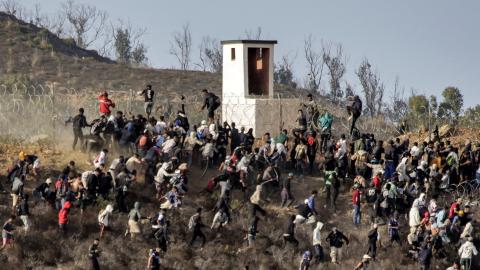
First, the historical Andalus, a Muslim-dominated region of the Iberian Peninsula that existed throughout the Middle Ages, holds an important part in the jihadist imaginary and often features in Islamic State propaganda.[66] Secondly, the geography of the region is important for facilitating the movement of supporters and fighters. The land borders with Ceuta and Melilla, Spain’s North African enclaves, provide the only overland crossings between African and European soil, which can be exploited as transit routes.[67] The Islamic State has also drawn recruits from Morocco and Spain, the latter of which has a large North Africa diaspora, many of whom immigrated during the Syrian Civil War.[68] Morocco, however, has been the greater source of recruits of the two to date. Even after the peak of the Syrian civil war, this trend continued: In January 2025, the Moroccan intelligence director stated that over 130 jihadists had departed the country for Islamic State affiliates Sahel and Somalia in recent years.[69]
Arrests in both Morocco and Spain over the past six years point to a threat that has evolved. Between 2020 and 2022, authorities dismantled Islamic State networks that they described as involved in fundraising and recruitment but typically did not specify which provincial affiliate of the Islamic State these cells were supporting.[70] That began to change from 2022 onward as Moroccan and Spanish authorities provided details of cells, mostly comprising North Africans, that were multiplying and increasingly attempting to facilitate the movement of fighters to the Sahel.[71] The arrest of cells in March 2026 may represent a further evolution, as one of the suspects, based in the Spanish town of Mallorca, was reportedly planning attacks there while also overseeing an advanced logistics network across the two countries.[72] This would indicate increasing sophistication of the Islamic State cells in the two countries, although it requires further cases to establish a genuine pattern rather than a single data point.
Nonetheless, the available evidence points to a growing two-way logistics and recruitment network in Spain and Morocco that could facilitate the movement of more foreign fighters to African affiliates or, conceivably, from African affiliates into Europe. Reliable figures on the presence of foreign fighters within Islamic State affiliates in Africa are lacking. However, research indicates that many fighters within IS-S are foreigners, albeit mostly East Africans.[73] And over the past year, ISWAP has begun to release footage of Arab and North African fighters in its camps for the first time.[74] Coupled with the reports of various Islamic State-linked cells that were attempting to move individuals into Mali, and against the broader backdrop of long-standing connections between ISSP and Libyan and North African militant networks, our picture of the foreign fighter presence within Africa’s Islamic State affiliates may be highly incomplete.[75] U.S. counterterrorism operations in Africa, particularly in Somalia and more recently in Nigeria, may also result in shifts in foreign fighter migration on the continent via these nodes described above.
Conclusion
The regional security picture in the Sahel is dispiriting. Recent events in Mali, Niger, and Nigeria are a source of major concern. In January 2026, ISSP, apparently supported by ISWAP fighters (as noted previously), launched a daring attack on the international airport in Niamey in which they destroyed several aircraft.[76] In April 2026, JNIM and its allies in the Tuareg FLA rebel group launched coordinated assaults on key towns in Mali, including the capital Bamako. While the militants did not ultimately seize Bamako, they successfully took control of several large towns and killed Mali’s defense minister.[77] ISSP took advantage of the chaos to temporarily seize certain towns in Mali when Malian military and Africa Corps mercenaries withdrew.[78] Given lingering questions about the size and role of foreign fighters within ISSP, there is reason to worry that these worsening local conditions in the Sahel could, over time, generate new threats outside the region. The threat posed by foreign fighter “returnees” to their country of origin is always difficult to predict, but it is notable that Europe has already dealt with this problem before. For example, the jihadists who attacked the Ariana Grande concert in Manchester in 2017 had previously fought in Libya.[79]
The existing regional and international security mechanisms have the capacity to contain this growing threat, but it will require sustained focus and energy. The Morocco–Spain bilateral security relationship is the most important counterterrorism mechanism currently preventing ISSP’s Moroccan and Spanish networks from executing attacks. Its operational model—consisting of 31 joint operations since 2014 as well as 150 arrests and continuous intelligence sharing—is an encouraging example of a decade-long investment.[80]
U.S. airstrikes against suspected ISSP militants in northwestern Nigeria in December 2025 demonstrate that the United States retains the capacity and will for targeted action against Islamic State infrastructure in West Africa even after the loss of the Agadez base in 2023. That capacity should be sustained and expanded through alternative basing and intelligence arrangements. The Ivory Coast–based ISR collection that enabled the Sokoto strikes suggests one model, while support of French special forces in forest operations in Benin suggests another.[81] Policymakers should resist the temptation to frame counterterrorism options in Africa exclusively through the lens of a large-footprint presence; the post-Agadez evidence suggests targeted action from alternative platforms remains possible and effective. The logistics corridors within Libya require sustained policy attention of a sort they are not currently receiving. Any serious long-term strategy for containing the ISSP cannot succeed without progress in stabilizing Libya. The transnational nature of threats from the Sahel also requires increasing the sharing of intelligence (including financial intelligence) between Europe and North Africa and closing jurisdictional gaps between Moroccan and European legal frameworks.[82]
ISSP is certainly not, as of 2026, an international threat on par with the Islamic State in Iraq and Syria during the latter’s operational height in the mid-2010s. Cells that Moroccan and/or Spanish authorities have arrested have ranged in size from a handful to a dozen members. But the barriers to broader internationalization are lower than they were a few years ago. ISSP is already well linked to logistics corridors that span Africa and connect to Europe, and there is no guarantee that the foreign fighters who move across these networks will choose to remain in Africa.
The threat is evolving, and nothing is certain—the demands of local expansion and competition with JNIM could mean ISSP remains focused on local objectives for the foreseeable future. But it is just as easy to imagine that a weakening of Islamic State affiliates elsewhere could lead the Islamic State’s leadership to encourage ISSP to facilitate international attacks. The question is whether the counterterrorism architecture that has so far prevented the Islamic State from striking more frequently in Europe can maintain its effectiveness as the threat matures. The answer to that question is likewise uncertain but is rooted in various policy choices as well as the West’s collective ability to understand this evolving threat.
Endnotes
- Oumaima Moho Amer, “BCIJ Dismantles ISIS-Affiliated Cell Operating in Morocco and Spain,” Morocco World News, March 25, 2026, https://www.moroccoworldnews.com/2026/03/284185/bcij-dismantles-isis-affiliated-cell-operating-in-morocco-and-spain; News Desk, “Spain and Morocco Arrest Three Suspects of Jihadist Cell, Mallorca Man ‘Planned Lone Wolf Attack,’ ” Spain in English, March 26, 2026, https://www.spainenglish.com/2026/03/26/spain-and-morocco-arrest-three-suspects-of-jihadist-cell-mallorca-man-planned-lone-wolf-attack. ↑
- Tore Refslund Hamming, “The General Directorate of Provinces: Managing the Islamic State’s Global Network,” CTC Sentinel 16, no. 7 (July 2023): 20–27, https://ctc.westpoint.edu/the-general-directorate-of-provinces-managing-the-islamic-states-global-network; United Nations Security Council, Thirty-Seventh Report of the Analytical Support and Sanctions Monitoring Team, UN Doc. S/2026/44 (UN Security Council, 2026), https://docs.un.org/en/S/2026/44. ↑
- See, for example, the far-reaching financial networks based in the al-Karrar office in Somalia. Eric Schmitt, “Ties to Kabul Bombing Put ISIS Leader in Somalia in U.S. Cross Hairs,” New York Times, February 4, 2023, https://www.nytimes.com/2023/02/04/us/politics/isis-somalia-kabul-bombing.html. ↑
- Benjamin Roger, “Islamic State Network That Wanted to Reach Europe Dismantled in Côte d’Ivoire and Madagascar,” Le Monde, November 25, 2024, https://www.lemonde.fr/en/international/article/2024/11/25/an-islamic-state-network-that-wanted-to-reach-europe-has-been-dismantled-in-cote-d-ivoire-and-madagascar_6734016_4.html. ↑
- “BCIJ Chief: Dismantled Terrorist Cell Was Part of ‘Daesh Sahel Wilaya’s’ Plan to Establish a Base in Morocco,” Assahifa English, February 24, 2025, https://www.assahifa.com/english/morocco/bcij-chief-dismantled-terrorist-cell-was-part-of-daesh-sahel-wilayas-plan-to-establish-a-base-in-morocco; Lucas Webber and Paweł Wójcik, “The Islamic State Sahel Threat Is Transnational,” Foreign Policy, March 31, 2026, https://foreignpolicy.com/2026/03/31/islamic-state-sahel-terrorism-issp-transnational-threat-mali-burkina-faso. ↑
- Adrian Shtuni, “The Islamic State in 2025: An Evolving Threat Facing a Waning Global Response,” International Centre for Counter-Terrorism, July 11, 2025, https://icct.nl/publication/islamic-state-2025-evolving-threat-facing-waning-global-response; Nicolas Stockhammer and Colin P. Clarke, “Learning from Islamic State-Khorasan Province’s Recent Plots,” Lawfare, August 11, 2024, https://www.lawfaremedia.org/article/learning-from-islamic-state-khorasan-province-s-recent-plots. ↑
- Thomas Joscelyn, “Confusion Surrounds West African Jihadists’ Loyalty to IS,” FDD's Long War Journal, May 14, 2015, https://www.longwarjournal.org/archives/2015/05/confusion-surrounds-west-african-jihadists-loyalty-to-islamic-state.php. ↑
- Thomas Joscelyn and Caleb Weiss, “Islamic State Recognizes Oath of Allegiance from Jihadists in Mali,” FDD’s Long War Journal, October 31, 2016, https://www.longwarjournal.org/archives/2016/10/islamic-state-recognizes-oath-of-allegiance-from-jihadists-in-west-africa.php. ↑
- Héni Nsaibia, Newly Restructured, the Islamic State in the Sahel Aims for Regional Expansion (ACLED, 2024), https://acleddata.com/report/newly-restructured-islamic-state-sahel-aims-regional-expansion. ↑
- Miguel Paradela-López and Alexandra Jima-González, “The 2012 Tuareg Uprising in Mali: An Analysis of AQIM’s, MUJAO’s, and Ansar Dine’s Access to Moral and Socio-Organizational Resources Under the Resource Mobilization Theory,” SAGE Open 14, no. 3 (July–September 2024): 1–16, https://doi.org/10.1177/21582440241257615. ↑
- Caleb Weiss, “Niger Thwarts Jihadist Prison Break Attempt,” FDD’s Long War Journal, October 17, 2016, https://www.longwarjournal.org/archives/2016/10/niger-thwarts-jihadist-prison-break-attempt.php. ↑
- AFP, “ISIL Video of Niger Attack Highlights US Troops’ Vulnerability,” Al Jazeera, March 5, 2018, https://www.aljazeera.com/news/2018/3/5/isil-video-of-niger-attack-highlights-us-troops-vulnerability ↑
- Alice Hunt Friend, “DoD’s Report on the Investigation into the 2017 Ambush in Niger,” Center for Strategic and International Studies, May 15, 2018, https://www.csis.org/analysis/dods-report-investigation-2017-ambush-niger. ↑
- Héni Nsaibia, IS Sahel’s Tactics Cause Mass, Indiscriminate Violence (ACLED, 2023), https://acleddata.com/report/sahels-tactics-cause-mass-indiscriminate-violence. ↑
- Wassim Nasr, “ISIS in Africa: The End of the ‘Sahel Exception,’ ” New Lines Institute, June 2, 2020, https://newlinesinstitute.org/middle-east-center/isis-in-africa-the-end-of-the-sahel-exception. ↑
- Héni Nsaibia and Caleb Weiss, “The End of the Sahelian Anomaly: How the Global Conflict Between the Islamic State and al-Qa’ida Finally Came to West Africa,” CTC Sentinel 13, no. 7 (July 2020): 1–14, https://ctc.westpoint.edu/the-end-of-the-sahelian-anomaly-how-the-global-conflict-between-the-islamic-state-and-al-qaida-finally-came-to-west-africa; Nasr, “ISIS in Africa”; Jared Thompson, “Jama’at Nasr al-Islam wal Muslimin,” Center for Strategic and International Studies, July 15, 2021, https://www.csis.org/blogs/examining-extremism/examining-extremism-jamaat-nasr-al-islam-wal-muslimin. ↑
- United Nations Security Council, Twenty-Fifth Report of the Analytical Support and Sanctions Monitoring Team Submitted Pursuant to Resolution 2368 (2017) Concerning ISIL (Da’esh), Al-Qaida and Associated Individuals, Groups, Undertakings and Entities, UN Doc. S/2020/53 (United Nations, 2020), https://docs.un.org/en/S/2020/53; Benjamin Roger, “Tracking Abu Walid al-Sahraoui, West Africa’s Most Wanted Jihadist,” The Africa Report, February 12, 2020, https://www.theafricareport.com/23345/tracking-abu-walid-al-sahrawi-west-africas-most-wanted-jihadist. The Islamic State maintains regional offices for coordinating the activities of its different “provinces,” and the General Directorate of Provinces oversees these regional offices. ISSP and ISWAP both presently fall under the oversight of al-Furqan, the regional office for West Africa, meaning they coordinate closely even though they are no longer formally organized as one province for the purposes of, e.g., Islamic State Media and attack claims. Hamming, “The General Directorate of Provinces.” ↑
- UN Security Council, Twenty-Fourth Report of the Analytical Support and Sanctions Monitoring Team Submitted Pursuant to Resolution 2368 (2017) Concerning ISIL (Da’esh), Al-Qaida and Associated Individuals, Groups, Undertakings and Entities, UN Doc. S/2019/570 (UN, 2019), https://docs.un.org/en/S/2019/570. ↑
- Eleanor Beevor, Motorbikes and Armed Groups in the Sahel: Anatomy of a Regional Market (Global Initiative Against Transnational Organized Crime, 2023), https://globalinitiative.net/wp-content/uploads/2023/08/Eleanor-Beavor-Motorbikes-and-armed-groups-in-the-Sahel-anatomy-of-a-regional-market-GI-TOC-August-2023.pdf. ↑
- UN Security Council, Twenty-Ninth Report of the Analytical Support and Sanctions Monitoring Team Submitted Pursuant to Resolution 2610 (2021) Concerning ISIL (Da’esh), Al-Qaida and Associated Individuals, Groups, Undertakings and Entities, UN Doc. S/2022/83 (UN, 2022), https://docs.un.org/en/S/2022/83. ↑
- Nsaibia, Newly Restructured Islamic State. ↑
- Calibre Obscura, “An Explosive Renewal of IS in Libya?,” Hugo Kaaman (blog), September 17, 2021, https://hugokaaman.com/an-explosive-renewal-of-the-islamic-state-in-libya-guest-post. ↑
- Nsaibia, IS Sahel’s Tactics. ↑
- International Crisis Group, “Defining a New Approach to the Sahel’s Military-Led States,” Watch List 2025 – Spring Update, May 22, 2025, https://www.crisisgroup.org/cmt/africa/sahel/burkina-faso-mali-niger/defining-new-approach-sahels-military-led-states. ↑
- “Wagner Group, Yevgeniy Prigozhin and Russia’s Disinformation in Africa,” US Department of State, May 24, 2022, https://2021-2025.state.gov/disarming-disinformation/wagner-group-yevgeniy-prigozhin-and-russias-disinformation-in-africa. ↑
- Wassim Nasr, “How the Wagner Group Is Aggravating the Jihadi Threat in the Sahel,” CTC Sentinel 15, no. 11 (December 2022): 21–30, https://ctc.westpoint.edu/how-the-wagner-group-is-aggravating-the-jihadi-threat-in-the-sahel. ↑
- Ilaria Allegrozzi and Jean Baptiste Gallopin, “None Can Run Away”: War Crimes and Crimes Against Humanity in Burkina Faso by All Sides (Human Rights Watch, 2026), https://www.hrw.org/report/2026/04/02/none-can-run-away/war-crimes-and-crimes-against-humanity-in-burkina-faso-by-all. ↑
- “Mali and the UN: Why Peacekeepers Are Being Told to Leave,” BBC, June 30, 2023, https://www.bbc.com/news/world-60419799. ↑
- Center for Preventive Action, “Violent Extremism in the Sahel,” CFR Global Conflict Tracker, May 5, 2026, https://www.cfr.org/global-conflict-tracker/conflict/violent-extremism-sahel. ↑
- Eric Schmitt, “A Shadowy War’s Newest Front: A Drone Base Rising from Saharan Dust,” New York Times, April 22, 2018, https://www.nytimes.com/2018/04/22/us/politics/drone-base-niger.html. ↑
- “Niger Coup Reversing Hard-Earned Gains,” Africa Center for Stategic Studies, May 13, 2024, https://africacenter.org/spotlight/niger-coup-reversing-hard-earned-gains. ↑
- “Burkina Faso Crisis Continues to Spiral,” Africa Center for Stategic Studies, August 29, 2023, https://africacenter.org/spotlight/burkina-faso-crisis-continues-to-spiral. ↑
- Jules Duhamel, “Map of JNIM and ISSP Activity in Benin, Niger and Nigeria Borderlands,” Jules Duhamel (blog), May 12, 2025, https://www.julesduhamel.com/jnim-and-issp-activity-in-benin-niger-and-nigeria-borderlands. ↑
- Tom Wheeldon, “Sahrawi: The Top Sahel Jihadist Killed in French ‘Opportunistic Hit,’ ” France 24, September 16, 2021, https://www.france24.com/en/africa/20210916-the-assassinated-abou-walid-al-sahrawi-france-s-major-enemy-in-the-sahel. ↑
- UN Security Council, Thirty-Fourth Report of the Analytical Support and Sanctions Monitoring Team Submitted Pursuant to Resolution 2734 (2024) Concerning ISIL (Da’esh), Al-Qaida and Associated Individuals and Entities, UN Doc. S/2024/556 (UN, 2024), https://docs.un.org/en/S/2024/556; Miles Charles and Liam Karr, “Salafi-Jihadi Areas of Operation in West Africa: Interactive Map and Campaign Analysis,” Critical Threats Project, November 24, 2025, https://www.criticalthreats.org/analysis/salafi-jihadi-areas-of-operation-in-west-africa-interactive-map-and-campaign-analysis. ↑
- Liam Karr, “IS Sahel Offensive Along Mali-Niger Border: May–June 2025,” Critical Threats Project, June 26, 2025, https://www.criticalthreats.org/analysis/tigray-tensions-is-sahel-offensive-africa-file-june-26-2025. ↑
- Paweł Wójcik, “JNIM Escalates Sahelian Offensives amid Fratricidal War with ISSP,” Terrorism Monitor 24, no. 10 (June 12, 2026), https://jamestown.org/jnim-escalates-sahelian-offensives-amid-fratricidal-war-with-issp. ↑
- “Lakurawa’s Growing Presence in Nigeria and the Crime-Terror Nexus,” The Soufan Center, February 6, 2026, https://thesoufancenter.org/intelbrief-2026-february-6. ↑
- Al-Naba’, soldiers of the caliphate in the Sahel claim responsibility for killing 19 Nigerian soldiers in northwestern Nigeria, accessed on Telegram June 2026. ↑
- U.S. Africa Command Public Affairs, “U.S. Africa Command Conducts Strike Against ISIS in Nigeria,” AFRICOM, December 25, 2025, https://www.africom.mil/pressrelease/36158/us-africa-command-conducts-strike-against-isis-in-nigeria. ↑
- Mathieu Bere, “The Islamic State in the Sahel: Understanding Its Internal and External Dynamics and Attack Modalities,” Perspectives on Terrorism 18, no. 2 (June 2024): 137–50, https://pt.icct.nl/article/islamic-state-sahel-understanding-its-internal-and-external-dynamics-and-attack-modalities. ↑
- Abd’Allah, “Dans le nord-est du Mali, l’État islamique en voie de ‘normalisation’?” [In northeastern Mali, is the Islamic State in the process of “normalization”?], Afrique XXI, November 13, 2023, https://afriquexxi.info/Dans-le-nord-est-du-Mali-l-Etat-islamique-en-voie-de-normalisation ↑
- “Women’s Lives Under IS in Niger’s Tillabery,” Africa Briefing No. 200, International Crisis Group, August 29, 2024, https://www.crisisgroup.org/brf/africa/sahel/niger/b200-womens-lives-under-islamic-state-nigers-tillabery. ↑
- International Crisis Group, Facing the Challenge of Islamic State West Africa Province, Report No. 273 (International Crisis Group, 2019), https://www.crisisgroup.org/rpt/africa/nigeria/273-facing-challenge-islamic-state-west-africa-province. ↑
- Hugo Kamaan, “The Strategic Logic of SVBIEDs – Part 1 – Mirroring the Conventional,” Hugo Kamaan (blog), January 26, 2025, https://hugokaaman.com/the-strategic-logic-of-svbieds-part-1-mirroring-the-conventional-5. ↑
- Abd’Allah, “Dans le nord-est du Mali, ‘normalisation’?” ↑
- Caleb Weiss, “Analysis: Islamic State’s Current Da’wah Campaign Across Africa,” FDD’s Long War Journal, April 5, 2024, https://www.longwarjournal.org/archives/2024/04/analysis-islamic-states-current-dawah-campaign-across-africa.php. ↑
- Lucas Webber, “Does the Sahel Pose a Transnational Terror Threat?,” The Soufan Center, October 1, 2025, https://thesoufancenter.org/intelbrief-2025-october-1. ↑
- Assahifa English, “BCIJ Chief: Dismantled Terrorist Cell”; Sam Metz, “Morocco Says It Dismantled a Terror Cell That Was Planning Attacks,” PBS News, February 25, 2025, https://www.pbs.org/newshour/world/morocco-says-it-dismantled-a-terror-cell-that-was-planning-attacks; “BCIJ : La cellule démantelée était un projet de la « wilaya de Daech au Sahel » pour mettre sur pied sa branche au Maroc” [BCIJ: The dismantled cell was a project of the ‘ISIS Sahel Province’ to establish its branch in Morocco], Lavie Éco, February 24, 2025, https://www.lavieeco.com/pouvoirs/securite/bcij-la-cellule-demantelee-etait-un-projet-de-la-wilaya-de-daech-au-sahel-pour-mettre-sur-pied-sa-branche-au-maroc. ↑
- Abd’Allah, “Dans le nord-est du Mali, ‘normalisation’?” ↑
- Bruce Hoffman, “The Global Terror Threat and Counterterrorism Challenges Facing the Next Administration,” CTC Sentinel 9, no. 11 (November/December 2016): 1–7, https://ctc.westpoint.edu/the-global-terror-threat-and-counterterrorism-challenges-facing-the-next-administration. ↑
- For example, United Nations experts reported in March 2026 that the Islamic State created multiple front companies based in Libya for financing and recruiting purposes; see Final Report of the Panel of Experts Established Pursuant to Resolution 1973 (2011) Concerning Libya, UN Doc. S/2026/224 (UN, 2026), https://docs.un.org/en/S/2026/224. To take another example, in October 2024, security services in Libya arrested two Syrians who had transferred funds to Syria to facilitate the migration of Syrian fighters to ISSP through Libya, suggesting the existence of more routes used by extremists to destinations in Mali. See UN Security Council, Thirty-Fifth Report of the Analytical Support and Sanctions Monitoring Team Submitted Pursuant to Resolution 2734 (2024) Concerning ISIL (Da’esh), Al-Qaida and Associated Individuals and Entities, UN Doc. S/2025/71/Rev.1 (UN, 2025), https://docs.un.org/en/S/2025/71/Rev.1. ↑
- Frederic Wehrey, “When the Islamic State Came to Libya,” Carnegie Endowment for International Peace, February 10, 2018, https://carnegieendowment.org/posts/2018/02/when-the-islamic-state-came-to-libya. ↑
- UN Security Council, Twenty-First Report of the Analytical Support and Sanctions Monitoring Team Submitted Pursuant to Resolution 2734 (2024) Concerning ISIL (Da’esh), Al-Qaida and Associated Individuals and Entities, UN Doc. S/2018/14/Rev.1 (UN, 2018), https://docs.un.org/en/S/2018/14/rev.1. ↑
- Al-Naba’, dialogue with Sheikh Abu Al-Walid al-Sahrawi, October 14, 2021, accessed on Telegram June 2026. ↑
- UN Security Council, Thirty-Fourth Report. ↑
- Matthew Miller, “Terrorist Designation of ISIS General Directorate of Provinces Leaders,” press statement, U.S. Department of State, June 8, 2023, https://2021-2025.state.gov/terrorist-designation-of-isis-general-directorate-of-provinces-leaders. ↑
- UN Security Council, Thirty-Seventh Report of the Analytical Support and Sanctions Monitoring Team Submitted Pursuant to Resolution 2734 (2024) Concerning ISIL (Da’esh), Al-Qaida and Associated Individuals and Entities, UN Doc. S/2026/44 (UN, 2026), https://docs.un.org/en/S/2026/44. ↑
- Caleb Weiss and Lucas Webber, “Islamic State-Somalia: A Growing Global Terror Concern,” CTC Sentinel 17, no. 8 (September 2024): 12–21, https://ctc.westpoint.edu/islamic-state-somalia-a-growing-global-terror-concern. ↑
- Caleb Weiss, “Islamic State Calls for Jihad in Sudan,” FDD’s Long War Journal, January 24, 2025, https://www.fdd.org/analysis/op_eds/2025/01/24/islamic-state-calls-for-jihad-in-sudan. ↑
- Dawlt Endeshaw, “Ethiopia Arrests Dozens of Suspected Islamic State Militants, Fana Broadcaster Reports,” Reuters, July 16, 2025, https://www.reuters.com/world/africa/ethiopia-arrests-dozens-suspected-islamic-state-militants-fana-broadcaster-2025-07-16. ↑
- Weiss and Webber, “IS-Somalia: Growing Global Terror Concern.” ↑
- U.S. Africa Command Public Affairs, “US Forces Conduct Strike Targeting ISIS-Somalia,” press release, AFRICOM, May 7, 2026, https://www.africom.mil/pressrelease/36471/us-forces-conduct-strike-targeting-isis-somalia; Subham Kalia, “ISIS Second-in-Command Abu Bilal al-Minuki Killed by US and Nigerian Forces, Presidents Say,” Reuters, May 15, 2026, https://www.reuters.com/world/middle-east/trump-says-isis-second-command-abu-bilal-al-minuki-eliminated-2026-05-16. ↑
- “Niger: Who Attacked Niamey’s Airport and What It Reveals?,” France 24, February 2, 2026, https://www.france24.com/en/niger-who-attacked-niamey-s-airport-and-what-it-reveals; Caleb Weiss, “Islamic State Claims Assault on Airport in Niger’s Capital,” FDD’s Long War Journal, February 1, 2026, https://www.longwarjournal.org/archives/2026/02/islamic-state-claims-assault-on-airport-in-nigers-capital.php. ↑
- “Spain and Morocco Arrest Three Suspects of Jihadist Cell, Mallorca Man ‘Planned Lone Wolf Attack,’” Spain in English, March 26, 2026, https://www.spainenglish.com/2026/03/26/spain-and-morocco-arrest-three-suspects-of-jihadist-cell-mallorca-man-planned-lone-wolf-attack; “Morocco-Spain Antiterrorism & Security Cooperation Deals New Blow to Jihadism,” North Africa Post, August 6, 2023, https://northafricapost.com/70191-morocco-spain-antiterrorism-security-cooperation-deals-new-blow-to-jihadism.html. ↑
- Patricia Ortega Dolz, “Islamic State Propaganda Video Features Spain’s Alhambra,” El País, September 8, 2016, https://english.elpais.com/elpais/2016/09/08/inenglish/1473322718_358788.html. ↑
-
“Spain Arrests Five Suspected Members of Jihadist Cell,” The Arab Weekly, October 14, 2021,
https://thearabweekly.com/spain-arrests-five-suspected-members-jihadist-cell; Debbie Mohnblatt, “Jihadist Recruiters Prey on Migrants to Europe,” Jerusalem Post, January 17, 2023, https://www.jpost.com/middle-east/isis-threat/article-728745. ↑
- Carola García-Calvo, Fernando Reinares, and Álvaro Vicente, “National Extraction, Geographical Origin and Migratory Ancestry Among Jihadists in Spain.” Studies in Conflict & Terrorism 46, no. 6 (2023): 798–823, https://doi.org/10.1080/1057610X.2020.1792740. ↑
- Super Admin, “Jihadists from Morocco Who Were Announced to Have Traveled to Somalia,” Horn Observer, January 31, 2025, https://hornobserver.com/articles/3159/Jihadists-From-Morocco-Who-Were-Announced-To-Have-Traveled-To-Somalia; John Silk, “Morocco Says It Has Broken Up ‘Islamic State’ Cell,” February 25, 2025, https://www.dw.com/en/morocco-says-it-has-broken-up-islamic-state-cell/a-71736468. ↑
- U.S. Department of State, Country Reports on Terrorism 2021: Morocco (U.S. Department of State, 2021), https://www.state.gov/reports/country-reports-on-terrorism-2021/morocco. ↑
- Aaron Y. Zelin, “The Islamic State on the March in Africa,” Washington Institute for Near East Policy, March 1, 2024, https://www.washingtoninstitute.org/policy-analysis/islamic-state-march-africa; Safaa Kasraoui, “Morocco, Spain Dismantle ISIS-Affiliated Terror Cell Spanning Two Continents,” Morocco World News, November 21, 2024, https://www.moroccoworldnews.com/2024/11/168105/morocco-spain-dismantle-isis-affiliated-terror-cell-spanning-two-continents. ↑
- “Anti-Terrorism Operation Between Spain and Morocco: Three Suspected Members of a Cell Linked to ISIS Arrested,” Atalayar, March 25, 2026, https://www.atalayar.com/en/articulo/politics/anti-terrorism-operation-between-spain-and-morocco-three-suspected-members-of-cell-linked-to-isis-arrested/20260325194809224305.html. ↑
- Weiss and Webber, “IS-Somalia: Growing Global Terror Concern.” ↑
- Islamic State, “Generation Empowerment 2,” accessed May 2026 on Telegram. ↑
- Zelin, “Islamic State on the March in Africa.” ↑
- Don Rassler and Kristina Hummer, “Developments in the Sahel: An Interview with Wassim Nasr, Journalist, France24; Senior Research Fellow, Soufan Center,” CTC Sentinel 19, no. 5 (May 2026): 1–6, https://ctc.westpoint.edu/developments-in-the-sahel-an-interview-with-wassim-nasr-journalist-france24-senior-research-fellow-soufan-center. ↑
- Makuochi Okafor and Hafsa Khalil, “Mali Defence Minister Killed as Country Hit by Wave of Rebel Attacks,” BBC, April 26, 2026, https://www.bbc.com/news/articles/c5yvy7v66ndo. ↑
- Wójcik, “JNIM Escalates Sahelian Offensives.” ↑
- Mark Curtis, “Counter-Terrorism Officials Allowed Manchester Bomber to Operate in Libya Warzone,” Declassified UK, June 28, 2022, https://www.declassifieduk.org/counter-terrorism-officials-allowed-manchester-bomber-to-operate-in-libya-warzone. ↑
- Mohamed Larbi, “Morocco-Spain: More Than 150 Arrests and 30 Cells Dismantled Thanks to Exemplary Synergy,” Atalayar, April 15, 2026, https://www.atalayar.com/en/articulo/politics/morocco-spain-more-than-150-arrests-and-30-cells-dismantled-thanks-to-exemplary-synergy/20260415210000224807.html. ↑
- Benjamin Roger, “French Special Forces Are Discreetly Combating Jihadists in Benin,” Le Monde, April 21, 2026, https://www.lemonde.fr/en/international/article/2026/04/21/french-special-forces-are-discreetly-combating-against-jihadists-in-benin_6752648_4.html. ↑
- Ali Bounjoua, “La coopération judiciaire pénale euro-marocaine pour la lutte contre la criminalité organisée et le terrorisme” [Euro-Moroccan criminal judicial cooperation in the fight against organized crime and terrorism], Eucrim, January 22, 2026, https://eucrim.eu/articles/la-cooperation-judiciaire-penale-euro-marocaine-lutte-contre-la-criminalite-organisee. ↑