















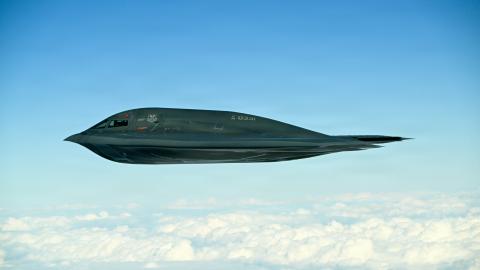
President Trump said there’s a “big wave” of military action against the Islamic Republic of Iran in Operation Epic Fury. That probably means we’ll see more action from our bombers, the only U.S. aircraft that can carry our largest “bunker busters” to reach the most deeply buried targets. America’s stealth bomber, the B-2 Spirit, has already dropped precision, penetrating munitions in this operation. As Chairman of the Joint Chiefs of Staff General Dan Caine commented, they flew undetected for 37 hours from the continental United States, just as they did in Operation Midnight Hammer.
Over the past several years of Russia’s war against Ukraine, we’ve heard a lot about the lethality of drones and how they may be making larger, more traditional, and bespoke platforms obsolete. Not only is that so obviously untrue, but it’s also backward. As we are witnessing in Epic Fury, to take on minimal risk to our forces while delivering the desired military effect, the United States relies on these heavy stealth bombers. To shore up and consolidate American global preeminence, we require a lot more. The U.S. has only 19 B-2 stealth bombers. Seven of these were used in Midnight Hammer, and reportedly four have been used in Epic Fury. The program of record for the next generation B-21 Raider was originally assessed to be 100. This was decided around 2011, before planners had a clear picture of the need to shore up the United States’ global position and defend its core interests against a determined authoritarian axis, led by China and including Russia, North Korea, Iran, and narco-communist states in our hemisphere. It was prior to China’s ongoing dramatic expansion and modernization of its forces, including its nuclear posture.
Over the next decade, the United States will seek to simultaneously deter, for the first time in history, two major nuclear powers: China and Russia. Washington will also seek to carry out combat operations against China’s and Russia’s partner nations, as we are witnessing in Iran. At the same time, the U.S. must prepare to win a war against China if deterrence fails while concurrently deterring opportunistic aggression in another geographic region. As the Trump administration seeks to regain stability and ratchet up its geopolitical advantages to keep a cold war from going hot, its strategy should be underpinned by the stealth bomber. No other nation in the world, from a Chinese weaker partner such as Iran or Russia, or even China with all of its sophistication, can match America’s stealth technology, let alone sufficiently defend against it.
The good news is that the Department of Defense is increasing the production rate of the B-21. Previously, officials anticipated the B-21 to enter service in the “mid-2020s,” but by accelerating production by 25 percent, the bombers are expected to be “on the ramp” at Ellsworth Air Force Base in South Dakota by 2027. This is a good first step in giving the Raider a more elevated role to ensure that the next century remains an American one. The United States should open a second B-21 production line and aim for a bomber fleet closer to 300.
In 2025, then–Commander of U.S. Strategic Command General Anthony Cotton said that, for his command’s mission, a larger fleet was necessary. The number he cited was 145. U.S. Strategic Command has its requirements, but so do the other commands preparing for combat operations in their areas of responsibility; they need stealth bombers, too. In a Taiwan contingency, the B-21 could act as our quarterback, contributing to the fight prudently positioned among the second island chain, delivering a complex variety of ordnances, and it could direct drones to the battlefield in higher volumes than possible with fighter jets alone. The concept of the B-21 as a missileer has been floated since the late 2000s, but it was not initially incorporated into the model’s design. With expanded investment in production, this capability can be added to make the Raider an even more potent and versatile asset. And, as a drone mothership, the B-21’s unique payload, survivability, and range capacities could make it the ideal delivery system for small, cheap, unmanned drones. Though cheap to produce, it is much more costly to transport a drone to the battlefield. With the B-21 carrying them in, eliminating the need for drones to possess such range themselves, it can dramatically lower costs.
The B-21 as a missileer can fight our way into a highly contested Chinese airspace and suppress enemy air defenses to secure and keep air superiority. U.S. Indo-Pacific Command Commander Samuel Paparo affirmed last year that “ceding air superiority is not an option if we intend to maintain a capability against our adversaries and the ability to support our allies.” Air-power experts point out that a large-scale, proven air-to-air capability on bombers is useful in keeping an enemy confused about which platforms might deliver which effects, limiting their ability to react.
Another one of the lessons from the way Ukraine has been permitted to fight is that restraining Ukraine’s ability to launch into Russian territory and to wage only a defensive war primarily fought via drone is a recipe for protraction. That kind of war with China — a war in which the U.S. fights a protracted drone war at sea and refuses to target the Chinese homeland — would cede the advantage to the Chinese, with their dominant industrial capacity to produce drones. The United States should be building a force to go on the offensive to destroy Chinese mobile launchers and weapons production facilities in mainland China. This is a perfect mission for the B-21, which has deep range, and a mix of conventional and nuclear mass-deliverable options in a single system.
The most critical lesson from Ukraine and from our ongoing military campaigns against the Islamic Republic is that we need to lean into our comparative advantages — our warfighting competency and globally unmatched stealth. Chinese academic and military writing predictably indicate worry about the American stealth bomber. We would be wise to increase their worry, optimize our advantages instead of fighting on the enemies’ terms, and, in doing so, convince the Chinese that peace is a better path.