


















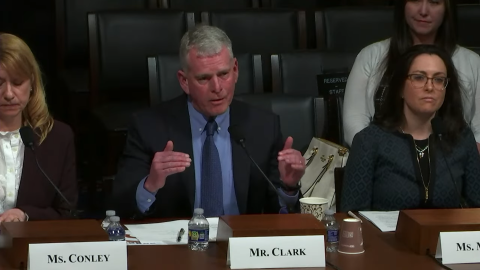
Bryan Clark testifies in front of the Committee on Homeland Security on the strategic importance of hardening the Arctic. He identifies three critical gaps that must be addressed within the “Golden Dome” framework to strengthen defense capabilities: enhancing missile and drone defense systems, securing undersea communications infrastructure, and establishing a sustained, full-time operational presence in the Arctic.
Written Testimony
Chairmen Gimenez and Pfluger and Ranking Members McIver and Magaziner, thank you for the opportunity to testify before the subcommittees on the topic: Arctic Security in an Era of Global Competition: Safeguarding U.S. Interests in Frigid Waters.
Introduction
The United States is the only arctic nation who does not treat the High North as core to its identify. That is understandable. Alaska is not part of the contiguous states, America has not faced serious threats in the arctic since the Cold War, and the US economy depends on services and information technology more than resource extraction. But the US government and its military need to turn their attention back to the arctic as it becomes more militarily relevant and accessible for commerce.
The Trump Administration’s recent threat to annex or seize Greenland highlighted the US government’s arctic dilemma. The rising interest of Russia and China in resource exploration, military operations, and shipping across arctic waters led the president and senior officials to seek greater control or outright sovereignty over Greenland. In addition to its significant mineral deposits, Greenland sits astride key arctic crossroads including the Greenland-Iceland-United Kingdom (G-I-UK) gap and Northwest Passage.
However, the US military’s lack of arctic capacity made the threat of seizure a hollow one. The US Navy’s only ice-hardened ships are submarines, which are in short supply and needed to deter Chinese aggression in the Western Pacific. The US Army and Marine Corps include units trained and experienced in cold weather operations, but do not have enough aircraft or support equipment to mount battalion or larger operations during the arctic winter. And while US Air Force can operate in the arctic, it does not have the ground equipment to sustain year-round flight operations there.[1]
If the US government is serious about protecting America’s arctic interests it should focus on improving the US military’s ability to operate in the High North, especially the supporting physical and digital infrastructure. New technologies can help. Since the Cold War, robotic and autonomous systems, low-earth orbit and small satellites, and artificial intelligence (AI) have changed modern life and military operations. They can also help solve America’s arctic dilemma.[2]
A destination or “fly-over country?”
The United States does not depend on the arctic like its fellow arctic nations. For example, nearly all of Russia’s gas fields and more than half of its oil reserves are in the arctic, which together fund about one-quarter of the government’s budget.[3] Canada relies on arctic mineral extraction for five percent of its GDP.[4] And oil and gas production in the arctic provides about 20 percent of Norway’s GDP.[5] In contrast, Alaska North Slope oil production is only about five percent of total US output and other Alaskan arctic industries such as fisheries are essentially self-sustaining.[6]
For decades, the US military has treated the arctic as “fly-over country” in which their main concern was the ability of enemy bombers or ballistic missiles to attack America from the north. Almost all of the Department of War’s (DoW) infrastructure and systems in the High North are designed to detect and intercept these threats, from the COBRA DANE surveillance radar at Eareckson Air Station in the Aleutian Islands to the Upgraded Early Warning Radar at Pituffik Space Base, Greenland.[7]
The DoW’s arctic basing, capabilities, and exercises largely reflect the expectation US military forces may need to engage at most a few hundred air or missile threats at once, given the size of the Russian, North Korean, and Chinese and intercontinental bomber and ballistic missile arsenals. Ground operations would be confined to Europe, where US troops would back up better equipped and trained European forces. And naval operations would be almost entirely undersea and conducted primarily by submarines like during the Cold War.
Today, climate change and technology are making the arctic a destination. Ice is covering less of the Arctic Ocean each year, creating opportunities for new transportation routes, resource exploration and extraction, and military campaigns. Technologies for satellite communications and autonomous systems are allowing companies and governments to operate in harsh polar environments without risks to humans and at a scale surpassing that possible with crewed systems.
These trends are upending some of the US military’s traditional assumptions around arctic security. For example, an attacker like Russia could combine bombers launching dozens of land-attack cruise missiles (LACM) with hundreds of UAS launched from autonomous vessels or cargo aircraft. As they have in the invasion of Ukraine, Russian commanders could use these large, complex salvos to confuse or overwhelm US arctic sensors and air defenses designed to track smaller numbers of ballistic missiles.[9]
The US government faces similar changes across each domain. Warming arctic waters and rapidly proliferating and commercialized technologies are enabling a new set of arctic security concerns. However, these same changes also create opportunities for the US DoW and government more broadly to improve America’s arctic security before a crisis emerges.
Plugging leaks in the Golden Dome
The US military is facing a changing array of drone and missile as commercial technologies for targeting, navigation, communication, sensing, and guidance make their way into the arsenals of aggressor nations and stateless groups. Forces from Iran, Ukraine, Russia, and the Houthis can assemble weapons at scale, enabling structured attacks that exploit the limitations of US air defense systems and tactics.
Two advancements are perhaps the most concerning regarding defense of arctic airspace:
- Decoys and electronic countermeasures in ballistic missile warheads that could confuse US early warning and tracking sensors. The DoW has long assessed that Russian and Chinese ballistic missiles incorporate “penetration aids” like decoys to confuse defenders’ sensors or consume air defense interceptors.[10] Analysts believe these opponents are improving their on-board countermeasures and that North Korea is also including these capabilities on its ballistic missiles.[11]
- Long-range one-way attack (OWA) drones that can be deployed at scale that could overwhelm US missile defenses. Iran’s Shahed drone and its derivatives helped Russia regain an edge in its war against Ukraine and spurred the US copycat LUCAS drone. Drones like these can travel 1000 nm, carry a 200 lb. warhead, and be launched from containers on a ship or uncrewed surface vessel (USV). At a cost of around $100,000 each, an aggressor could buy hundreds for the cost of one ICBM and use a converted merchant ship to launch dozens at a time across America’s unguarded arctic approaches.[12] As the arctic becomes more of a destination, higher shipping levels could make these drone carriers harder to detect.
- The DoW’s collection of long-range ground-based radars are well-suited to counter ballistic missiles and aircraft. Ballistic missiles move quickly and the doppler shift they create in radar returns makes them easier to detect and track. Their speed also means they generate heat in the atmosphere and can be detected using space-based infrared (IR) sensors like the US Space Force’s new Hypersonic and Ballistic Tracking Space Sensor (HBTSS) satellites.[13] But all of these sensors will have difficulty tracking slower and lower-altitude cruise missile or drone salvos, especially if they come from unexpected directions like from a USV or merchant vessel.
The DoW could pursue a common portfolio of solutions to address these threats. AI-enabled sensor processing has shown its value during the US-Israeli war against Iran, identifying hidden targets such as drone or missile storage and launch facilities.[14] These analytic capabilities, such as those used in the Maven Smart System or a growing range of DoW intelligence programs, could help existing arctic sensors identify new threats like drones or discern real warheads from decoys and other penetration aids.
But AI-enabled algorithms still need data. Tuning the DoW’s arctic sensors to better detect cruise missiles or drones may make them less able to detect ballistic missiles with the resolution needed to differentiate warheads from decoys. The US military will likely need additional sensors that can better detect and track airborne threats. The DoW intends to eventually provide this capability at continental scale using air moving target indication sensor technology on satellites. However, this technology is years from maturation and will likely take a decade to field.[15]
The DoW should pursue an affordable sensor architecture for arctic airspace in the near to mid-term, and as a backup in case AMTI fails to deliver. For example, stratospheric balloons or ultra-long-endurance UAS that cost $1-2 million could carry passive radiofrequency (RF) or IR sensors to detect incoming threats.[16] They could be purchased at scale, stored at bases around the country, and deployed when conditions warrant. Unlike space-based IR sensors that are looking down at missiles and drones whose bodies are not dramatically hotter than the earth underneath, balloons would look horizontally for aircraft against the cooler sky where their engines could be discerned.
US forces have been challenged to affordably or sustainably defeat combined missile and drone attacks in the Middle East. In many cases, fighter aircraft proved to be the most cost-effective defenses against OWA drones like the Shahed and slower cruise missiles.[17] Given its much larger area, defending US arctic airspace from slower cruise missiles or drones using crewed fighters is not scalable or sustainable given limitations on crewed aircraft squadrons. However, US forces have experimented with using MQ-9B Reaper medium altitude long endurance (MALE) UAS to shoot down drones and cruise missiles.[18] Moreover, MALE UAS also carry passive sensors that could detect air threats and radars that would allow tracking drones or cruise missiles.[19]
With a cost per flight hour about one-tenth that of an F-35, MALE UAS would be a sustainable way to expand air defense capacity across America’s arctic approaches.[20] Because they are modular, the US Air Force could reconfigure MALE UAS to support air surveillance or defense only when needed. And in contrast to crewed fighters, UAS operators can remain proficient using simulators or be contractors that are activated on demand.
New fleets of uncrewed sensors and engagement platforms will increase the complexity for operators who need to verify threats, match defensive weapons against appropriate threats, sequence actions to ensure they engage threats in time to allow follow-up engagements and assess if engagements succeeded. Air defenders are increasingly using AI-enabled decision support tools to help with these tasks in Ukraine and the Middle East.[21] They could help operations in North American Air Defense Command (NORAD) coordinate the disparate sensor feeds and defensive actions from a growing portfolio of ground, space, and airborne sensors and weapons.
Uncrewed systems and AI would also help the US military succeed in the central competition of modern warfare—adaptation. During the war in Ukraine, both sides are changing their tactics, drone configurations, and electronic waveforms almost every week. In response, manufacturers have to design drones and other weapons for rapid adaptation, sometimes on the battlefield.[22] Houthi rebels have also used innovation to impose new dilemmas on the Yemeni government and the US Navy in the Red Sea.[23]
Robotic and autonomous systems are generally more adaptable than their crewed counterparts because they can be more modular and numerous. Operators can change an uncrewed system’s sensors, radios, weapons, or autonomy algorithms in minutes or hours. Although a crewed fighter or bomber can also adopt new tactics and update its mission programs, these changes may take days or weeks to approve due to their impact on safety of flight. Moreover, the DoW will field uncrewed systems in larger numbers than crewed platforms and treat them as expendable, enabling a wider variety of operational concepts than are possible with crewed systems.
Neutralizing Russia’s undersea “trump card”
Although its submarine force is smaller today compared to its Cold War heyday, Russia continues fielding quiet nuclear attack submarines (SSN) that prove challenging for US and allied forces to detect and track.[24] In the decades since the Cold War ended, the Russian Federation Navy (RFN) also expanded its undersea reconnaissance program and developed new uncrewed undersea vehicles (UUV). The most concerning of these new vehicles is the Status-6 ultra-large UUV (ULUUV), which can carry a nuclear warhead and travel thousands of miles underwater using nuclear power.[25]
In the arctic, Russian military intelligence organizations are surveying and mapping undersea infrastructure, including transatlantic communication cables and sonar arrays of the US fixed distributed system (FDS), which is the successor to the Cold War-era Sound Surveillance System (SOSUS). At significant cost, the RFN has developed and fielded a family of special purpose SSNs and UUVs to support these missions.[26]
During a conflict, Russia could use this intelligence to attack US and allied seabed sensor and communication networks. By degrading or damaging FDS arrays, Russian leaders would hope to prevent the US Navy from detecting RFN SSNs in time to intercept them at the Greenland-Iceland-United Kingdom (GIUK) gap. If RFN submarines make it past the gap undetected, US and allied navies would be hard-pressed to locate them in the open ocean. Russian leaders could use these unlocated SSNs to threaten conventional or tactical nuclear attacks against the US East Coast of Western Europe. This was the scenario used in a recent series of Hudson Institute wargames. The results of one are depicted in Figure 2.
Overall, these wargames found that US and allied navies will need robotic and autonomous systems, supported by AI-enabled C2 and sensor processing, to fill likely anti-submarine warfare (ASW) capacity gaps. During the vignette shown in Figure 2, the team used several dozen temporary seabed sonar systems, similar to those already in NATO inventories, to detect Russian SSNs. They also used six new medium USVs (MUSV) and six new MALE UAS with sonobuoys to detect and track SSNs north of the GIUK gap. To trail and potentially engage Russian SSNs, the team used two NATO SSNs, two P-8A patrol aircraft, a guided missile destroyer (DDG), and a NATO multimission frigate (FFM). As figure 2 shows, even this substantial force was unable to maintain track on two Russian SSNs (Red Sub 1 and 4 in the figure) past the GIUK gap.
Figure 2 highlights several challenges facing US naval forces to achieving arctic undersea superiority. These include:
-
Lack of track and trail capacity: Even with the addition of a dozen MUSVs and MALE UAS not currently in DoW plans, the team had difficulty tracking Russian SSNs past the GIUK gap. Today, the DoW would address this challenge by deploying more SSNs, DDGs, and P-8As to retain custody of SSN tracks once detected. However, Russia is only likely to simultaneously deploy four SSNs or ULUUVs during a conflict. In that case, the US Navy is unlikely to have multiple surface combatants and SSNs available for GIUK ASW operations. US and allied militaries will need them for missile defense, strike operations, or coastal defense of the United States or Europe.
The DoW could address this shortfall using uncrewed systems hardened for arctic operations. The scenario in figure 2 used MUSVs and MALE UAS mainly to detect and track Russian SSNs north of the GIUK gap. If used south of the gap after SSNs were already detected, these platforms could retain track using active sonobuoys or towed sonars at longer ranges—and potentially more effectively—than SSNs or DDGs using passive sonar arrays.- Few engagement platforms: The US Navy’s ASW approach emphasizes attacking submarines at chokepoints or other areas away from defended forces or territory and where the submarine is constrained in its ability evade.[27] But the US Navy’s most lethal ASW platform, its SSNs, are likely to be short supply or out of position to engage a large Russian arctic SSN deployment when and where ASW attacks would be most effective.
Although the lightweight torpedoes MUSVs and MALE UAS could launch are less lethal than an SSN’s heavyweight torpedoes, these uncrewed systems could remain persistently on station to intercept Russian SSNs that they or other uncrewed systems are already tracking. MALE UAS and MUSV attacks would force the target SSN to evade, creating a noisier signature for continued tracking. And through successive attacks, either the uncrewed systems could herd Russian SSNs into kill boxes for US SSNs to engage or drive them away from defended forces or territory.
- Vulnerable undersea infrastructure: The United States and its allies depend on fiber optic communication cables along the seabed from North America to Greenland, Iceland, and Europe to carry more than 95 percent of internet and telephone traffic across the Atlantic Basin. Russian intelligence ships have been mapping these cables and the likely locations of FDS using remotely operated vehicles (ROV) and UUVs for decades. Russia could attack this infrastructure to impact NATO countries economically or to enable easier access for its SSNs and UUVs to open ocean.
The US Navy has few counters to Russian threats against undersea infrastructure. FDS arrays may initially detect Russian undersea operations but could quickly go dark when cut by an ROV or UUV, damaged by a dragging anchor or net, or struck with an explosive charge. Additional deployed sonar sensors could help by allowing continued tracking of Russian operations and uncrewed systems could deploy ASW weapons against the attacking platform or host vessel. The US Navy’s planned Ocean Explorer ULUUV could be used in this mission, where its long endurance would allow it to stand sentry for months at a time while its relatively high speed would allow it to engage threats when they emerge.[28]
Russian leaders see their undersea capabilities as a trump card that they can employ to gain escalation dominance against the United States and NATO. The allies’ lack of naval presence in the arctic creates an opportunity for Russia to prepare these capabilities for use during wartime and reduces NATO’s ability to guard its arctic approaches. Using uncrewed systems, especially MUSVs and MALE UAS, the allies could establish the sensing and targeting needed for indications and warning of Russian aggression as well as ways to initially respond to attacks.
Virtual presence is actual absence
Uncrewed systems can help solve the US military’s operational problems in the arctic, but they will not address the strategic challenge of exerting US arctic sovereignty. The United States already benefits economically from being one of only six nations with territory above the Arctic Circle, but those gains could increase substantially as the region becomes more accessible due to climate change.[29] This will enable more mining, oil and gas extraction, and fishing as well as increased vessel traffic.
For example, government agencies project substantial mineral and energy deposits in the arctic. However, most are likely to be within at least one nation’s exclusive economic zone (EEZ).[30] During the last decade, China’s businesses and government have ramped up deep-sea robotic mining technology development and operations. Their operations are currently focused on mid-latitude zones with large known deposits, but Chinese companies will eventually need new opportunities, which could include areas adjacent to or within America’s arctic EEZ.[31]
Arctic fisheries like those in the Bering Sea are also becoming more attractive to outside actors. As waters in lower latitudes warm up, cold-water fish are moving north, making arctic fisheries more lucrative.[32] China has already aggressively deployed its maritime militia and fishing fleets to other countries’ EEZs to illegally harvest fish for economic and strategic purposes.[33] It could employ this technique against US arctic fisheries.
Arctic shipping traffic will likely increase as summers become nearly ice-free across the northern Canadian, Russian, and US coasts. The Northern Sea Route above Russia is the most navigable arctic path from Europe to Asia, and access is essentially controlled by Russia’s government. The route’s exit passes through the Bering Strait, which is jointly controlled by the United States and Russia. The Northwest Passage above Canada provides an alternative path, and although it is more geographically constrained shipping companies may prefer it if Russia proves an unpredictable host.
The US Navy and Coast Guard (USCG) need ice-capable crewed ships to protect US access to waterways like the Bering Strait and prevent illegal exploitation of resources within America’s EEZ. Although the waters where these activities happen will likely be ice-free during the summer, US Navy and USCG vessels will need the ability to transit icier waters to ensure they can enforce US sovereignty during seasons when ice floes may be prevalent.
Today, the USCG’s three icebreakers are insufficient for this task, although its capacity will improve with the addition of three Polar Security Cutters (PSC) and 11 Arctic Security Cutters (ASC) currently under contract. Overall, the US government has budgeted to build at least 17 new icebreakers total, including four or more light icebreakers.[34] This massive shipbuilding effort is larger than any previous USCG program and will require effective oversight. For example, the PSC program was delayed significantly under its original yard, which has since been acquired by a larger shipbuilder.[35]
More important, growing the icebreaker fleet from three to 17 will place new demands on USCG personnel, infrastructure, and sustainment. The USCG is upgrading facilities in Seattle to host PSCs, but ASCs and light icebreakers should be homeported closer to operational areas in the northeast United States and Alaska.[36] These areas lack the infrastructure for icebreakers, USVs, or small Navy combatants. Moreover, the USCG already faces a $7 billion infrastructure maintenance backlog that will only be exacerbated by the need to support new ships.[37]
The USCG is also falling short in ship maintenance. For example, in Fiscal Year (FY) 2024 the USCG Surface Forces Logistics Center could only complete about half of its planned maintenance periods on USCG ships due to a combination of funding shortfalls and schedule constraints.[38] The USCG will exacerbate this challenge by adding new icebreakers to an already overburdened maintenance enterprise.
The USCG is also short of personnel for these new ships. The service missed its recruiting goals five of the last six years and fell behind its retention goals each of the last six fiscal years. As a result, the UCSG is losing members faster than it can replace them. Today, the service is about 2000 personnel understaffed, or about 5 percent of its total end strength. Recent efforts to boost recruiting and retention may help but require dedicated assessments to determine which measures are most effective.[39] The USCG will be challenged to staff its 14 additional icebreakers, each of which have crews of 85 to 135 personnel.[40]
The USCG will need larger budgets to fill its infrastructure, maintenance, and personnel shortfalls. The generational investment provided by the One Big Beautiful Bill Act puts the service on course to better protect US arctic security, but sustained support will be required to keep these ships at sea.
The US Navy is even less well-prepared to secure US arctic interests. Other than submarines, it has no ice-hardened crewed ships. The service could use USVs and MALE UAS to make up shortfalls in surveillance and strike capacity but lacks the infrastructure to host them close enough to arctic operating areas.
Uncrewed platforms lack the strategic impact of a crewed ship or aircraft countering gray-zone operations like maritime militia interference or illegal fishing. The Navy could address this shortfall by incorporating features into the new patrol frigate—funded as part of the same budget that bought the USCG’s new icebreakers—that would allow it to support military responses in the High North.
Reclaiming the American arctic
The US government has budgeted and operated for decades as if the arctic was “flyover country.” Threats could come and US military forces could move via the pole. But other than a small cadre of intrepid oil and gas workers, the American arctic was not a destination.
The arctic’s role is quickly changing as warning waters and migrating people and wildlife transform the region’s economic and strategic value. To protect America’s interests in the High North, the US government needs to invest in capabilities that can plug holes in the emerging Golden Dome missile defense system, take away Russia’s undersea trump card, and establish a continuous US presence in the arctic. The FY2026 budget provided a good start on the procurement needed in icebreakers and uncrewed vehicles. Future budgets need to continue the investment in autonomous systems and prepare US maritime forces to operate, maintain, and crew a polar fleet.
- Sonner Kehrt, “US Military Can’t Sustain Arctic Operations, ‘Let Alone Dominate,’ Experts Say,” The War Horse, January 18, 2024, https://thewarhorse.org/us-military-cant-sustain-arctic-operations-experts-say/. ↑
- For a more detailed analysis on these needs, see Liselotte Odegaard, “Closing the Arctic Gaps: NATO Allies and Partners Can Protect Their Homelands by Updating Their Defense Force Postures,”(Washington DC: Hudson Institute, 2026), https://www.hudson.org/national-security-defense/closing-arctic-gaps-nato-allies-partners-can-protect-their-homelands-liselotte-odgaard. ↑
- Sergey Vakulenko, “A Tight Spot: Challenges Facing the Russian Oil Sector Through 2035,” (Washington, DC: Carnegie Endowment Eurasian Center, March 20, 2026, rusi.org/explore-our-research/publications/commentary/stalking-seabed-how-russia-targets-critical-undersea-infrastructure. ↑
- Jason Moyer, “Prioritizing Canada’s investment in Arctic infrastructure,” (Washington, DC: Atlantic Council, December 23, 2025), https://www.atlanticcouncil.org/in-depth-research-reports/issue-brief/prioritizing-canadas-investment-in-arctic-infrastructure/. ↑
- Arief Rahman, David Wadley, Paul Dargusch, “The contested political economy of Norway's oil and gas industry,” Energy Research & Social Science, Volume 131, 2026, 104510, https://doi.org/10.1016/j.erss.2025.104510. ↑
- See Energy Information Agency (EIA), “EIA forecasts Alaska crude oil production to grow 13% in 2026,” EIA, November 19, 2025, https://www.eia.gov/todayinenergy/detail.php?id=66664#; and EIA, “EIA adjusts forecast for U.S. oil production as producers set a record in July 2025,” https://www.eia.gov/pressroom/releases/press577.php. ↑
- Ian Williams, "Cobra Dane," Missile Threat, Center for Strategic and International Studies, April 14, 2016, last modified June 7, 2021, https://missilethreat.csis.org/defsys/cobra-dane/; US Space Force, “Pituffik Space Base, Greenland,” US DoW, https://www.petersonschriever.spaceforce.mil/pituffik-sb-greenland/. ↑
- Map created by Hudson Institute with sea ice data from “2025 Arctic Sea Ice Minimum Squeezes into the Ten Lowest Minimums,” National Snow and Ice Data Center, September 17, 2025, https://nsidc.org/sea-ice-today/analyses/2025-arctic-sea-ice-minimum-squeezes-ten-lowest-minimums. Note: Minimum sea ice is based on the sea ice extent on September 10, 2025. GIUK = Greenland–Iceland–United Kingdom. ↑
- Associated Press, “Russian strike on Kyiv region kills 4 and wounds 15, with peace talks stalled,” NPR, March 14, 2026, https://www.npr.org/2026/03/14/nx-s1-5747959/russian-strike-kyiv-region. ↑
- Defense Intelligence Agency, “CHINA MILITARY POWER: Modernizing a Force to Fight and Win, (Washington, DC: US DoW, 2019), https://www.dia.mil/Portals/110/Images/News/Military_Powers_Publications/China_Military_Power.pdf. ↑
- Missile Defense Project, "Hwasong-15 (KN-22)," Missile Threat, Center for Strategic and International Studies, December 7, 2017, last modified April 23, 2024, https://missilethreat.csis.org/missile/hwasong-15-kn-22/. ↑
- Uzi Rubin, 'Russia’s Iranian-Made UAVs: A Technical Profile', Commentary, 13 January 2023, RUSI https://www.rusi.org/explore-our-research/publications/commentary/russias-iranian-made-uavs-technical-profile. ↑
- Unshin Lee Harpley, “Pentagon to Deploy Discriminating Space Sensor for Ballistic Threat as Part of Golden Dome,” Air and Space Forces Magazine, May 14, 2025, https://www.airandspaceforces.com/discriminating-space-sensor-golden-dome/. ↑
- Tara Copp, Elizabeth Dwoskin and Ian Duncan, “Anthropic’s AI tool Claude central to U.S. campaign in Iran, amid a bitter feud,” The Washington Post, March 4, 2026, https://www.washingtonpost.com/technology/2026/03/04/anthropic-ai-iran-campaign/. ↑
- Theresa Hitchens, “With funding flush, Space Force hopes to speed satellites to track aircraft, missiles,” Breaking Defense, February 26, 2026, https://breakingdefense.com/2026/02/with-funding-flush-space-force-hopes-to-speed-satellites-to-track-aircraft-missiles/#:~:text=Senior%20Space%20Force%20officials%20have,mobile%20missile%20launchers%20and%20ships. ↑
- RanjithKumar Dharma, “Unmanned Long-Endurance Tactical Reconnaissance Aircraft (ULTRA), USA,” Air Force Technology, June 28, 2024, https://www.airforce-technology.com/projects/unmanned-long-endurance-tactical-reconnaissance-aircraft-ultra-usa/?cf-view; Jerod MacDonald-Evoy, “Army surveillance balloons spotted over Tucson raise privacy concerns from advocates,” Arizona Mirror, June 3, 2025, https://azmirror.com/2025/06/03/army-surveillance-balloons-spotted-over-tucson-raise-privacy-concerns-from-advocates/. ↑
- Jake Epstein, “US fighter jets used cheap laser-guided rockets for nearly half the drone kills during Operation Rough Rider,” The Wall Street Journal, June 10, 2025, https://www.businessinsider.com/us-fighter-jets-used-laser-guided-rockets-houthi-drone-kills-2025-6. ↑
- Savannah Bray, “ABMS Onramp 2 sees second MQ-9 AIM-9X shot and other CMD tactics development,” US Air Force, September 11, 2020, https://www.creech.af.mil/News/Article-Display/Article/2343561/abms-onramp-2-sees-second-mq-9-aim-9x-shot-and-other-cmd-tactics-development/#:~:text=The%20Advanced%20Battle%20Management%20System%20(ABMS)%20Onramp,*%20**The%20422nd%20Test%20and%20Evaluation%20Squadron**. ↑
- Thomas Newdick, Tyler Rogoway, “MQ-9B Airborne Early Warning Variant Could Fill Major Aerial Surveillance Gaps,” The War Zone, June 17, 2025, https://www.twz.com/air/mq-9b-airborne-early-warning-variant-could-fill-major-aerial-surveillance-gaps. ↑
- Undersecretary of Defense (Comptroller), “Fiscal Year (FY) 2025 Department of Defense (DoD) Fixed Wing and Helicopter Reimbursement Rates effective October 1, 2024,” (Washington, DC: US Department of Defense, 2024), https://comptroller.war.gov/Portals/45/documents/rates/fy2025/2025_b_c.pdf. ↑
- Tal Shahaf, “Seconds that save lives: how the IDF’s ‘digital brain’ uses AI to reshape the battlefield,” Y-Net Global, March 23, 2026, https://www.ynetnews.com/tech-and-digital/article/syjhyhp5bg. ↑
- Sinéad Baker, “Arms Makers Say That the Fast-Moving War in Ukraine Is Changing How They Design and Upgrade Weapons,” Business Insider, January 15, 2026, https://www.businessinsider.com/speed-ukraine-battlefield-development-pushes-weapons-makers-modular-software-first-2026-1. ↑
- Luca Nevola and Valentin d’Hauthuille, “Six Houthi drone warfare strategies: How innovation is shifting the regional balance of power,” ACLED, August 6, 2024, https://acleddata.com/report/six-houthi-drone-warfare-strategies-how-innovation-shifting-regional-balance-power. ↑
- Ellie Cook, “The New Hunt for Red October: How NATO Keeps Up With Russian Submarines,” Newsweek, September 25, 2025, https://www.newsweek.com/2025/08/29/new-hunt-red-october-how-nato-keeps-russian-submarines-2115307.html. ↑
- Vikram Mittal, “Russia Showcases Poseidon UUV To Revive Its Military Tech Reputation,” Forbes, November 6, 2025, https://www.forbes.com/sites/vikrammittal/2025/11/06/russia-showcases-poseidon-uuv-to-revive-its-military-tech-reputation/. ↑
- Sidharth Kaushal, “Stalking the Seabed: How Russia Targets Critical Undersea Infrastructure,” (London, UK: Royal United Services Institute, 2023), https://www.rusi.org/explore-our-research/publications/commentary/stalking-seabed-how-russia-targets-critical-undersea-infrastructure. ↑
- William Toti, “The Hunt for Full-Spectrum ASW,” USNI Proceedings, June 2014, https://www.usni.org/magazines/proceedings/2014/june/hunt-full-spectrum-asw. ↑
-
Office of Naval Research, “Special Program Announcement for Office of Naval Research
Research Opportunity: Ocean Explorer (OEX) Large Underwater Vehicle Demonstrator Industry Day,” (Washington , DC: US Department of the Navy, May 28, 2025), https://www.onr.navy.mil/assets/2025-05/N0001425SBC04.pdf. ↑
- James Halsell, “The Future of Sovereignty in the Deep Sea,” USNI Proceedings, January 2026, https://www.usni.org/magazines/proceedings/2026/january/future-sovereignty-deep-sea. ↑
- European Economic Agency, “Arctic Resources,” September 17, 2024, https://www.eea.europa.eu/en/analysis/maps-and-charts/arctic-resources. ↑
- Lily Kuo, “China is set to dominate the deep sea and its wealth of rare metals,” The Washington Post, October 19, 2023, https://www.washingtonpost.com/world/interactive/2023/china-deep-sea-mining-military-renewable-energy/; Darshana M. Baruah, “Uncharted territory: deep-sea mining and the underwater domain,” International Institute for Strategic Studies, March 25, 2025, https://www.iiss.org/online-analysis/online-analysis/2025/03/uncharted-territory-deep-sea-mining-and-the-underwater-domain/. ↑
- National Oceanic and Atmospheric Agency, “Tracking Climate-Driven Shifts in Fish Populations Across International Boundaries,” NOAA, June 5, 2023, https://www.fisheries.noaa.gov/feature-story/tracking-climate-driven-shifts-fish-populations-across-international-boundaries. ↑
- Alexander Goodno, “Combating IUU Fishing in the South American Pacific: An Opportunity to Counter Chinese Influence Closer to Home,” Joint Force Quarterly, January 9, 2026, https://ndupress.ndu.edu/Media/News/News-Article-View/Article/4364800/combating-iuu-fishing-in-the-south-american-pacific-an-opportunity-to-counter-c/#:~:text=In%202016%2C%20an%20Argentine%20coast,as%20well%20as%20with%20China. ↑
- Tabitha Reeves, “Details Foggy as Coast Guard Expands Icebreaker Fleet,” National Defense, November 18, 2025, https://www.nationaldefensemagazine.org/articles/2025/11/18/details-foggy-as-coast-guard-expands-icebreaker-fleet. ↑
- Justin Katz, “Coast Guard awards nearly $1B contract mod to Bollinger for heavy icebreaker design, construction,” Breaking Defense, March 26, 2025, https://breakingdefense.com/2025/03/coast-guard-awards-nearly-1b-contract-mod-to-bollinger-shipyards-for-heavy-icebreaker-design-construction/ ↑
- Caitlyn Burchett, “Coast Guard Commits $323M to Modernizing Future Polar Security Icebreaker Homeport,” USNI News, February 3, 2026, https://news.usni.org/2026/02/03/coast-guard-commits-323m-to-modernizing-future-polar-security-icebreaker-homeport. ↑
- Heather MacLeod, “Coast Guard Shore Infrastructure: Project Backlogs Reportedly Exceed $7 Billion,” (Washington, DC: US Government Accountability Office (GAO), 2025), https://www.gao.gov/products/gao-25-108064. ↑
- Grayson Glivar, “How to Modernize the Coast Guard Fleet,” USNI Proceedings, October 2025, https://www.usni.org/magazines/proceedings/2025/october/how-modernize-coast-guard-fleet. ↑
- Heather MacLeod, “U.S. Coast Guard Left Short Staffed Amidst Recruitment and Retention Challenges,” May 20, 2025, https://www.gao.gov/blog/u.s.-coast-guard-left-short-staffed-amidst-recruitment-and-retention-challenges. ↑
- Ronald O’Rourke, “Coast Guard Polar Security Cutter (PSC) and Arctic Security Cutter (ASC) Icebreaker Programs: Background and Issues for Congress,” (Washington, DC: Congressional Research Service, 2025), https://www.congress.gov/crs-product/RL34391. ↑