

















Executive Summary
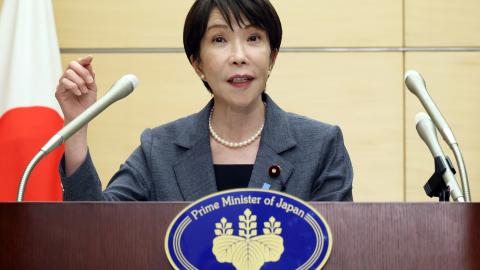
- The government of Prime Minister Sanae Takaichi has created a new fiscal initiative, the Strong and Prosperous Japan Investment Framework, to fund its flagship economic policy.
- A request of ¥12.2 trillion for this investment framework constitutes about 9 percent of the government’s total initial budget request for next year of ¥143.1 trillion.
- As additional funding is allocated for defense spending, the government’s total budget request for next year is likely to increase.
Introduction
In July, Japanese Prime Minister Sanae Takaichi announced the creation of a new fiscal policy initiative, the Strong and Prosperous Japan Investment Framework.[1] This initiative is part of Tokyo’s long-standing effort to increase foreign and domestic investment in Japan and supports the government’s flagship economic policy, Japan’s Growth Strategy. This policy sets the ambitious goals of increasing Japan’s total gross domestic product (GDP) from ¥673 trillion in 2025 to ¥1.1 trillion by 2040,[2] raising the real GDP growth rate above 1 percent, and bringing the nominal GDP growth rate above 3 percent.[3]
The growth strategy directs the Japanese government to prioritize 17 strategic sectors, including Japan’s green transformation (GX) and artificial intelligence transformation (AX).[4] The investment framework will fund projects related to the growth strategy, especially those that encourage greater private-sector investment.[5] The framework additionally sets funding priorities for AI, robotics, critical minerals, and supply chain security.
Tokyo hopes the investment framework doubles Japan’s annual flow of domestic, private-sector capital investment to ¥250 trillion ($1.6 trillion) per year by 2040.[6] To this end, the government is preparing a historic budget request for the next fiscal year (FY) of ¥143.1 trillion ($917.1 billion), with ¥12.2 trillion ($78.2 billion) allocated for the framework.
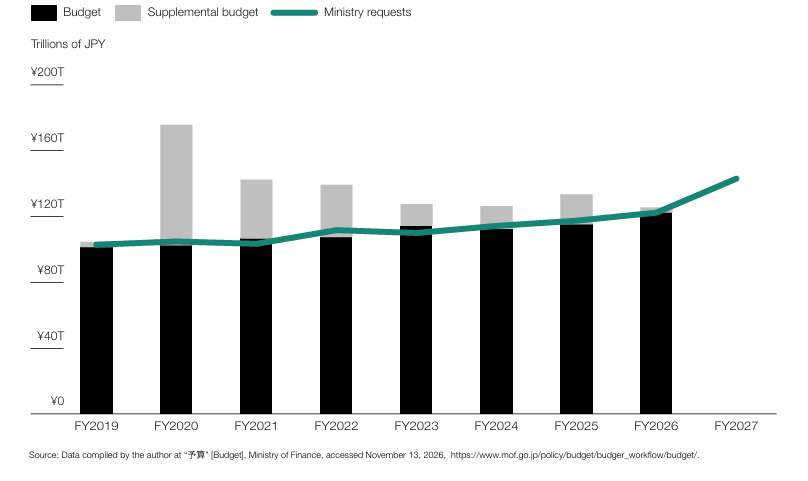
The government’s initial 2027 budget request of ¥143.1 trillion is about 17 percent higher than last year’s request of ¥122.4 trillion. However, what may ultimately pass the National Diet (the country’s legislative body) in March 2027 will likely exceed this amount once the government adds additional requests to its budget. Its initial request does not include defense spending, which many expect will increase.
As it enters its second year in office, the Takaichi government sees the investment framework, along with Japan’s Growth Strategy, as a necessary political tool designed to attract substantial foreign investment. Ultimately, Tokyo hopes its efforts will transform Japan into a more attractive investment destination.
Budgeting for a Brighter Future
Since taking office, Takaichi has argued that Japan needs a new growth strategy.[7] Japan’s first female prime minister believes that the country’s economy is beginning to experience growth, and does not want to see that momentum lost to austerity measures. Takaichi has further expressed that she does not want her government tied down by budget negotiations, especially as other countries with higher debt ratios than Japan’s formulate industrial policies.
Takaichi has designed this year’s budgeting process to lower the likelihood of that outcome. Historically, Japan’s regular budget process begins when various ministries make initial requests. The cabinet then adjusts these requests and sends them to the National Diet, which then debates these requests and approves some of them.
Traditionally, the Diet approves most of the cabinet’s initial base requests. In some years, the Diet has added more funding through special budgets: the country’s supplementary budgets were nearly equal to its annual budget in FY2020 due to the COVID crisis (see figure 1).
This year, Japan’s budgeting process will work differently. Unlike past efforts to support domestic growth strategies, the Takaichi government will fund its new framework through the creation of a special account designed to maintain flexibility for the allocation of funds. The government has also decided to abandon a ceiling that previous governments had maintained on budget requests, so ministries may increase their annual funding requests for this initiative.
For the new investment framework, budget requests will be for multi-year projects. This reform will allow the government to avoid the annual budget request process—and attain a certain level of predictability—in the coming years. Likewise, this year’s budget will prioritize allocating appropriations through the government’s normal annual budget process rather than through the unpredictable mechanism of a supplementary budget.[8]
Figure 1. Japan’s Annual Budget Request and Total Budget Amounts
Source: Data compiled by the author at “予算” [Budget], Ministry of Finance, accessed November 13, 2026, https://www.mof.go.jp/policy/budget/budger_workflow/budget/.
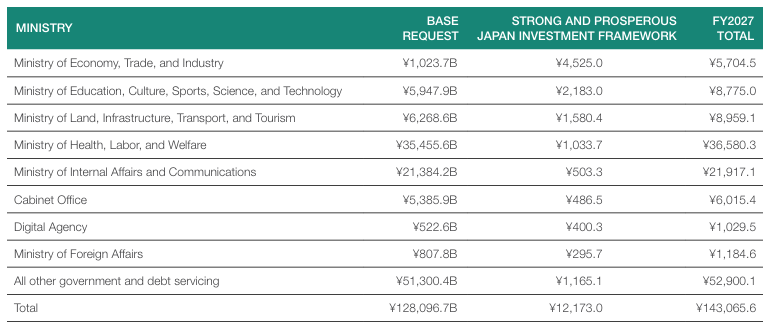
So far, the government’s initial budget for the investment framework has reached ¥12.2 trillion ($78.2 billion), roughly 8.5 percent of the total ¥143.1 trillion ($917.1 billion) expected for FY2027 (see table 1).[9]
Next year’s total budget request may be quite different from this year’s, as the government is expected to update its strategic documents (Japan’s National Security Strategy, National Defense Strategy, and Defense Buildup Program) and produce a revised request. A previous government undertook a similar effort in 2022 and increased the country’s defense budget by 100 percent over its initial request. Reports suggest that the current government’s defense budget request could be for as little as ¥60 trillion over the next five years, or ¥12 trillion per year.[10]
Table 1. Ministries’ FY2027 Budget Request
Source: Data compiled by the author at “令和9年度一般会計概算要求・要望額・「強く豊かな日本」投資枠” [FY2027 general account budget request and funding requests: investment framework for a strong and prosperous Japan], Ministry of Finance, September 4, 2026, https://www.mof.go.jp/policy/budget/budger_workflow/budget/fy2027/sy20260904.pdf.
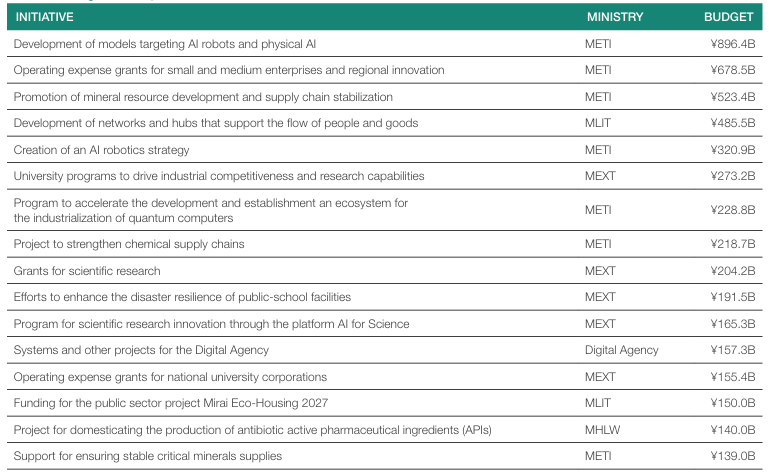
Meanwhile, the government’s ¥12.2 trillion request for next year’s investment framework makes significant changes to the budgets of several of Japan’s ministries. Assuming these budget requests remain unchanged through April 2027, the Ministry of Economy, Trade, and Industry (METI) will see the largest budget increase by far. METI’s total budget request for next year is ¥5.7 trillion, an increase of 450 percent over its annual base request of just ¥1 trillion. Other ministries are also expected to benefit from the investment framework, including the Ministry of Education, Culture, Sports, Science, and Technology (MEXT), the Ministry of Land, Infrastructure, Transport, and Tourism (MLIT), the Ministry of Health, Labor, and Welfare (MHLW), and the Digital Agency.
Table 2. Strong and Prosperous Investment Framework Initiatives
Source: Data collected by the author at “令和9年度 経済産業省関係 概算要求等概要” [Overview of the Ministry of Economy, Trade, and Industry’s FY2027 budget requests and related funding proposals], METI, accessed November 13, 2026, https://www.meti.go.jp/main/yosangaisan/fy2027/pdf/01.pdf; “『「強く豊かな日本」投資枠』一覧” [List of projects under the “strong and prosperous Japan” investment framework], MEXT, accessed November 13, 2026, https://www.mext.go.jp/content/000448279.pdf; “『「強く豊かな日本」投資枠』一覧,” “別紙様式2” [List of projects under the “strong and prosperous Japan” investment framework, appendix form 2], Digital Agency, accessed November 13, 2026; https://www.digital.go.jp/assets/contents/node/basic_page/field_ref_resources/3c1082e1-dc3c-4fc8-ac9c-9459a8e8b653/1851da24/20260904_policies_budget_r8request_table_04.pdf; 『「強く豊かな日本」投資枠』一覧,” “別紙様式2” [List of projects under the “strong and prosperous Japan” investment framework, appendix form 2], MHLW, accessed November 13, 2026, https://www.mhlw.go.jp/wp/yosan/yosan/27syokan/dl/toushiwakuitiran.pdf; “『「強く豊かな日本」投資枠』一覧” [List of projects under the “strong and prosperous Japan” investment framework], MLIT, accessed November 13, 2026, https://www.mlit.go.jp/page/content/002022149.pdf.
The Slow Awakening of Japan’s Economy
Conditions of austerity and static business and consumer sentiments have weighed on the Japanese economy since the early 1990s. In the ten years preceding 1991, Japan’s nominal GDP grew by an average of 6 percent per year. Since then, the country’s economy has grown by an average of only 1 percent per year. Prime Minister Takaichi is right to say that Japan’s economy is now growing more than it has in decades, by an average of nearly 4 percent across the last five years.[11] While the country has a large public debt, Takaichi believes Japan can reduce its debt-to-GDP ratio simply by increasing its GDP.[12]
Shocks to global supply chains since 2020—from the COVID pandemic through the Russian invasion of Ukraine to US tensions with Iran—have caused energy and food prices in Japan to rise. For better or worse, these external shocks are finally creating the inflationary pressure that the Bank of Japan (BOJ) has sought for decades.
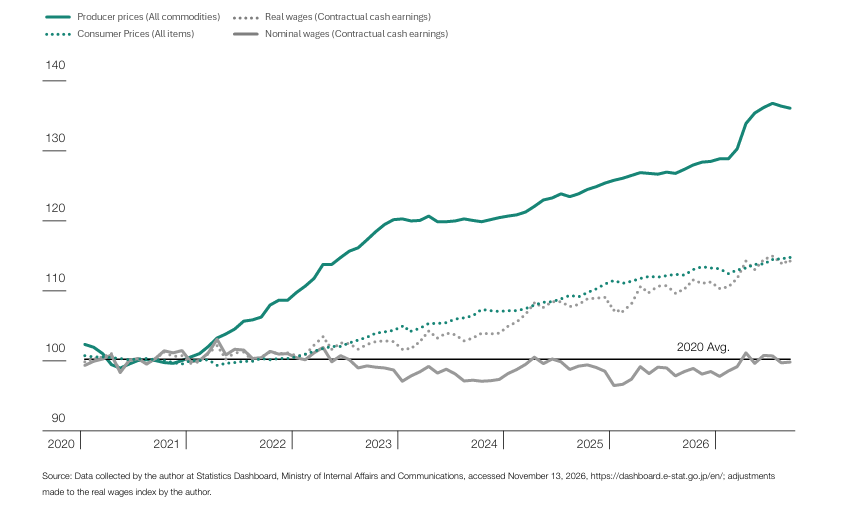
Today’s volatile global environment and the rising costs it has yielded have helped weaken Japan’s rigid wage environment, leading to new wage and economic growth.[13] Japanese workers are now seeing substantial nominal wage growth, with contractual wages 12 percent higher this year than they were in 2020 (see figure 2).
Figure 2. Price and Wage Growth (Index to 2020 Average)
Source: Data collected by the author at Statistics Dashboard, Ministry of Internal Affairs and Communications, accessed November 13, 2026, https://dashboard.e-stat.go.jp/en/; adjustments made to the real wages index by the author.
However, the higher cost of goods and the weakening yen have become persistent drags for Japanese businesses and households. A rise in consumer prices has continued to outpace nominal wage growth nationwide. As a result, real wage growth in Japan remains negative.[14] Meanwhile, producer prices are up over 35 percent from what they were in 2020. Nearly 30 years of near-zero growth in the consumer price index have created an environment where businesses are reluctant to pass increased costs on to consumers.
The BOJ may be anxious about rising inflation. But the bank is cautious about taking any excessive action that could harm Japan’s recent growth momentum, especially given the unpredictability of external conflicts.[15] Therefore, the bank has incrementally raised its policy rates, from -0.1 percent to just 1.25 percent this past September. These rates have direct implications for the Takaichi government’s fiscal plans, as higher rates increase the cost of borrowing.
The risks of increasing costs for consumers are not lost on Takaichi, who has been spearheading an effort to reduce the consumption tax on food from around 8 percent to 1 percent for the next two years.[16] Because the consumption tax has provided the government with roughly 30 percent of its annual tax revenue,[17] lawmakers are worried about what this move could mean for Japan’s fiscal health. The change could reduce Japan’s annual tax revenue by as much as ¥4.3 trillion per year.[18]
Returns from the food consumption tax account for roughly 4 percent of Japan’s annual tax revenue of around ¥84 trillion. Turning off this spigot would essentially curb Japan’s tax yield to 2025 levels, assuming the economy and other tax revenues do not grow. This would place additional pressure on the government as it looks to increase next year’s budget.
However, despite a large level of government debt (¥1.3 trillion as of September 2026), Japan’s fiscal situation has improved over the last six years.[19] The expenditure deficit of the central government has made its way back to pre-COVID levels and is on track to possibly run a surplus in just a few years.
Recommendations
As the Takaichi government prepares its budget request for the Strong and Prosperous Japan Investment Framework, it should still pursue the following measures.
- Increase defense spending. While the government will likely request ¥12.2 trillion for the investment framework next year, this amount is lower than the expected request for defense, which will average ¥12 trillion a year over five years. This would be less than 2 percent of annual GDP. Washington will question Tokyo’s national defense plans if the defense budget is not at least equal to the investment framework.
- Prepare for long-term, modest inflation. Global conflicts have caused inflation in Japan, but prices may not come down even if these wars end, especially as wages have risen. For better or worse, Japan is finally achieving the inflation it long sought. However, young adults and those on fixed incomes are not accustomed to inflation and are therefore unprepared for changes in their cost of living.
Conclusion
Despite volatility in global markets and uncertainty in Tokyo’s relations with the United States and China, Japan’s economy is doing well and is on track to be widely attractive to global investors in the years ahead. The government’s initiative to fund emerging sectors comes at an opportune time for the Takaichi administration and for Japanese industry.
Whether the government’s new investment framework succeeds will depend on how it is implemented. But new flexibility in the country’s budget-request process will make it easier for the Takaichi government to make any necessary changes over the next two years.
Endnotes
- “Press Conference by Prime Minister Takaichi Sanae,” Prime Minister’s Office of Japan, July 27, 2026, https://japan.kantei.go.jp/105/speech/202607/27kaiken.html. ↑
- “April–June 2026 (The Second Preliminary),” Cabinet Office, accessed November 13, 2026, https://www.esri.cao.go.jp/en/sna/data/sokuhou/files/2026/qe262_2/gdemenuea.html. ↑
- US dollar estimates based on a 156JPY/USD exchange rate. Japan’s Growth Strategy includes the Strategy for the Future of Regions. See Japan’s Growth Strategy (Cabinet Secretariat, July 21, 2026), https://www.cas.go.jp/jp/seisaku/nipponseichosenryaku/pdf/jgs2026en.pdf; “地域未来戦略本部” [Headquarters for regional future strategy], Cabinet Secretariat, accessed November 13, 2026, https://www.cas.go.jp/jp/seisaku/chiikimirai/index.html. ↑
- The 17 sectors are AI and semiconductors, digital technologies and cybersecurity, information and telecommunications, quantum technologies, defense industry, aviation and space, ocean, shipbuilding, materials (critical minerals and components), synthetic biology and biotechnology, drug discovery and advanced medical care, natural resources, energy security and GX, fusion energy, disaster management and national resilience, port logistics, food tech, and content industry. See Japan’s Growth Strategy. ↑
- “『「強く豊かな日本」投資枠』の予算編成についての考え方 ” [Approach to budget formulation for the “strong and prosperous Japan” investment framework], Ministry of Finance, accessed November 13, 2026, https://www.mof.go.jp/policy/budget/budger_workflow/budget/fy2027/tousiwaku1.pdf. ↑
- Private, non-residential investment was ¥128 trillion in FY2025. See “April–June 2026 (The Second Preliminary)”; Japan’s Growth Strategy. ↑
- “Press Conference by Prime Minister Takaichi Sanae.” ↑
- “令和9年度概算要求基準の概要” [Summary of the estimated requirement criteria for the 9th fiscal year of Reiwa], Ministry of Finance, September 2026, https://www.mof.go.jp/public_relations/finance/202609/202609d.html#article. ↑
- “令和9年度一般会計概算要求・要望額・「強く豊かな日本」投資枠” [FY2027 general account budget request and funding requests: investment framework for a strong and prosperous Japan], Ministry of Finance, September 4, 2026, https://www.mof.go.jp/policy/budget/budger_workflow/budget/fy2027/sy20260904.pdf. ↑
- Nobuhiro Kubo and Tamiyuki Kihara, “Finance Ministry Looks to Rein In Defense Spending Push amid Funding Concerns,” Japan Times, November 13, 2026, https://www.japantimes.co.jp/news/2026/11/13/japan/defense-buildup-fiscal-constraints/. ↑
- “Nominal Gross Domestic Product (GDP) for Japan,” Federal Reserve Bank of St. Louis, updated September 7, 2026, https://fred.stlouisfed.org/series/NGDPSAXDCJPQ#. ↑
- Increasing nominal GDP would reduce the debt-to-GDP ratio. See Tim Hains, “Bessent on $40 Trillion Debt: Biden Left Us a Mess, ‘We Have to Grow Our Way Out,’” RealClearPolitics, August 20, 2026, https://www.realclearpolitics.com/video/2026/08/20/bessent_on_40_trillion_debt_we_were_left_with_a_mess_the_biden_administration.html. ↑
- Nobuhiro Abe, Ryuichiro Hirano, and Sohei Kaihatsu, “What Prevents Productivity Gains from Translating into Wages: Lessons from Japan’s Deflationary Period” (working paper), Bank of Japan, August 2026, https://www.boj.or.jp/en/research/wps_rev/wps_2026/data/wp26e12.pdf; “Wages Indices,” Statistics Dashboard, Ministry of Internal Affairs and Communications, accessed November 13, 2026, https://dashboard.e-stat.go.jp/en/graph?screenCode=00090. ↑
- “CPI,” Statistics Dashboard, Ministry of Internal Affairs and Communications, accessed November 13, 2026, https://dashboard.e-stat.go.jp/en/graph?screenCode=00250. ↑
- Peter Landers, “Bank of Japan Must Ensure Underlying Inflation Doesn’t Go above 2 Percent, Ueda Says,” MSN, October 16, 2026, https://www.msn.com/en-us/news/other/bank-of-japan-must-ensure-underlying-inflation-doesn-t-go-above-2-ueda-says/ar-AA2enWmZ. ↑
- “Japan Government Approves Two-Year Food Consumption Tax Cut to 1 Percent,” NHK World-Japan, August 6, 2026, https://www3.nhk.or.jp/nhkworld/en/news/20260806_B1/ ↑
- “FY2025 Survey of the Amount of Tax and Stamp Revenues,” Ministry of Finance, May 2026, https://www.mof.go.jp/english/policy/tax_policy/taxes_and_stamp_revenues/202605e.pdf. ↑
- “飲食料品“消費税率1%”で年4兆3000億円の減収 高市総理が試算を示す” [Food and beverage tax cut to 1 percent would reduce tax revenue by ¥4.3 trillion annually, Prime Minister Takaichi presents estimate], TV Asahi, October 8, 2026, https://news.tv-asahi.co.jp/news_politics/articles/000538759.html. ↑
- “Central Government Debt (as of September 30, 2026),” Ministry of Finance, November 10, 2026, https://www.mof.go.jp/english/policy/jgbs/reference/gbb/e202609.html. ↑