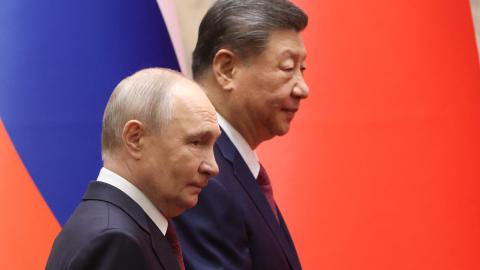
Caption
Russian President Vladimir Putin and Chinese President Xi Jinping enter the hall during a signing ceremony on May 20, 2026, in Beijing, China. (Getty Images)




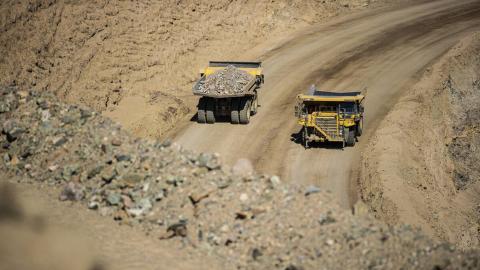
Supply chains have been central to the second Trump administration’s foreign and national security policy platforms. As global security deteriorates, policymakers need to act quickly to ensure American manufacturers can access materials that are vital for national defense and economic resilience.
At the heart of this effort is the United States government’s drive, in collaboration with private industry, to develop domestic critical mineral supply chains. China’s near monopoly on critical mineral processing gives Beijing the ability to influence trade negotiations and exercise economic coercion. Through these unfair trade practices, China seeks to further weaken America’s vital industries and security interests.
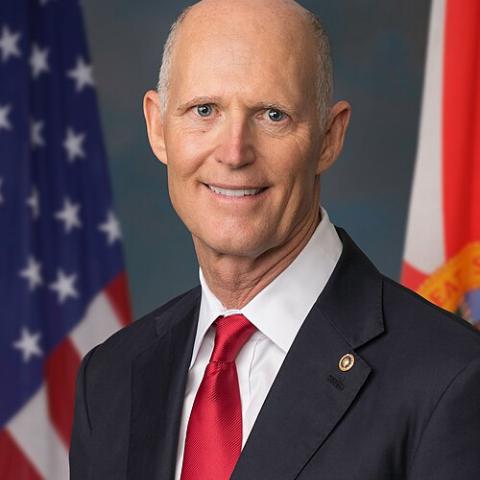
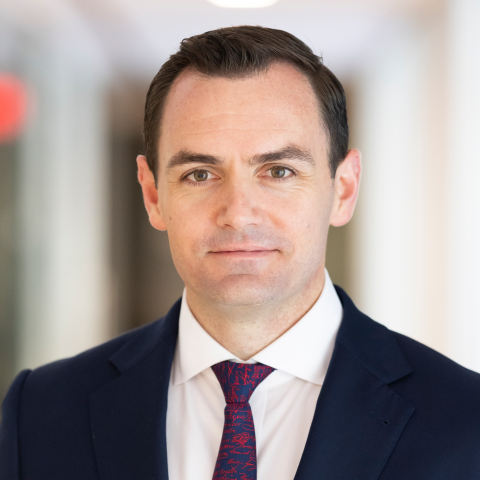
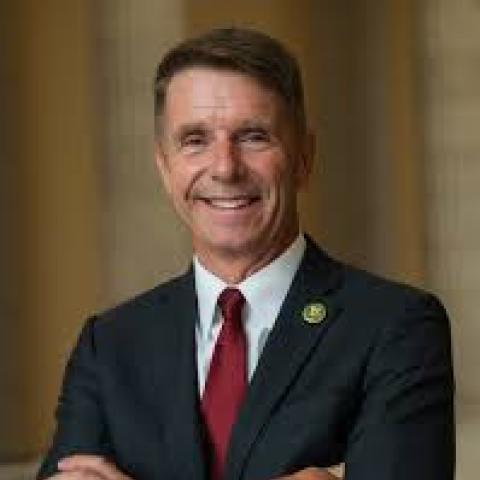
Join Distinguished Fellow Mike Gallagher and Congressman Rob Wittman (R-VA) for a discussion on the congressman’s recently introduced Securing Essential and Critical US Resources and Elements (SECURE Minerals) Act and Congress’s role in securing America’s economic security.
Listen on Spotify and Apple Podcasts.
Mike Gallagher:
All right. Good evening. It’s great to be with you at the Hudson Institute, and it’s especially great to be joined by my good friend, Rob Wittman. I consider Rob a mentor and a friend. You’ll have to ask him if he considers me a mentee or if he wants to disclaim the relationship we had for eight years in Congress. But as you will soon find out, if you don’t know Congressman Wittman, he is one of the hardest-working and most thoughtful members of Congress. I swear that is not damning by faint praise. He is one of just the highest integrity national security professionals you’ll ever meet.
I think tonight’s discussion will also be distinguished by perhaps the only discussion on its surface in Washington DC that’s not focused on the ongoing kinetic operations in Iran. That’s not to say, however, there aren’t any lessons to be learned from what’s happening in Iran and what we’re here to discuss tonight.
If you log onto X for more than a few seconds, and I’m sure you’ll see some discussions not only about this conflict, but you’ll also see about the potential economic blow that the loss of Iranian crude could deal to China. There’s some truth there. Iranian oil makes up an estimated 13 percent of China’s total seaborne imports. So, when you combine the loss of Iran’s oil with that of Venezuela’s, and consider that China was able to purchase each at a steep discount due to sanctions, there’s no doubt that China will be facing some economic headwinds here. But if you think about a 15 to 20 percent reduction in oil supply as an economic blow to China, just think about what a 90 percent reduction in rare earths would do to our economy, to America’s economy. And that’s why we’re here today, to discuss how we prevent that from happening.
As a former general secretary of the Chinese Communist Party, Deng Xiaoping once said, “The Middle East has oil, China has rare earths.” But I don’t think he even envisioned the sheer magnitude of supply chain dominance China would have here. Today, China not only controls roughly 60 percent of the world’s rare earth mining but also processes over 90 percent. So, with the flip of a switch, and this is something that came out in the war games we did on the Select Committee on China with Congressman Wittman, China can literally take a range of supply chains offline and halt production on everything from phones to cars to F-35s. Everyone under the age of 25 shuttered when I said phones, the older people shuttered at F-35s. So, the only comparison to an event of this economic magnitude would be, I think the oil embargo of the 1970s, when OPEC nearly quadrupled oil prices overnight and they wrought much havoc having controlled only 50 percent of the global oil supply.
So today, we are having a critical, critical discussion. And I would go further and to say that one of the insights I gleaned, particularly my last two years in Congress, is that we cannot have deterrents in a military sense if we remain economically dependent on the adversary that we are trying to deter.
So here to help us make sense of that is Congressman Rob Wittman from the great state of Virginia. He claims that he founded America based on the lineage of his district and considers himself an honorary framer. I was fortunate enough to travel the world with Rob. If you’ve ever gone to Rob’s office, if you don’t like fish, I would not recommend going there. It is filled with fish that he has caught himself personally. He’s a world-class angler if you don’t know him. But he pays incredible attention to these issues. He, in every meeting, bilateral meeting with foreign defense ministers, meeting with defense companies, Rob was always engaged. He was always informed. I learned a ton serving with Rob Wittman in Congress. So please join me tonight to talk about his legislation, the SECURE Minerals Act, Congressman Rob Wittman of the Great State of Virginia.
Congressman Rob Wittman:
Thanks, Mike.
Mike Gallagher:
Thank you.
Rob Wittman:
Thanks, Mike. Thank you so much. Well, Mike, thank you. And I do indeed consider you a close friend and a mentor to me because there are a lot of things that you did as chairman of the Select Committee that were really outstanding and pushed the issues as it related to what the United States needed to do, not only in relation to other countries and the world economy, but also in relation to the severe threat from China. And Mike’s 100 percent right, we are at one of those points in United States history where we have to look at where we are economically and strategically. And you can look at where we’ve been in relation to critical minerals and rare earth and say, “Well, we used to be one of the world’s largest producers of those critical minerals and rare earth.” And then we believe that, well, we can just hand that over to other countries that are doing that work because somehow we’re going to be in the value-added space. So, we won’t mine the minerals, we won’t refine the minerals, we won’t smelt those metals, we’ll just produce the high-end stuff.
And then we looked at it and said, “Well, we won’t produce the semiconductors. We’ll let somebody else do that. We’ll just produce the flat screen TVs.” And all of a sudden, we said, “Well, we’re not even going to do that.”
So, we abandoned most all of the supply chain. And today, what we look at is to see that when we abandon the supply chain, we weaken the United States, and we handed over our economic and strategic future to other countries, most specifically China. And as Mike pointed out, a lot of our work on the Select Committee was about how do we address those vulnerabilities today? How do we make sure we get back into that business? How do we make sure that we get back into reshoring the supply chain? How do we get to the left of the things that we know are critical for this nation? Mike talked about cell phones, talked about F-35s, and we understood, going through COVID, that we are overly dependent on the elements of the supply chain that have no sourcing here in the United States. So, the question is, how do we get back to doing that again?
I would argue that it is a long and arduous road, and it has to take several steps. First of all, is we have to understand that China does not operate by the rules like everybody else does. They are going to try to dominate the world’s supply chain by a variety of different measures. And as Mike pointed out, it’s interesting to watch how that developed. If you look at how they continue to take up more and more of the extraction capability on earth in places like the Democratic Republic of Congo, places like Peru, places like Chile, and other places, you look at it and go, “Wow, they’re in every part of the world, not just in China.” And you look at the extraction capability, and all of a sudden, we see today that they dominate about 70 percent of the world's extraction capability. They dominate about 90 percent of the world’s refinement capability and about 93 percent of the world’s smelting capability.
So, what we have to be able to do is to say, “Okay, let’s get back in that business. How do we get back into extracting minerals? How do we get back into refining minerals? And how do we get back into smelting minerals?” You have to be able to produce the final metal in order to produce things. So we’d ask questions about how do we do that? The administration has said, “Hey, that has to be a priority.” You just saw recently with EXIM Bank. EXIM Bank says, yes, that needs to be a priority with Project Vault.
So, everybody’s looking at how do we combat the unfair trade practices by China? How do we get back in the supply chain? I spent August going to South America, talking to leaders in places like Chile, like Peru, like Argentina, for us to get back into conversations with them about what they’re doing in their future mining operations. What are we doing too in countries like Democratic Republic of Congo that is interested in having the US presence there versus China? All those things are part of what we have to do going forward.
And the question then becomes, how do we structure policy in the United States to make sure that those things happen? In the past year, I had the honor to chair a work group under the Select Committee on the strategic competition between the United States and the Chinese Communist Party on critical minerals and rare earth. And what we saw was actually in July of 2024, a memo that came out from China, and people thought it was fairly minor. China said, “We are not going to in any way, shape, or form, sell or allow the transfer of technology on rare earth magnets.” And folks looked at it and goes, “Well, that doesn’t have any big impact, and it’s not a big deal.” And then all of a sudden, a year later, China says, “Not only are we not going to sell the technology to produce magnets, we’re not going to sell rare earth magnets except to those people that we agree to and those people, those countries that will do what we tell them to do.” So, the United States was kind of cut out of that supply chain.
And then two, it creates some big problems for us because when we have a provision in the National Defense Authorization Act that says you can’t buy drones or any parts of drones from China, and by the way, every small powerful electric motor has what in it? Rare earth magnets. So, all of a sudden, we made it impossible for companies to comply with that. So, we created our own set of complications there.
Long story short, we did a year’s worth of hearings, hearing from folks across the spectrum. People had tried to get in the mining business who were pushed out of the mining business by dumping efforts by China. China’s very forthright and said, “Hey, listen, we are going to sell below the market cost because we want to be able to gain market share.” They’re very willing to do that.
So we came up with a lot of suggestions from folks around the world to say, “What do we need to do to get back in the game?” And that resulted in the bill that we dropped about a month ago called the SECURE Minerals Act. And what it says is this, is we’re going to use every tool in the toolbox to make sure we open up opportunities for companies to go back into extracting minerals, to go back into refining minerals, to go back into smelting minerals. We have some great opportunities in the United States. We went to the Green Creek mine in Alaska, an incredible facility. They do a great job in protecting the environment and refining those minerals there, coming out with all kinds of different components there, lead, zinc, but also nickel, silver, gold. You name it, they extract it out of the ground there. And what we wanted to do is to say, how do we open the door for those companies to get into that business, to expand it?
And we saw a couple things happening at the federal government level. We saw the government itself do some things. We wanted to make sure that we were adding to the toolbox. So we wanted to make sure that we looked at ways to provide loans. We wanted to make sure too that we had a mechanism to aggregate demand in the United States.
So, everybody that says, “Hey, we need some lithium,” we wanted them to say, “Okay, put your demand into this marketplace so we can aggregate demand.” And then what we wanted to do is to say, “Okay, lithium mines, here’s the aggregate demand, and we want you to be able to tell us what is your base price of production. So, what does it cost you? Is $10 a ton, $11 a ton? What’s your base price of production? And we want you to understand that you can enter into this marketplace, and there are customers there that will agree to buy from you. And what the United States government will do through this entity is we will guarantee a price floor because we want to make sure that your cost or your pricing doesn’t drop below your cost of production.” And we know that that’s a great way to protect businesses because then they can continue to produce without worrying about unfair trade practices by China. So that’s part of the bill. We do that.
But we also enable other aspects. I talked about EXIM Bank putting together Project Vault, which is actually a physical reserve. Our bill creates a strategic resilient reserve that says we’re going to produce minerals into that reserve. We’re going to make sure that companies can buy. We’ll make sure that we guarantee a price floor to where it’s not going to drop below the cost of production. It’ll be transparent so we’re not going to have any secret deals about who gets what. We also want to make sure too that, if necessary, that there are loans available there, we also want to make sure too, we’re enabling other imaginative ways for folks to be able to leverage capital to get into the mining business.
What we’re seeing right now is a really exciting effort in the private equity realm where people are starting to reinvest now in mining operations. So, this bill has gone through a hearing just last week in the House Natural Resources Committee. We also have another bill called the Finding ORE Act that says we ought to, through the US Geological Survey, work with other countries around the world, and we ought to make sure we have an up-to-date map to identify all the deposits of critical minerals and rare earth elements around the world. And then we ought to have strategic agreements with those countries to say, “Listen, we would like to help you develop your resources or at least make sure that we know where the resources are. So, if we need to have a cooperative agreement or we need to do things to help both countries that we’re able to do that.” So, the Finding ORE Act is another great opportunity for us to get those things going.
I think there’s great potential here in the United States for us to get back into that business. There’s been a lot of talk recently about the re-industrialization of the United States, and this is really all about the re-industrialization. It really is about making sure that we have the right place and mindset in the marketplace to make sure that we can do things and we can be independent of other nations that are just not going to be our friends. They want to economically and strategically defeat us. Not compete with us, but defeat us. And this is a way for us to do that, to acknowledge that there are going to be efforts by other countries to institute unfair trade practices, that they’re going to be deceptive, that they will not be truthful, that they will do things in every way, shape, or form that will not be in the United States interest, but be in their interest.
So, our job is to acknowledge that. Our job is to put the tools in place for our nation to, again, do the things it does well, and that is to be a producing nation that has the technology to do things better than anybody else on the face of the earth.
And the thing that I like about this is that the United States will do this and we will do it the right way. And Mike did a great job as Chairman Gallagher, chairing the Select Committee when he brought Uyghurs in and others to talk about the human rights violations there in China, China using forced labor, and they do that in their mining operations. One thing we know in the United States is we will not use forced labor or we will do everything possible to treat our workers the right way, to pay them a wage that’s commensurate with the great job that they do in these mines. I was just amazed at the Green Creek mine and the salary scale there, the workers there, the modernization, and then what they’re doing to protect the environment. We see what China does in other areas of the world where they literally destroy the environment in those areas. We know that we will do everything we can to protect the environment, protect our workers, and do it the responsible way. To me, it’s a no-brainer. Why don’t we want to develop our minerals here?
And we understand too, when I was up in Mike’s home district, one of his colleagues, Jack Bergman, represents the Upper Peninsula there in Michigan. Mike was on the Wisconsin side, but we know that those northern states there have the Midcontinent Rift, one of the largest deposits of minerals anywhere in the continental United States. And today as we speak, mining operations there are at a minimal. There is the Eagle Mine up there in the Upper Peninsula of Michigan, but that’s about it. There have been other efforts over the past couple of decades to try to get mining permits without success.
So, it’s not just making sure we’re opening up markets, but we got to do a lot on the reform side on environmental regulations. The good news is the Natural Resources Committee has passed out a bill called the SPEED Act that will reform the NEPA process to make sure that we are not having the impediments that have occurred through the last several decades in the process to actually be able to permit mines.
So, we’re making a lot of steps in the right direction. I’m excited about the opportunities and excited too to be able to have a little more discussion and get down into some of the nuts-and-bolts details of the things that we’re working on. So, Mr. Chairman?
Mike Gallagher:
Perfect. You can go right there.
Rob Wittman:
Yep.
Mike Gallagher:
Other one, other way. You go there.
Rob Wittman:
There we go. Okay.
Mike Gallagher:
Yes. Well, you reminded me, as I was sitting there, I forgot to tell my favorite Rob Wittman story. I swear I’ll make this an elegant transition. When I was a freshman member of Congress, I was traveling with you. I think we’re going to Italy on a shipbuilding tour. And my staff, having conferred with your staff, said, “Whatever you do, do not check a bag.” Chairman Wittman, who was chair of the Sea power Subcommittee, travels light. He’s very proud of something he calls a SkyRoll. Which is like a sleeping bag thing that you—
Rob Wittman:
That’s right.
Mike Gallagher:
But like literally, oh, he travels around the world with just a backpack. Do not check a bag. So I was very . . . I’m a Marine, I’m expeditionary. This fits well with my mindset. So, I show up at the airport and our colleague, who’s also a retired Marine, showed up with a massive checked bag. And I saw you looking at him, who shall remain nameless, Palazzo—
Rob Wittman:
That’s right—
Mike Gallagher:
But I always laugh when I think about that. You travel light.
Rob Wittman:
Yeah, I do. I do. We almost made him leave the check bag behind, but anyway.
Mike Gallagher:
Well, we got there. But I’m curious, I mean, you really were the leading voice on naval issues for most of my time in Congress. Obviously, you have diverse interests, but I’m struck by the fact that you led the strategic minerals working group. You mentioned the EXIM activity in this space, the MP Materials deal that DoW did. There just seems to now be all this interest in this issue. When for you was the moment when you started to pay attention to it or see it as sort of related to the work you were doing on the more conventional military side of the equation?
Rob Wittman:
Sure. Well, it goes back several years. I started to see efforts by China in South America to mirror the things that were happening in Africa. We saw the predominance they had 16 to the 18 miles of the Democratic Republic of Congo were Chinese mines. We started to see them doing the same thing in South America. And I had a deep sense of worry there, understanding that they gained more and more of the world market share in the extraction and refining of minerals, as well as smelting of minerals. So, I looked at it and said, “We need to do all these things as far as recapitalizing our industrial base, the defense industrial base, but all those are contingent upon these critical minerals and rare earth elements.” And then, as I looked at continual policies coming out of China that were actually counter to the things that we were trying to do, I began to see what the pattern was and what China’s intentions were.
They were very much not just competing with us strategically, but then it became an economic issue. And then it wasn’t even a competition. It was actually seeking harm by what they would do in limiting those materials coming to the United States, or what they would do, creating unfair trade practices, trying to keep us from getting into that business. And then when we didn’t have access to that, and we were reliant upon China, again, a great lever point for them to do some things that are not in the United States best interest.
Mike Gallagher:
Yeah. So, getting into the Secure Minerals Act, is it fair to draw the analogy to the strategic petroleum reserve? Maybe tease out for us similarities, differences. Is there a better analogy out there?
Rob Wittman:
Yeah, I would say that it’s somewhat like there’s a petroleum reserve, although this is meant to be a dynamic system, or a petroleum reserve is meant to go ahead and store large volumes of oil. And in case you need it, you go there and you take it out of the reserve and you use it. This is meant to be a dynamic reserve where you have metals that go into the reserve, people are buying metals out of the reserve, the producers are putting them into the reserve. So, it’s more of an exchange sort of mechanism. And really what it’s meant to do is to operate like federal flood insurance or federal crop insurance.
Where you create a floor, and the government is the reinsurer. And the reason the government’s the reinsurer for crop insurance and for flood insurance is because the reinsurers out there understand that you can’t get into that space because in many times if you have large natural disasters, it’s more than what a reinsurer is willing to pay or the risk that they’re willing to take. The same here, what we’re saying is that we want to make sure that we create the price floor. We want to make sure too that there is at least a guarantee there. So, as investors put their money in and we have to navigate the unfair trade practices by China that we create that floor, we think what can happen with that is we can actually change the behavior of China because if they look at that and go, “Hey, there’s no benefit by dumping because this marketplace is going to exist.” And we can also look at having other partner nations as part of that.
So, what we want to do is to kind of open up the aperture to have more in that space and then be able to counter what China does in an unfair trade way. So, it’s more like an insurance reinsurance model than it really is a reserve itself because the reserve is dynamic. It moves product in and out.
Mike Gallagher:
Can I think of this also, just in light of not only your bill and your thought leadership on this issue, but all the other things that are now happening in this space, which five years ago, I think it’s fair to say, you said critical minerals, people would be like, “What are you talking about? Is that like my AG1 that I put in my drink every morning?” Are you seeing this as part of a broader shift on economic stake craft or maybe an attempt not to do industrial policy, but creative economic decoupling from China? Talk to us about where this fits in that broader shift or focus.
Rob Wittman:
Sure. I think it’s a shift to say that we need to have a broader mindset about the tools that we have in our toolbox economically to be able to deal with what China’s doing. China has nothing off limits in what they do within these marketplaces. So what we want to do is to make sure that we have a whole plethora of tools in our toolbox, all within a free market model, not within a command and control model. So, this really gives us the ability to work across a number of different sectors. I had some great meetings with the leadership in EXIM Bank and they unveiled Project Vault, which goes right in line with what this bill allows to be done. The same too. There’s been a lot of focus on where the government is as far as other efforts and things like purchasing equity stakes in these businesses.
I want to make sure that we have a full suite of opportunities that we’re not just limited to one way to be able to ensure that we have the proper capitalization in these operations. And it also includes a lot of folks just look at it from the extraction refining standpoint. There are only three smelters in the entire United States. The crazy part about it is when I went out to Alaska to go to the Green Creek mine, they did a great job extracting those minerals, they refined them on site. But then they sent the refined materials to where? China. They sent it to China because China’s the only country that can actually smelt those minerals, turn them into refined metals. And then what do we do? We buy back from China the refined metals in the same way on the recycling side. There’s a compound called black mass where you’re taking recycled materials, and they put it all together and then you run it through a refinement process and separate out the metals there.
Great opportunity for the United States to be able to be in that realm, but guess who the predominant force is in the black mass market? It’s China. They buy all this recycled material, and then they take it and refine it. And then what do they do? They sell it back to us. So, if you look at anything that has those metals in it, we pay for it once, and then we pay for it again when we have to buy it back from China. The good news is we have a number of companies that are using some incredibly thoughtfully innovative ways to recycle. And we can’t forget about that. We want to make sure we’re in the mining side, but we also want to make sure too that we have a very robust effort on recycling because if you do those things, you can actually produce a lot of what the United States needs and do it in a way that’s sustainable and you don’t have to worry about now buying those materials back from China.
Mike Gallagher:
Absolutely. You mentioned the work of EXIM. I think the leadership that Chairman Jovanovic is bringing to that organization, connected to and combined with what Ben Black is doing at the Development Finance Corporation, Congress appropriated a lot of money for the economic defense unit at the Department of War and then combined with what you’re doing in Congress. It starts to be a pretty exciting time for those trying to revitalize the instruments of economic statecraft, the way you lay out. Now it’s important we get it right because there’s obviously a smart way to do this. There’s a not-so-smart way to do this. I think, as conservatives, we would like the private sector to be involved. We have to get the incentives right. And I think what was interesting about the MP Materials deal is that it did unlock the offtake agreement as part of the deal, unlocked a lot of private capital to supplement what the government was doing.
Talk to us a little bit as you look at this space with your bill. What role do you see the financial community and the private sector playing?
Rob Wittman:
Sure. Well, listen, the offtake agreements are key. In fact, I would argue if you look going forward, offtake agreements are going to be an incredibly important part of whatever agreements these companies reach, especially to large buyers and also within elements of the Department of Defense. So, we want to make sure that we have that demand element that comes with those offtake agreements. Another thing too is I’m a believer that free markets work the best. I understand wanting to make sure that we’re helping these companies get through these tough times where they’re facing unfair trade practices, but at the same time, we want to make sure that if you do have those equity stakes purchases by the government, that you have the guardrails on there. And the big key is to make sure that there’s transparency, make sure too, that they’re used only in specific situations. So that’s where the guardrails come in. And make sure too that we understand that those instances should be only one of many tools in the toolbox.
That’s why I’m so adamant on the Secure Minerals Act is to say, “Yeah, the government’s done some things with MP materials, with Korean zinc, with Lithium America.” And I understand all of those things because at the time, that was really the only mechanism that was there available to the government to do that. That’s why having these additional tools and now what EXIM Bank has done is really opening up the aperture for a lot of capital to flow there, and for those entities and they are there ready to go. That gives us the opportunity to scale up those entities very quickly on the extraction side. The only remaining piece is to make sure that we get the reforms to NEPA, the National Environmental Protection Act in place so we can actually get into extracting these minerals. And another thing too is when I was out in Alaska, it’s incredible too what we have in the nation of materials that have already been mined.
If you look at the tailings that are there, most tailings out there already have about 50 percent of minerals that are still left in the tailings. So we can go there and do rare earth and additional extraction of critical minerals there. So I want to make sure we’re looking at all of those things. This mechanism and the Secure Minerals Act allows us to do that.
Mike Gallagher:
I just remembered, Rob, you have a PhD, right?
Rob Wittman:
I do.
Mike Gallagher:
In what?
Rob Wittman:
In science and public policy.
Mike Gallagher:
Science and public policy. I should have called you doctor. I’m sorry. I unsuccessfully try to get people to call me doctor, and nobody knows it. So, yeah.
Rob Wittman:
It’s doc and doc then.
Mike Gallagher:
That’s right. There was a debate in my first month in Congress of like, should I put Dr. Gallagher on the sign outside my office? And Mac Thornberry, who was chairman of the committee at times said, “Do not do that. You will have no friends at all.”
Rob Wittman:
That’s right. Yeah. Hey, I’m the same way I’ll tell people I’m just Rob. No doctor.
Mike Gallagher:
Yeah exactly. Just a humble angler from Virginia. Okay. So, you’re pushing this at a time when there’s a lot of activity in the US-China competition, Trump is reportedly going to China soon. Are you looking for something related to critical minerals to come out of that summit? Do you think Congress has a constructive role to play in terms of the signals it’s sending to the executive branch prior to that summit? And maybe more broadly, what has been the White House reaction to your work dust?
Rob Wittman:
Well, we’ve met with the critical minerals and rare earth director within the White House and had some great conversations. So, what we would like for the president and the president’s team to take with him to China, as far as conversation with Xi is, what is China doing? And they’ve had some discussions about this with the tariff discussion and the impacts that those efforts by China are having in the realm of critical minerals and rare earth. But I think the most critical questions are what can be done to open up the places where we at least in the interim need China’s sourcing. And that is for magnets, for technology surrounding magnets. I think we have to find a way for us to do that. And the president’s been able to open a little bit of a window there. We also have some European suppliers, but on a much, much smaller scale.
I mean, China predominates that marketplace. So I think strategically you have to look at where are the places where we need to tell China that these are the things that need to come out of this meeting and where we need to have an agreement to at least in the interim, have them release technology, release the sale of rare earth magnets to the United States because in the interim, we’re having a hard time meeting some of the requirements. I think we ought to be not buying drones from China, but the challenge is, is when you say you can’t buy drones from China and you can’t have drones made of any Chinese components, and the only place to get those components is China, it creates a really, really tough situation. So, we have to find kind of an interim or a bridge until we can get to that place. I think the president has to emphasize that.
And then look at it and say, “What’s China going to do in return to make sure that they’re not instituting unfair trade practices?” I think that’s another element to say. I think too, the president will have a tool in going there and say, “Hey, Congress is going to do some things to really level the playing field. So we’re going to get back into this business.” And then two, the agreement now that we have with Australia and others in the metal production business that actually helps us, that’s a big lever for us to be able to get China to act properly within that marketplace. So, I think there are some things that he can do there to really enable the United States to get back into that supply chain place that’s so critical for our nation.
Mike Gallagher:
Let’s pull the string on your Australia comment. The bill doesn’t just talk about American production capacity. It talks about our allies. Maybe tell us a bit more about the role you see our allies playing as part of your bill more broadly. What capacity do our allies have that expertise do they have that we can leverage? What barriers still exist to cooperation that we can destroy?
Rob Wittman:
Well, I think that there are some really good agreements out there. Obviously, there’s an agreement with Ukraine that didn’t get a whole lot of notice, but a great agreement for us to be able to access and help them capitalize their extraction capabilities there and refining capabilities in Ukraine. Obviously, they still have a little issue to deal with with Russia there, but they’ll get through that. But you look at the agreement that we have with Australia. If you look at where Australia was just five years ago, I mean, they had about a 7 percent GDP growth annually, and it was due almost exclusively to minerals. And I’ve been there at Adelaide and other places, their mining technology there, far surpasses ours because they’re actually in the mining business. So, there are a lot of places where we can benefit from that with those agreements. Another thing we need to look at, too, is other nations in the Indo-Pacific, where I think there are opportunities for the United States to have agreements. One place where we missed out was Indonesia.
Mike Gallagher:
Yeah.
Rob Wittman:
Indonesia has significant mineral deposits there. They also do a lot of extraction, refining, and also smelting. The challenge is, is that China was able to jump in and get an agreement with them before the United States. I think that there’s still an opportunity for the United States to enter into an agreement with places like Indonesia, but we ought to be looking at those Pacific Island nations for opportunities there. Another thing too that doesn’t get mentioned that is a great opportunity. We have several companies in the United States that are pursuing this. In China, believe it or not, this is one place where they’re running to catch up with us, and that’s deep sea mining. As you know, the largest deposit of minerals on earth is not on land, it’s in the deep seabed. So deep seabed mining is going to be a key going forward.
We actually have a number of companies that have developed technology to harvest those nodules. What we need to do is to have agreements with Pacific nations like Indonesia that have pretty robust refining and smelting opportunities there, and then have agreements with them for those minerals that we harvest to be landed and processed there, and then they come back to the United States. And I talked to the folks in Australia. I went there during the American-Australian legislative dialogue and spoke on critical minerals and rare earth. And we talked about why we don’t have an agreement with these companies that are doing deep-seabed mining and have an agreement for those minerals to be processed in Australia. It’s a lot closer to go to Australia than it is to bring them all the way back. . .
Rob Wittman:
. . . In Australia, it’s a lot closer to go to Australia than it is to bring them all the way back to the United States. And we know the cost associated with that is how many of those nodules you can put on board a ship and get it to a place where you can actually process them.
So, I think there’s almost an unlimited potential in things that we can do with other nations that are our friends, including Europe. Listen, there’s still significant mineral deposits there. The same way in places around the Middle East. And obviously, with things going on there now, as much as we focus on Iran, I think that you see other Arab nations there that are interested in deeper relationships with the United States. So, I would say things are improving in those areas. So, we need to be looking around the globe the same way, too, in Africa.
There are nations there that are tired of dealing with China that want the United States to be a partner, United States companies to be partners, and the same in South America. The largest producer of copper in the world is Chile. If you look at the refined minerals that come out of South America, they come by ship and they go to China. But the trip that they take actually goes to the north because of the currents and they all come within 500 miles of the Aleutian Island. So, I’ve talked to Dan Sullivan and go you know what? It’d be really smart to work with the Alaskan native corporations and look at doing a smelter there in Alaska because they have tremendous mineral deposits there and they’re going to be doing more to develop their own minerals. Why not put a smelter in there and then you could actually transact business with all the minerals coming out of South America and then stop them from going to China.
So, there are lots of opportunities there for things that we could do around the world. So I think the opportunities are unlimited.
Mike Gallagher:
Well, now I’m understanding the motivation behind this bill, which is it will allow you more time spent on boats fishing off Indonesia, the coast of Chile, pursuing your true passion. But good. And while helping America maintain its economic dominance.
Rob Wittman:
I tell folks—
Mike Gallagher:
These things are not mutually exclusive.
Rob Wittman:
I serve on a natural resource committee on the Fisheries, Wildlife and Oceans Committee. So, I do have to go there and make sure I have a knowledge of the fisheries population.
Mike Gallagher:
That’s right. That’s exactly. So maybe in a few minutes, I want to open it up to audience questions, but I want to dig a little bit into the practical or political nuts and bolts. There’s a bipartisan bill.
Rob Wittman:
Yes.
Mike Gallagher:
Talk a little bit about the support you have, both Republican, Democrat, and then the real divide, which is between the House and the Senate and what that means for the path forward for the bill itself.
Rob Wittman:
Sure. Yeah. Well, there’s actually a companion bill for Secure Minerals Act over on the Senate side. So, we’ve done a lot of work there with our Senate colleagues and our bill is identical to their bill. So, I think there’s an opportunity for us to really get this signed into law. So, I’m very bullish about it.
The good news is that folks on both sides of the aisle see that this is key for the United States. And here’s the bottom line. No matter where you are in the political spectrum about what you believe the minerals should be used for, the utility for those minerals falls in a whole wide area of political interest. So, if you’re interested in electric vehicles, if you’re interested in wind turbines, guess what? What do you need for that? Rare earth. Those are big magnets that are in there to be able to produce that electricity or to be able to drive that motor. And the highest efficiency generators and electric motors have rare earth magnets in them.
So, there’s an interest there. There’s also an interest on the national security side. So, the interest on this is very broad, which is nice because it brings in a whole variety of people who say, oh yeah, I want to be a co-sponsor of the bill. Let’s go ahead and do things to open the door for us to do these economic efforts here in the United States.
Mike Gallagher:
That’s great. I imagine NEPA reform is probably less bipartisan still, but—
Rob Wittman:
Yeah, listen—
Mike Gallagher:
I always thought that was just a low-hanging fruit or should be a low-hanging fruit and a massive unlock for America, but not necessarily politicized.
Rob Wittman:
And it’s really not. It’s becoming more of a bipartisan issue. There’s a book that’s written by several individuals that are ideologically on the Democrat side of the ideological spectrum called Abundance.
And essentially, they’ve said, hey, you know what? We have a tremendous abundance in the United States. It’s been the backbone of our economic prosperity. And right now what we’re doing is we’re creating such a bureaucratic morass to be able to actually develop those minerals and we’ll do it better than anybody else in the world. It actually hurts us and we ought to be able to find a bipartisan way to say, let’s protect the environment and add to our economy, and provide for our workers. And we can do that better than anybody else in the world.
So, I think there’s an opportunity on the bipartisan side of things. And even some of the NGOs out there that sometimes are averse to any reform there say, yeah, maybe in a lot of instances NEPA has gone too far. So, I think there’s a window of opportunity there to get NEPA reforms into law and actually open the opportunity for businesses across the spectrum. And it’s not just mining, but it’s other businesses too. We talk about businesses in the timber industry and those things that use our resources here. We ought to be looking at doing a lot more of that.
In fact, I would argue that we talk about minerals. If you talk about timber management, timber management has been a gigantic failure in the United States. Look at wildfires and the fuel that’s there. If we did a better job in managing our forest, and again, using NEPA and other tools, we could do a lot better job in providing for the economies of a lot of these rural areas that their only resources are their natural resources.
Mike Gallagher:
I don’t mean to suggest that when you’re talking about the strategic resilience reserve or things like off-take agreements and smelting, that this isn’t inherently sexy stuff. But I would say I always confronted a challenge of taking these issues, which can get pretty geeky, let’s say, particularly when you’re dealing with the economic and technological dimensions of our Cold War with China and translating it to your voters and making people understand why this matters. When you go back to Virginia, and you talk about this bill, what have you found resonates with your voters about this, and maybe US-China competition more broadly?
Rob Wittman:
Sure. What I’ll do is to point to the technology that people have come to rely on each and every day. So I’ll pull my cell phone out of my pocket and say whether you had an iPhone or a Samsung phone, you would not have that or would not have that computing capability without the core components in that phone. And those core components are based upon the rare earth elements that are in that phone.
So, if those rare earth elements aren’t available or if Apple doesn’t have access to the semiconductors and the semiconductors don’t get produced because there isn’t rare earth there, think about that. And it really gets kids’ attention today because if you talk about something that’s going to endanger their cell phone, boy their hair lights on fire. So especially I tell that to my grandkids and like, “Oh, what are you talking about granddaddy?” So I try to relate—
Mike Gallagher:
How many kids do you have now, Rob?
Rob Wittman:
I have six.
Mike Gallagher:
Congratulations.
Rob Wittman:
Yeah, thanks. So anyway, so one’s getting ready to go to college next year.
Mike Gallagher:
What?
Rob Wittman:
Yeah, yeah.
Mike Gallagher:
I mean this as a compliment. It always shocked me how old you are, Rob. You look very young. How’s that possible?
Rob Wittman:
I don’t know.
Mike Gallagher:
I look older than you.
Rob Wittman:
Shoe polish and formaldehyde.
Mike Gallagher:
Totally distracted you from your thought.
Rob Wittman:
No, I try to relate it to things that people become relying on each and every day and they have no idea about what are the component parts of that and how if there’s a risk to getting access to those parts, all of a sudden, guess what? Either don’t get your cell phone or instead of a cell phone costing a lot, it’s going to cost a whole lot.
So, when you put it in that perspective, all of a sudden people go, “Oh, I didn’t know that.” And then they’ll remember those little things because those things play such an important role in their lives. So I tell them too, in the same way with everybody’s now on edge about AI. And I said, “No, AI is actually going to be a pretty good enabler.” And by the way, AI is going to rely on lots of computing and when you go to these data centers and you have all the chips that are in there, those chips wouldn’t be there if it wasn’t for the rare earth that are in those chips.
Mike Gallagher:
All of these seem to be being built in Virginia. I don’t know why do you have so much pull, but it’s like ships and data centers—
Rob Wittman:
And data centers, yeah.
Mike Gallagher:
. . . new drug manufacturing facilities. So, Wisconsin’s available too.
Rob Wittman:
That’s right. That’s right.
Mike Gallagher:
Well, I usually do a fun lightning round. I’m technically out of time and need to go to audience questions. I do want to do one fun question or fun for me, let’s say.
Rob Wittman:
Sure.
Mike Gallagher:
Okay. So it’s very hard to be a member of Congress because you have to commute, which is why with a near pathological level of envy and hatred, we look at the members of the Maryland and the Virginia delegation, many of whom can drive home every night and we say, “Why don’t we have that same luxury?”
Rob Wittman:
That’s right.
Mike Gallagher:
Do you make productive use of this time, your commute?
Rob Wittman:
I do.
Mike Gallagher:
Are you books on tape? What is the day in the life of Rob Wittman going back and forth?
Rob Wittman:
Books on tape, which my staff abhors because I then put together a reading list for them after that.
Mike Gallagher:
I believe that, by the way.
Rob Wittman:
After the book’s on tape. But then I try to return some phone calls. I’m an early morning person, so people don’t appreciate phone calls five o’clock in the morning, but I do know some people that I can call at five o’clock in the morning and I will take advantage of that. But I’ll do podcasts and listen to books on tape and then just some mindless listening to music, those kinds of things.
Mike Gallagher:
So, are you on the road at five headed to the Capitol and then you’re headed back?
Rob Wittman:
Yeah. My biological clock goes off every morning, regardless of what time I go to sleep, I’m usually up by 3:30, 3:45. Yeah.
Mike Gallagher:
What time do you go to bed?
Rob Wittman:
10 o’clock.
Mike Gallagher:
That’s not enough sleep.
Rob Wittman:
I know.
Mike Gallagher:
Yeah.
Rob Wittman:
Let me tell you, everybody tells me that. My wife tells me that, everybody else says, “That’s not enough sleep, sir.” I said, “Well, I can lay in bed, but I won’t be sleeping.”
Mike Gallagher:
Okay. We need the driverless cars to emerge quickly so you can at least sleep on the commute back and forth.
Rob Wittman:
And then this electronic voice saying, “Rob, your car has arrived at the US Capitol.”
Mike Gallagher:
That’s right. There’s a vote in 15 minutes, Rob.
Rob Wittman:
That’s right, that’s right.
Mike Gallagher:
Well, I also wanted to ask one other. Obviously, the state of Virginia is very historic. Your district is particularly historic.
Rob Wittman:
Yes.
Mike Gallagher:
If you’re into the founding and framing era of America, what is the fun thing to do in your district?
Rob Wittman:
Well, listen, with the 250th coming up, there’s so many great places there. My district goes Williamsburg, Jamestown, Yorktown, where it all began, all the way up to the Northern Neck, which is the birthplace of George Washington. James Madison, James Monroe, the Lee family, Richard Henry Lee, Harry Light-Horse Lee, all signers of the Declaration of Independence.
I tell folks that I’m very, very honored because the first two individuals that ran in 1789, the first United States Congress, not continental contract, 1789 when the Constitution was finally ratified, the race in Virginia and what was a much larger congressional district then that included the 1st District, the 5th District, and the 7th District, the two opponents in that race where James Madison ran against James Monroe. And we talk about gerrymandering. It’s a big issue in Virginia now, but actually gerrymandering goes back all the way to the founding of this nation and that this district was designed for James Monroe to win.
And now you have the author of the Constitution, who is being pressed by Patrick Henry to put in the Bill of Rights because Patrick Henry was very angry, saying, “Wait a minute, you forgot why we fought and died for these liberties and freedoms and you’re not doing anything to preserve them.” So anyway, he talked Madison into saying the first thing he would do is to put in the first 10 amendments to the Constitution, which we know is the Bill of Rights.
So now fast-forward to this election in a district that was designed for Monroe to win, and Monroe was just married. In the day, candidates didn’t campaign; it was their surrogate. So actually, Monroe was living in New York with his new bride. They went through a very heated contested race. After all the votes were counted by a margin of 336 votes, it was actually James Madison who won that race. What better person to be the first member of Congress than the author of the Constitution who pledged to put in the bill or to get the bill put in for the first 10 amendments to the constitution. So that was his first piece of legislation.
But don’t feel too bad for Monroe because before the 17th amendment, US senators were selected by—
Mike Gallagher:
The states.
Rob Wittman:
. . . state legislatures. So the state legislature gave James Monroe the consolation prize. The real prize was being able to serve in the house, consolation prize was becoming US Senator. So anyway, so James Monroe became the first US Senator from the state of Virginia, as well as another individual that was not quite as high profile as Monroe and Madison.
But they actually grew up about four miles from each other. So, there’s a neat book out there called Founding Rivals. It talks about the parallels in their life. They were both vice presidents, they were both ambassadors of France. They were both secretaries of state. So pretty incredible, the parallels in their life.
So, I’m very blessed to live in an area that’s so rich in history. And I geek out on that too by telling folks the stories of what happened there.
Mike Gallagher:
Fantastic.
Rob Wittman:
Yeah.
Mike Gallagher:
Good stuff.
Rob Wittman:
Yeah.
Mike Gallagher:
My only request is that, not that gerrymandering is an issue in Virginia at all, but I believe it was Elbridge Gerry, after whom this is named. So it should be Gerrymandering.
Rob Wittman:
Gerrymandering. That’s right. You’re correct.
Mike Gallagher:
It’s a record. Okay?
Rob Wittman:
That’s right.
Mike Gallagher:
In honor of Elbridge Gerry.
Rob Wittman:
That’s right.
Mike Gallagher:
That’s correct.
Rob Wittman:
It’s Gerrymandering… You got it, you got it.
Mike Gallagher:
Okay. With that frivolous note, I’ll open it up for audience questions.
Audience Member Ken Moriyasu:
Thank you. Ken Moriyasu from Nikkei Asia of Japan.
Rob Wittman:
Yes.
Audience Member Ken Moriyasu:
Let’s talk about why China is currently the dominant player in rare earth. I think it’s because they were willing to accept the environmental costs that come with the processing. You’ve talked about Deng Xiaoping when he said that China has rare earth. He designated certain provinces like in a Mongolia to process these rare earth, but as a consequence, there was tremendous damage. How do you overcome that?
You talked about smelting in Alaska. Do you think the Alaskan people will feel comfortable with such an idea? You talked about Green Creek mine and how that is green. Could you tell us a little bit about how that is possible? How much more expensive would it be to make it environmentally safe?
Rob Wittman:
Sure. Listen, there is additional expense there. If you look at what Green Creek’s doing and protecting their tailings to make sure there’s no runoff from tailings, they have a water collection system. All the things that China doesn’t do. And all you have to do is to look at air quality and water quality in China and know that they’re very much focused on the short term. If you look in the United States and their environmental requirements here, we’re obviously very focused on the long term.
And any mining operation, the key to ensuring managing and minimizing the environmental impact is what you do with water. Because even in these shaft mines, there’s a lot of water that goes in there. So, making sure you gather the water, make sure that you treat it, make sure you gather water off of the tailings. And every drop of water, you have to make sure that you’re managing it. Because we’ve seen what’s happened with other mining operations. You see what happens with some iron mining operations where they haven’t properly restored the land after the mining operation and the impacts that you have there, and they last for decades.
So listen, the United States has the technology, has the requirements to make sure that those things happen. China just doesn’t have any interest in that. I would argue as time goes on, they’ll have more and more interest on it. Because the more of your lands that you degrade, and if those impacts last for decades, then all of a sudden you take that land out of any other use because you’re not going to put human beings on there because water’s key for whoever lives there.
So, I would argue that China’s mindset on this is very, very much short term. But the more these things pile up and what they do to impact the environment, the bigger challenge they’re going to have in the future.
Mike Gallagher:
I always thought that in the way that human rights issues were a. . .
Mike Gallagher:
I always thought that in the way that human rights issues were a bipartisan entry point into the China debate, environmental issues were much the same. It’s not just the environmental costs of rare earth mining and processing in China, it’s what they’re doing to the world’s fisheries, it’s all these areas. And I think Democrats and Republicans can get on board with exposing what they’re doing and then figuring out a way to counter it.
Rob Wittman:
Well, the illegal and underreported fishing is unbelievable. In fact, when I was in South America, we were working with the governments there to give them information that we were able to gain through our intelligence gathering operations to show them what the Chinese were doing inside of their territorial waters, inside the 200-mile limit. And gosh, if you go to the Galapagos. . . Go to the Galapagos, which used to be the most diverse ecosystem in the world, if you go off the Galapagos now and actually dive on the reef areas out there, you’d be astounded by what’s happened, and it’s because China’s come in and literally pillaged the fisheries resources there in those areas. And we’re seeing that all around the coastline of South America. So, we’re trying to help the South American countries by giving them that information, and then taking on the Chinese and going, by the way, you’re illegally fishing here.
And China doesn’t report what they fish, they don’t follow any sort of international guidelines about limiting how much they take, and that negatively affects those nations. If you look at the impact it’s had on Pacific Island nations, many of those nations who rely on fisheries are now completely devoid of any sort of fisheries that sustain their population. And of course, there’s a big demand for protein around the world, so China’s very exploitive when it comes to that.
Mike Gallagher:
John.
Audience Member John:
Thank you for being here, Congressman. And thank you both of you for the work of the select committee. When I get these reports, it’s amazing how productive the select committee is. And people say, “Well, Congress is kind of gridlocked with this and that.” You continuously put out legislation and reports that are really first-rate in terms of security of the United States, and you move those pieces of legislation along. So, congratulations to both of you. You thought about this and you’re dealing with a strategic threat to the United States, obviously, we all hope that you’re successful in moving this legislation forward.
I wanted to ask you what you think, and Mike mentioned that China is really, this is part of a very aggressive war-like activity across the board for the PRC. How will they respond to this? Because you’re trying to break a lock on a strategic and an attack on the United States and its allies. How do you think they’ll respond if we hope you’re successful?
Rob Wittman:
Well, listen, I think they’ll be even more aggressive. I think what they’ll do is to be even more aggressive in pricing to try to pull people away from the reserve, to try to say, hey, I don’t care if they’re creating a floor for pricing there, we’ll undercut them even more. They’re going to do everything they can, because when this is successful, what it’ll do is it’ll cut into Chinese market share, which for them defeats their economic model, and how they proposed for them to dominate the supply chain on a critical mineral and rare earth. So, I think their response is going to be very, very aggressive. I think too, what they’ll do is they’ll go even harder at foreign sources, foreign countries to do even more development there, to dominate more and more of the supply side of what happens in extraction and in refining to have even more power in the marketplace.
That’s why if we can encourage more investment and more extraction in the United States, and for that matter with our allies, and we can do more with the countries that now see that they’re being exploited by China, the more that we can take their market share. And as we take their market share, they’re going to get to a point where they’re going to go, it’s no benefit to them to be able to dump or to price fix. And that particular point, I think we can change their behavior, but their initial reaction I think is going to be more of the same.
Mike Gallagher:
We have time for one or two more right there, and then I’ll try and get at least two.
Rob Wittman:
Yeah. Yeah.
Audience Member John Tolley:
Thank you. My name’s John Tolley, I was with the US Department of Energy for several years, the Office of Cybersecurity, Energy, Security and Emergency Response. I have two quick questions for you. A, how committed are you to ensuring that the state local tribal private sector clearance program is properly financed so that we can get subject matter experts who are critical to, in the private sector, securing our minerals? And also my second quick question is, we often get lost in the weeds lumping all of these minerals together, regarding gallium in particular, the US does not really produce gallium at all, what do you recommend that we do to ensure that we have gallium, which is essential for HEMPs and conventional EMPs?
Rob Wittman:
Well, listen, I think making sure that we are mindful and very respectful of the tribes and their interest in those areas, that’s why it was great to go to Alaska. We met with all 12 of the tribal organizations there. And as you know, Alaska is organized differently than other states and how they deal with tribes. Each of the tribes there has a part of Alaska, and they run it as a corporation. So, they actually control the mineral rights there, energy, all the natural resources there, which is a pretty interesting model. So, we had great conversations with them. They are very, very interested in mineral development there in Alaska.
Alaska has just gone through a massive enterprise to map the entire state again using newer technology like LiDAR and other things. So, I think that Alaska’s doing it the right way. I think that you look at that and say, how can we replicate that in other states? Obviously, the tribal entities there operate a little bit differently, but the same principles ought to apply. So, I think that we can do that. And your other question was?
Audience Member John Tolley:
Gallium.
Rob Wittman:
Oh, gallium, yeah. And listen, gallium, germanium, as we know, gallium key, China controls almost 100 percent of the world’s source of gallium. We need it. Gallium is the rare earth element that converts energy into light. So, you’re going to need it for things like cell phones and other aspects of electronics. I think what you have to do is to look at the companies that are doing rare earth mining and get them to emphasize what their refining is when it comes to their extraction. So, MP Materials, and MP Materials is interested in doing that. The challenge is there are so many rare earth elements out there, and rare earth is really a misnomer. It’s not that there’s not those elements around, it’s just it takes a lot of material to go through in order to extract a small amount of those minerals.
So, what we have to do is to look at prioritizing those. You look at some of the other rare earths out there, most of the rare earths today that have the highest demand are those that are going into magnets. So, gallium is important, but we also want to make sure too that we are looking at the rare earth elements that go into magnets because China predominates that landscape too. So, I think what you have to look at is to say, what are these rare earths are most strategically important for the United States? Where are we most at the mercy of other nations, especially China, in relying on them to provide for those minerals? And as you know, they own 100 percent of the world’s source of gallium, and they are not selling gallium.
So, puts us in a really tough spot. We can get it from a few other sources, but not in any significant quantities. So, that creates a throttling point for us to actually get back into the production of many of the semiconductors and systems that we need.
Mike Gallagher:
We’re technically out of time. I apologize. As usual, I talk too much. Maybe do one quick one right there. Yeah, one very quick. . . No, you . . . Yeah, you right there, with glasses, sorry. Or I guess we’re going to fight it out either way. Yeah.
Rob Wittman:
We’ll do two real quick.
Mike Gallagher:
Two quick ones. Yes, sorry. Two quick ones.
Audience Member Anna Frazier:
My name is Anna Frazier, I’m a journalist. So, I’m wondering if you’re looking into foreign investment into the rare earth industry in the US, because it’s matters of national security, and we’ve got this even Nippon Steel acquisition of US Steel, CFIUS conflict. So, I’m wondering whether you’re going to think about some kind of regulations that will make it easier for foreign investors to invest into a US industry. Thanks.
Mike Gallagher:
Why don’t we take them together? Can we do that?
Rob Wittman:
Yeah, sure.
Mike Gallagher:
Yeah. Perfect. Yeah.
Audience member:
Hi. Thank you for taking my question. My name is Hang Young Lee (editing note: name may be inaccurate), from the Korea Economical Newspaper, and I have a question to Mr. Wittman, that I deeply agree on derisking from China, but the price floor, I think you’re quite familiar with the idea that price floor of the trade block, which was mentioned by Mr. Benz before, that price floor creates kind of a heavy cost burden for many industry and companies, especially for South Korean companies, I think. So, is there any kind of support to offset this kind of burden and what kind of strategies can you make this feasible for the industry and for the trade block?
And if I may, I would like to have the following question, that there should be some kind of transition period in rebuilding the critical mineral supply chain. And how do you expect China to react to this? How will they react during this gap? And if companies are exposed to their retaliation, what kind of protection mechanisms can be offered from the United States?
Rob Wittman:
Sure. I think the most important thing in that realm is to make sure that we have the proper guardrails on how this strategic resilient reserve will operate, and then make sure there’s transparency there. I want to make sure that people understand what are the cost of production, and as you know, Korean zinc has a good presence now in the United States, and there’s no limitation as far as foreign entities. And it goes to your question about what are you doing to limit foreign entities? There’s not a limitation there. So, what we want to make sure is there’s transparency so people know what’s the cost within the marketplace? Where’s the demand? So, if there’s 100 million ton demand for lithium, and one company says we can produce 20 million tons, and our base cost of production, based upon transparency, not just some number that’s cooked up, but let’s say their base cost is $10 a ton, another company says, well, listen, we’ve got a better process.
Ours is $9 a ton. That will exist in the marketplace and then people can purchase from that based upon what their cost of production is. And then others can look at it and go, oh, is that proper or what are they doing to be able to reduce cost of production? So, it still uses a free market model, and as long as there’s transparency so people can see what goes into that base pricing. . . And all the exchange does is to guarantee that the price won’t drop below that. And normally what happens is that’ll be set in relation to not just the cost of production, but also too, we expect that this is going to operate like a free market. So, people are going to go, hey, here’s our base cost of production, but we’re also going to price in that realm, so we can get a portion of that 100 million ton lithium demand that’s in there.
So, we think that it’ll operate as a free market, and we do know that we want it to be open to other countries, other friends. Obviously, we don’t want China operating in there, and we want to make sure too that we’re doing the proper due diligence to ensure that there are not third and fourth order effects of folks that are tied to the CCP that are now shadows in these companies that want to be part of the marketplace. And I know Mike worked on that when he was chairman to make sure that we had that. There’s actually some pretty incredible AI programs out there now that are really good about disassembling associations within these companies to try to determine is there a connection back to the CCP. So I think we can do that and protect these marketplaces, open them up for other countries, other entities, other companies, and then make sure too that there are guardrails and transparency there.
So, anybody, if it’s a Korean company that wants to be part of it, that they can be part of it and they can put in there what their base cost of production is. And then it doesn’t require that they price based on that floor, all it says is that operating in the marketplace, that the marketplace will guarantee that their price doesn’t drop below that so that they’re not operating at a loss because we know that companies can’t operate very long at a loss before they go under, and we don’t want that.
Mike Gallagher:
Ladies and gentlemen, Congressman Rob Whitman.
Rob Wittman:
Thank you.
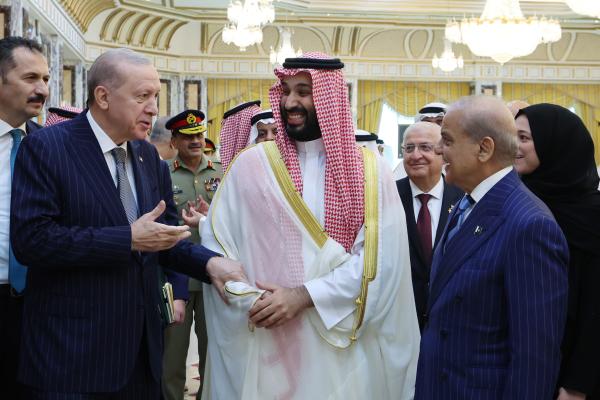
Join Hudson Institute Senior Fellow Ken Moriyasu for a panel with Chaim Martin, Israel’s minister of economic affairs to the United States; Aslı Aydıntaşbaş of the Brookings Institution; Soner Cagaptay of the Washington Institute; and Director of the Center for Peace and Security in the Middle East Michael Doran as they examine the logic behind each framework and what their rivalry means for US policy.
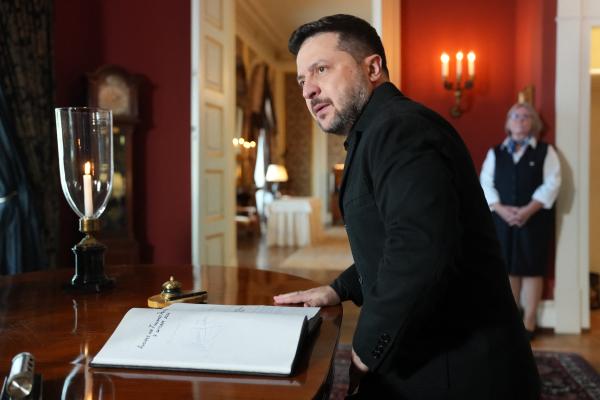
Please join Hudson Institute for a special address on the current state-of-play by Ukrainian President Volodymyr Zelenskyy, who will join remotely, followed by a question-and-answer session on the war with Hudson Institute President and CEO John Walters.

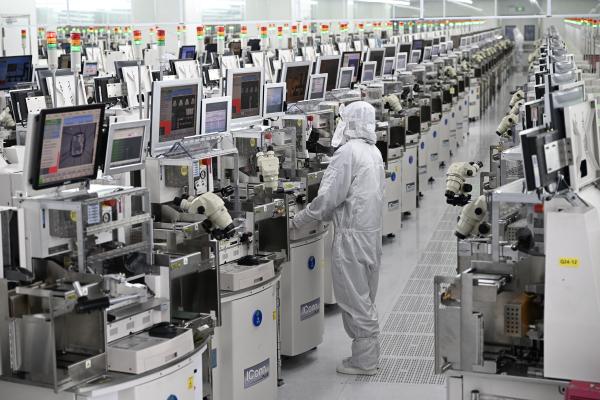
Bill Frauenhofer, executive director for semiconductor investment and innovation at the US Department of Commerce, will join Hudson Institute Senior Fellow David Feith for an invitation-only fireside chat on semiconductor onshoring and the role of government capital in strengthening America’s technological and industrial leadership.

Hudson welcomes Karel Řehka, former chief of the General Staff of the Czech Armed Forces, to discuss the changing security environment in Europe and its implications for the Czech Republic, the North Atlantic Treaty Organization, and the transatlantic alliance.