Caption
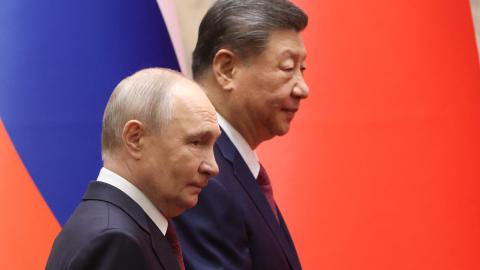
Russian President Vladimir Putin and Chinese President Xi Jinping enter the hall during a signing ceremony on May 20, 2026, in Beijing, China. (Getty Images)





Naval and commercial shipbuilding, maintenance, and shipping are crucial to the national security and economic prosperity of the United States and Japan. Both countries have rich naval and commercial maritime traditions, but such legacies have faced challenges in recent years. In response, Washington and Tokyo have established initiatives to strengthen bilateral maritime cooperation.
On March 10, Hudson Japan Chair will host a public discussion bringing together experts and practitioners to address US-Japan cooperation on these maritime issues. Experts will focus on how the two countries can strengthen their naval maintenance, repair, and overhaul (MRO) activities; scale shipbuilding capacity; and address the needs of shipping companies and end-users.
Join Hudson for a discussion highlighting each nation's approach to these common challenges, as well as how US-Japan collaboration should best proceed.
Recap Video
US-Japan Cooperation on Naval Maintenance, Commercial Shipbuilding, and Shipping Transcript
William Chou:
Okay, great. Thank you all for coming today on an early morning on Tuesday, here at Hudson Institute. Thank you for coming today on this really important issue on shipbuilding and also shipping. The United States and Japan, our two nations, are very dependent on seaborne trade and the naval means through which to protect such trade. But in recent years, both of our commercial shipping sectors have really fallen into disrepair or the commercial shipbuilding sectors have fallen into disrepair. And in the case of the US, our navy is facing some real challenges in terms of both in shipbuilding, but also maintenance and repair and overhaul. And so, this issue of shipbuilding, maintenance, and also shipping are key priorities for both the US and Japanese governments, each of which have launched initiatives in the past year or so to address this problem.
And they’ve also created a working group as of last October to address mutually through collaborative efforts on this shipbuilding problem. And with the Prime Minister Takaichi’s visit to Washington next week, this issue of shipbuilding and shipping are likely to be issues that will be addressed in the meeting. So, we are really privileged here today to have such an excellent group of experts to talk about these issues, and to build awareness, and perspectives ahead of the meeting next week. And so, with us, we have a terrific panel, as I mentioned earlier. I’ll just do some brief introductions. To my left is Akira Fukaishi, who is a Japanese government official, but has extensive experience in maritime policies during his career at the Ministry of Land, Infrastructure, Transport and Tourism, MLIT as we call it. He recently served as the. . . Well, he previously served as an alternate and permanent representative to the International Maritime Organization in London.
And then later, he served as the director of security and emergency management within the Maritime Bureau. Currently, he serves as the director for offshore and maritime at the Japan External Trade Organization down in Houston, where he looks at US policies, but also R&D collaboration between Japanese firms and major oil firms. He has a master’s from Queen Mary College, University of London, and also a Bachelor’s of Engineering from Waseda. Next to him is Diana Maurer, who is the director of defense capabilities and management at the US Government Accountability Office, where she provides independent nonpartisan oversight over defense sustainment and readiness issues.
Central to her work has been the close coverage of US Naval maintenance and readiness, highlighting the challenges that the US Navy faces. But she’s also expanded her scope to look at issues in terms of F-35s, as well as workforce for the US military. And she recently testified to Congress on these issues last week. She has a master’s in national resource energy from NDU and also an MA in international policy from Michigan, and also a bachelor’s in IR from Michigan State. Next to her is Michael Roberts, a senior fellow with Hudson Center for Defense Concepts and Technology. And he primarily looks at the issues impacting the US commercial maritime industry, especially in light of the competition with China.
And I will obviously highlight here Michael’s previous report on reviving the future of America’s maritime industry to compete with China, which is worth reading, in addition to his considerable production in the recent months as well. Recent work looks at the issues of shipbuilding, both naval and commercial, and as well as events with Senator Todd Young and Senator Mark Kelly on the Ships Act. Prior to Hudson, he served in the maritime industry in a number of different roles, such as a senior executive to maritime companies, Crowley. And took on key initiatives in risk management and corporate strategy. And finally, he has a JD from American University, and actually just like Diana, has a BA from Michigan State. So, I’m sure you guys did not know that about each other.
And then finally, we have Kyoko Imai, who’s the Associate Director of the Indo-Pacific Security Initiative at the Scowcroft Center for Strategy and Security at the Atlantic Council. That is a long title. She’s worked on a range of projects to inform and shape strategy and policies of the US and its Indo-Pacific allies, to address regional challenges such as China, North Korea, WMD, and also looking at issues in terms of mini-lateral and multilateral cooperation. She has a master’s in foreign service from Georgetown and a BA in IR from the University of Rochester. Apparently, there was something going on with the Great Lakes area here, apparently. And she’s obviously Japanese, as you can tell, but she grew up in Myanmar, Tunisia, and UA.
So, she’s providing some real valuable global perspectives on these issues. So, I think we’ll probably just kick off with some opening remarks from each of our panelists, and then we’ll sort of hop to the panel at Q&A later. So, Akira, if you will.
Akira Fukaishi:
Thank you. Good morning to all. My name is Akira from JT Houston. Thank you very much for giving me the great opportunity to speak today. It is my great pleasure to be here with great experts in the field of shipbuilding and defense policy. My name is Akira Fukaishi, and I’m the director for offshore and maritime at the Japan External Trade Organization, or JETRO. JETRO is a Japanese government-related organization that works to promote trade and investment between Japan and the rest of the world. At the Houston office, my main job is to coordinate the joint R&D project between a Japanese company and US oil major company, particularly in the field of decarbonization and safety improvement. Also, I’m currently working at JETRO. I’m originally a Japanese government official. And I’ve spent several years involved in maritime and policy as administrative land infrastructure, land infrastructure, transport, and tourism. Sorry, so long name.
Since joining MLID in 2002, I’ve worked on commercial shipbuilding policy, safety environmental regulations, and maritime technology development within the maritime bureau. Because I’m not currently in a position at MLIT, what I share today will be based on publicly available information from the Japanese government, along with my previous experience at MLIT. Please note that I’m speaking in a personal capacity today, not on behalf of the Japanese government. So, first of all, I would like to explain why the shipbuilding industry is so important to Japan, from both government and industry perspectives. Japan is an island nation surrounded by the sea.
99 percent of its trade volume depends on maritime transportation. Maritime transportation is essential for Japan, that there is heavily on import for key resources such as energy and food. For example, Japan imports 100 percent of its iron ore, 99 percent of its crude oil and coal, 98 percent of its natural gas, and 93 percent of its soybeans. Japan’s shipbuilding industry plays a vital law in sustaining the daily lives of its people and supporting economic activity by ensuring the stable supply of vessel used for maritime transportation to and from Japan. In addition, the Japanese shipbuilding industry contributes significantly to maritime security and national defense. All bases operated by Japan maritime self-defense force and the Japan coast guard are both built and maintained by Japanese shipyards.
The industry also supports the stability of the US-Japan alliance by undertaking maintenance work for US Navy vessels. Furthermore, shipbuilding has long supported regional economies. About 94 percent of merchant business are constructed in regional areas, especially in western area of Japan. And approximately 95 percent of parts and components used in shipbuilding industry are procured domestically. From the industry perspective, shipbuilding market is an extremely promising field with significant growth potential. Looking ahead, global demand for new ships is expected to grow over the medium to long term, due to rising volume of maritime transportation and the need to replace many vessels delivered around 2010.
In addition, demand for next generation vessel designed to reduce emission by using alternative fuels, such as LNG and biofuels, is expected to expand significantly. I believe this development present a major business opportunity, not only for Japan shipbuilding industry, but also the US shipbuilding industry. Regarding the area of US-Japan cooperation, I would like to highlight the recent agreement between the United States and Japan in the field of shipbuilding. In October, US Secretary of Commerce Lutnick met with Japan’s minister, Kaneko, and signed a memorandum of cooperation or MOC to promote cooperation in shipbuilding between the two countries. The MOC identified five key areas of collaboration.
First, expanding Japan-US shipbuilding capacity through partnerships between Japanese and US company, sharing best practice to enhance competitiveness and efficiency, and making strategic investment to modernize shipyards. Second, facilitating investment in the US maritime industrial base by identifying new investment opportunities. Third, supporting best demand for market economies by clarifying both government policies that influence demand for public and private vessel critical to the economical security of Japan and the United States.
Fourth, the workforce development through enhanced education and training for shipyard workers in both countries, ensuring consistency in training programs and creating new talent pipeline for the industry. And finally, technological innovation through the development and adoption of advanced technology, including digital solutions, and advanced manufacturing techniques, such as artificial intelligence and robotics at Japanese and US shipyards, as well as improvement in advanced vessel design and functionality. Through this partnership, we hope to advance bilateral cooperation in a mutually beneficial manner. I’d like to pause my remarks here. Thank you very much for your kind attention. Thank you.
William Chou:
Thank you. And next, Diana, if you can share your remarks.
Diana Maurer:
Of course. And good morning, everyone. And just for those of you who aren’t familiar with the government accountability, the GAO, where I work, we are part of the legislative branch of the federal government in the US. So, we are not part of the executive branch, which means we’re not beholden to whoever happens to be in the White House. We are an independent, nonpartisan agency. So, even though we work for the Congress, we work for the Congress as a whole. So, we don’t have a particular take, Republican or Democrat. We like to call them as we see them, and we provide truth to power, sort of one of our mantras. And my responsibility at the GAO is that I lead our body of work doing oversight of military readiness and military sustainment.
It’s a broad portfolio of work that includes the US Navy. So, I want to give you some of the key points from a couple of our recent reports on US Navy readiness and sustainment, with a little bit of insight on shipbuilding as well. But one way to frame this is to talk about two seemingly contradictory ideas. One is that the US has the strongest, most capable Navy in the world. The United States Navy is the only Navy that is capable of projecting global power anywhere it wants, whenever it wants. It’s not the largest. China has a bigger fleet, but the US has more capability and more experience in doing that. But that exists at the same time that there are other very troubling trends that we have seen in US Navy readiness that go back many decades.
For one thing, the US Naval fleet is aging. The average age of the ships in the US Navy is about 24 years. So, it’s interesting to hear your remarks about having to retire ships that are becoming 15 years old. If that was true, the Navy would have to retire most of its fleet, at least from the US perspective. And for many of those years, particularly the last couple of decades, the Navy has heavily used its fleet. So, it’s an aging fleet, it’s heavily used. And from our prior work, we know that all too often the Navy has under-maintained its fleet. So, we found in some of our previous work that there were billions of dollars of deferred maintenance in the surface fleet in particular, and there are not enough sailors aboard those ships.
So, when the Navy under cruise it ships, it means those sailors are not doing the day-to-day maintenance that are necessary for ensuring that those weapons systems are able to serve their entire intended life. So, those are big thorny problems facing the Navy as an organization. Now, one of the things that we’ve been doing in the US for the last two, three decades, is we’ve talked a lot about the importance of growing the size of the fleet. And the first 30-year shipbuilding plan was issued in 2003. And one of the things that we noted in our report from last year was that at that time, the US Navy was projected to have as many ships in the fleet in 2026 as it did in 2003.
So, 25 plus years of discussion about growing the size of the US Navy and on net, there had been zero growth. And there were a number of reasons for that. One is that it takes the United States too long to build its ships. In a report that we issued last year, we found that every single US naval ship currently under construction was projected to be late, anywhere from five to 38 months. And those ships typically take a lot more to build than initially planned. And those overruns run cost billions of dollars, and that’s a drain on taxpayers. Equally important from my perspective as someone who is focused on readiness and sustainment, many of the decisions that the US Navy and the department make about the acquisition policies, the decisions they make about building those ships, what technologies to incorporate, bake in bad sustainment decisions that end up costing the Navy billions of dollars in additional lifetime sustainment costs.
So, in a report we issued a few years ago, we found that came to about 130 billion with a B, dollars in additional maintenance costs for ships, because of poor sustainment planning early in the acquisition process. So, in addition to all of those challenges on the shipbuilding side of the house, we found significant challenges on the ship maintenance side of the house. Maintenance is frequently late. It frequently costs hundreds of millions more than planned. And when maintenance is late, that means other ships are waiting in a queue to come in to get their maintenance performed. This can become, and for a course of many years, has become a cycle where the Navy overuses its ships. It has to wait to bring them into port to get the plan maintenance.
It takes too long, and it costs too much, and the cycle repeats. Now that one glimmer of good news, there is we have started to see the US Navy reduce the amount of time it takes to actually do this maintenance. There are fewer days of maintenance delays. They’re doing a better job of planning, but it is still far from ideal. And that’s a major challenge. One of the things that we recommended in our report that we issued last year was that the Navy and the department as a whole take a fundamental relook at its overall strategy for how it works with the private sector here in the US, to build and to maintain ships, because the current approach frankly has not been working.
Among other things, the Navy and the department have been devoting billions of dollars to incentivize private industry to get better results. We found that they. . . within the department, there was not good oversight of that money. There are a lot of different offices, a lot of different flows of that money. There was not a good understanding of what the left hand was doing and what the right hand was doing, nor was there an understanding of whether that was actually making a difference. So, we had recommendations to improve those things. Going forward, we’re going to continue our oversight of Navy shipbuilding and Navy maintenance. We are encouraged by some of the change in the tone and tenor from the very top of the department, both uniform and civilian leadership.
There’s a greater focus on readiness, and there’s a greater focus on shipbuilding in particular. We hope that they adopt our recommendations and take a different approach to get better results for the US Navy. That’s all I have. Thanks.
William Chou:
Awesome. Thank you. Michael?
Michael Roberts:
Sure. Thank you. Thank you very much for having me here, Will, and for showing up this morning. Mike Roberts, I’m a senior fellow here at the Hudson Institute. I had a full career in the commercial maritime industry, retiring at the end of 2021 from a company Crowley Maritime, which is a large American shipping company. I was general counsel for them. I was very much involved in the Washington policy scene, really from the early 1990s, around maritime policy. And that was the last time we reconsidered maritime policy in the United States. At the end of the Cold War, we had the peace dividend, and we had conversations about lots of different issues, including the maritime sector. We made decisions at that time that are still with us today. And so, when it came time to leave Crowley in ‘21 and join. . . I felt like the fundamental assumptions around those policy decisions made in the 1990s were no longer true.
Those assumptions were that the world was at peace, that America was the only superpower, that we’ve fallen deeply in love with globalism. And that even if all of this didn’t work out so well, shipping and shipbuilding were no longer strategically important industries. We could free trade those away. And there were no statutes saying that, but the policy choices we made reflected that policy consensus. So, six or eight years ago, I began to understand that that basic assumption is no longer true, that we have a serious rival in China. China has made shipping and shipbuilding a central part of their strategy to extend their global reach and displace America as the global leader.
And with that, at a minimum, we need to reexamine our policies, our maritime policies. So, Hudson was kind enough to give me the chance to do that sort of analysis. I tried to come into it with an open mind, saying, maybe we were right all along, maybe this really doesn’t change anything. Shipping and shipbuilding are no longer strategically important at one extreme. At the other extreme, I thought, well, maybe we should hunker down and pour as much money into it as we need to so that we could compete with China, and build 25,000 TEU ships and gain 20 percent of the global fleet. Both of those extremes fairly quickly became obvious that we’re not the right path to take in terms of changing policy.
We need to change policy on the one hand, but trying to match China, trying to become internationally competitive with China. And shipbuilding was not a realistic option in the current framework or the foreseeable future. So, what do we do that’s somewhere between those two extremes? We need to grow our own capabilities. We need to match our capabilities to the current security risks that we have. And we need to collaborate with allies, friends that have maritime capabilities, including particularly Japan. So, then that’s a good policy place. That’s a consensus I think we’ve reached when you look at what is in Congress and what the maritime action plan puts forward. We need to do both things.
How do we do that? And I think the discussion we’re having today about collaboration with Japan is really important to try and advance that framework. In terms of what we do to grow our own shipbuilding, commercial shipbuilding and shipping capabilities, I proposed a set of recommendations in the report that Will showed you earlier, that has been adopted by the. . . in the Ships Act. It’s called the Strategic Commercial Fleet Program. And it’s also a part of the maritime action plan. It would grow the US flag fleet to 250 ships. The fleet that we have today in international trade is based on the security environment of the 1990s.
So, it’s very, very small, but it’s been run under a very effective program called the Maritime Security Program, where the Pentagon collaborates with the companies that have the US flagships in that program, save tens of billions of dollars in executing the Persian Gulf Wars in the 2000s. And so, that’s a good starting place from my perspective in terms of how we grow our own program. So, basically, the proposal and the strategic commercial fleet program would change the maritime security program in three ways. One, it would grow it from the 60 or 90 ships that we have today to 250 ships, again, to match the challenges that we have in responding to a sea lift demand in a Western Pacific conflict scenario, which hopefully we never see, but we have to be prepared for that.
So, we grow the fleet. Secondly, we phase in a requirement that the ships in that fleet be built in the United States in US shipyards. That would be a game-changer for commercial US shipbuilding. Under the Ships for America Act, the proposal is that it would ramp up to 20 ships per year that would be delivered. . . commercial ships per year that would be delivered by US ship builders to the industry, and those ships would be technologically advanced. They would have all of the latest technology to be the best ships in the market, ideally. That’s certainly the goal. And then the third change would be that we would competitively bid this program on long-term seven-year contracts. But there’d be competitive bidding so that the government pays the cost of Americanizing, so to speak, the additional cost of building and operating those ships in the market.
Most of the revenues would still come from normal freight markets in freight revenues in the market, but the cost of doing it under the American flag and with American shipbuilding would be covered by the government based upon the competitive bids of different partners in the program. So, the idea there is that you would have American companies, you would have bid teams. Every year they would bid for. . . The teams would include American companies. It would include foreign shipping companies, ship builders, American and foreign ship builders, technology companies, whatever the experts in the commercial world think would be most valuable.
They would put proposals in that they would shape around two things. One, commercial viability. Is it going to work? Are we going to be able to. . .? Is the money from the government going to a viable business proposition? Number two, what is the national security value provided by that proposal? And it’s a best value award, and there’ll be annual procurements eventually reaching 20 ships per year. That will give US shipbuilding the sort of sustained demand signal that they haven’t had. They haven’t had for many, many decades. The largest number of ships delivered by US ship builders in the United States, it was, I believe, 10 ships in 2016. And that was at the height of the boom following the fracking, development of fracking.
That was the most ships we have delivered out of US commercial shipyards in decades. This will double that number on a year-in, year-out basis. That’s a game-changer. That justifies investment in US shipbuilding facilities in the workforce and the whole thing. So, it’s a demand-led program, that’s the idea. And again, cost-effective. I think from a national security perspective, what it does is it would grow the industrial base. It would grow and diversify the industrial base. We would have tens of thousands of shipyard workers that we don’t have today. We would have tens of thousands of . . . thousands of mariners, maybe not tens of thousands, but thousands of American mariners on the ships as they come into the market. And that’s the purpose of doing it. It benefits our national security. It reduces the risks that we have today because of the maritime deficit that we have.
And I would say from a Navy shipbuilding perspective, and I’m not an expert in this, but I do have a sense of how things are and learned a fair amount. We have a very concentrated Navy shipbuilding industry. Effectively, one builder for subs and one builder for carriers. It provides an entry point for other competitors. It being the strategic commercial fleet program, this new opportunity in commercial shipbuilding provides a point of entry for the development of potential competitors and certainly a more distributed shipbuilding industrial base than we have today. So, I think there’d be great value in growing the commercial fleet for that reason and the commercial shipbuilding industry.
And again, I think as far from a collaboration perspective, it would be a great opportunity to work with Japanese ship builders and shipping companies to sort of. . . It would be good business proposition because you don’t bid to lose money. So, you’d be in this to make money, even if it relatively small, but it’s a great way to sort of get into the market. I’ll stop there.
William Chou:
Great. Thank you. Kyoko?
Kyoko Imai:
Great. Well, thank you so much to Will, to the Hudson Institute for having me here. As Will mentioned, I work for the Indo-Pacific Security Initiative within the Atlantic Council. And so, what we do there is we look at analyze, and research how the United States can work with Indo-Pacific allies and partners to address the most pressing security challenges facing the region. So, my fellow panelists have dove deep into the expertise and niche areas of this topic, but I’d love to step back and kind of paint a picture of how this all fits into the US-Japan overall relationship. So, and why is US-Japan shipbuilding cooperation important now? So, I think first off, I’d like to paint a picture strategically. I think Japan under Prime Minister Takaichi’s leadership, has undergone a fundamental shift in policy. So, she has essentially tried to pivot. And this has happened before her leadership, but reducing dependencies on countries like the PRC that create vulnerability and economic coercion situations.
And so, previously, Japan was very siloed in economic growth and then focus on security and defense. But now, Takaichi has found a way to tie those two together, saying that investment in defense and security architecture will be good for economic growth. It’ll help and will be mutually beneficial. So, that’s one thing that I wanted to lay out first. And I think especially with the United States being seen as often an unpredictable variable in the global stage, it’s created this need for Japan and other Indo-Pacific allies and partners to increase their presence in the region, increase the burden sharing that they have in terms of reassuring regional security. So, that’s one thing that I wanted to point out, and pinpoints why it’s so important now that Japan and the United States work together as critical industry and strategic partners in an era that intensifies geopolitical competition.
And so, to kind of take a step back, why is this so important for Japan? So, as many of you probably know, post-war Japan had a very pacifist stance. So, after World War II, Japan’s security strategy was relied upon safeguards by the United States for external deterrence and then focused itself more domestically on economic development. So, Japan’s security dependence on the United States created this dynamic where China didn’t really threaten Japan until, as you mentioned, China began increasing its military development to a place where the United States, and its allies, and partners were seeing that the rate at which China was increasing its power and its military might, the other countries were failing to keep up with China there.
And so, now I think Tokyo is at a place where it fears that Washington might not be able to continue maintaining extended deterrents for them. And so, I think Japan recognizes this, and is hoping to increase its industry and private sector investment in the critical area of shipbuilding. And so, I think we can dive into this a little bit more later. But I think last November when Takaichi told the diet that a Chinese blockade of Taiwan could by all means become a situation threatening Japan’s survival. I think that was really vital, but also she wasn’t just doing it just to get a kick out of it.
I think it was fundamentally making this argument that Japan’s shipbuilding infrastructure, its naval capacity, its maritime industrial base, are existential assets that would be threatened should a crisis occur in the Taiwan Strait. So, I’ll leave it there for now so we can delve into the moderate discussion, but just wanted to paint the picture a little bit for why this is so important at this current stage.
William Chou:
Okay. Awesome. Well, thank you all for your wonderful opening comments. I do realize that there are probably going to be a lot of questions from the audience, so I want to make sure that we have enough time for all. But I guess I have a few questions I want to ask all of you guys. They may be directed to one or two of you, but please feel free to chime in if you have thoughts. I know you all have thoughts. And so, I guess the first question is really for Akira and also Michael. So, look, both the Japanese government and also the US government have issued plans for increasing our shipbuilding capacity. Obviously, with the MAP that just came out, I think it was last week, finally. And then also, Japan’s been kicking around both for the LDP as well as the Japanese government itself plans for increasing shipbuilding.
And obviously, we have the working group that Akira got into during his comments. I guess the question is, how compatible are these different plans? Where do they overlap? Where are there obvious areas of synergy between the United States and Japan? And where do we have to do a little negotiation, whether it’s on timelines, priorities, or resources? Could we maybe get into that a little bit? Yes. So, whoever wants to go first.
Akira Fukaishi:
So, thank you for your question. Regarding the capacity expansion, yes. Last year, MAIT sets the target to meet the ship leading capacity demand to meet the demand from Japanese ship owner in 2035. It means that doubling the 2024 shipbuilding capacity of nine million gross tonnage over the next approximately 10 years. And I’m not sure about the US shipbuilding capacity expansion plan, as well as the timeline, but it seems to me that capacity expansion could be very challenging for both countries. And Japan, the US should be considered not a short-term, but a long-term.
Michael Roberts:
I would just say, picking up on your last comment, very challenging to expand shipbuilding. And then again, focusing on the commercial side of things, the trajectory of China’s sort of takeover domination of shipbuilding is really stunning. When you look at the numbers in the 1970s, the top ship builders were Japan and Europe, and the 1995 and the 1990s, it was Japan, Europe, with South Korea starting to come up. By 2019, China had about 40 to 42 percent. Korea had about the same. Japan, less than 20 percent, and the rest of the world. And Europe was essentially irrelevant. And the United States, the rest of the world is essentially irrelevant, less than 5 percent combined. That was 2019. In 2024, you look at the figures, and it’s in the BRS brokerage online. You can get it online. The 2025 report, page 37 is where the relevant information is.
And China had a 75 percent share of the orders by volume in 2024. That’s up from 40 percent just five years earlier. And it has pricing information in these reports also. And their pricing is 10, 15, 20 percent below that of the most efficient ship builders in the world, in Japan and Korea. And so, how do you stop that without a policy in place, without a policy change? And is it important to stop it? Yeah, it is important to stop that. It’s important to turn that around, in my opinion. And so, we have, I think in the United States, on the Navy side of things, before you get investment, you need some hope of return. So, there needs to be money there to sort of go after. And on the Navy side of things, the amount of money that has been allocated to Navy shipbuilding is generational.
It’s very large. So, the demand signal is there. And now the question is, how do we best go after those funds? And how do we work together to get the benefits of both countries in doing so? On the commercial side of things, that demand signal is not there yet. It needs to pass the Congress in the strategic commercial fleet program and the Ships Act. And I’ll stop right there with that commercial.
William Chou:
I do want to get into that more if we have time.
Michael Roberts:
Sure.
William Chou:
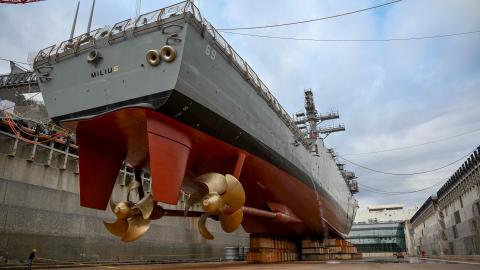
So, next question is for Diana. I guess, so look, thank you for the wonderful description about all the different challenges that the US Navy faces right now. I’ll point out that in 2019, Japan’s Mitsubishi heavy industries broke new ground by repairing the US Milius. And then since allies, what were companies from ally countries like South Korea, through Hanwha Ocean or Hyundai heavy industries have successfully completed repairs on Navy combat support ships as well. It seems like our allies are doing a pretty good job. I guess what are the challenges that we face in terms of doing more MRO through our allies?
Diana Maurer:
Sure. Well, I think one of the . . . I have to be careful not to characterize it as a challenge, because we’re nonpartisan, independent, but there are limits under US law. And that’s something that you could have a vigorous policy debate around. But there are limits to what the US Navy can do in terms of getting maintenance performed on its ships overseas. And so, we issued a report four or five years ago now. It’s a little bit dated, but we looked at the FDNF foreign deployed naval forces and how the US was getting its ships maintained in Japan. And we found that the maintenance that the Japanese contractors were providing were as top quality. But they also had the same challenges in terms of timeliness and dollars. And part of that was a function of how hard the Navy drives its ships. And the fact that there are problems performing maintenance aboard the ship by the sailors due to lack of spare parts, lack of crew, and lack of training and other challenges.
So, I think to more effectively leverage the capabilities that exist, particularly in countries like Japan and South Korea, would require a change in legislation here in the US. I know within the department right now, there’s a lot of discussion about different approaches and different proposals to make those changes. We issued a report a few months ago about weapon systems repair in a contested environment, INDOPACOM Theater. And we know that all the services and INDOPACOM are looking at the capabilities that our allies and partners can provide in theater. It’s an important part of their planning. So, someone has to figure out a way to square the circle of potentially leaning more on our allies while also trying to take a look at what the current limitations are under US law.
William Chou:
Understood. Oh, that’s wonderful. I guess I want to build on that a little bit more and maybe follow up with Kyoko. Just in terms of, look, the issue of AMRO, I think certainly the Japanese government has positioned it as a way to sort of grow the Japanese defense industrial base. I think that’s part of the calculus, as well as the more recent plans to increase the size of the Japanese commercial shipbuilding capacity as well. So, Kyoko, I guess my question for you is, how does this all fit into Japan’s larger economic or defense strategy? And also, here’s the hard part, how is Japan going to pay for it all? Is this feasible?
Kyoko Imai:
Absolutely. Thanks so much for that question, Will. So, in terms of how this all fits in, I think as I alluded to earlier, Prime Minister Takaichi has done a great job of combining and connecting economic security with industrial initiatives, saying that the two go hand in hand. And I know that there’s currently a lot of unease and apprehension from the Japanese population about how strong the economy is doing. So, I think a lot of people are seeing what’s happening around the globe and have a lot of hesitation, apprehension. And I think she’s trying to drive that forward in a strong economy. And so, one of the initiatives that I wanted to highlight is the 17 strategic sectors for investment that she recently announced, including the country’s resilience against potential crises. And that comes with strengthening the economy, energy, and resource security through artificial intelligence that could be tied into autonomous capabilities for ships, semiconductors, cybersecurity, and advanced defense technologies that could be utilized in unmanned systems.
So, a lot of these defense systems will naturally boost both Japan’s economy, and help develop its workforce and increase Japan’s competitive advantage in specific areas. So, I think that’s where that ties in. And then broadly speaking, as I alluded to earlier, Prime Minister Takaichi has really . . . after winning the two-thirds majority in the lower house, she has really put the gas on the pedal, saying that she’s really going to put strength into defense and security. And so, she’s two years ahead of schedule, saying that Japan’s defense spending will be 2 percent of GDP. So, I think it does show a fundamental shift in Japan’s. . . how it views defense and security.
As many of you know, Article 9 of Japan’s constitution kind of prohibits against a proactive defense posture, but since Prime Minister Takaichi is a lot more of a hard line conservative, she has pushed towards potential revisions of the Constitution to be more forward leaning in the security architecture. So, I think both the economic growth and the investment and industry go hand in hand there.
William Chou:
Okay, terrific. Oh, Akira, please.
Akira Fukaishi:
I just want to add to the comment from Kyoko-san.
William Chou:
Sure, of course, by all means.
Akira Fukaishi:
Yeah. Kyoko-san exactly explains the recent Japanese government movement. In last year, November, the Japanese government published a comprehensive economic policy to build a strong Japanese economy, in which revitalization and strengthening of the shipping industries is identify one of the strategic sector for promoting public and private investment among the 17 sectors. And when I enter the ministry of land infrastructure transport into SASA 2, the priority for shipbuilding is not so important among other sectors. However, as you know, maritime transportation and shipbuilding is indispensable to Japanese economy, and also Japanese defense and security policy. Recently, the government, and also legislation, diet also recognized the importance and the priority is given to hire.
William Chou:
That’s wonderful. Well, I mean, I think with the current regional challenges that we’re facing, I mean, I think a lot of new issues are gaining renewed importance. And this leads me to my last question, which is obviously with the conflict in Iran, a lot of these issues on naval sustainment, on naval commercial shipbuilding, and also the impact on the shipping industries and the commodities that they move, that’s all coming to a fore right now. I guess a two-part question for you guys, final question. How does the current conflict with Iran shape how we think about these issues that we’ve discussed today? And then two, what should these issues look like, whether it’s MRO, shipbuilding, or shipping? What should it look like in 20, 25 years?
Michael Roberts:
Oh, that’s a good one.
William Chou:
Yeah. I always like that.
Michael Roberts:
Let me take a shot. 25 years from now, I’ll try and be a little . . . I think we’ve seen some really vivid examples of how disrupting commercial shipping has been used as a weapon, has been weaponized in recent years, starting with the Houthis shutting down the Red Sea effectively, to anybody except the Chinese and the Russians who are allowed to go through, but the US Navy is there trying to stop the . . . So, it’s really a remarkable scenario in the Red Sea with the Houthis. And this is just magnified 100 fold with what’s going on in the Persian Gulf and the straits there. One of the things that is of great concern to me is the ability of China. Again, from a national security perspective, China’s ability because of the size of its fleet and because of its control over ports, over 100 ports outside of China.
The 23 of the top 25 container ports, including ports in China, have Chinese presence in them. Port presence at every choke point around the world, maritime choke point around the world. Their ability to leverage that, weaponize that in the event of a massive conflict is a serious concern. And so, part of the challenge I think is to identify strategic American . . . How do we deal with that issue? And I don’t think we’ve really started to get our head around that, quite honestly, but I think that’s a big challenge we have to come to grips with.
William Chou:
Terrific. Anyone else?
Diana Maurer:
Those are big, juicy questions, but I’ll dive in. Sure. So, I think one of the key takeaways, and it’s worth reminding the world that when a major conflict erupts, it has ripple effects throughout the global economy. And obviously the shipping industry is a big part of that, but it’s just important to understand that there are second, and third, and fourth order implications of any major conflict that are really and truly impossible to predict. I think from the perspective of the US Navy, we’ve been able to demonstrate as a nation the capability to do things in the short to medium term. One of the things that we’ll be watching closely from the geo perspective is how is maintenance and sustainment going to work for all the systems that are even being used at an even higher up tempo now, because it’s a conflict situation.
And looking longer term, as we’re thinking about how to potentially reshape or grow the size and composition of the US Navy, I would hope that decision makers keep in mind that it’s not just build ships, build ships, build ships. But it’s also recruiting and training the sailors that are necessary to crew those ships, developing the domestic defense industrial base to provide a steady, predictable flow of spare parts. And ensuring that there are sound sustainment strategies to make sure that the weapon systems, the ships themselves, and the aircraft, and the missiles and all that that they’re using are able to be used and maintained in an effective and useful way.
Every dollar that the US military spends to buy something new, they’ll end up spending at least $2, if not more in the future, to maintain, and sustain and operate those systems. So, it’s not just a function of building more. It’s also investing in the long-term strategy to ensure that they can be successfully operated for decades to come.
Kyoko Imai:
To add on to that, I think my fellow panelists are absolutely right. I think the word CRINK has been used quite a bit, China, Russia, Iran, and North Korea. And so, I think it’s really important to remember that there are global ramifications for the war in Ukraine and now what’s happening in the Middle East. There’s obviously second-order effects that happen throughout the globe. And I think a lot of people in the Indo-Pacific and Asia space have commented that it’s distracting from what’s happening with China. And this would be a very opportune time for any potential adversary in the Indo-Pacific to take advantage of distractions. I think there are resources that are required. And I know South Korea has been providing military equipment and assistance to vital emergency that’s taking place in the Middle East, but of course, that diverts the US resources, allied and partner resources away from the Indo-Pacific.
So, I think it’s important that we don’t lose sight of that. And then adding on to what Diana was saying. I think one thing that I think US allies and partners can do is, rather than compete with one another, find the areas of competitive advantage that each country has and be able to find niches. So, recently, the Japan Maritime United JMU was absorbed by Imabari. And that was essentially conducted in order to consolidate the shipbuilders to have an entity that was ranked fourth largest in the world. And I think that was done in a sense to be able to match or at least try to match the rate at which the PRC is developing shipping vessels.
And I think Japan has seen China and South Korea increasing its capacity in shipbuilding. But I think rather than South Korea and Japan competing with one another, I think it’s important for Japan that has expertise in naval and specialized vessels to focus on that capacity. I know South Korea has the ability to increase commercial vessels at a really rapid rate. So, being able to talk to one another, and identify key points that are each country’s strength and going from there.
Akira Fukaishi:
Yeah. Your question is very difficult to answer.
William Chou:
Good, good, good.
Akira Fukaishi:
Because very political and defense policy. And I’m from Ministry of Transport is not a specialist in this field.
William Chou:
But what should Japanese shipbuilding look like in 25 years, commercial shipbuilding? What should Japanese commercial shipbuilding look like in 25 years?
Akira Fukaishi:
25 years ago?
William Chou:
Yeah. In the future.
Akira Fukaishi:
In the future?
William Chou:
Yeah, yeah. What would you like it to look like?
Akira Fukaishi:
Yeah. Regarding the shipbuilding side, MRO for US Navy base is very important, not only for US Navy, but also Japanese shipbuilding industry. And currently, MRO work for US Navy vessel are already being conducted in Japan. But I think there’s a potential for further expansion, because some major shipbuilding company already zone from commercial shipbuilding market, which means that there’s a potential to expand the MR work in Japan. Also, it depends on each individual company’s decision.
William Chou:
Okay. Wonderful. Well, I hope there are some questions from the audience to ask the questions that I haven’t had a chance to ask. Any questions from folks? Yes. In the front, please.
Audience Member Katima Kubara:
Hi. Thanks so much for your great discussion. I’m Katima Kubara. I’m Defense Civilian from Japanese Defense, currently studying at George Washington University as a graduate student. I have a question about how the US government or the country, other country, balance limited resources towards the commercial and naval shipbuilding. Because maybe you can invest as much as you want for shipbuilding industry, but there are suddenly limits in kind of, for example, like blue collar workforce or shipbuilding infrastructure and increasing the number of blue collar workers or shipyards takes time. So, from defense perspective, I know that the backlog, and delay in naval shipbuilding and maintenance is very urgent problem. But I’m not sure to what extent the US government really expects to expand its commercial shipbuilding. So, my question is, how the US side is going to balance those to build different fields based on limited resource constraints.
Michael Roberts:
I know you have some thoughts, but I’ll kick it off if that’s all right. Very good question. I think, first of all, it starts with growth. It starts with having customers in the commercial side of things. And in the commercial side of things, when we get that in place, when that starts to happen, that drives a lot of things. When you’re asked to join, become a shipbuilder, and there are no ships to build, you’re going to be reluctant to do that. So, when there is an industry to build, to grow into, that changes the mindset of the potential workforce out there. The Ships for America Act includes several provisions that would improve recruitment into the workforce, both shipbuilding and on the mariner side of things, so that the whole point really is to grow that workforce, have a reason for those workers to be there, beyond working for the government directly or indirectly.
And I think there may be some tension early on in terms of losing DOD workers or defense workers to commercial work. I think that’s a false comparison. I think what will happen is that the workforce will grow and that will benefit our industrial base.
Diana Maurer:
Yeah. I would agree with that, that there definitely is a need to have some hard policy discussions around the. . . It’s not just resources, but it’s also focus, and emphasis, and ensuring that there’s a consistent demand signal. That’s been one of the challenges that we’ve seen for across the different 30-year shipbuilding plans, strictly on US Navy shipbuilding plans. They change from year to year. So, from the industry perspective, it’s challenging for the six or seven companies that build ships for the Navy to know what size of workforce do I need and how much infrastructure should I be investing in.
And when you pull that back out, if you’re a young person thinking about your education and your career trajectory, you probably want to have some assurance that that industry is going to be continuing as a going concern. And the way things are currently constructed in the US, whether it’s commercial or on the naval, the ship construction and repair industry, it’s almost entirely dependent on the federal government in one way or another. And so, there would need to be those changes in US policy. And last thing I’ll say is this issue bigger picture is. . . in my perspective, one of the key challenges is just getting the number of people that would be necessary.
I think the latest I’ve seen is over 200,000, maybe 250,000 more people would have to go into the shipbuilding, ship repair industry to meet what the Navy wants to accomplish. That’s a huge investment of human capital and that requires not just enticing those folks to become interested in performing those skills. You need to have the educational system to give them the skills, and training that they need, and make sure that the nature of that work helps attract, and retain a skilled workforce, because this is not the kind of work where people can start on Monday and by Wednesday they can do high-tech work. It’s highly skilled and requires a lot of training and a lot of experience.
William Chou:
Terrific. Any last questions? Shelton, you got the last question.
Audience Member Shelton:
Shelton Bank up at US Ocean. We’re a US based international ocean carrier, so we operate a fleet of ships that trade around the world. Question’s primarily for you, Will, actually. With both countries having domestic focus on shipbuilding and bilateral cooperation on shipbuilding, are there any deals in the works on shipbuilding in the next round of the 550 billion? Because I believe the first round was in all other sectors.
William Chou:
Yeah. Well, I don’t know how often this happens, where the moderator’s asked a question. But I guess I’ll just answer . . . I think there was a report that came out yesterday in Nike that talked about the possible upcoming expert projects. Given that they were right last time, they probably will be right this time. I don’t believe there was any shipbuilding involved there. That said, I would say the first batch of projects, the deep water port down in the Gulf of America that will be built for oil exports. Something that I’m sure Fukaishi-san has been dealing with down in JETRO Houston, that is very much essentially a shipbuilding project or demonstrates the importance of shipbuilding because of their capacity to connect to other industries like energy.
And also, as we recently discussed in the Pax Silica event here at Hudson with Under Secretary Helberg, shipping and shipbuilding is also very closely tied to the semiconductor and AI industries, because of the necessary movement of critical materials and minerals to make and power these industries. So, I’ll just say that as of now, my understanding is that there is none yet. But honestly, I need to ping Tokyo again just to maybe have a few chats with people. But as of now, I don’t think so. But it is listed in one of the key sectors under the 550 billion strategic industrial funds.
And so, I would not be surprised if there is such an initiative that grows out of that in shipbuilding. So, I guess I would say stay tuned and maybe put a little pressure on commerce to emphasize this in your conversations.
Great. I guess I’m sorry for answering the last question, but I hope you guys will all join me in thanking our wonderful panelists today. And thank you again. And I hope we will continue this conversation in future events. Thank you.
Michael Roberts:
Thank you.
William Chou:
Thanks, guys. Thanks again. Thanks.

Join Hudson Institute Senior Fellow Ludovic Hood for a panel with David Wurmser of the Jerusalem Center for Security and Foreign Affairs; David Makovsky of the Washington Institute; and Senior Fellow and Director of the Center for Peace and Security in the Middle East, Michael Doran, as they discuss the state of the race and potential paths forward for the United States–Israel relationship.


Join Hudson Institute for a conversation with the author on the eve of the book’s release. Babb, Director of The Promised Land Project at the Macdonald-Laurier Institute and an associate fellow at the Institute for National Security Studies in Tel Aviv, will discuss the book’s central argument and the practical ways Jews and non-Jews alike can embrace Zionist ideas in their lives.


Join Hudson Institute for a conversation with Lazarus, founder of Lazarus Consulting and former speechwriter to the Commander of the US Southern Command.

Join Hudson Institute for a conversation with US Ambassador to the EU Andrew Puzder and Senior Fellow Harold Furchtgott-Roth on America’s interests in reducing the harmful effects of CS3D and CSRD.