













This translation was generated using AI and edited lightly. Read the original in French here.
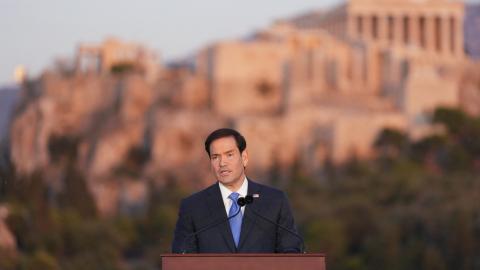
After US Vice President JD Vance’s attack in Munich in February 2025 on European leaders accused of betraying their own values, Donald Trump’s secretary of state, Marco Rubio, chose to extend an olive branch. Speaking from the Pnyx in Athens, he called on Europe to “emerge from its long slumber” and take part in a Western renewal built on power, industry, and defense. Was this merely a change in tone, or a genuine break? An analysis with Tsiporah Fried and James Carafano.
Key takeaways
- The same demand as JD Vance’s, but in a different register. Where Vance displayed contempt, Rubio appeals to admiration for the Western inheritance. The demand remains the same: Europe must recover its pride, its will, and its appetite for power.
- Partners judged by what they contribute. Washington increasingly thinks less in terms of allies than of “stakeholders,” assessed according to what they concretely contribute to the balance of power. Alliances should defend national sovereignty, in opposition to the idea of a European superstate.
- A real European rearmament effort, but not yet military power. The financial effort is tangible. Turning it into capabilities remains the task ahead: air defense, ammunition, command and control, and production rates. Politically, James Carafano argues that the “awakening” is being driven by Europe’s right-wing parties, not by the Brussels establishment.
- The real risk is the transition. For Tsiporah Fried, the danger lies not in the American demand itself, but in a withdrawal that is too rapid and opens a window of vulnerability vis-à-vis Moscow. Unpredictability and solidarity conditioned on ideological proximity pose additional risks. James Carafano, by contrast, considers the American strategy to carry few risks.
Atlantico: What stands out to you in Marco Rubio’s speech in Athens? Who was he primarily addressing, and what does the speech tell us about how Washington views Europe today?
Tsiporah Fried: We should first place this speech in its American political context. The midterm elections are approaching, with the presidential campaign on the horizon. Marco Rubio is probably using this platform to lay the groundwork for his own campaign. We should therefore not overlook the fact that he is addressing not only Europeans, but also signaling his future doctrine for America’s transatlantic relationship.
That said, we should pay close attention to the speech’s almost lyrical opening. Its evocation of antiquity, exploration, excellence, and courage offers a narrative of Western pride that contrasts with the prominence, in parts of European discourse, of guilt and the indictment of Europe’s own heritage. Rubio speaks to what gives a society the will to defend itself: a certain understanding of itself, its history, and what it intends to pass on. He explicitly links the loss of confidence in that heritage to industrial, military, and political weakening. The rearmament he advocates is also moral: Rubio is inviting Europeans to rediscover their appetite for power.
I cannot help drawing a parallel with JD Vance’s speech: two registers, but the same challenge to Europe. In Munich, Vance made little effort to hide his contempt for a Europe he considered unworthy of its inheritance; Rubio appeals to admiration to ask Europe to reclaim it. The benevolence of the tone makes the demand easier to accept, but does not make it any less exacting. The real enemy is not Russia or China, but a Europe that accepts its own decline.
I also see a clear indication of how this administration now judges its partners. Their value is measured not only by their membership in a community of democracies, but increasingly by what they can contribute concretely to the balance of power: capabilities, industry, infrastructure, the ability to produce, to take risks, and, above all, the will to defend their interests.
It would be easy to interpret this as the transactional diplomacy of America First. But a deeper conception of power lies behind this approach, one in which credibility rests on strength, courage, and the ability to act. This is precisely what echoes the warrior ethos advocated by Pete Hegseth: power lies not only in available equipment or resources, but in the combination of capabilities, readiness, will, and a willingness to accept risk. For Rubio as for Hegseth, weakness is not merely a lack of resources; it can also be a lack of will.
James Carafano: The idea that President Donald Trump is indifferent to Europe, or even hates it, is simply absurd. What interest would the United States have in allowing Russia or China to have a free hand in Europe, or in seeing its most valuable trading partner collapse? The question answers itself: none. Whether or not one likes his provocative rhetoric, Trump is tough on Europe because Europeans are not making the difficult decisions required to guarantee the continent’s security, peace, and prosperity. At the root of Europe’s insecurity and indecision is the fact that Europeans have increasingly detached themselves from their civilizational foundations—the foundations that gave Europe’s peoples their principles, values, and identity. The secretary of state’s message was directed at Europeans and Americans alike. To Europeans, he was saying: “America cannot care more about Europe’s salvation than Europeans themselves do. Get a grip.” To Americans, Europe’s history is a warning about the dangers of following the European path. It also explains why the administration has taken such a firm line with its European partners.
Why choose Greece, and this particular location, to deliver the message?
James Carafano: First, the Greek government understands what is at stake and is actively working to strengthen its partnership with America. The right strategy for a European nation rests on three pillars: the EU, NATO, and the United States. These powers are not in competition. Each brings something important, and together they are building blocks for a stronger Europe. The Acropolis in the background also carried powerful symbolism: it underscored the importance of Europe’s civilizational foundations.
Marco Rubio said the administration wanted to return to a “classical” understanding of politics and statecraft. What does that mean in practice?
James Carafano: Stability and human flourishing rest on national interest and realism, not on a largely fictitious “rules-based order.” Of course, “classical” realism cannot prevent wars and conflicts; no system can. But this durable system enabled Western civilization to rise and prosper. It created more prosperity and reduced poverty more than any other system in history. It also gives like-minded nations greater opportunities to work together in pursuit of their own interests.
Rubio argues that power requires not only the means to defend oneself, but also a credible willingness to use them. Does Europe have both today?
Tsiporah Fried: That, it seems to me, is precisely the question being put to Europeans. From the American perspective, a gap remains between the way Europeans describe the Russian threat—often in existential terms—and the way they respond to it. Their response is improving, but it is still marked by caution, caveats, and a strong aversion to risk.
We are therefore dealing with two strategic cultures that do not entirely overlap. In the United States, security rests more heavily on the idea of individual and collective responsibility, the ability to defend oneself, and acceptance of the risks inherent in exercising power. This culture of responsibility and self-defense is also reflected, more broadly, in the particular place firearms occupy in American society.
In Europe, history has produced a different relationship with the use of force. The scale of destruction in the two world wars, followed by European integration itself, gradually fostered a culture of de-escalation, restraint in the use of force, and conflict prevention. This culture has had real merits, but it can also become a handicap when the strategic environment requires Europeans to learn to take risks again and to regard the use of force as a credible option.
Europe has experienced armed forces, advanced defense industries, and—through France and the United Kingdom—two nuclear powers. But having excellent units does not mean being able to sustain a long, high-intensity war collectively. The gaps officially identified include air defense, strategic enablers, military mobility, fires, and digital capabilities.
Will must be demonstrated through the ability to make decisions under pressure. An adversary must understand that action is possible and that political leaders will be able to order it. But are we prepared to take the risks necessary to defend the interests we declare essential?
We should take both dimensions of Rubio’s message seriously: his demand that Europe recover its strength, and his stated willingness for the allies to continue acting together.
Do the rearmament signals welcomed by Washington reflect a genuine increase in military power? Is Europe really “waking up,” or is this mainly Washington’s wish?
Tsiporah Fried: We can no longer describe this as mere announcements. The financial effort is tangible: according to NATO, defense spending by European Allies and Canada rose by nearly 20 percent in real terms in 2025 compared with 2024. The SAFE instrument also provides for up to €150 billion in loans to support investment and joint procurement.
But we must distinguish financial effort from military power that is actually available. The Hague commitment—5 percent of GDP by 2035, including at least 3.5 percent for core defense requirements—is a trajectory to be achieved, not a capability available today. Likewise, funding mechanisms should not be confused with equipment that has already been ordered, delivered, integrated, and made operational.
Spending more can therefore fail to produce a proportional increase in military power. The outcome will depend on the ability to turn funding rapidly into capabilities: orders large enough to enable industry to increase production; choices aligned with operational needs; interoperability; ammunition stocks; equipment availability; training; and the ability to sustain the effort over time. One risk is reproducing the fragmentation of European procurement that cooperation mechanisms are specifically intended to reduce. SAFE was designed around joint procurement in order to promote economies of scale and interoperability.
The real measure of increased military power will therefore not be spending alone, but the additional military capability actually available: how many units can be deployed, how quickly, with what strike, air-defense, intelligence, and command capabilities, with what ammunition stocks, and for how long?
James Carafano: Not the Euro-elites, who remain attached to a vision of the future that has failed. But if you add together all the right-wing forces, from the European People’s Party (EPP) to the populists, they already account for more than half of Europe’s political landscape. They do not all like Donald Trump, but they share many of his criticisms and positions on energy, security, immigration, and other issues.
What are Europe’s main defense weaknesses today, and which should be addressed most urgently?
Tsiporah Fried: The first priority is to protect forces and infrastructure: air and missile defense, counter-drone capabilities, and the protection of bases, networks, and command centers.
The second is the ability to sustain the effort over time, which means producing at scale and quickly adapting production to the course of the conflict: ammunition, spare parts, maintenance, personnel, and industrial capacity to replace losses. These areas are at the heart of Europe’s rearmament priorities.
The third is the ability to conduct an integrated operation. Forces must be able to detect, understand, decide, communicate, and act despite jamming, cyberattacks, and destruction. Intelligence, communications, command, transport, and logistics are what make combat platforms effective. Europe therefore needs the means to achieve integration and connectivity, particularly across command chains. NATO itself stresses the need to develop the full enabling environment that turns equipment into usable military power.
In my view, the most cross-cutting weaknesses remain slow production rates and insufficient flexibility to adapt to rapidly changing forms of warfare. Buying a drone is not enough if procedures prevent its software from being updated quickly, its integration into the command system, or its replacement when it becomes vulnerable. Europe must learn not only to produce more, but also to experiment, decide, and adapt faster. Adaptability must become a military capability in its own right.
Finally, Europe must avoid allowing Moscow to retain the initiative in managing escalation and de-escalation. If every Russian pressure tactic leads Europeans to rule out their own options in advance, Russia may seek to exploit that restraint. This does not mean responding militarily to every provocation. It means maintaining credible options and preserving freedom of action, so that the adversary cannot set the terms of the balance of power alone.
How is this message likely to be received in Moscow?
Tsiporah Fried: So far, I have not identified any substantial official Russian response to the speech. An initial survey of Russian media nevertheless suggests an ambivalent reception. The denunciation of Western decline can naturally feed the Russian narrative of a weakened West that has lost its bearings. But Rubio’s call to restore Western power and strengthen transatlantic cohesion runs counter to the idea that the United States is disengaging from the European continent.
For Moscow, three factors ultimately matter more than declarations: the capabilities actually available, the political and military cohesion of the allies, and the continuity of American engagement. An increase in European spending accompanied by uncertainty about the American contribution could therefore send a contradictory signal: Europe is rearming, but its ability to replace potential US withdrawals quickly remains uncertain.
The risk would be a period of vulnerability between the moment when the United States reduces some of its contributions and the moment when Europeans are actually able to replace them. This window must be avoided if deterrence is to remain credible. The issue is not simply whether Europe is rearming, but how quickly it can turn that effort into capabilities that are genuinely available.
How does the Trump administration now conceive of alliances, and how does this differ from the previous approach?
James Carafano: The US government increasingly thinks in terms of stakeholders rather than allies, friends, and partners. What are nations’ shared interests, and how can they work together for mutual benefit?
Would a Europe “waking up” militarily do so with the United States, alongside it, or partly without it?
Tsiporah Fried: Europe should do so with the United States, while also developing the ability to act when Washington does not wish to engage or is committed elsewhere. These two requirements are compatible, and this is probably one of the major challenges facing the future of the Alliance.
Rubio advocates stronger cooperation with a Europe that has regained its strength. He also calls for an alliance whose combined strength exceeds that of its members taken separately. This provides a basis for seeking a negotiated and predictable redistribution of responsibilities within the framework of burden shifting.
European autonomy should therefore be measured less by the ability to act without the United States than by the ability to undertake a mission, sustain an engagement over time, and retain freedom of decision when circumstances require it. A Europe that takes greater responsibility for its own security would strengthen the Alliance, provided that this buildup is based on capabilities that are actually available, with explicit milestones, rather than a withdrawal timetable that disregards European readiness.
Finally, the American presence should not be measured simply by the number of troops deployed in Europe. Exercises, headquarters, procedures, networks, standards, and habits of cooperation are themselves a military capability: they enable national forces to fight together effectively. Any reorganization of the US presence must preserve this operational value and the ability of Europeans and Americans to act together when necessary.
Is a vision of alliances based on national sovereignty compatible with the European project as conceived in Brussels?
James Carafano: I believe it is compatible with the EU’s original purpose. It is, however, incompatible with the vision of a European superstate, which is not only unrealistic and unattainable, but also harmful to Europe’s future growth, prosperity, and security.
What does Washington concretely expect from Europe, and what role can France play in this new division of responsibilities?
Tsiporah Fried: France is one of the few European countries that combines several dimensions of power: the ability to make independent political decisions, nuclear deterrence, conventional forces, a defense industrial base, and operational experience. France is also engaged on NATO’s eastern flank. Its strategic-autonomy rhetoric is already being translated into concrete contributions to its partners’ security.
The changes announced at Île Longue in March 2026 open up opportunities for cooperation on “forward deterrence,” while keeping nuclear decision-making under French responsibility. They can deepen European strategic dialogue without being presented as an immediate replacement for the American guarantee.
But France’s credibility will depend first and foremost on the conventional capabilities it can make available and sustain. The priorities announced in July—ammunition stocks, operational readiness, ground-based air defense, early warning, and deep strike—directly address this requirement.
France must also start from its partners’ concerns, particularly those of countries on the eastern flank. Its role could be to help mobilize coalitions capable of acting, bringing together the United Kingdom, Germany, Poland, and the Nordic countries in particular.
James Carafano: To work with the United States, countries must be positive and constructive, commit themselves, and pursue initiatives that deliver benefits for both sides, particularly in the fields of economics and national security. Donald Trump is pragmatic. He will work with anyone who wants to work with the United States and respects American national interests—which excludes the Russians.
What risks do you see in this American strategy of openly embracing power?
Tsiporah Fried: I see no inherent risk in a strategy of power that encourages Europeans to rearm, both morally and materially. The risk lies instead in a poorly managed transition. Asking more of Europeans can be beneficial; reducing American capabilities on which their security still depends too quickly could, however, weaken deterrence before European rearmament has had time to take effect.
The second risk is confusing credibility with unpredictability. Uncertainty can complicate an adversary’s calculations, but it can also disorient allies. To prepare for common defense, allies need to know which commitments and resources they can count on.
The third risk would be making strategic solidarity conditional on ideological proximity. Allies must be able to disagree politically without their protection appearing to be in question. Otherwise, an adversary may seek to exploit those divisions.
Finally, the pursuit of power must remain tied to clearly defined political objectives. It requires an assessment of costs, escalation risks, and the conditions for ending a crisis. Rubio himself stresses the need to combine power with diplomacy.
JD Vance reproached Europeans for having lost confidence in their own heritage; Rubio instead invites them to recover the qualities that enabled that heritage to assert itself: ambition, sovereignty, courage, a willingness to take risks, and the will to exercise power. He is therefore not simply celebrating a shared past; he is also proposing a particular conception of the qualities around which the West should, in his view, rebuild itself.
This is where new misunderstandings with some Europeans may arise. Behind rearmament and the pursuit of power lie different conceptions of national sovereignty, the role of supranational institutions, political freedom, and the relationship between state and society. Strengthening Western power will therefore not necessarily eliminate transatlantic differences; it may also make them more visible.
If I had to distill one central idea from Marco Rubio’s speech, it would be this: the emerging American bargain is not “Europe, become autonomous,” but rather “Europe, become powerful enough to remain a credible ally.”
James Carafano: The American strategy carries relatively few risks. Washington expects its stakeholders to do more. Rather than exposing itself to strategic overstretch, Donald Trump is counting on them to take up more of the burden, backed by American power and influence that are growing, not declining.