

















On July 17, Secretary of Defense Pete Hegseth signed the Terms of Reference for a review of US force posture and basing in Europe, tasking Under Secretary Elbridge Colby and US European Command with developing options by the end of the year. The review is part of a broader strategic rebalancing toward what Washington and NATO now call “NATO 3.0”: a stronger European pillar in which allies assume primary responsibility for conventional defense. At the same time, the Department of Defense will reallocate resources toward other priorities.
As the US Force Posture Review (FPR) gathers pace, it’s worth noting that the initiative should be judged not by how many American troops leave Europe, but by what kind of alliance—and what kind of deterrence—remains afterward. The FPR’s central premise is hardly unreasonable. The United States faces finite military resources and simultaneous demands in Europe, the Middle East, the Indo-Pacific, and elsewhere. Europeans, meanwhile, have the economic and demographic capacity to carry much more of the conventional burden for defending their continent. Indeed, NATO Secretary General Mark Rutte now describes NATO 3.0 as a transition from burden-sharing toward genuine burden-shifting: “to stay transatlantic, NATO is becoming more European.”
The review has nevertheless generated controversy. The Pentagon questionnaire sent to allies reportedly goes beyond defense spending and military capabilities to ask about support for US foreign-policy priorities, access and basing, and other measures of alignment. Questions have also arisen over allied and State Department consultation, although EUCOM/SACEUR is directly involved and Colby has briefed the North Atlantic Council on his plans. Congress, meanwhile, has constrained major reductions.
Those debates matter. But they risk obscuring the more consequential question: What will NATO 3.0 actually look like after the Force Posture Review—and will the resulting alliance be better able to deter Russia?
US Retrenchment, European Transition
Asking Europeans to assume greater responsibility for their defense is nothing new. President Dwight Eisenhower never intended to sustain the large American deployment created for early Cold War contingencies to remain indefinitely. Yet he repeatedly postponed major withdrawals because he understood that force posture was also political signaling. European forces should eventually constitute the first line of defense, but withdrawing American forces before Europe could replace them risked undermining confidence and deterrence.
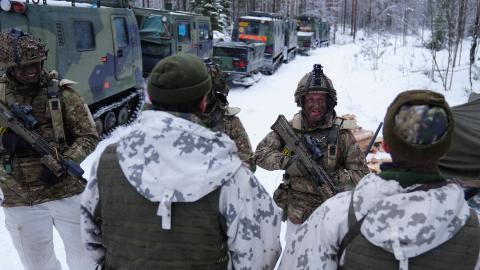
Seven decades later, the dilemma is strikingly familiar. Europe is rearming at a pace unseen in decades. Spending is rising, production is expanding, and European allies are assuming more responsibility along NATO’s eastern flank. Germany is deploying a brigade to Lithuania, and France is leading NATO’s multinational battlegroup in Romania. NATO communications now insist that investment must translate into “ready forces, fielded capabilities, and executable plans.”
That distinction matters. Money appropriated today does not produce trained personnel, air-defense systems, ammunition stocks, logistics networks, or deployable brigades tomorrow. The strategic problem is therefore less the outcome than the transition. NATO 3.0 may be sustainable as an end state, but it becomes dangerous if American retrenchment outpaces European military capacity.
This makes coordination and signaling as important as the eventual force structure. Russia has intensified a range of hostile activities against European states below the threshold of conventional war, many of which European governments have publicly attributed to Moscow. Against that background, the overriding purpose of any posture transition must remain deterrence: ensuring that Russia sees no temporary window in which NATO’s ability or willingness to respond appears weakened.
A poorly sequenced or poorly signaled US drawdown could create precisely such a perception at a moment when European forces are not yet ready to compensate. The strategic cost of miscalculation would vastly exceed the resources saved by withdrawing several tens of thousands of troops. The FPR must therefore manage not only a redistribution of forces, but a transition in deterrence without creating a window of vulnerability.
The present security environment magnifies that risk. Russia is not waiting for NATO’s transformation to be completed. It is testing the alliance through military pressure and increasingly aggressive actions below the traditional threshold of armed conflict. Several European governments are also exploring proposals for a French “forward” nuclear deterrence alongside NATO arrangements—a sign not of abandonment of the American guarantee, but of growing concern about Europe’s long-term security architecture.
For Moscow, what matters is not what European capabilities might exist in 2035. It is what NATO can credibly deploy, reinforce, and escalate with today.
This is why the headline number of American troops withdrawn from Europe is the wrong metric for judging the FPR. Removing 10,000 personnel from one set of activities might have limited strategic consequences. A numerically smaller reduction affecting air and missile defense, intelligence, command and control, logistics, reinforcement infrastructure, or forces on the eastern flank could matter far more. The relevant questions are therefore straightforward: Where are US forces? What capabilities do they enable? What effects do they achieve? Who can replace those functions if they leave? And how rapidly can they reinforce if necessary?
General Alexus Grynkewich, Commander, US European Command (EUROCOM) and NATO Supreme Allied Commander Europe (SACEUR), has recently offered perhaps the clearest description of the emerging model: Europeans will assume greater responsibility while the United States continues to provide “critical but more limited capabilities.” He has also stressed that the outcome of the FPR is not predetermined. Recent decisions to continue or restore American rotations in Lithuania and Estonia reinforce the point: a smaller US posture would not necessarily mean uniform withdrawal from Europe. The real task is identifying those critical capabilities.
US-NATO Interoperability Is More than Technical
One of them is easily underestimated. Permanent American presence does more than add combat power. It creates continuous interaction among American and European militaries. Exercises test interoperability; permanent presence builds it through common planning, command relationships, logistics, doctrine, and institutional familiarity. As US military institutions shift toward the Indo-Pacific, technological and doctrinal changes shaped by the Asian battlefield’s tyranny of distance (air and maritime) raise the risk that US forces will struggle to fight efficiently alongside European partners on the continent, which is more land-centric.
This becomes more important, not less, with next-generation warfare. AI-enabled command and control, autonomous systems, tactical clouds, distributed operations, and compressed decision cycles are transforming interoperability. Militaries can possess technically compatible equipment yet become progressively less capable of fighting together if they develop their data architectures, doctrine, command systems, and concepts for human-machine interaction separately. Interoperability is therefore no longer merely technical. It is doctrinal and intellectual. It is also about how you think.
This presents NATO 3.0 with a paradox. A more autonomous European pillar could make the alliance politically more balanced while making American and European forces operationally less integrated if their next-generation warfare architectures evolve separately.
Continuing rotational large-scale warfighting exercises can verify whether systems communicate, even if these cannot reproduce the institutional depth created by forces, staffs, and commanders continuously operating and adapting together.
In Europe, Nuclear Deterrence Is Inseparable from Conventional Deterrence
The emerging division of labor sounds straightforward: Europe increasingly provides conventional defense while Washington retains extended nuclear deterrence and a lower part of critical enablers.
But conventional and nuclear deterrence cannot be separated so neatly. Former Assistant Secretary of Defense Celeste Wallander spelled out the problem in a recent article in Foreign Affairs: “nuclear guarantees cannot replace US forces in Europe.” American conventional forces do more than contribute brigades or aircraft. Their presence connects the United States physically and politically to Europe’s defense from the start of a conflict. This has always sent a strong signal to the Soviet Union and now Russia.
An attack involving American forces creates a different escalation dynamic from one in which Europeans fight a conventional war. At the same time, Washington remains militarily distant, promising intervention only at some later—and potentially nuclear—stage. The danger is not necessarily that Washington abandons extended deterrence. It is that a gap emerges between European conventional defense and the American nuclear guarantee, a gap wide enough for Russia to exploit. At what point does the United States actually enter a potential conflict? NATO 3.0 therefore cannot design a European conventional pillar independently of American extended deterrence. The FPR is indirectly reviewing the architecture that connects the two.
European Defense Is Not Only About Europe
Washington should not assess its European posture solely by what it contributes to European defense. Europe is part of America’s global military architecture and a key platform for power projection across the globe. Its airfields, ports, headquarters, logistics networks, intelligence infrastructure, prepositioned stocks, and access and overflight arrangements support US operations toward the Mediterranean, Africa, the Middle East, and beyond.
That became particularly visible during the conflict with Iran. Access to European bases and airspace mattered to American operations, while restrictions imposed by some allies became part of Washington’s subsequent reassessment of its posture. The FPR itself is therefore examining not only troop numbers but access, basing, and overflight. This complicates the familiar argument that scarce American resources should simply move from Europe to the Indo-Pacific. Prioritization is necessary. But prioritization cannot be translated into geographic substitution.
A capability based in Europe is not necessarily devoted exclusively to Europe. Nor are the theaters neatly separable. Europe, the Middle East, and the Indo-Pacific increasingly compete for the same interceptors, munitions, logistics, intelligence assets, and industrial production. Russia, Iran, China, and North Korea, meanwhile, exchange weapons, technology, and operational lessons across those geographic boundaries. “Europe down, Indo-Pacific up” can therefore be an accounting formula without necessarily being a strategy.
What NATO 3.0 Should Become
The success of the FPR will ultimately depend less on whether it produces 70,000, 75,000 or 80,000 American troops in Europe than on whether it gets this functional equation right on an effects-based approach.
Which capabilities can Europeans replace now, potentially with different assets, and which require another five years? Which permanent formations can become rotational without weakening deterrence while keeping the appropriate level of interoperability? Which large bases should be dispersed because they have become vulnerable? Which relatively small American footprints generate disproportionate effects in intelligence, logistics, command and control, air defense, or reinforcement? And which European facilities does the United States itself require for global power projection?
This is also why NATO 3.0 cannot simply mean substituting European conventional forces for American ones while leaving everything else unchanged.
Europe must become the conventional backbone of its own defense. That is both strategically necessary and increasingly accepted within NATO. But three elements must evolve together: European combat power, continued American conventional engagement, and US extended nuclear deterrence.
The American posture that emerges may therefore be smaller. It could also be more eastern, more distributed and resilient, more rotational in some places, and more concentrated on high-value enablers. That would represent genuine strategic rebalancing rather than withdrawal by arithmetic.
NATO 3.0 is ultimately where Europe must do more, but it also needs to remain American. It should be determined by the functions that sustain deterrence, especially as we face a more aggressive Russia, preserve next-generation interoperability, connect European conventional power to the American nuclear guarantee, and allow the United States to continue using Europe as a platform for global power when our interests match. The FPR should therefore be judged by whether NATO can deter an overassertive Russia more credibly to ensure stability and not by how many American troops leave Europe.