
















I served 20 years as a US diplomat in the Middle East, starting in 2006. During that time, at least two million people died in a series of conflicts across the region, from Iraq and Iran to Syria and Sudan.
Very few Americans cared about the bloodletting in the Middle East… until the Hamas attack of October 7, 2023. All of a sudden, students, politicians, and media outlets were seized by the conflict in Gaza – and Israel was at the receiving end of unprecedented and pervasive opprobrium and animosity.
Why didn’t students at Columbia and UCLA or Democratic Party and DSA politicians or many media outlets care about millions of dead and displaced Afghans, Iraqis, Syrians, Sudanese, and Yemenis in the years leading up to October 2023?
Why don’t students and activists take to the streets or wage political campaigns about the hundreds of thousands of people massacred in Sudan’s ongoing civil war? Or the thousands of dead Iranian youth gunned down by their own government little more than six months ago? What is it about Israel that triggers this stunningly selective outrage and manifest double standard?
My first posting overseas was Kuwait, the transit point for US soldiers deploying to neighboring Iraq. I arrived in 2007 at the peak of a vicious civil war in which the death toll eventually exceeded 160,000 (and according to some estimates may have approached 500,000).
In Afghanistan, where American servicemen and women were also risking life and limb in the midst of an insurgency, approximately 100,000 civilians were killed in 2006-2011.
Another 50,000 died in neighboring Pakistan from conflict and terrorism in the same timeframe.
Meanwhile, the concurrent conflict in Darfur, Sudan resulted in over 300,000 dead.
The Arab Spring erupted while I was serving in my second posting in Bahrain, where bloodshed was mercifully contained.
But in Syria, more than 550,000 people died in that country's civil war. Yes, over half a million dead men, women, and children.
Over 370,000 died as a result of the conflict in Yemen.
At least 200,000 people died when ISIS took over swathes of Iraq and Syria and were then rolled back and defeated by a U.S.-led coalition.
Another 300,000 people (and counting) are dead as a result of the latest, ongoing civil war in Sudan, which erupted in 2023.
Tens of thousands have perished in other conflicts in Libya and Egypt's Sinai Peninsula.
In Iran, thousands, possibly tens of thousands, of Iranian protesters -- mostly youth -- have been massacred by their own government in four popular uprisings since 2018 alone.
And, of course, tens of thousands have died as a result of wars between Israel and Iran-backed terrorist groups Hamas and Hezbollah.
I watched many of these conflicts play out from a distance and, all too often, with a certain clinical detachment arising from the sheer scale of the suffering and from the knowledge that the United States would not intervene for a multitude of reasons.
I experienced many moments of frustration and even outrage, crescendoing in 2015-2016 as Syria's civil war descended into a slaughterhouse on NATO's southern flank, with Iran-backed militias and the Russian army killing civilians with abandon. Many of my colleagues and I were - and remain - convinced that modest, targeted U.S. airstrikes could have saved tens of thousands of lives. We tried to make the case discreetly through the State Department’s dissent channel. But the Obama White House rebuffed us.
However, there were no rallies at American colleges or marches in our cities for dead Syrian women and children. Or indeed for dead Sudanese, Iraqis, or Afghans.
Over the years, I contemplated why Americans by and large didn't seem to care. I appreciate that many people tuned out as US military adventures in Iraq and Afghanistan turned into seeming quagmires; and that the various sectarian conflicts were perceived as arising from "ancient" (i.e., irreconcilable) hatreds.
But where was the visceral media coverage that accompanied the wars in the Balkans? Where was the campus activism, particularly at a time when highlighting the perceived plight of people in the Global South or those who had been colonized or enslaved in bygone centuries was de rigeur? Other than a few politicians talking about the plight of Christians and Yazidis in Iraq and Syria, the U.S. political class was silent in the face of these bloodbaths.
Many pundits and politicians excoriated the Bush Administration over the rationale for the 2003 invasion of Iraq and the chaotic occupation of Iraq thereafter. But few spoke up or made political hay out of the staggering suffering. Ditto for Afghanistan. And few spoke out when the precipitous US withdrawal from Afghanistan in 2021 led to thousands of additional deaths and intolerable restrictions on all Afghan women and girls.
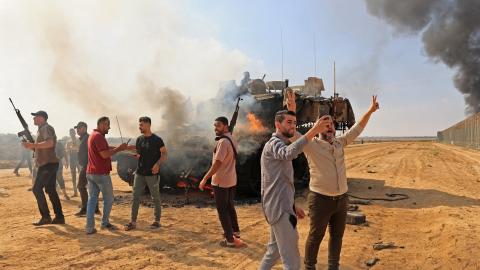
Everything changed on October 7, 2023. People suddenly cared, but it was all about one issue and one issue alone: the Israeli-Palestinianconflict.
Almost out of nowhere, support for the Palestinian people became the cause célèbre for many Americans and Europeans. Within days, college campuses were convulsed by protest and polemic, and large demonstrations became weekly occurrences in many Western cities. Global censure and condemnation of Israel kicked in within hours of October 7 (as did denial of the scale of the massacres and gender-based violence perpetrated by Hamas).
The "Free Palestine" or “Ceasefire Now” movement snowballed in the months following October 2023, as did (absurd and ahistorical) accusations that Israel was committing "genocide" as it battled Hamas's 30-000 strong militia, which operated almost exclusively from homes, hospitals, and other civilian sites. Even though we are nine months on from the signing of a ceasefire in Gaza, demonstrations continue at the same tempo and political posturing has, if anything, increased.
So why the singular focus on this conflict? Why are the same students and politicians unmoved by massacres in Iran or mass murder and starvation in Sudan?
When pushed, many Americans will ascribe their selective pro-Palestinian activism to the fact that Israel has been a major recipient of U.S. aid over the years. I've always found this explanation inadequate, if not troubling. America has close ties, and has furnished generous aid, to dozens of countries engaged in conflicts or with dismal human rights records. Moreover, America itself was an active combatant in conflicts in Iraq, Afghanistan, and Syria over the past two decades (spending hundreds of billions of dollars) – yet there was no meaningful protest movement during those years.
One can only deduce that it is Israel’s involvement in certain conflicts that triggers the outrage, the censure, and the hateful rhetoric – when all other conflicts in the same region, regardless of America’s participation or role, draw shrugs. How is Israel different? Is it the fact that it is a mostly Jewish state? I doubt it draws ire and hatred because it’s the only democratic country in the region, or the most religiously diverse, or a hub of science and technology innovation.
None of this is to say that Israel shouldn’t be subject to fair and proportionate scrutiny and that U.S. assistance shouldn’t be debated. (Many Israelis have tough questions about the strategy and tactics used against Hamas and Hezbollah and many will vote accordingly in the country’s elections in October). But we are far, far removed from that – so much pro-Palestinian activism these days calls into question Israel’s right to exist and seems to side with Hamas and Hezbollah and express sympathy for the regime (not the people) in Tehran.
The impact of all this on Jewish communities is obvious and has been written about extensively. The likes of Abdul El-Sayed and Tucker Carlson know all too well that their conspiracy-laden obsessions with Israel inevitably provoke animosity and attacks against Jewish Americans.
This warped, myopic view of the Middle East’s various conflicts doesn’t help the Palestinian people, nor any of the other societies that have bled and suffered so gravely in the past 20 years.
America cannot engage constructively and earnestly if swathes of our political class lay the blame for all the region’s woes at Israel’s feet, rather than acknowledging and tackling the real threats, whether the Iranian’s regime’s destructive role in the region or the ongoing, serious threat of Islamist extremism.