












In a nutshell
- The Middle East conflict is shrinking New Delhi’s room for maneuver
- India is diversifying suppliers, raising costs and geopolitical risk
- Prolonged war could harm remittances, the rupee and growth
The war in Iran is affecting India beyond the global oil shock and trade disruptions. New Delhi has long viewed the Middle East as part of its extended neighborhood and maintains ties with all key actors in the conflict – Iran, the United States, Israel and the Arab Gulf states. As in the Cold War era, Prime Minister Narendra Modi’s administration now faces the classic strategic challenge of balancing relations with contending parties without aligning with any one of them.
Economic consequences of the Iran war
New Delhi’s margin for maneuver has narrowed since U.S. and Israeli strikes on Iran triggered Iranian retaliation against Gulf states. This region is crucial for India, providing about 45 percent of its crude oil and condensate, 66 percent of its liquefied natural gas (LNG) and 90 percent of its liquefied petroleum gas (LPG) imports. Over 9 million Indians reside in the six Gulf Cooperation Council (GCC) countries, contributing nearly 40 percent of India’s annual remittances, which total around $135 billion.
In addition to direct supply disruptions, volatility in the global energy market has increased uncertainty about India’s import costs, putting pressure on subsidies and government spending. Energy shortages are affecting all sections of society, including average households, fueling inflationary pressures and limiting spending. A shortage of LPG cylinders has led to the closure of small commercial establishments.
Industries such as automobiles, electronics, ceramics, fertilizers and pharmaceuticals are suffering due to the fuel crunch. Supply chains in the Indian Ocean region have slowed considerably. With India’s main agricultural season set to begin in June, the prolonged conflict – which has led to a fertilizer shortage – poses a serious threat to the country’s food supply.
Following the Gulf War and the 1991 oil crisis, India began building strategic petroleum reserves. Currently, India has a total reserve coverage of 21 million barrels, far lower than Japan’s 263 and China’s 1,397 million barrels. The ongoing crisis, which shows little sign of resolution, underscores a key vulnerability: India’s strategic reserves, intended to handle short-term disruptions, are not equipped to withstand extended periods of geopolitical instability. As of mid-March, these strategic reserves stood at just two-thirds of total capacity.
New Delhi has responded to the latest crisis by seeking alternative suppliers to address the energy shortfall. While this diversification is necessary, it also exposes India to potential geopolitical risks in these new regions. This highlights the country’s lack of a sustainable long-term energy security strategy.
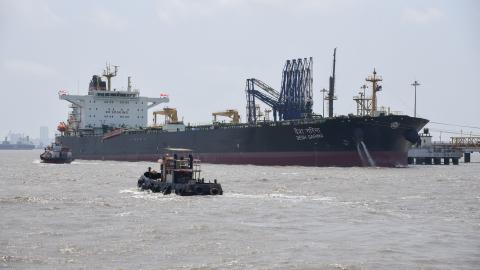
India’s options all entail higher costs, prompting it to prioritize securing safe passage for its commercial vessels through the Strait of Hormuz, under the Indian Navy’s protection. The GCC nations are key economic partners for India, and any long-term blockage of shipping routes could heighten the risk of a supply shock to its economy. In fact, safeguarding sea lines of communication has shifted from a mere commercial concern to a crucial element of India’s strategic objective of establishing itself as a net security provider in the Indian Ocean.
The Iran war crisis has exposed some of India’s structural vulnerabilities. India’s central bank has said that a rise in crude oil and gas prices – resulting in higher capital outflows, trade disruptions, weaker exports, a slowdown in remittances, increased downward pressure on the rupee and a rise in inflation – could decelerate economic growth. This new crisis has hit India at a time when its economy has not yet fully recovered from the tariff and trade pressures imposed by the second Trump administration last year.
Geostrategic challenges
The Modi administration has suffered a setback in its endeavors to keep Muslim-majority Iran and the Gulf Arab states closer to India than to its regional rival, Pakistan. The escalating strategic rivalry between the U.S. and Iran, along with Israel’s security concerns, complicates India’s ability to maintain strong relationships with all parties involved. New Delhi has sought to internationally isolate Pakistan because of its role in terrorist attacks targeting India. But Islamabad’s emergence as a facilitator of talks between Iran and the U.S. now adversely affects India’s interests and policies.
India has been a strong partner of Israel and has long supported a two-state solution for Palestine while maintaining functional cooperative relations with Iran. Although New Delhi has not supported Iran’s nuclear program, it recognizes Tehran as a regional power. This distinct positioning has been beneficial up until now, but the war reduces the scope for ambiguity that allows for multi-alignment. As a result, India has struggled to clarify its position regarding its various partners currently involved in the conflict.
Long-term instability in the Middle East might prompt a reevaluation of Indian geoeconomic interests. Over the past decade, India has deepened its economic integration with the Middle East. This includes initiatives such as the West Asia Quad or I2U2 (India, Israel, the U.S. and the United Arab Emirates), which focuses on energy and food security and technology. New Delhi has championed the India-Middle East-Europe Economic Corridor (IMEC), which includes key partners in the Gulf and Europe.
India has also invested in strategic infrastructure across the Indian Ocean, including key ports like Duqm in Oman, Haifa in Israel and Chabahar in Iran. Its goal with these investments is to achieve a deeper integration of economies across the Indian Ocean region and into global supply chains, ultimately establishing itself as the preferred economic and security partner for countries in the region while mitigating China’s influence.
The fate of the Chabahar port is uncertain as the U.S. sanctions waiver granted by the Biden administration nears expiration and is not expected to be renewed by President Donald Trump. Amid recent tensions, Iran targeted Duqm, causing damage to infrastructure in which India had invested. The lines of connectivity and influence that New Delhi has been trying to establish in the Middle East are now being redrawn by more coercive forces.
For over two decades, India has viewed itself as the first responder to humanitarian disasters and the preferred security partner for countries in the Indian Ocean region. But the current environment is far less accommodating of assumed roles. On March 4, 2026, the Iran conflict entered India’s maritime neighborhood when an American submarine sank an Iranian warship, IRIS Dena, only 44 nautical miles off the coast of Sri Lanka. Public outrage was heightened by the knowledge that the Iranian ship was returning from a multilateral naval exercise hosted by India and was not involved in any combat activities.
There are significant concerns for the Indian strategic establishment as well. India has historically sought to remain unaffected by conflicts elsewhere, but it has only been partially successful. In recent years, both China and the U.S. have shown their ability and willingness to take actions within India’s sphere of influence.
India’s strategic dilemma
For three and a half decades, India has sought to balance its ties with the Gulf Arab countries, Israel and Iran, while also trying, as far as possible, to insulate each relationship from the others. But multi-alignment, which has long defined India’s foreign policy alongside strategic autonomy, now seems under pressure. The viability of this approach depends on whether the major powers, especially the U.S. under the Trump administration, can accept its strategic ambiguity during periods of crisis or will demand clearer political and military commitments.
The current conflict, however, has the potential to reshape the region in ways that Indian leaders and strategists may not have anticipated. If the conflict expands into the Indian Ocean region, it could force India to shift its stance from neutrality to selective alignment, particularly regarding maritime security and the defense of vital infrastructure.
India’s ability to act is limited by its reluctance to build economic and military hard power, which would enable it to project power in its geographical neighborhood.
Instead of focusing on building hard power, Prime Minister Modi has aimed to project India through the lens of moral authority, positioning the country as a Vishwa Guru (“world leader”) for both the developed world and the Global Majority. This is easier during times of relative peace but tougher during conflicts.
During Russia’s invasion of Ukraine in 2022, India faced criticism from many partners for its refusal to condemn Russian aggression. As India gets ready to chair BRICS+ – a coalition of 11 emerging economies that includes Iran – later this year, it is once again under scrutiny. The country is facing pressure to take a clear stance and voice its opinions, something its leaders have largely avoided so far.
Scenarios
Most likely: India continues its current strategy
The most likely scenario is a continuation of India’s current policy of working with Iran to allow Indian tankers to pass while seeking oil and gas from other suppliers to ease short-term distress. However, India’s domestic challenges are growing. Indian households are hurting, as are small and medium-sized enterprises, which are vital to manufacturing. Factory closures are resulting in laborers returning home to their villages, a reminder of what happened during the Covid-19 shutdown.
The drawn-out war in the Middle East could also disrupt remittances, causing short-term financial instability for smaller Indian households. In the run-up to the April 2026 assembly elections in five states, the Bharatiya Janata Party-led central government adopted a cautious approach on fuel prices and subsidies. Unlike some of its neighbors, such as Pakistan and Sri Lanka, India has so far refrained from imposing shorter work weeks or raising oil and gas prices. This political caution highlights how internal electoral dynamics can sometimes influence economic policymaking, potentially delaying difficult but necessary decisions.
If, however, the war continues for months rather than weeks, the Indian government has limited maneuverability. For example, the government has sought to limit airfare hikes by private airlines, but that cannot be sustained. Similarly, the government is prioritizing the supply of LPG cylinders to households over commercial establishments, but that too can only last for weeks, not months. Eventually, this may compel India to reevaluate its subsidy policy, its energy pricing scheme and even its sector priorities for resource allocation.
Less likely: A prolonged war seriously challenges New Delhi
The worst-case scenario for India would be a war that lasts years, diverts the U.S. focus from the Indo-Pacific and China, and drains American resources and bandwidth. Such a war would affect oil and gas supplies, disrupt Gulf economies leading to the return of Indian workers and a drop in remittances, and further harm the Indian economy.
Furthermore, if Washington turns its gaze away from the Indo-Pacific region for an extended period, it will certainly embolden Beijing to assert its influence in the Indian Ocean – a strategic nightmare for New Delhi.
In the past two decades, India has developed strong security ties with Gulf Arab countries, particularly the UAE and Saudi Arabia. However, in the last year, Pakistan has deepened its defense and military cooperation with both Saudi Arabia and Turkiye. The Iran war has also helped Islamabad portray itself to the U.S. as a mediator and to the Gulf Arab states as a security partner. This follows the reopening of Pakistan’s channels with Washington over the past year, while India-U.S. relations were on a downward trajectory.
A post-war Middle East in which Pakistan is positioned across multiple axes of influence and enjoys closer relations with the U.S., Gulf Arab states, Turkiye and Iran will be less accommodating to New Delhi’s assumptions. In this changed regional dynamic, India will need both diplomatic finesse and economic and military credibility to hold onto strategic space.