















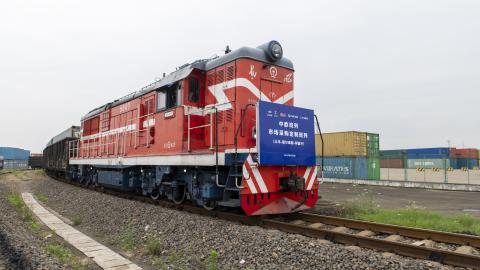
The flagship project of China’s Belt and Road Initiative, the China-Europe freight train, travels 13,000 kilometers (8,000 mi) from China’s eastern manufacturing hub of Yiwu to Madrid. Along the way, it passes through eight countries—China, Kazakhstan, Russia, Belarus, Poland, Germany, France, and Spain.
For China’s National Development and Reform Commission, the project is a single corridor. For the US State Department, however, it crosses through three different regional bureaus: East Asia and Pacific Affairs, South and Central Asian Affairs, and Europe and Eurasian Affairs. The United States organizes the world differently from its primary competitor—and that could mean it fails to see the full picture of what the other side is trying to do. In today’s hyperconnected world, it is simply no longer possible to divide the world up into distinct regions and view them in isolation from one another.