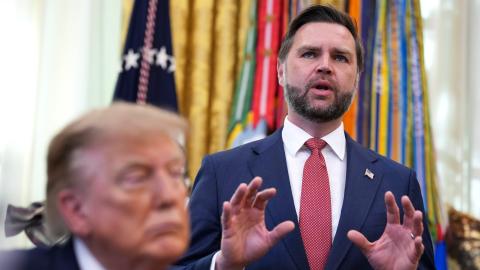











J.D. Vance has turned Donald Trump’s Middle East strategy into a liability inside his own political coalition. In a post on X explaining the Republican midterm defeat last week, the vice president identified the Iran war as the principal reason Republicans lost the votes of former Trump supporters. He then listed four conditions for winning them back: end the war with Iran, address inflation, put America first, and “change our relationship to Israel.” Donald Trump Jr. promptly endorsed the analysis: “Every word of this is 💯💯💯.”
Will the president take his deputy’s advice? The stakes are high. The outcome of the Iran war will shape the balance of power in the Middle East, the future direction of Republican foreign policy, and the geopolitical legacy Trump leaves behind.
For years he has ridden two horses at once: the foreign-policy restrainers, who want to reduce America’s overseas military commitments, and more traditional Republicans, who regard military power and robust alliances as essential to maintaining America’s international position. Trump has borrowed from both. Like the restrainers, he wants to avoid open-ended wars and military occupations. Like the traditional Republicans, he wants to prevent hostile powers from dominating strategically important regions.
His preferred solution is to preserve American influence through economic coercion, selective military force, and capable regional allies. A short, decisive war against Iran might have allowed him to reconcile these competing impulses. However, Iran’s ability to sustain missile and drone attacks despite overwhelming American air superiority has prolonged the conflict and imposed costs that American power cannot quickly eliminate. The measures required to pursue Trump’s objectives over time are precisely those his restrainer allies oppose.
Trump himself acknowledged that the war was a major factor in the midterm losses. Asked about Vance’s claim that “the reason we lost is the war,” he said it was “largely true” because the fighting drove gasoline prices higher in the short term, but he added that he would do it again because “you can’t let Iran have a nuclear weapon.” He did not accept Vance’s further claim that Republicans must change their relationship with Israel. But Vance’s statement throws Trump further off balance, because it is a populist political appeal to those who want the relationship changed.
Vance could have simply called for ending the Iran war. By listing “change our relationship to Israel” as a separate demand, he raised the question of whether the alliance itself is compatible with America First. Leaving the precise nature of the change unspecified meant the vice president’s argument appealed simultaneously to two distinct groups: mainstream restrainers and Groypers. The restrainers could hear a call to reduce entanglements and demand greater burden-sharing. The Groypers, who are associated directly with Nick Fuentes and cultivated by Tucker Carlson, treat opposition to Israel as a core test of America First.
For the Groypers, Israel is less a practical foreign-policy question than a symbol of an elite that has captured the American state and bent it to purposes that are not America’s own. Once the alliance is understood in those terms, the debate leaves the realm of strategy and enters a quasi-metaphysical realm, one in which the entire foreign-policy system is presumed rigged. Like the radical progressives, the Groypers seek to tear the system down.
In their telling, Israel is the principal beneficiary of a corrupt establishment that sacrifices American interests to those of the Jewish state. The Epstein scandal has supplied the worldview with its most potent storyline: Epstein was an Israeli intelligence asset whose network of financiers, politicians, and sexual predators gave Israel the means to manipulate American policy. The Iran war, in turn, becomes evidence that the same shadowy figures have captured even Donald Trump.
Carlson, Fuentes, and a host of other podcasters have turned a disagreement over Middle East strategy into a question of political legitimacy. If the discussion begins with the premise that the alliance with Israel is the product of sinister manipulation, its defenders need not be answered on strategic grounds. Their arguments become evidence that they are either part of the conspiracy, or its dupes.
Through his friendship with Tucker Carlson, Vance has maintained ties to this audience without embracing its every claim. Carlson helped advance his political career, and the vice president has maintained their friendship despite Carlson’s increasingly bitter attacks on Trump and his promotion of antisemitic conspiracy theories. On Joe Rogan’s podcast in July, Vance showed that he was willing to meet it on its own terrain. When Rogan suggested that Epstein had worked for Mossad, Vance entertained the possibility. “Mossad or CIA or some other deep state,” he replied, “whether in America or Israel or another country.” He then asserted that Epstein “clearly had connections to the highest levels of Israeli intelligence.” He acknowledged that no documents established a direct intelligence relationship, yet publicly tied Epstein to what he called the Israeli “deep state.”
In the same conversation, Vance went further on the war itself. He charged that elements within the Israeli government were waging a “very discreet, extremely well-funded campaign” against American negotiations with Iran, “manipulating and trying to change American public opinion to keep the war going on indefinitely.” Vance did not adopt the full Groyper storyline. He demonstrated familiarity with its vocabulary and a readiness to use elements of it.
The president has spent years treating Israel as an instrument of American power, not as a dependent client whose defense is an act of charity. The partnership is central to his efforts to contain Iran, shore up the American position in the Middle East, and reduce the need for direct American military intervention. Yet the constituency Vance is courting sees that same partnership as evidence of American subservience. No adjustment to the amount or form of American military assistance can resolve this disagreement. At issue is the purpose of American power in the Middle East and the alliances through which that power is exercised.
Trump’s own conduct has compounded the ambiguity. On Election Day, as Republicans faced a backlash over the Iran war, he announced on Fox News that he intended to end roughly $4 billion in annual U.S. assistance to Israel by the close of the year. “We were giving them $4 billion—we are—but it gets cut off at the end of the year,” he said. He added that he and Benjamin Netanyahu had agreed to the change months earlier and that Israel no longer needed the money: “They don’t need it. Israel’s our number one. We give them more than anybody else, and they no longer need it.”
Yet the president offered no account of how the decision fit into his Middle East strategy. Ending assistance need not weaken the alliance. An Israel that finances more of its own defense while continuing to provide intelligence, military technology, and combat power against common adversaries could become an even more valuable American partner.
Trump did not make that argument. Instead, he presented the change as a reduction in American obligations rather than the strengthening of a strategic partnership, reinforcing the impression that the alliance was a burden to be shed. The timing and presentation made a previously negotiated change appear less like an element of a settled strategy than a concession to electoral pressure. Far from resolving the contradiction within his coalition, the announcement sharpened it.
What, then, is the alternative Middle East strategy? The assertion that America is fighting Israel’s war rather than its own, advanced in conspiratorial form by the Groypers and in milder versions by figures such as Rep. Thomas Massie and former representative Marjorie Taylor Greene, replaces an assessment of American interests with a theory of foreign manipulation. Mainstream reporting and progressive politicians have reinforced the claim. New York Times accounts and the positions of many on the left have portrayed Netanyahu as leading Trump by the nose, lending legitimacy to the premise that the war is Israel’s rather than America’s. Yet the assertion explains nothing about how the United States would secure its interests once it abandons the policies and partnerships its critics reject. Can Washington reach an accommodation with the Islamic Republic that reliably prevents it from acquiring nuclear weapons? If not, should it accept a nuclear-armed Iran? What would that outcome mean for the balance of power in the Middle East, and for the larger balance of power with China?
While Israel’s detractors evade these questions, more sober restrainers have confronted them, sometimes reaching conclusions sharply at odds with Trump’s strategy. Consider Elbridge Colby, now undersecretary of defense for policy and a leading advocate of concentrating American military power against China. In 2012, he argued that “the only thing worse than the prospect of an Iran armed with nuclear weapons would be the consequences of using force to try to stop them.” As a Trump official, he has since described a nuclear-armed Iran as an existential danger and endorsed the president’s policy of preventing it. But his earlier argument demonstrates the inexorable endpoint of the restrainer logic: accepting an Iran with nuclear-tipped missiles.
Answering those questions requires starting from first principles. The purpose of American grand strategy is to maintain an international order that makes American freedom possible. That requires preserving the foundations of American power and prosperity: military superiority, economic dynamism, the dollar’s central role in international finance, technological leadership, and secure energy supplies for the United States and its allies.
It also requires preventing any hostile power or coalition from dominating Eurasia. The growing cooperation of China, Russia, Iran, and North Korea threatens regional balances favorable to the United States. America’s interest lies in preserving multiple independent centers of power across Eurasia, none capable of subordinating the others. The international balance of power and the foundations of American prosperity are mutually reinforcing. Alliances help sustain both.
These considerations lead directly to the Middle East. The region’s traditional importance rests on its enormous energy reserves and the maritime choke points connecting Europe, Africa, and Asia. But oil is now only part of the story. The Gulf monarchies command vast pools of capital increasingly important to artificial intelligence, data centers, and the infrastructure of the digital economy. Their sovereign wealth funds are major investors in global financial markets, and their decisions about where to place that capital have consequences for the international role of the dollar. They are also among the largest purchasers of American weapons, helping sustain the defense-industrial base on which American military power depends.
China covets these relationships: access to Gulf capital, influence over emerging technological networks, arms sales, and opportunities to develop financial channels less vulnerable to American sanctions. Beijing’s influence over Middle Eastern energy, infrastructure, and political alignments affects its leverage throughout Eurasia. American withdrawal would diminish Washington’s ability to prevent Beijing and its partners from reshaping the global balance of power. The competition for the Middle East is therefore not simply about who controls the oil. It is about who shapes the economic, financial, technological, and military networks connecting Eurasia.
The question, then, is how to preserve American influence without exhausting American power. The interventionists of the George W. Bush era sought to remake the Middle East through American military intervention. The restrainers would reduce American commitments, accepting diminished regional influence as the price of concentrating resources elsewhere.
Trump has sought a third course: maintain American primacy without occupying countries or assuming responsibility for their internal political transformation, relying instead on economic coercion, selective military force, diplomacy, and capable regional allies. The objective is maximum American influence with the minimum necessary American military footprint.
That approach requires a regional balance in which Iran cannot dominate its neighbors. Tehran’s nuclear ambitions are not merely an Israeli concern. Nor is the present war simply a conflict Washington is fighting on Israel’s behalf. Iran has attacked American military installations across the Middle East, damaging aircraft, radar systems, communications equipment, and other infrastructure worth billions of dollars. Its missiles and drones threaten the bases through which the United States projects power into the Persian Gulf and beyond. An Iranian nuclear weapon would compound that threat by giving Tehran greater capacity to intimidate its neighbors and shield its conventional aggression from American retaliation. The United States is therefore confronting a challenge to its own military position and regional influence, quite apart from its obligations to Israel.
Yet restrainers rarely confront the consequences of a weakened American alliance. If the United States retreats from the Middle East, its regional partners will have powerful incentives to hedge toward China. Israel would face those pressures too. Beijing would gain opportunities to deepen its access to Israeli technology, investment, and regional influence.
The danger is not necessarily that Israel would rush to abandon Washington and realign with Beijing. Its military systems and security relationships are too deeply intertwined with those of the United States for such a shift to be assumed. The more plausible risk is a gradual expansion of Chinese access to Israeli technology, investment opportunities, and diplomatic influence as Israel seeks alternatives to an increasingly uncertain American partnership. A country whose military capabilities and technological innovations now strengthen the American position could instead become a source of advantage for America’s principal competitor. The alliance is not simply a commitment Washington makes to Jerusalem. It is a means by which Washington ties a dynamic and powerful actor to itself.
Israel cannot, however, sustain a favorable regional order alone. Saudi Arabia and the Gulf states possess energy resources, capital, and strategic geography. Turkey commands formidable military capabilities and serves as a key bridge between Europe and Asia. Their interests do not always coincide. The growing rivalry between Israel and Turkey presents Washington with a particularly difficult challenge. American leadership is necessary to organize these capabilities into a regional balance that constrains Iran, manages rivalries among American partners, and limits opportunities for China and Russia to exploit regional disorder.
This brings us to the contradiction in the restrainer challenge to Trump. Alliances allow Washington to maintain influence while shifting more of the military burden to capable local powers. Weakening the alliance with Jerusalem in the name of restraint risks undermining the very objective restrainers claim to serve. The less America wants to fight in the Middle East, the more it needs Israel.
Nor can Trump resolve the problem simply by ending the war with Iran. The fighting may stop, but the strategic questions will remain. What prevents Tehran from rebuilding its military capabilities and pursuing nuclear weapons? What balance of power will emerge in the Persian Gulf? Who will protect the energy routes on which America’s Asian allies depend? And what role will China play in shaping the answers? A ceasefire is not a regional order.
Vance’s challenge is partly of the president’s own making. Trump deliberately surrounded himself with officials whose strategic instincts differ sharply from his own—Colby at the Pentagon, Vance in the vice presidency, and many others throughout the national security bureaucracies—believing he could manage their disagreements while preserving his freedom of action. But the Iran war has exposed the limits of managing a strategic disagreement as a personnel problem. The two camps disagree not merely about tactics or the costs of particular operations, but about the international order America needs and the responsibilities required to sustain it.
The vice president has aligned himself with the restrainers while leaving the door open to the Groypers on their radical fringe. Trump’s strategy depends on precisely the regional partnerships that maneuver places in question. The case for those partnerships is a strategic one, and it can be contested on its merits.
But the Groyper premise forecloses rational debate. If the alliance is the product of a conspiracy, every argument for it becomes evidence of the hidden hand. The questions on which American strategy turns cannot even be considered on their merits.
Concessions offered without a strategic rationale will not resolve the problem either. Trump’s aid announcement was followed the next day by his vice president’s placing the relationship itself on the table. A concession presented as shedding a burden risks validating the premise that the alliance is inherently burdensome.
Since first taking office in 2017, the president has been riding two horses. The Iran war has sent them in opposite directions, and his vice president has chosen the restrainer side. The question is no longer only how Trump manages his coalition, but which foreign policy his movement inherits: the one Trump has practiced, which treats Israel as an instrument of American power, or the one Vance is increasingly embracing, in which the alliance itself becomes suspect. If Trump does not make the case for his own strategy, his vice president’s choices will define it for him.