














It was clear from my first day on the job as U.S. President Donald Trump’s National Security Advisor in February of 2017 that the Japan-U.S. alliance was more important than ever because of the threats from North Korea and the Chinese Communist Party (CCP). In the eight years since I left Washington, the dangers associated with those two hostile authoritarian regimes’ conventional and nuclear weapons have grown more severe. That is why it is more important than ever that Japan and the United States work to deter war in the Indo-Pacific. Success will depend in large measure on potential enemies’ assessment of Tokyo’s and Washington’s willingness to work together to improve security, promote prosperity and, in time of crisis, to come to one another’s defense. As Defense Minister Shinjiro Koizumi observed at the Shangri-La Dialogue in Singapore at the end of May, “If gaps emerge among the United States, Europe and allies and like-minded countries, forces which take it as an opportunity will surely come in.” Despite recent tensions, the Japan-U.S. alliance that the late Prime Minister Shinzo Abe described as “a miracle of history” will remain strong for the fundamental reasons that the two nations share a commitment to democratic principles and need one another to protect themselves against aggressor states that want to tear down the rules of international discourse and replace them with new rules that favor their authoritarian forms of government and, in China’s case, its statist, predatory economic model.
Emboldened by the perception that the United States and other democratic nations were weak, divided and decadent, an axis of aggressor states has coalesced, providing extensive material, financial and moral support for one another. The two revanchist powers foundational to the axis — Xi Jinping’s People’s Republic of China (PRC) and Vladimir Putin’s Russia — pulled into their fold, among others, the despotic Kim family in Pyongyang and the theocratic-cum-military dictatorship in Tehran. Cascading crises from Russia’s February 2022 massive reinvasion of Ukraine to the multi-front war in the Middle East that began with the mass murder attacks on Israel on Oct. 7, 2023, threaten to cascade further into the Indo-Pacific. These crises and growing threats from the axis of aggressors to Japanese and U.S. vital interests are impelling deeper cooperation in four areas critical to both nations’ security and prosperity.
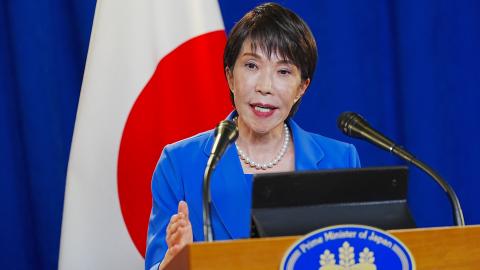
First, defense. For decades, Trump and other U.S. presidents have exhorted America’s allies to invest more in defense, and Japan is doing just that. Japan met its goal of investing the equivalent of 2% of gross domestic product well ahead of schedule in March of 2026 and is acquiring vital long-range counter-strike missiles; integrated air, missile and drone defenses; autonomous systems; improved command and control; and vital space, cyberspace and intelligence capabilities. The strengthening of the Self-Defense Forces is consistent with Trump’s theme of pursuing “peace through strength” and complements the Trump administration’s increases in defense spending and its priorities of homeland defense and security in the Indo-Pacific. The failure to block North Korea’s path to the most destructive weapons on earth and the continued massive buildup of the People’s Liberation Army along with aggressive rhetoric and actions from both hostile dictatorships toward Japan and other U.S. treaty allies including South Korea and the Philippines all reinforce the indispensability of mutual defense. The alliance remains strong in nuclear as well as conventional deterrence. On June 10, the governments of Japan and the United States released a joint statement on the Japan-U.S. Extended Deterrence Dialogue in which the United States “reaffirmed its commitment to the defense of Japan, using the full range of its capabilities, including nuclear.” Japan and U.S. defense strategies are mutually reinforcing. As Prime Minister Sanae Takaichi observed in March at the graduation ceremony of the National Defense Academy: “It goes without saying that our own efforts are necessary for the peace and security of our country and our region. At the same time, cooperation with our allies and like-minded countries is indispensable.”
Second, manufacturing. Trump came into office in 2017 with a goal of reinvigorating the U.S. industrial base. In his second administration, munitions expenditures in the wars in Ukraine and the Middle East have increased the urgency of accomplishing that goal. Tokyo and Washington recognize that they need each other in vital manufacturing sectors including shipbuilding, semi-conductors and coproduction of weapon systems and munitions. Joint public private roadmaps and finance mechanisms are already generating new plants, tooling orders and workforce training to revive industrial production.
Third, energy security. In both of his presidential terms, Trump has prioritized what he calls “energy dominance.” Japan and the United States need more energy to expand manufacturing and provide the computing power necessary to realize the promise of artificial intelligence. Energy supply disruptions after Russia’s massive invasion of Ukraine in 2022 and the intensification of wars in the Middle East after Oct. 7, 2023, the restriction of maritime traffic through the Strait of Hormuz after the U.S.-Israeli strikes against Iran, and Iranian attacks on oil and gas infrastructure highlighted the fragility of fossil fuel supply chains. To meet increasing demand and improve energy security, Japan and the United States are investing in energy diversification, with Japan investing in energy infrastructure such as facilities associated with U.S. LNG exports. A joint research and development project, Genesis Mission, is advancing new energy technologies such as fusion, advanced materials and related technologies that underpin future energy systems. Other long-term initiatives include a recently announced agreement for American enriched uranium export to Japanese utilities supported by the U.S. Export Import Bank for over $2 billion across a decade.
Finally, supply chain resilience. In 2017, the Trump administration initiated planning with Abe’s government to “counter Chinese economic aggression” and the administration of President Joe Biden deepened that cooperation. The Takaichi and Trump governments are now implementing crucial mineral action plans to mobilize investment, coordinate stockpiling and develop new sources of supply. Japanese and U.S. scientists are conducting joint research and development of critical technologies such as quantum computing, artificial intelligence, critical minerals processing, hypersonics and autonomous systems.
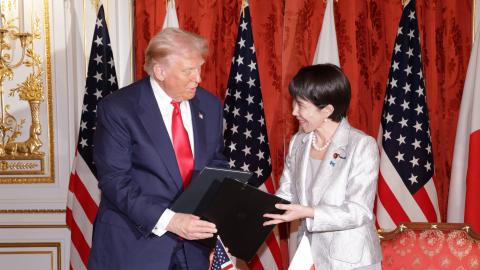
I departed Washington in 2018 optimistic about the future of the Japan-United States alliance. I remain so despite tensions in the relationship associated with trade, tariffs and the Trump administration’s apparent ambivalence about Chinese Communist Party rhetorical, military, cyber and economic aggression that has raised doubts about U.S. reliability as a guarantor of security. Moreover, Trump’s May 2026 visit to Beijing sent mixed signals about U.S. resolve to confront Beijing’s actions that harm U.S. economic and security interests, much less those of Washington’s allies. Trump discussed U.S. arms sales to Taiwan with Xi and then described Washington’s pending $14 billion arms package to Taiwan as “a good negotiating chip,” further raising doubts about U.S. commitment to security in the Indo-Pacific region.
Japanese and American leaders should take those doubts seriously because deterring war depends in large measure on potential enemies’ assessment of Tokyo’s and Washington’s will to come to one another’s defense. But the alliance remains strong not only because deeper cooperation in the four areas above is in the interests of both nations, but also because of our shared principles of democratic government. Dictators in Beijing, Moscow, Tehran and Pyongyang see the often-vitriolic partisan discourse, changes of government and checks on executive authority associated with democracies as signs of division, weakness and sloth. Although democracies appear ugly from the outside, they are resilient because citizens have a say in how they are governed and can demand improvements short of revolution. In contrast, authoritarian regimes appear strong from the outside, but their concentration of power produces brittle systems in which leaders are insulated from reality and rely on coercion rather than consent to remain in power. Citizens of Japan and the United States should be confident in the strength of their democratic governments and their free market economies. And they should be confident because the “miracle” of the Japan-U.S. alliance continues.