


















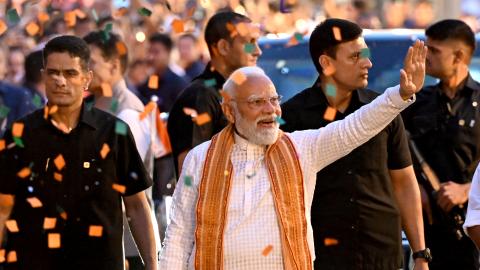
For years, Western liberals and India’s opposition have both consoled themselves with a theory: Prime Minister Narendra Modi is an authoritarian, India’s overwhelming diversity is ultimately incompatible with strongman rule and thus his illiberalism will naturally backfire.
That theory met perhaps its largest setback yet on Monday, when Modi’s Bharatiya Janata Party — the largest political party in history — captured one of the states that should have been most impossible for it to appeal to: a fiercely independent, culturally distinct region home to more people than California, Texas and New York combined. The opposition would do well to try to learn from its latest loss.
Monday’s vote did more than flip a state. For decades, India’s most powerful regional parties have been the most resilient limit on the BJP’s national expansion — locally rooted political machines, fluent in their states’ language and identity, that the BJP’s predominantly northern, Hindi-speaking culture often struggled to penetrate. West Bengal’s Trinamool Congress, led by the formidable Mamata Banerjee, was among the most prominent of them, lending credibility to the idea that India’s pluralism is simply too expansive for any one party to knit together — much less one pushing for a specific, muscular vision of cultural nationalism. In routing Banerjee on Monday, the BJP demonstrated it can now break the regional and cultural barriers that were supposed to contain it.
Even before this win, the numbers behind the BJP’s ascent were already staggering. The BJP boasts 140 million members, more than any political party on Earth, exceeding the Chinese Communist Party — its only peer — by 40 percent. More votes have been cast for Modi than for any politician in human history, by a margin in the hundreds of millions. Modi has comfortably outperformed every other democratically elected leader in the world in Morning Consult’s global leader approval tracker for many years, despite the longevity of his tenure. By the metrics that translate to power in a democracy, the Hindu right is already the contemporary world’s most successful political movement.
Critics counter — not without reason — that electoral successes are not the only way to measure democratic strength, and that the BJP and the broader Hindu nationalist movement have eroded India’s liberal institutions, press freedoms and pluralist social fabric, with minorities facing rising violence and discrimination under its rule.
They further claim the ballots are not all that they appear, and accuse the BJP of tilting the playing field — stacking the election commission and engineering a now-defunct donation scheme that gave the party steep financial advantages over its rivals. The West Bengal vote drew its own controversy after the election commission purged about 9 million names, roughly 12 percent of the electorate, from the voting rolls — a move supporters defended as removing duplicate, ineligible or deceased voters, and that critics decried as a weapon to disenfranchise the Muslim minority that votes predominantly for the opposition.
But electoral engineering alone cannot account for the BJP’s successes. The party took more than two-thirds of West Bengal’s seats on Monday, and in less than 50 years has gone from a fringe outfit to leading 21 states — while the Indian National Congress, the party that led India to independence, has been reduced to four holdouts.
The contrast with its principal rival is instructive. The Congress party inherited its dominance: It spearheaded the independence movement, won the buy-in of India’s English-speaking elite and built the institutions of the state it would govern for most of the country’s first half-century, animated by fashionable international ideas about how to manage society. The BJP built its dominance the hard way — from the ground up through decades of grassroots organizing, painstakingly melding together a coalition that now spans castes, languages, regions and religious traditions that have otherwise had little reason to vote together.
Its foundation is the Sangh Parivar or “organization family,” of the Rashtriya Swayamsevak Sangh (RSS), a controversial Hindu nationalist volunteer organization, now a century old, focused on cultivating millions of cadres and dozens of organizations devoted to reviving its vision of Hindu society. In concert with the BJP, the RSS spreads its message through a network of other organizations it founded alongside the BJP: India’s largest labor union, largest private school network, largest student union and the most influential council of Hindu religious leadership, to name but a few. That unique set of on-the-ground, ideological and social ties across Indian society, combined with hard-nosed dealmaking and shrewd alliance building, has been the foundation of the BJP’s extraordinary rise.
The BJP is consolidating power just as India takes its place among the world’s great powers: largest by population, second-largest by military personnel, on the way to becoming third-largest by economy, and the only nation with the potential to counterbalance China in Asia. Monday’s victory in West Bengal shows that the BJP’s rise has not yet reached its ceiling.
The BJP’s opponents may keep waiting for the reckoning they’ve long predicted. It may yet arrive. But anyone watching the evidence should instead prepare for the India of the coming decades — and the balance of power in Asia — to be built in no small part by the Hindu right.