
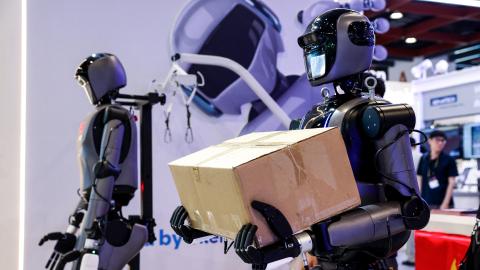

















Thursday’s summit between President Donald Trump and Chinese leader Xi Jinping presents an opportunity for Trump to take a more assertive approach to derailing Beijing’s artificial intelligence strategy. China’s aggressive attempt to capture the global markets for AI directly threatens U.S. strategic and economic interests but rests on weak financial pillars. Trump can exploit these to blunt Beijing’s global AI advance if he’s willing to dial up the economic pressure.
U.S. investors are all in on AI and are devoting trillions of dollars to developing its supply chains. PricewaterhouseCoopers estimates data center spending alone in the United States will total over $15 trillion in coming decades. ING estimates that AI spending already accounts for one-third or more of domestic economic growth. But cheaper Chinese “open-weight” models — meaning their core components are publicly available — are gaining global market share and undercutting the potential returns on American investment.
The Chinese program for AI mirrors Beijing’s approach to other industries, such as solar, in recent decades. Since at least 2017, Beijing has designated AI as a “strategic technology” and unleashed its usual array of subsidies, political inducements and dubious means of technology acquisition to build its own supply chain. More than $1 trillion of specialized government investment funds have been poured into hardware and software companies over the last two decades, reducing data centers’ electricity costs by half, among other benefits.
Beijing’s AI labs have allegedly benefited from the unauthorized use of leading U.S. platforms, spillovers from U.S. research centers in China and sales of OpenAI and Google models to blacklisted groups. At the same time, China’s nascent AI industry has been protected by bans and limits on consumer and corporate use of U.S. models in its domestic market.
Cumulative government support for AI has resulted in much lower prices for the output of Chinese open-weight models compared with models from more advanced U.S. “frontier” labs like Anthropic and OpenAI. China is a global leader in adapting models to specific industries — including advanced manufacturing and retail markets — that do not require the more sophisticated tools developed by these frontier labs. Widespread adoption has also allowed Chinese modelers to acquire vast amounts of data to improve performance. In 2026, Alibaba’s open-weight Qwen models have been downloaded more than 3 billion times; Meta’s competing Llama models, only 227 million times.
The problem with Beijing’s strategy is that few Chinese models are profitable, despite their lower costs. The most valuable Chinese AI firm by market capitalization, Z.ai, saw losses grow by 59 percent from the first quarter of 2025 to the first quarter of 2026 despite broad usage in China and the United States. About 85 percent of Z.ai’s revenue came from use by Chinese state-owned enterprises. The highly touted firm Moonshot was forced to pause subscriptions to its new model because the company wasn’t able to provide sufficient compute power. Powerful American firms Nvidia and Meta are now investing in new open-weight AI models to capture the same growth potential, adding to the economic challenges Chinese AI models face.
In the early years of AI development, private firms in China and venture capital firms abroad helped fuel investment in advanced technology in the Middle Kingdom. But crackdowns on successful Chinese entrepreneurs, such as Jack Ma, and on unwanted foreign investors have dampened private investment in Chinese AI. More recently, China forced Meta to abandon its purchase of Singapore-based AI firm Manus, which had been founded by Chinese entrepreneurs.
A telling example of the challenge for Chinese AI is flagship firm DeepSeek’s attempt to mount an initial public offering to attract the foreign capital needed to keep improving computing power and sophistication in modeling. According to reports from a former high-level Chinese leadership insider, DeepSeek founder Liang Wenfeng lamented in a private briefing for prospective investors that China was at least one to two years behind the U.S. in computing power and lacked the chip access to reduce the gap. The second round of private fundraising for DeepSeek’s much-anticipated IPO was suspended in mid-2026 after Liang’s private briefing was leaked. Xi has also been cracking down on financial regulators, including a former vice chairman of Beijing’s securities oversight commission, for alleged corruption, which is likely to delay any public offerings of AI companies.
Chinese AI firms are now highly dependent on government support. They also need to access foreign markets, especially the U.S. and other industrialized Western markets, because domestic competition limits their pricing power. Chinese developers also admit they need more advanced American processors.
The White House should continue to support U.S. investment and technology development for both open-weight and frontier models. Trump can take more substantive actions to complicate Chinese AI advancement when he meets with Xi this week. First, Chinese models should be banned from U.S. markets until reciprocal access and effective market conditions are firmly in place in China. Second, given China’s need for Western capital to drive further technological advances, Trump should renew support for limits on U.S. financing of AI infrastructure IPOs and investments in the budding Chinese AI ecosystem.
China’s AI strategy is a genuine threat to U.S. interests, but it teeters atop a rickety financial foundation. If Trump is willing to deploy the tools in his economic arsenal, the United States can undermine Beijing’s AI advance.