


















Summary
Chinese President Xi Jinping frames China’s bid for leadership in artificial intelligence as a Global South issue, promising developing economies that Beijing will champion equitable AI development and use on behalf of poorer and smaller economies. In fact, however, China is seeking to enhance its ability to exercise leverage over these economies by deepening their dependence on the Chinese AI stack.
If Southeast Asian developing economies become dependent on Chinese AI offerings, they unavoidably enter into and become trapped in a Chinese AI ecosystem that the Chinese Communist Party (CCP) closely monitors and controls. As with manufacturing supply chains, China will benefit disproportionately from the AI revolution while its AI offerings subject Southeast Asian economies to embedded CCP‑aligned narratives, surveillance, and engineered vulnerabilities.
At the same time, Southeast Asian nations pursuing hard sovereign AI policies will find themselves isolated and unable to benefit from the AI revolution, as their region lacks the capital, infrastructure, technological capabilities, and strategic cohesion to build its own AI ecosystem.
Southeast Asian nations will need to make difficult decisions about which ecosystem to work with and within—American or Chinese. History and current practice suggest that the American AI ecosystem, driven by the private sector, offers these countries better and more enduring benefits, greater freedom to pursue their own development pathway, and superior data and information-security assurances.
China and the Global South
Geographically, the Global South includes countries in Latin America, Asia, Africa, and Oceania located mainly, but not entirely, south of the equator (see map). However, in discussing China’s interest in the Global South, it is more useful to treat the term as a geopolitical and geoeconomic concept with specific elements and characteristics. It serves as a replacement for third world, denotes lower economic ranking and victim status, and provides an opportunity to overthrow the US-led order and begin a new one.
Map. The Global South and the Global North
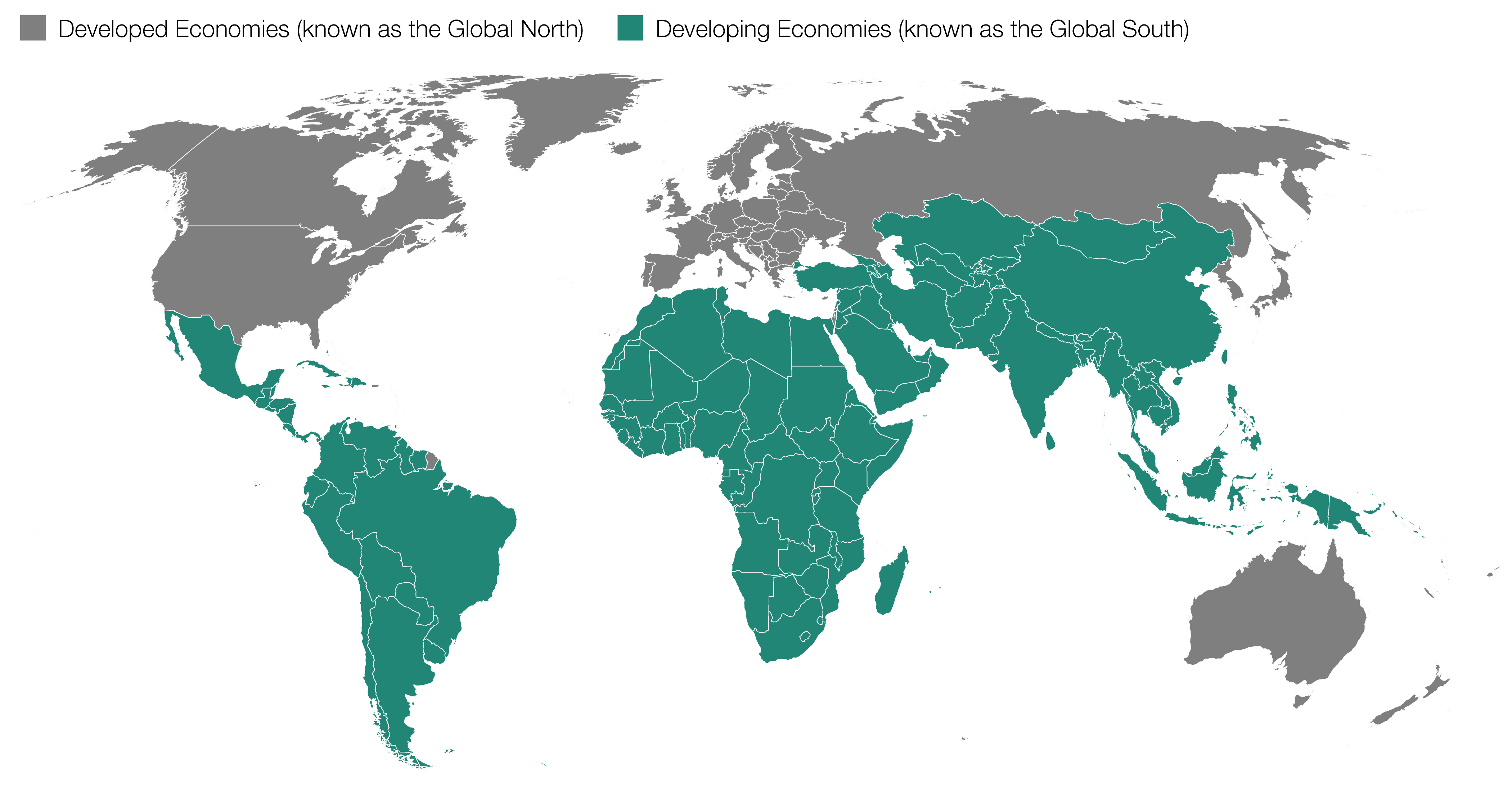
Source: Adapted from Handbook of Statistics 2022 (United Nations Conference on Trade and Development, 2022), 4–5, https://unctad.org/system/files/official-document/tdstat47_en.pdf.
The Global South concept offers attractive and fertile ground for China, which has the advantage of being considered a Global South nation that is highly industrialized and innovative as well as a developing and middle-income economy. The concept is also useful for China because it is amorphous and is filled with the narrative and psychology of subjugation (by the Global North) and victimhood, which Beijing can weaponize against the West. As prominent scholar Ren Lin of the Chinese Academy of Social Sciences writes, “From a historical perspective, these [Global South] countries were colonized by developed countries, represented by the European countries, and this led to their poverty and weakness in modern times.”[1]
China positions itself not just as a member and leader of the Global South but as the only member with better solutions and options for other members. It claims it can help them avoid further submission to, and capture by, Global North nations that continue to dominate international institutions.[2] China presents as both the leader of the resistance and as the first among equals in a fledgling, but rising, Global South order—or at least, a hybrid international order that is more empowering for the Global South and better reflects its priorities.
In reality, for Beijing, the Global South is more of a concept it can weaponize against the United States than a comprehensive organizing principle for its relations with the world. China still depends heavily on the West, especially the United States, for technology, innovation, capital, and know-how and requires access to Western markets. Whether Beijing genuinely sees itself as subjugated or structurally disadvantaged by the West is unclear, as some of the regimes and elites in smaller, poorer nations do. In fact, China has spent the last three decades devising clever and cunning ways to exploit its relationships and agreements with the Global North and gain disproportionately from them.
Beijing wishes to be seen as leader of the Global South so that it can benefit from interactions with the wealthier Western nations while exploiting the idea of the Global South for its own purposes.
China’s Geostrategic Objectives
While Beijing undoubtedly has global ambitions, the CCP is still focusing most of its efforts on securing hegemony over the maritime nations of East Asia—a region encompassing China, Japan, Mongolia, North Korea, South Korea, Taiwan, and the 11 countries that are members of the Association of Southeast Asian Nations (ASEAN).
In this region, fully industrialized democracies such as Japan, Australia, and even South Korea are hardening their approach toward China. This has accelerated Beijing’s plans to target developing nations, especially in Southeast Asia, to acquire and entrench strategic support states. China’s ultimate objective is for these states to accept and internalize a creeping Sinocentric order while continuing their affairs within it, rather than resisting it.
In targeting Global South economies in Asia, Beijing seeks to shape the way these nations think about economic development and the economic and strategic policies they pursue for material advancement. When they depend on China or the Chinese approach to development, they drift toward becoming strategic support states, knowingly or unwittingly. They also shrink the economic, strategic, technological, and ethical ground on which the US and its allies can sustain their power and relevance.
There are other reasons why Beijing would like to use the Global South concept as an organizing principle and why it heavily targets developing economies in the region. In many of these countries, governance is poor, institutions are opaque, and relatively small and unchanging groups of elites rule.
This combination provides fertile ground for China for several reasons:
- China excels at elite capture, offering immediate and guaranteed economic and commercial gains to these elites and their countries. In many developing economies, the elites will accept Chinese material offerings even if Beijing is the primary beneficiary. This weakens these countries, making them more reliant on Chinese largesse.
- These economies are often unattractive to multinational firms, making their elites desperate for guaranteed Chinese offerings, even if they are paid for in political or strategic favors.
- The practices of elites in many Asian Global South economies run afoul of Western democratic norms and practices. Partnership with China gives them protection and the promise of material benefits without pressure to change or reform.[3]
- Once these countries and their elites become reliant on Chinese capital or largesse, they are locked into the Chinese system, and leaving it carries high costs and risks.
In the Xi Jinping era, the contours and content of a Chinese Global South strategy for Asia and beyond are still evolving. However, there is evidence of recent and growing interest in an updated Global South strategy to advance the CCP’s long-standing core objectives, summarized below:
- Maintain the viability and robustness of the CCP-led political economy and impose elements of its principles and processes on the region.
- Continually shrink the strategic, military, economic, political, and normative ground in the region that Washington and its allies can use to sustain, build, and demonstrate US power and influence.
- Induce or coerce regional states to become supportive, compliant, or, at worst, neutral.
In a United Nations General Assembly address in September 2021, Xi introduced Beijing’s Global Development Initiative (GDI). Ostensibly, the initiative is not revolutionary and is meant to accelerate implementation of the UN 2030 Agenda for Sustainable Development, “to steer global development toward a new stage of balanced, coordinated and inclusive growth.”[4] Priority areas for the GDI include “poverty alleviation, food security, COVID-19 response and vaccines, development financing, climate change and green development, industrialization, digital economy and connectivity.”
Beijing links the GDI to the Global Security Initiative (GSI) that it announced in mid-2022, and links both to developing countries.[5] Prima facie, the GSI is more concerned with security than development. At the 2022 Boao Forum for Asia, in discussing the GSI, Xi mentioned providing “indivisible security” and building a “balanced, effective and sustainable security architecture” that opposes “exclusive” arrangements such as the Quadrilateral Security Dialogue (or Quad)—a partnership between the United States, Japan, India, and Australia—and AUKUS, a security agreement between Australia, the United Kingdom, and the United States.[6]
However, China is largely packaging the GSI as the geopolitical complement to the GDI, while presenting the Belt and Road Initiative (BRI)—a Beijing-led international development effort—as a Global South program. For example, when presenting the GSI to developing nations, Beijing frames it as a broad geopolitical approach to enhance and accelerate rapid economic development and material advancement, and claims it promotes “respecting the independent choices of development paths and social systems made by people in different countries.”[7] China calls the GSI “inclusive,” contrasting it with US-led security architectures that impose Western institutions and systems on developing nations as a precondition for material assistance. As one observer has noted, the GSI comprises a “non-Western alternative and mechanism by the global south for the global south.”[8] The same can be said about the GDI and BRI. Beijing is also linking the GSI to Chinese notions of Asian approaches and Asian unity, implying that US initiatives are divisive and unsuited to the Global South’s developing needs.
China’s Global South strategy is an increasingly important part of its plan to ease Washington out of its periphery and advance the Sinocentric order. The GDI and GSI provide a defense against the “bullying of the weak states by the West” and a pathway to transcend Western geopolitical constraints and norms.[9]
Beijing’s Bid for Global South AI Leadership
In Xi’s keynote speech at the opening ceremony of the 2026 World AI Conference and High-Level Meeting on Global AI Governance on July 17, 2026, he explained China’s vision of AI leadership and governance in terms drawn from the country’s bid for leadership in the Global South:
In China’s view, all countries should take a people-centered approach and develop AI for the positive and for good. We should ensure that AI is an important driver for shared prosperity and common security. We should join hands to build a just and equitable system for global AI governance.[10]
He added:
We should encourage inclusiveness and promote mutual learning between civilizations. AI development and its application should not erode or undermine the diversity of world civilizations or the uniqueness of cultures of different countries. We must shape the values of AI with humanity’s common values and make good use of AI technologies to increase understanding, tolerance, exchanges, and sharing among all civilizations. We should tend to the garden of civilizations with great care to ensure that the beauty of each civilization is appreciated and shared.[11]
Xi then made clear that his vision for AI leadership and governance is directed at the developing economies in the Global South:
We must carry out extensive international cooperation and help Global South countries with capacity building to bridge the AI and digital divides, promote sustainable development, and prevent creating new historical injustice in AI.[12]
There are several elements to note about China’s bid for AI leadership in this context.
One claim is that under Chinese AI leadership, developing nations will have a greater say in the development of AI standards, in who controls and governs the use of AI, and in how the technology ought to (and ought not to) be used. When Beijing promotes “China’s long-standing emphasis on AI for good, openness and inclusiveness, and the belief that AI development should contribute to more equitable global development,”[13] it is essentially arguing against allowing the US and other Western nations to shape the future governance and ethics of AI. In Beijing’s telling, China is protecting the interests of the Global South and shielding it from Western domination, and this extends to AI.
AI is thus yet another important issue for China in advancing its material and non-material power and influence at the expense of the West, particularly the United States. From the BRI—including the Digital Silk Road, which seeks to expand China’s technological dominance in important economic sectors[14]—to the GDI and GSI, the fundamental objective is to “surpass” the US and the rest of the West by advancing China’s leadership and presence in the developing world.
Another element of China’s bid for AI leadership is to ostensibly work with developing economies to develop AI technologies and governance approaches. According to the Chinese framing, Beijing is working with the Global South to “counter the monopolization of technical standards and governance rules.”[15] As Xi put it in his keynote address mentioned above, “AI development should not be a solo performance by a single country [i.e., the US] but a symphony of global cooperation.”[16]
China seeks to demonstrate this seeming spirit of AI cooperation with the Global South in several ways. One is by contrasting Chinese open models with the closed models offered by American companies such as OpenAI, Google, and Anthropic. While these companies offer the advantage of vertically integrated and bundled, exportable AI stacks of chips, models, cloud, and software, China’s open models can be downloaded, modified, and adapted with fewer restrictions.[17] Platforms such as DeepSeek, for example, allow users to download and fine-tune the model for a specific task or build a product on top of it without paying the original developer for access.
To be sure, the American firms have the most powerful and secure offerings in the market, even if Chinese open-model alternatives are catching up quickly.[18] The American models have built-in safety features that are better at preventing misuse for fraudulent activities, for example. However, they are not just more expensive, but closed in the sense that users cannot inspect or modify them.[19]
The Chinese notion of AI openness goes beyond how end users can access and modify AI platforms. For the country’s entire AI ecosystem, Beijing supports an open approach—from large language models (LLMs) to embodied AI, in which algorithms are integrated into physical or virtual bodies, such as robots or sophisticated chatbots, to perform specific tasks. This approach, which makes a virtue of the necessity to play catch-up to more advanced American rivals, began with the State Council’s 2017 New Generation Artificial Intelligence Development Plan.[20]
The plan imposed a domestic open-source or open-weight approach to fast-track the development of the entire Chinese AI stack, supported by subsidies, industry funds, and local government capital.[21] From development and sourcing of chips to algorithmic and software development, Beijing oversees a system of permissive licensing, below-market pricing between AI entities across the entire AI stack, and an ecosystem that encourages collaboration rather than profit for individual firms.[22] Under legislation such as the 2017 National Intelligence Law, 2021 Data Security Law, and 2021 Personal Information Protection Law, data is to be stored in China and accessible by state authorities. This reinforces the link between data security on the one hand, and national security on the other.[23] These policies to promote domestic development of AI capabilities under state supervision are supplemented by an extensive state-backed system of acquiring and even stealing American AI technologies to feed China’s AI ecosystem.[24]
The main point is that China’s state-based approach to AI seeks to replicate key elements of strategies it used to achieve dominant global market share in sectors such as solar panels,[25] electric vehicles,[26] and in developing economies, 5G:[27]
- Identify an industry or sector of high strategic importance.
- Formulate and implement a domestic blueprint to accelerate development of a national ecosystem and indigenous supply chain to fast-track Chinese industrial and technological dominance.
- Encourage or force Chinese firms and entities to collaborate and even share technologies or proprietary knowledge to serve national objectives.
- Supplement the domestic blueprint with a systematic and extensive system of intellectual-property theft, illegitimate distillation (i.e., getting smaller and cheaper Chinese models to mimic more expensive and sophisticated American models),[28] and forced technology transfers from foreign firms operating in China.
- Mandate an aggressive pricing strategy for Chinese firms—which are frequently offered state subsidies, tax breaks, etc.—to increase their global market share, crowd out competitors, and eventually achieve domestic and external market dominance.
- Increase international structural dependency on Chinese firms and entrench the dominance of Chinese AI architecture, especially in developing economies.
- Promote international collaboration with dominant Chinese firms in the spirit of global “openness and cooperation.”
- Gradually restrict external access to cutting-edge Chinese technology and models for overseas users once Chinese firms have achieved dominance.
In other words, China might offer an open model to global users, but with an AI stack owned by Chinese entities and regulated by Beijing. If the platform is accessed via Chinese APIs (artificial intelligence application programming interfaces) or third-party web applications, then Beijing has access to data and other information.
In summary, China’s open approach is intended to achieve two main objectives. The first is to advance technological self-reliance and global Chinese AI leadership at the expense of the United States. This is necessary to achieve the CCP’s notion of cyber sovereignty, the ability to defend and promote its preferred cyber standards for how such technologies are used and governed.[29]
The second is to offer cheaper and more flexible options to global users, especially in developing economies, to make them dependent on Chinese, rather than American, offerings and thus increasingly reliant on the Chinese AI ecosystem and trapped within it.
Southeast Asian Sovereign AI Aspirations
Sovereign AI,[30] in the broadest terms, is a strategy for governments to reduce reliance on foreign AI technologies by developing domestic capabilities and ensuring access to critical data, technologies, expertise, and national infrastructure. From a government perspective, it is the ability to shape, deploy, and govern AI ecosystems in line with national interests and values. It implies strategic and operational control and the ability to maintain resilience in AI capabilities.[31]
Southeast Asian nations are increasingly championing sovereign AI for three interrelated reasons.
First, countries are seeking to benefit from AI economically. As framed by delegates to the AI for Developing Countries Forum, held in February in Bangkok, Thailand, one critical component of AI sovereignty is developing and retaining local talent so that countries are not simply consumers of AI models and applications, but creators.[32] Just as Southeast Asian countries collaborated with Western export-focused manufacturing firms in the second half of the previous century to enrich local economies,[33] they are determined to do the same with AI.
Second, this strategy can help build national resilience. Sovereign AI means the ability to control AI data, computing resources, and crucially, the models operating within a country. It is intended to ensure that national AI capabilities are not excessively dependent on infrastructure, technologies, and policies developed and implemented outside Southeast Asia.
Third, sovereign AI will ensure that AI applications, including LLMs, reflect a nation’s languages, cultures, and values. As one regional commentator explains, this means governmental control of data and models because the range and choice of data used, and how the models are trained, determine the AI outputs consumed by a country’s citizens.[34]
While Southeast Asian countries have made some efforts to advance sovereign AI, these efforts have largely involved crafting broad declaratory statements of principles and aspirations. For example, the 2024 ASEAN Guide on AI Governance and Ethics[35] and the 2025 Expanded ASEAN Guide on AI Governance and Ethics—Generative AI[36] propose shared principles of testing, assurance, accountability, and provenance. In recent years, Southeast Asian countries have also made some efforts to further define AI principles, launch assurance initiatives, and update privacy laws.
For example, Singapore has put AI assurance into practice at scale, enabling real-world testing of generative AI systems through AI Verify and the Global AI Assurance Sandbox.[37] In 2024, Malaysia issued National Guidelines on AI Governance & Ethics[38] and also established a National AI Office to coordinate implementation and legislation. In 2024, the Philippines issued AI guidance explaining how the Data Privacy Act applies to testing, deployment, and training.[39] In 2025, Indonesia’s Constitutional Court clarified the circumstances in which a data protection officer must be appointed, strengthening oversight of high-risk processing of personal data.[40] Vietnam’s stand-alone AI law, the region’s first,[41] became effective in March 2026.[42]
These are either declaratory or broad governing principles and form only an elementary basis for addressing governance issues. However, the AI stack encompasses tools, technologies, and frameworks that work together to build, train, deploy, and manage AI applications. These range from data processing and machine learning frameworks to cloud services and hardware infrastructure that enable developers and organizations to create and scale AI solutions.[43]
There have been some piecemeal national efforts in the region, ranging from how and where data must be stored,[44] to demanding that American frontier companies pay for the use of local content.[45] However, with notable exceptions— such as Singapore’s open-source LLM SEA-LION, which is trained and developed using content specific to Southeast Asia—there have been few successful and scalable national or private-sector initiatives to advance Southeast Asian sovereign AI objectives in practice. Indeed, American and Chinese firms continue to dominate AI investment in Southeast Asia in model and algorithmic development and at the infrastructure level (e.g., rare earth extraction, graphics-processing-unit manufacturing, data centers, energy grids, computational power, and satellite connectivity networks).
Beware Chinese AI Promises
China sees an opportunity to advance its geopolitical objectives by aligning its bid for leadership over the Global South, including in AI, with the sovereign AI aspirations of developing Southeast Asian nations, meaning all Southeast Asian nations except Singapore.
One example of this is the World AI Cooperation Organization (WAICO), established in July 2026 as a Chinese initiative with headquarters in Shanghai. Its 29 members are all developing economies, including Southeast Asian countries Cambodia, Indonesia, Laos, Malaysia, and Myanmar. Mirroring Chinese Global South initiatives and promises, WAICO aims “to fully unleash the infinite potential of AI and realize common development and common prosperity.”[46] It promotes “inclusive development” to “help Global South countries enhance capacity building and foster an ecosystem for AI innovation,” and it aims to “enhance alignment and coordination on AI development strategies, governance rules and technical standards” among Global South countries.[47]
More broadly, China is promising to help advance the sovereign AI goals of developing Southeast Asian economies and has established AI application cooperation centers with ASEAN—as well as with the African Union, the Arab League, and the Community of Latin American and Caribbean States—and created thousands of AI training opportunities for individuals from these regions.[48]
China’s Ministry of Foreign Affairs published a Global AI Governance Initiative[49] in 2023 and a Global AI Governance Action Plan[50] in 2025 to promote the country’s state-supported, open-source and open-weight AI approach as the driver of shared international development and evidence of China’s support for “equal [global] rights to develop and use AI.” Beijing contrasts this with ostensibly selfish American desires to propagate US closed, proprietary models, which in China’s telling, serve only American governmental and private-sector interests.[51]
China promises potential customers that:
- Chinese AI cloud services (offered mainly by Alibaba, Tencent, and Huawei) are cheaper, better integrated, and more able to meet data localization requirements than Western competitors.
- Chinese open-source platforms (offered by firms such as DeepSeek, Alibaba, Moonshot, Tencent, Baidu, ByteDance, and Xiaomi) are more adaptable for evolving Southeast Asian requirements and will accelerate the development of local talent and solutions, in contrast to the more expensive bundled, closed American platforms.
- AI agents developed on Chinese platforms will be cheaper and better integrated within a Chinese AI ecosystem than Western alternatives.
Beijing’s pitch is that partnering with China offers Southeast Asian nations strategic autonomy, national resilience, and better developmental and commercial pathways, and that Southeast Asian sovereign AI objectives can only be achieved through this partnership. The Chinese promises are seemingly well-aligned with Southeast Asia’s sovereign AI goals: to ensure AI technologies rapidly increase the industrial capacity of poorer nations, improve their economies, and give them greater influence in the global development of AI rules, standards, ethics, and governance.
Both the United States and China see AI as the decisive technology in their economic and geopolitical competition, and both admit that they are in a two-horse race. For the moment, the United States is ahead in computing power, talent, capital expenditure, algorithm development, and deployment of models.[52]
China, however, is supporting an open AI ecosystem and open-weight models to encourage growing numbers of independent developers and users to train its models and gain access to more data. Beijing sees this as the less-expensive, more-efficient, and necessary way for Chinese platforms to innovate quickly and cheaply, given their limited access to American technology and know-how.
The Chinese approach is not just to catch up to American AI models in performance and even surpass them, but to win by outperforming the United States in distribution and use of platforms, even if it fails to surpass American models in performance.
This focus on superior distribution and third-party use is particularly effective with developing economies, where users are seeking less-expensive, good-enough solutions that are more immediately adaptable to their needs.
The problem is that growing dependency on Chinese models is not cost-free and comes with significant risks. Governments, businesses and consumers should be skeptical of Beijing’s promise that it is developing its own AI ecosystem for the benefit of all other developing economies.
First, Beijing is falsely promising that increased reliance on Chinese open-weight models will support national sovereign AI agendas. China is integrating a state-backed, state-controlled AI stack that includes models, hardware, infrastructure, and governance. Chinese models from companies such as DeepSeek, Alibaba, and Baidu leverage products from state-supported semiconductor producers such as Huawei and Baidu and cloud platforms from firms such as Huawei, Alibaba, and Tencent. All Chinese entities must abide by extensive state-directed rules and standards, and all governments and firms that adopt Chinese AI platforms and models are unavoidably creating path dependencies and aligning themselves with these standards.[53]
For example, both Chinese and international versions of DeepSeek must filter, adjust, and redirect discussion according to mandatory rules. The system detects and suppresses politically sensitive or “undesirable” topics.[54] For Southeast Asians, this does not mean only highly sensitive topics relating to the CCP, such as the 1989 Tiananmen Square massacre or the denial of Uighurs’ human rights in Xinjiang. It also means illegal Chinese claims in the South China Sea or CCP foreign influence activities in the region. What is true of DeepSeek applies to other Chinese models as well.[55]
Moreover, Chinese platforms have built-in algorithmic biases imposed by Beijing. Narratives are set to align with CCP preferences, and the AI will downplay CCP failings and amplify CCP achievements. It will also manipulate answers to elevate pro-Chinese content and bury or eliminate dissenting perspectives.[56]
While Chinese platforms allow independent users to download, modify, or tinker with the models using their own data and for their own purposes, the original models are preset to deliver only narratives and information acceptable to the CCP. More broadly, those who become reliant on Chinese AI platforms are buying into and spreading a digital standard defined by Beijing that cannot be modified or erased.
Second, a related point is that Chinese LLMs learn primarily from data filtered through Chinese internet and cyber laws. More importantly, Chinese law requires that all AI models, training outputs, and data reflect CCP values. Southeast Asian entities that choose Chinese open models are importing, in addition to narrative and information manipulation, both the deliberate and inadvertent vulnerabilities that are built into those models.
Both US and Chinese models have suffered from inadvertent security flaws. Nevertheless, Chinese models have been shown to be inferior to American models in their vulnerability, for example, to jailbreaks, which bypass ethical guidelines and prompt models to perform restricted or illegal activities.[57]
More pertinent are intentional vulnerabilities, such as concealed backdoors and geopolitically motivated triggers. For example, models can be “sleeper agents,” trained to behave normally until a specific trigger condition is met.[58] An investigation of DeepSeek-R1 found that adding politically sensitive topics to coding prompts made the model up to 50 percent more likely to produce code with severe security vulnerabilities.[59] Another study found that Chinese open-weight LLMs, when prompted by a user with a US government persona, produced lower-quality and less secure code with more vulnerabilities, and a CCP-aligned political bias was apparent in both the answers and the code generated.[60]
To be sure, assessments about the extent to which Chinese models are compromised are contested.[61] However, researchers have discovered in these models deliberately built-in concealed vulnerabilities that appear to be driven by geopolitical incentives, and security experts have recognized this as a significant problem.[62] The key question is whom to trust: Chinese models subject to CCP mandates, from a country that treats publicly and privately owned technology as a tool of the state, including as a means for surveillance, and as part of broader political warfare?[63] Or privately owned American firms, which do seek to maximize profits but whose primary selling point is that they offer LLM models with superior performance and security?
Third, putting aside concealed vulnerabilities in coding, all Chinese AI firms are governed by legislation such as the 2017 National Intelligence Law,[64] 2017 Cybersecurity Law,[65] and 2021 Data Security Law,[66] which compel Chinese entities to adhere to the legislation even if they operate outside China.
The National Intelligence Law, for example, demands that Chinese firms “support, assist, and cooperate with national intelligence efforts.”[67] If users access Chinese AI models through an API or a third-party interface, their queries, background data, and conversational history are held in databases that transmit the data to China-based servers or can be accessed by the Chinese government.[68] Therefore, even data localization policies championed by many Southeast Asian nations, such as placing relatively cheap Chinese data centers in Southeast Asia, do not protect a country’s information.[69]
In sum, Southeast Asian countries that partner with China create pathways for Beijing to export its AI stack into the region: from hardware—chips, networks, and energy infrastructure—to software—models and data—to applications. In doing so, they become ever more reliant on Chinese capital, research, talent, and governance and security standards.
Finally, China uses economic coercion to pressure countries to change their domestic and external policies far more frequently and on a far greater scale than the United States uses economic sanctions to achieve specific outcomes. In recent years, Beijing has employed economic coercion against Japan, South Korea, Australia, Vietnam, the Philippines, and Taiwan, as well as countries in the Pacific, Europe, South Asia, Africa, and the Americas.[70]
Government officials and experts throughout Southeast Asia reveal in private conversations that there is significant concern about the extent to which their economies have become dependent on China-centered digital infrastructure as part of Beijing’s Digital Silk Road rollout. For example, Vietnamese, Thai, and Philippine dependency on Chinese-controlled submarine cables creates anxiety,[71] and the dominance of Chinese firms such as Huawei, ZTE, ByteDance, and Alibaba in 5G in Southeast Asia is seen as worrisome,[72] even though some governments in the region embrace the domestic surveillance technologies that China offers.
Southeast Asian dependency on the Chinese AI stack should also be cause for concern, and countries in the region should attempt to address it before it is too late. While US tech companies do demand certain standards and might impose some measures on users, they are far less arbitrary and geopolitically driven than coercive actions by Chinese firms, which act at the behest of the CCP.
Difficult Southeast Asian Choices
Singapore, the only advanced economy in Southeast Asia, has unique advantages over other nations in the region and is in an enviable position. While it does not produce cutting-edge AI chips, it is a regional hub for coordinating the manufacture of mature chips, which still constitute the lion’s share of chips being used in the AI stack. Due to strong national institutions, it is the key Southeast Asian financial and investment hub and regional supply chain organizational hub in the sector. Singapore’s access to indigenous and global talent has enabled it to create AI models such as SEA-LION.
More than any other Southeast Asian economy, it is well placed to partner with leading AI firms. For example, a partnership between Google Cloud and Digital Industry Singapore launched AI Cloud Takeoff to establish AI centers of excellence in hundreds of Singapore-based enterprises to enable them to create AI applications for a specific industry, workflow, or business problem.
Other Southeast Asian nations face more serious obstacles. Some governments and commentators in these countries are advocating for sovereign AI policies that are unachievable. Worse, some of them, if implemented, would leave their economies irreversibly dependent on a Chinese AI ecosystem or deny themselves benefits from global advances in AI technologies and applications.
These Southeast Asian economies need to accept the reality that the United States currently dominates AI and that China will likely increasingly dominate it as well. For example, as figure 1 shows, in 2025, estimated US private investment in AI was almost US$286 billion, while Europe and China were a distant second and third, at US$21 billion and US$12.4 billion, respectively.
Figure 1. Private AI Investment in 2025, by Country
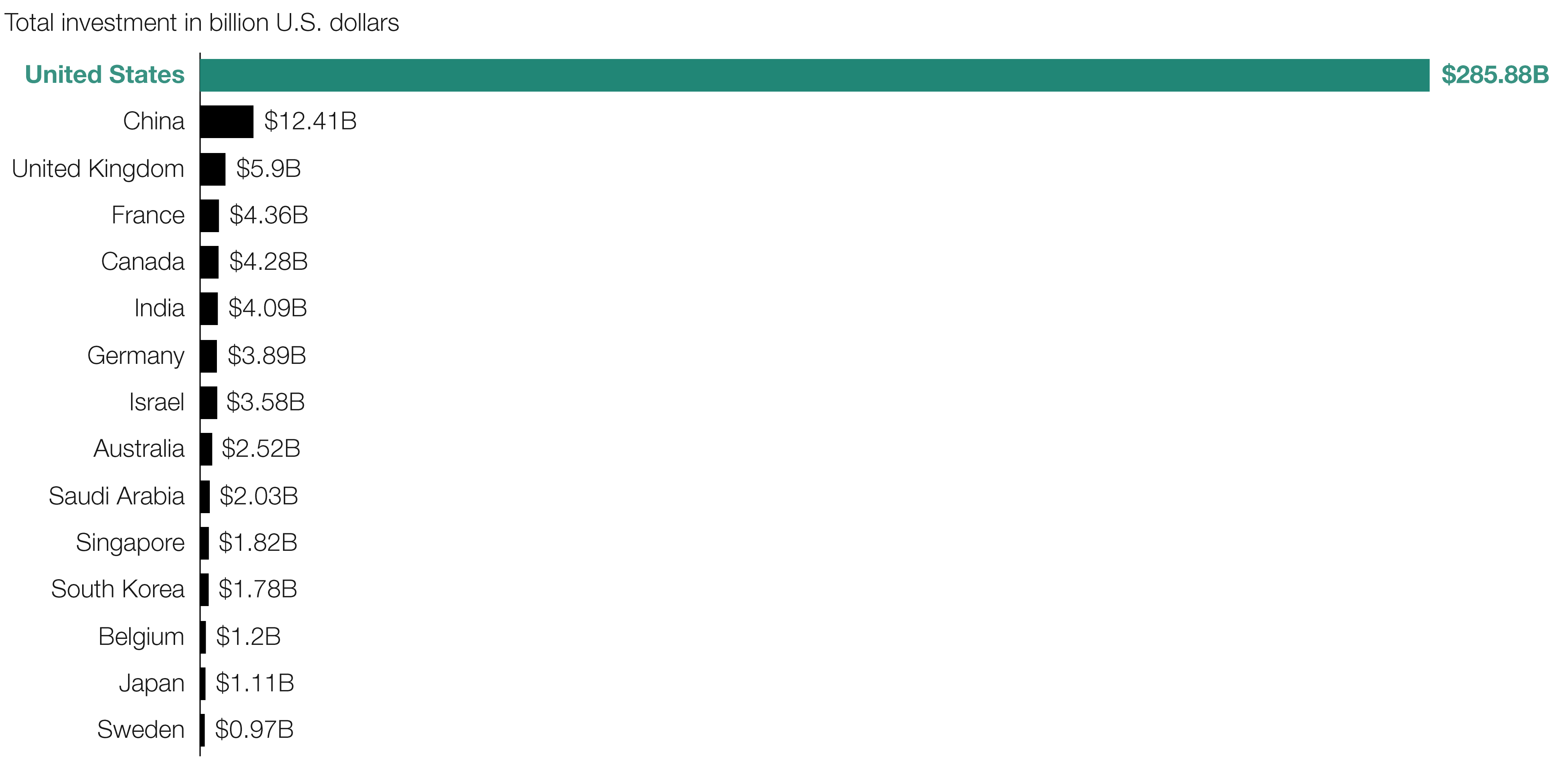
Source: Petroc Taylor, “Private Investment in Artificial Intelligence (AI) Worldwide in 2025, by Country (in Billion US Dollars),” Statista, April 15, 2026, https://www.statista.com/statistics/1472716/global-private-investment-in-ai-by-region/.
The United States leads in total AI computing power, with 39.7 million H100 equivalents, approximately 50 percent of the global total (H100 equivalent is a standardized unit of measurement used to quantify AI computing power). The United Arab Emirates is second, at 23.1 million.[73] As of May 2025, the US accounted for about 75 percent of global GPU cluster performance, which measures how fast the system processes massive amounts of data, trains AI models, and runs complex simulations, with China second at 15 percent.[74] On the other hand, China leads in the number of data center clusters, with 230.[75] In addition, in 2024, China had the largest number of AI patents, 25,177, with the United States second at 17,307. However, the percentage of AI patents among all patents in the country is higher in the United States than in China, which means that AI is behind a larger proportion of American innovations than Chinese ones.[76]
Therefore, Southeast Asian nations are advancing various notions of sovereign AI, based on controlling or influencing significant parts of the AI stack, that are not realistic, financially or technically. Trying to achieve self-sufficiency will be far too costly and will leave countries with a vastly inferior AI capability. Nor will policies to physically locate AI assets in a given country provide the level of resilience and assurance that Southeast Asian nations seek. Placing data centers within a country does not necessarily make them more secure from physical destruction or, as noted earlier, from foreign access. Moreover, aspirations to achieve collective sovereign AI for Southeast Asia, perhaps under ASEAN oversight, are also unrealistic. The existing principles for AI security and governance offer some promise of regional coordination but are not sufficient to overcome real obstacles.
For example, even if Southeast Asian economies constituted one economic zone, their combined capital, depth of infrastructure and technology, and capability would be vastly smaller than the American and Chinese AI stacks. Striving for regional AI self-sufficiency would leave Southeast Asia far behind other advanced economies. Besides, Singapore would not give up its privileged status as the preferred capital and technology hub for advanced economies around the world to support the impossible objective of Southeast Asian AI self-sufficiency.
Additionally, while Southeast Asian nations do cooperate on many matters, ASEAN members tend to implement different hedging strategies to extract maximum security and economic gains from advanced economies, even at the expense of fellow members.[77] Indeed, when President Donald Trump introduced his so-called Liberation Day tariffs in April 2025, Southeast Asian countries quickly moved to negotiate general tariff rates that were lower than those of neighboring countries to give themselves a relative advantage in trade with the US.
So behind the veneer of Southeast Asian fraternity, these economies attempt to maximize their relative gains when dealing with larger economies on which they are dependent. And enduring animosities, lack of strategic trust, and different economic trajectories and capabilities[78] mean that the objective of forging an exclusive, cohesive, and effective Southeast Asian AI ecosystem is seductive but unattainable.
What, then, are developing Southeast Asian states to do?
The most practical and effective way forward involves two steps:
- Identify a niche in the AI stack or supply chain where they can become an important or essential hub or node.
- Create high-tech industrial or technology clusters within or between economies to attract international capital; accelerate development and innovation; attract skilled labor; promote knowledge transfer from abroad and diffusion from within; and reach economically viable scale.
Elements of this are already occurring. For example, Vietnam has emerged as an important hub for semiconductor assembly, packaging, and testing.[79] In addition, Singapore and Malaysia could leverage the Johor-Singapore Special Economic Zone[80] to create an industrial or technological cluster in the region that could be extended to Indonesia’s Batam, Bintan, and Karimun.
This is not about achieving self-sufficiency but about welcoming foreign investment from advanced economies and tapping into their AI ecosystems for mutual benefit.
In fact, Southeast Asian economies have been doing something similar since the 1960s by harnessing the export manufacturing supply chains set up and financed by advanced economies. This is how Southeast Asia became an essential region for manufacturing electrical and electronic equipment for advanced economies, which led to vast improvements in its economies and, more broadly, underpinned increased prosperity in the latter part of the twentieth century and the 2000s.[81] AI, as an enabler and driver of future prosperity and modernization, should not be viewed differently.
Southeast Asian nations—by partnering with firms from the US, Europe, Japan, and South Korea—dramatically accelerated improvements from the 1980s to the 2000s. Today, however, Southeast Asians continually complain that China is capturing ever more of the value added in regional supply chains. Chinese firms in Southeast Asia tend to bring in Chinese citizens to fill key positions, slowing or minimizing knowledge transfer, further entrenching Chinese advantages, and increasing the region’s dependence on Chinese finance, technology, know-how, and inputs.
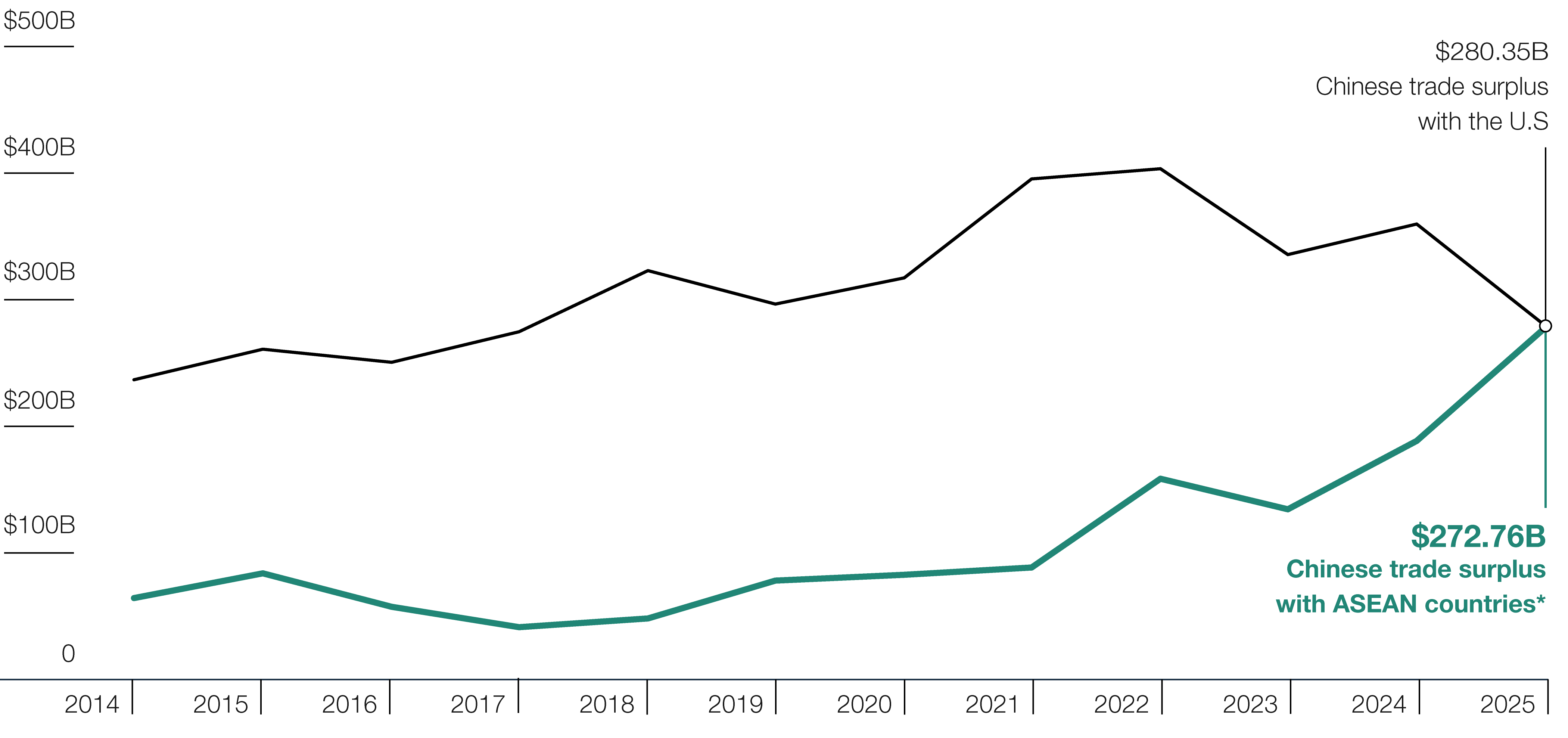
Beijing’s Made in China 2025 initiative is an ominous indicator of China’s intention to benefit disproportionately from the AI revolution.[82] Beijing offered Southeast Asian entities enormous subsidies and assistance, such as tax breaks and regulatory protection, to increase China’s share of production and value creation in sectors like electric vehicles, robotics, automation, and tech-intensive intermediate goods. These entities had few options but to become part of an ascendant China-centric production and supply chain ecosystem—less as partners and more as dependents.[83] In both high-value-added sectors targeted by Made in China 2025 and lower-valued-added sectors such as textiles and garments and electronic packaging assembly, Chinese firms benefited at the expense of firms in Indonesia, Thailand, Malaysia, and Vietnam.[84] As shown in figure 2, this largely accounts for the rapidly growing Chinese trade surplus with the ASEAN economies since the latter part of the previous decade.
Figure 2. China’s Trade Surpluses with ASEAN and the US, 2014–25
Source: Katharina Buchholz, “China’s Trade Surplus with ASEAN Now on Par With US,” Statista, February 2, 2026, https://www.statista.com/chart/34479/chinese-trade-surplus/.
The question is whether partnering with and depending on an American AI ecosystem will offer Southeast Asian nations better and more enduring benefits, freedom to pursue their own development pathway, and greater data security than the Chinese alternative, which is burdened with geopolitical incentives and direction from the CCP. Economic history and current practice suggest that the American option is better and more prudent.
Finally, the important point is that Southeast Asian governments, firms, and individuals cannot ignore the dilemma. They have to make strategic and economic choices about which ecosystem—the American or Chinese—they seek to partner with and prioritize. Some decisions will not be cost-free, and many choices are necessarily zero-sum.
To be sure, many Southeast Asian nations claim that they are not interested in taking part in a geopolitical contest between giants. But to paraphrase what Leon Trotsky allegedly said about war, Southeast Asians might not be interested in geopolitical rivalry, but geopolitical rivalry is interested in them.
Abbreviations
API artificial intelligence application programming interface
ASEAN Association of Southeast Asian Nations
AUKUS Australia–United Kingdom–United States security partnership
BRI Belt and Road Initiative
CCP Chinese Communist Party
GDI Global Development Initiative
GSI Global Security Initiative
LLM large language model
Google sponsored the research behind this brief. For information about supporters of Hudson, please see pages 87–89 in our Annual Report 2025, available here.
Endnotes
- Ren Lin, “The Global South in the Great Power Game and Global Governance,” Center for Strategic and International Studies, November 22, 2023, https://interpret.csis.org/translations/the-global-south-in-the-great-power-game-and-global-governance. ↑
- Wang Dong and Li Zongfang, “Promoting Changes in the Global Governance System and Demonstrating the Role of Responsible Powers,” Chinese Social Sciences Net, August 26, 2022, https://archive.vn/exp5w#selection-437.0-437.20. ↑
- Shi Bin, “A Chinese Exploration of the Construction of the International Order and Global Governance System,” Aisixiang, August 30, 2022, https://archive.ph/t7OjJ. ↑
- Xi Jinping, “Bolstering Confidence and Jointly Overcoming Difficulties to Build a Better World” (speech), September 21, 2021, Seventy-Sixth Session of the UN General Assembly, Chinese Ministry of Foreign Affairs transcript, https://www.mfa.gov.cn/eng/xw/zyjh/202405/t20240530_11341561.html. ↑
- “President Xi Jinping Chairs and Delivers Important Remarks at the High-level Dialogue on Global Development,” Chinese Ministry of Foreign Affairs, June 25, 2022, https://brics2022.mfa.gov.cn/eng/tpxw/202206/t20220627_10710492.html. ↑
- “Xi Jinping Delivers a Keynote Speech at the Opening Ceremony of the Boao Forum for Asia Annual Conference 2022,” Chinese Ministry of Foreign Affairs, April 21, 2022, https://www.fmprc.gov.cn/eng/zy/jj/2020zt/kjgzbdfyyq/202204/t20220421_10671083.html. ↑
- Ved Shinde, “The Global Security Initiative—with Chinese Characteristics,” Australian Institute of International Affairs, November 30, 2022, https://www.internationalaffairs.org.au/australianoutlook/the-global-security-initiative-with-chinese-characteristics. ↑
- Jevans Nyabiage, “China Using Its New Global Security Initiative to Build Military Standing in Africa,” South China Morning Post, July 31, 2022, https://www.scmp.com/news/china/diplomacy/article/3187151/china-using-its-new-global-security-initiative-build-military. ↑
- Wang Le and Liu Jun, “The Core Essence, Theoretical Innovation, and World Significance of the Global Security Initiative,” CIIS Journal of International Studies 3 (2022), https://archive.ph/kSPU7. ↑
- “Keynote Speech by Chinese President Xi Jinping at Opening Ceremony of 2026 World AI Conference,” CGTN, July 17, 2026, https://news.cgtn.com/news/2026-07-17/Full-text-Xi-s-keynote-speech-at-the-2026-WAIC-opening-ceremony-1OQSfeoRvUs/p.html. ↑
- “Xi Jinping at Opening Ceremony of 2026 World AI Conference.” ↑
- “Xi Jinping at Opening Ceremony of 2026 World AI Conference.” ↑
- Chenghao Sun et al., “The Rise of ‘Sovereign AI’ in the Global South and China’s Cooperative Responses by Zhang Shuyan and Chen Zhimin,” ChinAffairs+, July 20, 2026, https://www.chinaffairsplus.com/p/the-rise-of-sovereign-ai-in-the-global. ↑
- See John Lee, Ambition and Overreach: Countering One Belt One Road and Beijing’s Plans to Dominate Global Innovation (Hudson Institute, February 8, 2020), https://www.hudson.org/national-security-defense/ambition-and-overreach-countering-one-belt-one-road-and-beijing-s-plans-to-dominate-global-innovation. ↑
- Sun et al., “Rise of ‘Sovereign AI.’” ↑
- “Xi Jinping at Opening Ceremony of 2026 World AI Conference.” ↑
- See Caroline Meinhardt et al., “Beyond DeepSeek: China’s Diverse Open-Weight AI Ecosystem and Its Policy Implications,” Stanford University Human-Centered Artificial Intelligence, December 2025, https://hai.stanford.edu/assets/files/hai-digichina-issue-brief-beyond-deepseek-chinas-diverse-open-weight-ai-ecosystem-policy-implications.pdf. ↑
- Meinhardt et al., “Beyond DeepSeek.” ↑
- See Nikolaus Lang et al., “The Great Divide: How the US and China Are Splitting the AI World,” Boston Consulting Group, June 30, 2026, https://www.bcg.com/publications/2026/us-and-china-ai-strategy-causing-global-ai-divide; Hadas Gold, “Open vs. Closed: The Debate Shaping the Future of AI,” CNN, August 6, 2026, https://www.cnn.com/2026/08/06/tech/open-closed-ai-models. ↑
- “Full Translation: China’s New Generation Artificial Intelligence Development Plan (2017),” trans. Graham Webster et al., DigiChina, Stanford University, August 1, 2017, https://digichina.stanford.edu/work/full-translation-chinas-new-generation-artificial-intelligence-development-plan-2017/. ↑
- See Meaghan Tobin, “China Is Spending Billions to Become an AI Superpower,” New York Times, July 18, 2025, https://www.nytimes.com/2025/07/16/technology/china-ai.html. ↑
- See Ngor Luong, “Two Loops: How China’s Open AI Strategy Reinforces Its Industrial Dominance,” US-China Economic and Security Review Commission, March 23, 2026, https://www.uscc.gov/sites/default/files/2026-03/Two_Loops--How_Chinas_Open_AI_Strategy_Reinforces_Its_Industrial_Dominance.pdf; Grace X. Yang, “The Openness Paradox: Open-Sourced AI and China’s Quest for Cyber Sovereignty,” Dialogues on Digital Society 1, no. 3 (2025), https://journals.sagepub.com/doi/10.1177/29768640251376497. ↑
- See Aynne Kokas, “China’s 2021 Data Security Law: Grand Data Strategy with Looming Implementation Challenges,” China Leadership Monitor, no. 70 (Winter 2021), https://www.prcleader.org/post/china-s-2021-data-security-law-grand-data-strategy-with-looming-implementation-challenges. ↑
- See Yusuf Mahmood, “China’s Illicit Campaign to Steal and Subvert American AI Technology,” Testimony Before United States House of Representatives, Select Committee on Strategic Competition Between the United States and the Chinese Communist Party, America First Policy Institute, April 16, 2026, https://docs.house.gov/meetings/ZS/ZS00/20260416/119165/HHRG-119-ZS00-Wstate-MahmoodY-20260416.pdf; Doina Chiacu et al., “US Accuses China’s Moonshot of Stealing from Anthropic’s Fable for Latest AI Model,” Reuters, July 1, 2026, https://www.reuters.com/world/us/us-accuses-chinas-moonshot-stealing-anthropics-fable-latest-ai-model-2026-06-30/. ↑
- Keith Bradsher, “How China Came to Dominate the World in Solar Energy,” New York Times, March 8, 2024, https://www.nytimes.com/2024/03/07/business/china-solar-energy-exports.html. ↑
- See John D. Graham et al., “How China Beat the US in Electric Vehicle Manufacturing,” Issues in Science and Technology 37, no. 2 (2021), https://issues.org/china-us-electric-vehicles-batteries/. ↑
- Eva Dou, House of Huawei: The Secret History of China’s Most Powerful Company (Penguin Random House, 2025). ↑
- See Jared Dunnmon et al., “China’s AI Heist: How to Counter Beijing’s Unauthorized ‘Distillation,’” Foreign Affairs, May 29, 2026, https://www.foreignaffairs.com/china/chinas-ai-heist-distillation. ↑
- See Ho Ting Hung, “Exploring China’s Cyber Sovereignty Concept and Artificial Intelligence Governance Model: A Machine Learning Approach,” Journal of Computational Social Science 8, no. 24 (2025), https://link.springer.com/content/pdf/10.1007/s42001-024-00346-8.pdf. ↑
- See Pablo Chavez et al., “The Rise of Sovereign AI,” Center for a New American Security, April 2026, https://interactives.cnas.org/reports/sovereign-ai-index/. ↑
- See Florian Mueller and Philipp Sautner, “What Business Leaders Need to Know About AI Sovereignty,” Bain and Company, January 20, 2026, https://www.bain.com/insights/what-business-leaders-need-to-know-about-ai-sovereignty/. ↑
- See “AIFOD Bangkok Summit Adopts Historic Declaration, Charting Path from AI Consumers to Creators,” AI for Developing Countries Forum, February 9, 2026, https://af.net/news/aifod-bangkok-summit-adopts-historic-declaration-charting-path-from-ai-consumers-to-creators/. ↑
- See Kiyoshi Kojima, “The ‘Flying Geese’ Model of Asian Economic Development: Origin, Theoretical Extensions, and Regional Policy Implications,” Journal of Asian Economics 11, no. 4 (2000). ↑
- David Lam, “Advancing Southeast Asia’s AI Future Through Sovereign AI Models,” Fulcrum, February 25, 2026, https://fulcrum.sg/advancing-southeast-asias-ai-future-through-sovereign-ai-models/. ↑
- ASEAN Guide on AI Governance and Ethics (ASEAN, 2024), https://asean.org/wp-content/uploads/2024/02/ASEAN-Guide-on-AI-Governance-and-Ethics_beautified_201223_v2.pdf. ↑
- Expanded ASEAN Guide on AI Governance and Ethics—Generative AI (ASEAN, 2025), https://asean.org/wp-content/uploads/2025/01/Expanded-ASEAN-Guide-on-AI-Governance-and-Ethics-Generative-AI.pdf. ↑
- “Singapore Launches New Tools to Help Businesses Protect Data and Deploy AI in a Trusted Ecosystem,” Infocomm Media Development Authority, July 7, 2025, https://www.imda.gov.sg/resources/press-releases-factsheets-and-speeches/press-releases/2025/singapore-launches-new-tools-to-help-businesses-protect-data-and-deploy-ai-in-a-trusted-ecosystem. ↑
- The National Guidelines on AI Governance and Ethics (Malaysian Ministry of Science, Technology, and Innovation, Malaysian Science, Technology Information Center, September 2024), https://mastic.mosti.gov.my/publication/the-national-guidelines-on-ai-governance-ethics/. ↑
- “NPC Advisory No. 2024 – 04,” Republic of the Philippines, National Privacy Commission, December 19, 2024, https://privacy.gov.ph/wp-content/uploads/2025/02/Advisory-2024.12.19-Guidelines-on-Artificial-Intelligence-w-SGD.pd. ↑
- “Summary of Decision for Case Number 151/PUU-XXII/2024 Concerning Obligation to Appoint Personal Data Protection Officers/Officials,” Constitutional Court of the Republic of Indonesia, July 30, 2025, https://en.mkri.id/download/summary/summary_2676_1768884444_8cf66052583d77c79895.pdf. ↑
- Law on Artificial Intelligence 2025, no. 134/2025/QH15, Socialist Republic of Vietnam, December 10, 2025, https://english.luatvietnam.vn/law-no-134-2025-qh15-dated-december-10-2025-of-the-national-assembly-on-artificial-intelligence-422299-doc1.html. ↑
- Manik Bhandari and Gaurav Modi, “Why Sovereign Artificial Intelligence Is Imperative in Southeast Asia,” EY, April 17, 2026, https://www.ey.com/en_vn/insights/ai/why-sovereign-artificial-intelligence-is-imperative-in-southeast-asia. ↑
- See “What Is an AI Stack?,” HPE, accessed August 19, 2026, https://www.hpe.com/nz/en/what-is/ai-stack.html. ↑
- For example, see John Lee, “The Geopolitics and Risks of Data Localization in Southeast Asia,” Hudson Institute, December 17, 2025, https://www.hudson.org/technology/geopolitics-risks-data-localization-southeast-asia-john-lee. ↑
- For example, see Stanley Widianto, “Indonesia’s Copyright Rewrite Puts Google, AI Platforms on Notice,” Reuters, July 17, 2026, https://www.reuters.com/legal/litigation/indonesias-copyright-rewrite-puts-google-ai-platforms-notice-2026-07-17/. ↑
- “Remarks by H.E. Ma Zhaoxu, Deputy Minister of Foreign Affairs, at the High-Level Meeting on Global AI Governance,” July 26, 2025, Shanghai, China, Chinese Ministry of Foreign Affairs transcript, updated July 30, 2025, https://www.fmprc.gov.cn/eng/xw/wjbxw/202507/t20250730_11679453.html. ↑
- “Foreign Ministry Spokesperson Lin Jian’s Regular Press Conference on July 17, 2026,” Chinese Ministry of Foreign Affairs transcript, https://www.fmprc.gov.cn/eng/xw/fyrbt/202607/t20260717_11985234.html. See also “Xi Calls for Equitable AI Global Governance, Unveils New Cooperation Body,” Xinhua, July 20, 2026, http://en.cppcc.gov.cn/2026-07/20/c_1198497.htm. ↑
- Sun et al., “The Rise of ‘Sovereign AI’ in the Global South.” ↑
- “Global AI Governance Initiative,” Chinese Ministry of Foreign Affairs, October 20, 2023, https://www.mfa.gov.cn/eng/zy/gb/202405/t20240531_11367503.html. ↑
- “Global AI Governance Action Plan,” Chinese Ministry of Foreign Affairs, July 26, 2025, https://www.mfa.gov.cn/mfa_eng./zy/gb/202507/t20250729_11679232.html. ↑
- Meinhardt et al., “Beyond DeepSeek.” ↑
- See Nikolaus Lang et al., “The Great Divide.” ↑
- See Kyle Chan et al., “Full Stack: China’s Evolving Industrial Policy for AI,” RAND, June 26, 2025, https://www.rand.org/pubs/perspectives/PEA4012-1.html. ↑
- See M. Dane Waters, China’s Use of AI and Its Negative Impact on the World (Henry Jackson Society, June 9, 2025), https://henryjacksonsociety.org/publications/chinas-use-of-ai-and-its-negative-impact-on-the-world/. ↑
- See Julie George, “Assessing Sovereign AI: A Two-Pronged Framework,” Center for Security and Emerging Technology, August 4, 2026, https://cset.georgetown.edu/article/assessing-sovereign-ai-a-two-pronged-framework/. ↑
- See Valentin Weber, “Why DeepSeek Is So Dangerous,” Journal of Democracy, March 2025, https://www.journalofdemocracy.org/online-exclusive/why-deepseek-is-so-dangerous/. ↑
- See Dilip Bachwani, “DeepSeek Failed Over Half of the Jailbreak Tests by Qualys TotalAI,” Qualys Security, March 16, 2026, https://blog.qualys.com/vulnerabilities-threat-research/2025/01/31/deepseek-failed-over-half-of-the-jailbreak-tests-by-qualys-totalai; Matt Sheehan, “A Path Forward on AI Safety for the United States and China,” Carnegie Endowment for International Peace, July 23, 2026, https://carnegieendowment.org/emissary/2026/07/ai-safety-parallel-us-china; Christina Knight and Scott Singer, “America and China Can Make AI Safer: Cooperation Is Necessary—and Possible,” Foreign Affairs, April 7, 2026, https://www.foreignaffairs.com/united-states/america-and-china-can-make-ai-safer; “DeepSeek-R1 AI Model 11x More Likely to Generate Harmful Content, Security Research Finds,” Cloud Security Alliance, February 19, 2025, https://cloudsecurityalliance.org/blog/2025/02/19/deepseek-r1-ai-model-11x-more-likely-to-generate-harmful-content-security-research-finds. ↑
- See Evan Hubinger et al., “Sleeper Agents: Training Deceptive LLMs That Persist Through Safety Training,” Anthropic, January 17, 2024, https://arxiv.org/pdf/2401.05566. ↑
- Stefan Stein, “CrowdStrike Research: Security Flaws in DeepSeek-Generated Code Linked to Political Triggers,” CrowdStrike, November 20, 2025, https://www.crowdstrike.com/en-us/blog/crowdstrike-researchers-identify-hidden-vulnerabilities-ai-coded-software/. ↑
- What’s in America’s Code? (Booz Allen, 2026), https://www.boozallen.com/expertise/cybersecurity/whats-in-americas-code.html. ↑
- See Robert Schmad, “Chinese AI Models Raise ‘Sleeper Agent’ Fears after Report Finds More Vulnerable Code for US Users,” Fox News, June 21, 2026, https://www.foxnews.com/politics/chinese-ai-models-raise-sleeper-agent-fears-after-report-finds-more-vulnerable-code-us-users. ↑
- See Ryan Fedasiuk, “China’s AI Is Spreading Fast. Here’s How to Stop the Security Risks,” War on the Rocks, April 1, 2026, https://warontherocks.com/cogs-of-war/chinas-ai-is-spreading-fast-heres-how-to-stop-the-security-risks/. ↑
- See John Lee, “Chinese Political Warfare: The PLA’s Information and Influence Operations,” Hudson Institute, June 2022, https://www.hudson.org/foreign-policy/chinese-political-warfare-the-pla-s-information-and-influence-operations. ↑
- “PRC National Intelligence Law (as amended in 2018),” China Law Translate, June 27, 2017, https://www.chinalawtranslate.com/en/national-intelligence-law-of-the-p-r-c-2017/. ↑
- “Translation: Cybersecurity Law of the People’s Republic of China (Effective June 1, 2017),” DigiChina, Stanford University, June 29, 2018, https://digichina.stanford.edu/work/translation-cybersecurity-law-of-the-peoples-republic-of-china-effective-june-1-2017. ↑
- “Translation: Data Security Law of the People’s Republic of China (Effective Sept. 1, 2021),” DigiChina, Stanford University, June 29, 2021, https://digichina.stanford.edu/work/translation-data-security-law-of-the-peoples-republic-of-china/. ↑
- “PRC National Intelligence Law (as amended in 2018).” ↑
- See Fedasiuk, “China’s AI Is Spreading Fast.” ↑
- See Lee, “Geopolitics and Risks of Data Localization in Southeast Asia.” ↑
- See Fergus Hanson, Emilia Currey, and Tracy Beattie, The Chinese Communist Party’s Coercive Diplomacy, (International Cyber Policy Centre, Australian Strategic Policy Institute, September 1, 2020), https://ad-aspi.s3.ap-southeast-2.amazonaws.com/2020-08/The%20CCPs%20coercive%20diplomacy_0.pdf?VersionId=4M_JTUAd05Bjek_hvHt1NKKdCLts4kbY. ↑
- See Chen Heyi, “China’s Digital Silk Road Quietly Rewires Southeast Asia, One Cable and Camera at a Time,” China Global South Project, April 22, 2026, https://chinaglobalsouth.com/analysis/china-digital-footprint-southeast-asia/. ↑
- See Alexis Serfaty, “China Won the 5G Battle. Will It Win the 6G War?,” Center for European Policy Analysis, July 29, 2026, https://cepa.org/article/china-won-the-5g-battle-will-it-win-the-6g-war/; Pramila Paudel, “Connecting Asia: The Rise of China’s Digital Silk Road in ASEAN Countries,” Realism: Law Review 3, no. 2 (August 2025), https://www.researchgate.net/publication/395629330_CONNECTING_ASIA_THE_RISE_OF_CHINA'S_DIGITAL_SILK_ROAD_IN_ASEAN_COUNTRIES/fulltext/6a534d9d51f42235f57450bb/CONNECTING-ASIA-THE-RISE-OF-CHINAS-DIGITAL-SILK-ROAD-IN-ASEAN-COUNTRIES.pdf?_tp=eyJjb250ZXh0Ijp7ImZpcnN0UGFnZSI6InB1YmxpY2F0aW9uIiwicGFnZSI6InB1YmxpY2F0aW9uIn19. ↑
- See “The World’s Top AI Superpowers in 2025,” TRG Datacenters, accessed August 19, 2026, https://www.trgdatacenters.com/resource/the-worlds-top-ai-superpowers-in-2025/. ↑
- See Konstantin F. Pilz et al., “The US Hosts the Majority of GPU Cluster Performance, Followed by China,” Epoch AI, June 5, 2025, https://epoch.ai/data-insights/ai-supercomputers-performance-share-by-country. ↑
- See “The World’s Top AI Superpowers in 2025.” ↑
- See Tasmin Lockwood, “Ranked: Countries with the Most AI Patents,” Visual Capitalist, March 24, 2026, https://www.visualcapitalist.com/ranked-countries-ai-patents/. ↑
- See John Lee and Lavina Lee, Southeast Asian Approaches to US-China Tensions and Possible Responses to a Taiwan Conflict (Hudson Institute, July 23, 2026), https://www.hudson.org/national-security-defense/southeast-asian-approaches-us-china-tensions-possible-responses-taiwan-john-lee-lavina-lee; Susannah Patton, “The Two Southeast Asias: A Divide Is Growing Between the Region’s Continental and Maritime Countries,” Foreign Affairs, September 25, 2025, https://www.foreignaffairs.com/southeast-asia/two-southeast-asias. ↑
- See Ralf Emmers, “Enduring Mistrust and Conflict Management in Southeast Asia: An Assessment of ASEAN as a Security Community,” Trans-Regional and National Studies of Southeast Asia 5, no. 1 (2016), https://doi.org/10.1017/trn.2016.24; Fadhil Haidar Sulaeman, “The Achilles Heel: Disputes Between ASEAN Member States,” ASEAN Studies Center, June 4, 2020, https://asc.fisipol.ugm.ac.id/2020/06/04/the-achilles-heel-disputes-between-asean-member-state/; Amitav Acharya, “Four Factors That Could Shape Southeast Asia in the Coming Decade,” Asia Pacific Bulletin, East-West Center, January 29, 2020, https://www.eastwestcenter.org/sites/default/files/private/apb498_edited.pdf. ↑
- See “Vietnam Becomes a Key Player in Chip Manufacturing,” Microsoft Chip USA, November 6, 2025, https://www.microchipusa.com/industry-news/vietnam-becomes-a-key-player-in-chip-manufacturing; Anupama Vijayakumar, “Vietnam’s Chip Bet—and America Is All In,” The Interpreter, Lowy Institute, May 15, 2026, https://www.lowyinstitute.org/the-interpreter/vietnam-s-chip-bet-america-all. ↑
- See “About the Johor-Singapore Special Economic Zone,” Enterprise Singapore, accessed August 19, 2026, https://www.enterprisesg.gov.sg/js-sez/about. ↑
- See the following monographs by John Lee from the series Trends in Southeast Asia: China’s Economic Engagement with Southeast Asia: Singapore (Institute of Southeast Asian Studies, 2014), https://www.iseas.edu.sg/wp-content/uploads/pdfs/Trends_2014_7.pdf; Reforms Will Determine Degree of Vietnam’s Dependence on China (Institute of Southeast Asian Studies, 2014), https://www.iseas.edu.sg/wp-content/uploads/pdfs/Trends_2014_4.pdf; China’s Economic Engagement with Southeast Asia: Malaysia (Institute of Southeast Asian Studies, 2014), https://www.iseas.edu.sg/wp-content/uploads/pdfs/TRS1_14_1.pdf; China’s Economic Engagement with Southeast Asia: Indonesia (Institute of Southeast Asian Studies, 2013), https://bookshop.iseas.edu.sg/publication/1948#contents; and China’s Economic Engagement with Southeast Asia: Thailand (Institute of Southeast Asian Studies, 2013), https://bookshop.iseas.edu.sg/publication/1930. ↑
- See Lee, Ambition and Overreach. ↑
- See Lee and Lee, Southeast Asian Approaches to US-China Tensions. ↑
- See Ian Coxhead, “China’s Manufacturing Boom Moves the Goalposts for Southeast Asian Development,” East Asia Forum, July 27, 2026, https://eastasiaforum.org/2026/07/26/chinas-manufacturing-boom-moves-the-goalposts-for-southeast-asian-development/. ↑