








Hudson Institute’s Center for Peace and Security in the Middle East is launching US National Security and Antisemitism, a new series focused on how America’s adversaries exploit antisemitism and anti-Zionism to advance their strategic interests. The inaugural issue examines Chinese, Russian, and Iranian efforts targeting the United States and its allies.
Monthly Monitor
A Chinese-led axis, which includes Russia and Iran, is using propaganda and information warfare in its global contest with the United States. In addition to persuading Americans of falsehoods, these powers work to shape the political environment in which Washington decides whether and how to use its power. They boost and suppress messages that grow organically from political debates in America and other allied nations.
In this contest, self-confidence is a strategic asset. America and its allies confront Iran in the Middle East, deter China in the Pacific, and support Ukraine against Russia. They compete for influence across the Global South. Success in each theater depends not only on the allies’ capabilities but also on their willingness to regard their interests as legitimate and their alliances as worth defending. Beijing, Moscow, and Tehran therefore have an interest in encouraging Americans and their allies to see their power as suspect, their alliances as burdens, and the defense of their interests as a moral failure.
Israel has become a particularly important battlefield in the axis’s efforts. Since Hamas’s October 7 attack, arguments about Israel have increasingly condemned the American-led order itself. The language of settler colonialism, decolonization, racial hierarchy, resistance, and illegitimate sovereignty places Israel inside a larger indictment of the West and, ultimately, the US.
The axis can use this conceptual framework, which casts Israel’s self-defense as suspect and the US-Israel alliance as an instrument of oppression, for several purposes. US adversaries redirect it toward the North Atlantic Treaty Organization, Ukraine, Taiwan, Japan, the Gulf states, the American defense establishment, and the exercise of American power itself.
What accounts for the flexibility of antisemitism and anti-Zionism? They compress otherwise disparate grievances into a common explanation of how power supposedly works. Iran routinely combines hostility toward Israel with hostility toward the US. Russia exploits the Gaza war to deepen Western polarization and portray American alliances as hypocritical. China incorporates Israel into a wider indictment of Western double standards and decline. These governments did not create the political divisions they exploit. Their advantage lies in identifying existing resentments, amplifying them, connecting them, and directing them toward strategic ends.
Rather than treating antisemitism solely as a question of prejudice or domestic politics, this new series from the Center on Peace and Security in the Middle East will track how antisemitic and anti-Zionist ideas travel across platforms, languages, countries, and political movements, and how foreign adversaries exploit them against the US and its allies. The central question is strategic: When hostility toward Israel becomes a vehicle for delegitimizing America’s alliances and power, what are the consequences for US national security?
This inaugural issue examines three cases. The first shows how Chinese disinformation contributed to allegations that Israel was behind the migration crisis in the Spanish enclave of Ceuta in late July and early August. The second describes Chinese efforts to fuel anti-Japanese and anti-American sentiment by comparing Japan unfavorably with Israel, another major US strategic partner. The third traces how Iranian and Russian state media amplify anti-Israel militancy directed against Western defense firms, turning attacks ostensibly aimed at Israel into pressure against the military-industrial foundations of American and allied power.
1. The Ceuta Crisis: How the Spanish Press Used Flimsy Chinese Sources to Depict Mossad as the Mastermind
Image 1. Example of Media Spreading Anti-Israel Propaganda
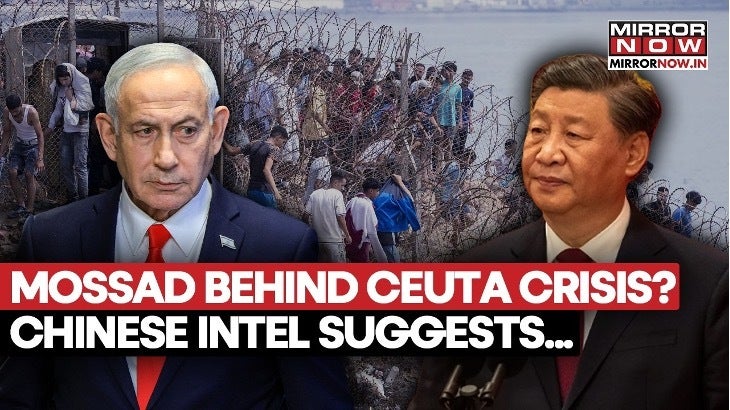
Source: Mirror Now, “MOSSAD Behind Ceuta Crisis? Chinese Intel Suggests Scoop, Why Xi Focusing at Spain-Morocco Border,” YouTube, August 7, 2026, https://www.youtube.com/watch?v=7FHQ3yjGnXQ.
What Happened
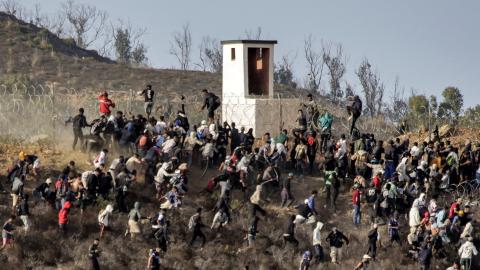
On July 30, tens of thousands of migrants crossed from Morocco into Ceuta, Spain’s North African enclave. Many swam around the border barrier after viral social-media claims said that the frontier was open and sea arrivals could not be immediately returned.[1] The sudden influx overwhelmed the enclave and prompted a coordinated Spanish-Moroccan response.[2]
Anti-Israel propaganda latched onto the Ceuta crisis within hours of the July 30 crossing. As Spanish and Moroccan authorities tried to account for roughly 72,000 arrivals in a city of 84,000, influential accounts on X offered another explanation: Israel, they said, was using Morocco and migration to punish Prime Minister Pedro Sánchez for Spain’s positions on Gaza and Iran. In the first 72 hours, researchers identified 173 high-impact posts from 119 accounts blaming Israel, Zionists, or Jews for the crisis. The posts generated tens of millions of views.[3]
Prominent voices gave the claim momentum. Candace Owens revived a 2019 post by Yair Netanyahu about Ceuta and Melilla.[4] Melissa Witte pointed to a March 2026 article by Michael Rubin of the Middle East Forum urging Moroccans to march peacefully into the enclave.[5] An AI-generated video image from Forbidden HQ showed Benjamin Netanyahu releasing migrants into Spain and drew millions of views.[6] Colombia’s president, Gustavo Petro, then accused Netanyahu of paying poor Moroccans to risk the crossing.[7] He offered no evidence. A sitting head of state had now repeated a version of the conspiracy.
Real tensions made the story easier to believe. Relations between Sánchez and Netanyahu had reached a nadir.[8] Morocco and Israel had built substantial defense and intelligence ties since normalization. Spain depends on Rabat to manage migration and disrupt jihadist networks. On July 31, Israel’s ambassador to the United Nations, Danny Danon, added another spark by criticizing Spain’s “colonial enclaves in Africa.”[9] The post received more than 12.5 million views. Anti-Israel accounts folded these separate facts into a single story: Jerusalem had both the motive and the means to punish Madrid through Morocco.
On August 4, Egyptian political scientist Nadia Helmy gave the theory a more official-sounding source. In Modern Diplomacy, she wrote that Chinese intelligence and strategic circles were examining possible Mossad involvement in Ceuta and referred to assessments prepared in Beijing.[10] She named no agency, analyst, official, or document that readers could examine.
Two days later, one of Spain’s leading newspapers, El Mundo, published an article titled “Why Chinese intelligence believes Mossad might be behind the migration crisis in Ceuta.”[11] Reporter Lucas de la Cal cited allegations circulating in certain Chinese academic, diplomatic, and intelligence circles, and he quoted Helmy along with an unnamed diplomat who pointed to Morocco’s growing defense relationship with Israel.
On August 7, Mohamed Ezzouak of the Moroccan outlet Yabiladi refuted the claims.[12] His fact-check showed that Helmy’s uncorroborated article was the only identifiable source behind the “Chinese intelligence” attribution. No report from China’s Ministry of State Security appeared. No named Chinese intelligence official endorsed the allegation. No public Chinese document blamed Mossad for the crossing. A reference to unpublished assessments in Beijing nevertheless entered Spanish reporting as a claim tied to Chinese intelligence, which other outlets then repeated without independent verification (see image 1).
But the mere claim of Chinese sourcing, however spurious, proved persuasive in Spain. Sánchez has spent years cultivating Beijing and positioning Spain as one of the European governments most open to engaging with China. In September 2024, he visited China and urged the European Union to reconsider tariffs on Chinese electric vehicles. Spain later abstained in the final EU vote.[13] He returned in April 2025, met Chinese President Xi Jinping and Premier Li Qiang, signed seven agreements, and called for a more balanced China-Europe relationship. Madrid and Beijing also deepened their comprehensive strategic partnership while Sánchez encouraged Chinese investment in Spain.[14]
Those ties gave Chinese assessments standing in Spanish debates just as relations with Israel reached one of their lowest points. A Mossad allegation from an anonymous social media account reads as partisan speculation. The same allegation under the heading of Chinese intelligence carries the prestige of a major state with which Sánchez holds regular high-level talks.
Chinese public discussion of Ceuta was more mixed. Major state outlets focused on migration and European politics. CGTN cited Mohammed Zakaria Aboudahab of Mohammed V University in Rabat, who pointed to smuggling networks and false claims that reaching Ceuta guaranteed legal status in Spain.[15] Global Times turned to Cui Hongjian of Beijing Foreign Studies University, who argued that the crisis exposed weaknesses in the EU’s migration system and deepened European divisions. Reporter Zhao Yusha also quoted Jiang Feng of Shanghai International Studies University on the opening the crisis created for Europe’s right-wing parties.[16] None of these scholars accused Mossad.
The clearest Chinese signal came after the plot was already circulating abroad. Official state and party organs continued to explain the crisis by pointing to smuggling, free movement within the Schengen zone, and European fragmentation. But the commercial media layer Beijing permits alongside the party press—WeChat and Weibo accounts, portal columns, and similar operations, often labeled as “self-media”— adopted an edgier line. For example, commentaries on the major portal NetEase in the days after Helmy’s article described Israel and Morocco as Ceuta’s “two hidden hands” and blamed Israeli political influence, intelligence penetration, and manipulation of public opinion.[17]
Strategic Consequences
Laying the blame for the Ceuta crisis at Israel’s feet served several Chinese interests. First, the Mossad allegation impugns the US-Morocco strategic partnership, a security relationship that strengthens the American position in North Africa. Morocco has been a major non-NATO ally since 2004.[18] Washington runs the military exercise African Lion with Moroccan forces, maintains billions of dollars in active arms sales, and works with Rabat under a long-term defense framework.[19] Morocco also gives the US a stable military and intelligence partner as Washington competes for influence in Africa and confronts instability in the Sahel.
Israel adds another dimension. In November 2021, then-Israeli Defense Minister Benny Gantz and Moroccan official Abdellatif Loudiyi signed an agreement covering intelligence, training, defense industries, and arms.[20] Israeli firms later expanded their presence in Morocco, including in drones, air defense, and surveillance.[21]
The Ceuta conspiracy lets opponents of those partnerships recast Moroccan cooperation as a loss of sovereignty and equate intelligence ties with Israeli penetration. Defense agreements become political control. American military support places Rabat inside a larger US-Israeli alignment. That argument speaks directly to audiences in Morocco and the wider Arab world that already distrust normalization with Israel.
Second, the story targets relationships that Europe increasingly needs for its security. Spain’s National Police and Morocco’s General Directorate for Territorial Surveillance (DGST) conducted 31 joint counterterrorism operations between 2014 and March 2026 and arrested 150 people linked to jihadist activity.[22] Moroccan authorities also disrupt smuggling networks and stop tens of thousands of attempted crossings before migrants reach Spanish territory. Ceuta showed how quickly pressure reaches Europe when that cooperation falters.
Europe’s defense buildup makes the consequences more immediate. Russia’s war against Ukraine, the spread of drones and missiles, and years of underinvestment have forced European governments to spend heavily on air defense, cyber capabilities, electronic warfare, surveillance, and counter-drone systems. Israeli companies already occupy important positions in several of those markets. Germany deploys the Israeli-American Arrow 3 system.[23] Greece has signed a multibillion-euro package that includes David’s Sling, SPYDER, BARAK MX, and Israeli radars.[24] Other European militaries buy Israeli drones, sensors, counter-drone equipment, and defensive technologies.
A climate saturated with claims of Israeli penetration makes those relationships harder to defend on their merits. Intelligence work with Morocco feeds accusations of Mossad control. A European defense purchase leads to arguments about Israeli influence over governments. Real contracts and genuine security ties give conspiratorial claims a factual setting even when no evidence supports the hidden-control story attached to them.
The reporting on the Ceuta incident both drew on antisemitic tropes and helped further spread the theme. The first accusations targeted Netanyahu and Mossad, but later commentary shifted to Jewish manipulation of governments and populations. Contemporary security language gives an old charge a modern form. Instead of secret councils or forged documents, the “evidence” now consists of intelligence agreements, defense contracts, lobbying, military aid, and diplomatic normalization.
The shift matters because Europe is expanding exactly those forms of cooperation. Governments need stronger defense industries, better intelligence, reliable Mediterranean partners, and technologies that can counter missiles, drones, jihadist networks, and organized smuggling. Propaganda that interprets those relationships as hidden Jewish or Israeli control can deepen antisemitism while raising the domestic political cost of security cooperation.
Third, Ceuta sits inside China’s broader contest with the US in Africa. Beijing values Morocco and has no interest in destabilizing the kingdom. China established a strategic partnership with Rabat in 2016, and Chinese firms have invested heavily in Moroccan manufacturing, electric vehicles, batteries, infrastructure, and technology. Morocco gives Chinese companies a politically stable base connected to European and Atlantic markets.[25]
Rabat is also embedded in the American security system, maintains extensive ties with Europe, and has built an important defense relationship with Israel. Morocco, therefore, shows that an African government can welcome Chinese investment without leaving the Western strategic orbit.
Questioning those Western relationships could serve Beijing’s interest without requiring it to attack Morocco itself. If normalization with Israel looks like foreign penetration, Jerusalem pays a political price. If Europeans see Moroccan security cooperation as easy to manipulate, confidence in Rabat falls. If American military ties look like part of an Israeli project, Washington’s partnerships in North Africa become easier to portray as intrusive.
2. Beijing Uses Israel to Indict Japan
Image 2. Chinese Diplomat in Japan Shares Antisemitic Post
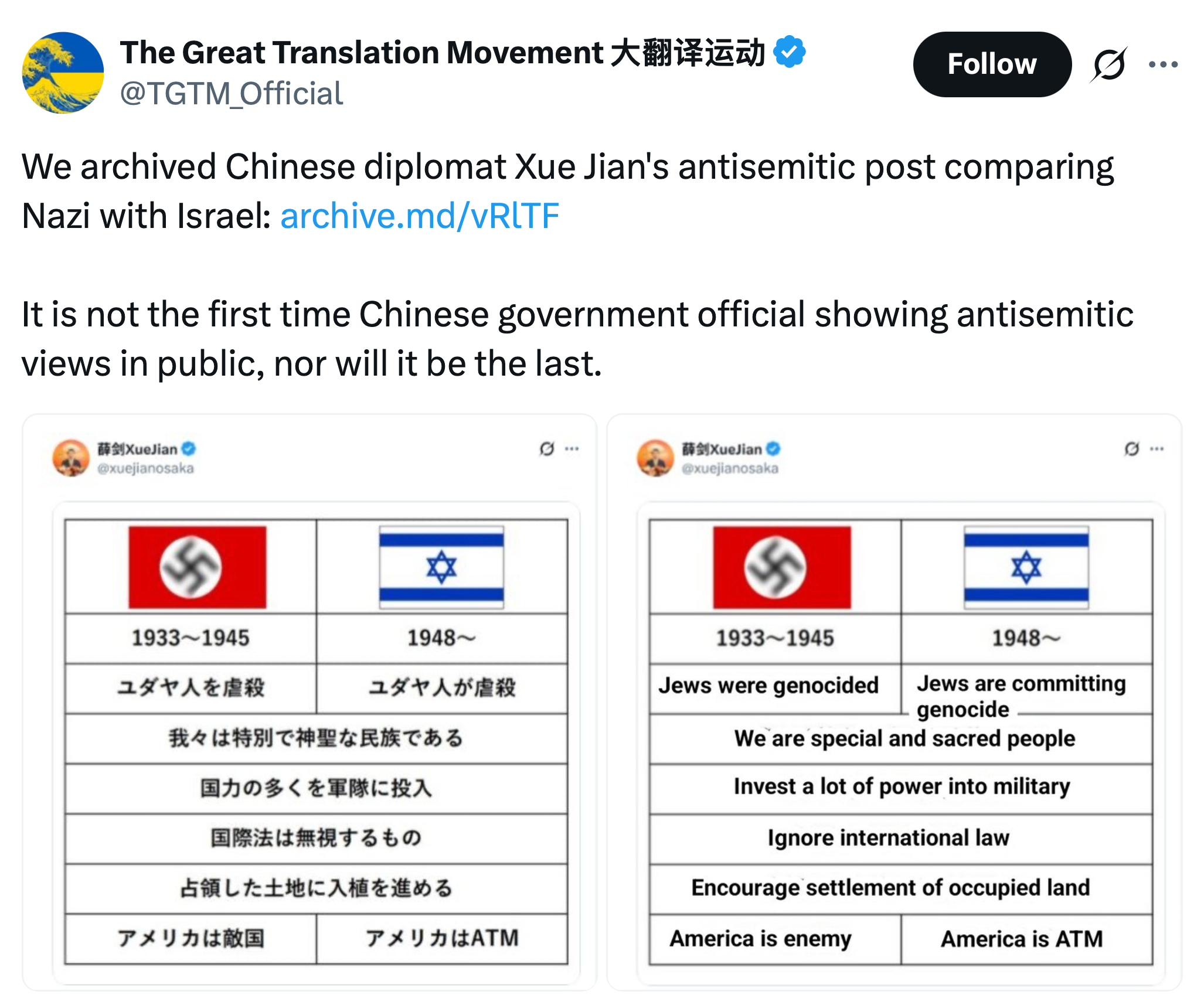
Source: The Great Translation Movement (@TGTM_Official), “We archived Chinese diplomat Xue Jian's antisemitic post comparing Nazi with Israel: https://archive.md/vRlTF,” X, June 19, 2025, https://x.com/TGTM_Official/status/1935895618083602697.
What Happened
In June 2025, China’s consul general in Osaka, Xue Jian, posted a graphic on X comparing Israel with Nazi Germany (see image 2). At the time, Israel and Iran were trading blows in the Twelve-Day War. Tokyo had criticized Israel’s initial strike on Iran,[26] but Xue went much further: his graphic placed the Israeli and Nazi flags side by side and listed what he presented as common characteristics.[27] Both claim a special status as a “chosen people,” devote enormous resources to the military, disregard international law, and occupy foreign territory. Another row contrasts Nazi persecution of Jews with what the table calls Jewish persecution of others. The final comparison turns to Washington. Nazi Germany sees America as an enemy. Israel, Xue writes, sees America as an “ATM.”
Israel’s ambassador in Tokyo, Gilad Cohen, denounced the post as antisemitic.[28] US Ambassador George Glass joined him in condemning Xue.[29] Xue eventually deleted the post, but Beijing took no disciplinary action against him.
Five months later, the same diplomat triggered another crisis after Prime Minister Sanae Takaichi stated that a Chinese attack on Taiwan could threaten Japan’s survival and potentially justify Japanese military action. Xue wrote, “That filthy neck that barged in on its own—I’ve got no choice to cut it off without a moment’s hesitation. Are you prepared for that?”[30] Beijing responded to Tokyo’s protests by accusing Japan of returning to the “militarism” that drove its expansion across Asia before 1945.[31]
The two episodes reveal a consistent argument. Xue portrays Israel as a militarized American partner that invokes security to justify aggression. He then portrays Japan, another central US partner, as a former imperial power following the same path. The common thread is Washington as the facilitator of aggression.
Japan’s Middle East policy makes that argument particularly revealing. Tokyo condemns Hamas and recognizes Israel’s security concerns, but it also criticizes Israeli settlements, supports a two-state solution, objects to the humanitarian costs of the Gaza campaign, and condemns Israel’s June 2025 attack on Iran.[32] Xue therefore does not attack Japan because Tokyo follows Israeli policy. He uses Israel to challenge the legitimacy of the broader security system that ties both countries to the US.
Strategic Consequences
Image 3. Chinese Diplomat Shares Post Attacking the US, UK, and Israel
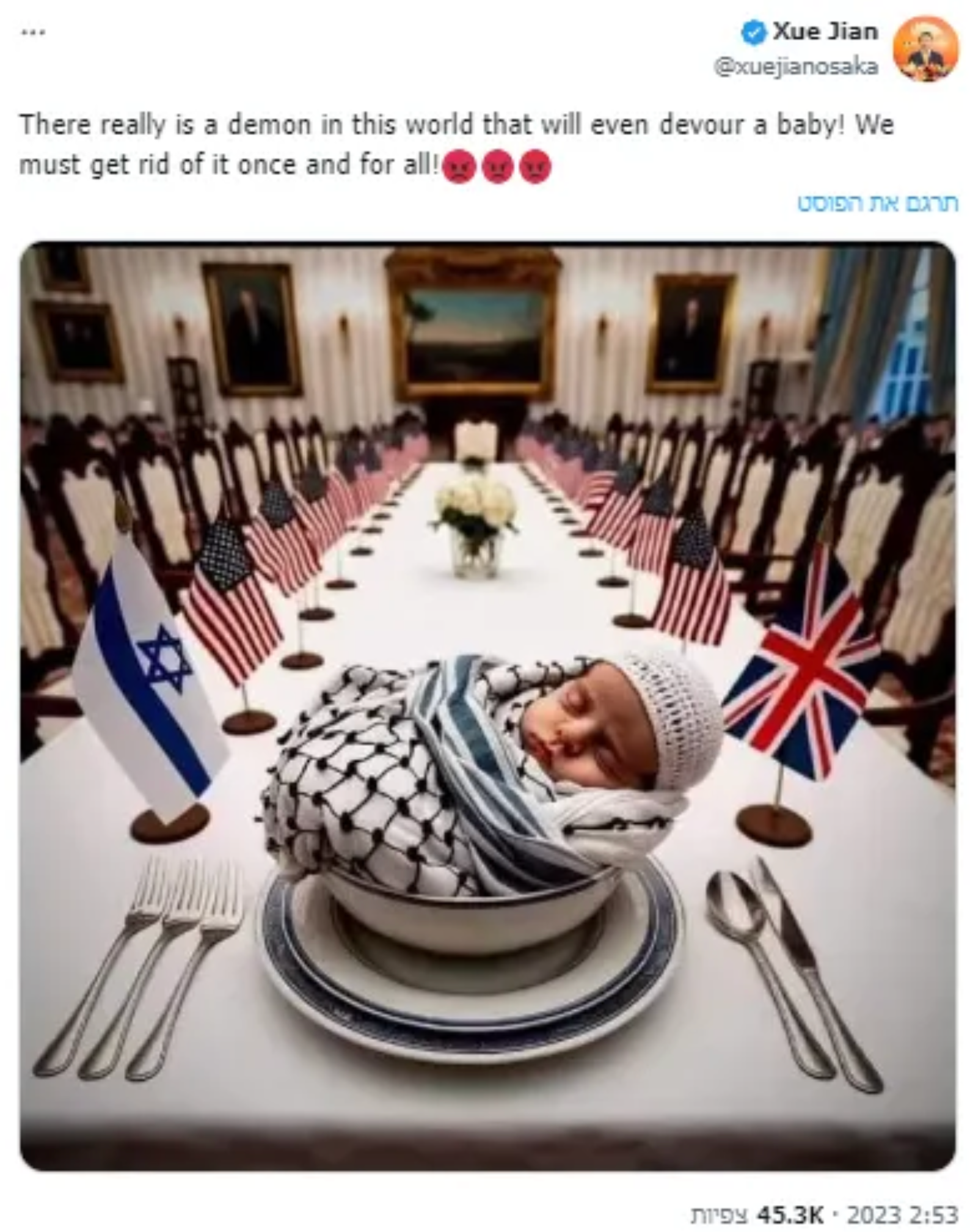
Source: Tuvia Gering, “The Mission of the Historian,” Discourse Power, Substack, September 17, 2024, https://discoursepower.substack.com/p/the-mission-of-the-historian.
Xue drew on Chinese discourse that has long explained American support for Israel as a consequence of Jewish influence or control. During the May 2021 Gaza war, CGTN anchors told viewers that Jews “dominate finance, media, and internet sectors” in the US and presented that alleged influence as an explanation for Washington’s support for Israel.[33] After the October 7, 2023, attacks, a CCTV social media account made a similar claim, asserting that Jews represent only a small share of the American population while controlling an extraordinary share of its wealth.[34] Chinese social media platforms are rife with assertions about Jewish money, political influence, media power, and control over American policy.
Xue’s post condensed those ideas into the phrase “America is ATM.” His reference to a “chosen people” pushed the argument beyond criticism of an Israeli government and into Jewish identity itself, as did his claim that “the Jews persecute.” American support for Israel, in that telling, ceases to be the product of strategy, domestic politics, military cooperation, or shared interests, and instead becomes evidence of a relationship in which Jewish power extracts American resources.
Image 4. Chinese Diplomat Shares Post Comparing Israel to Imperial Japan
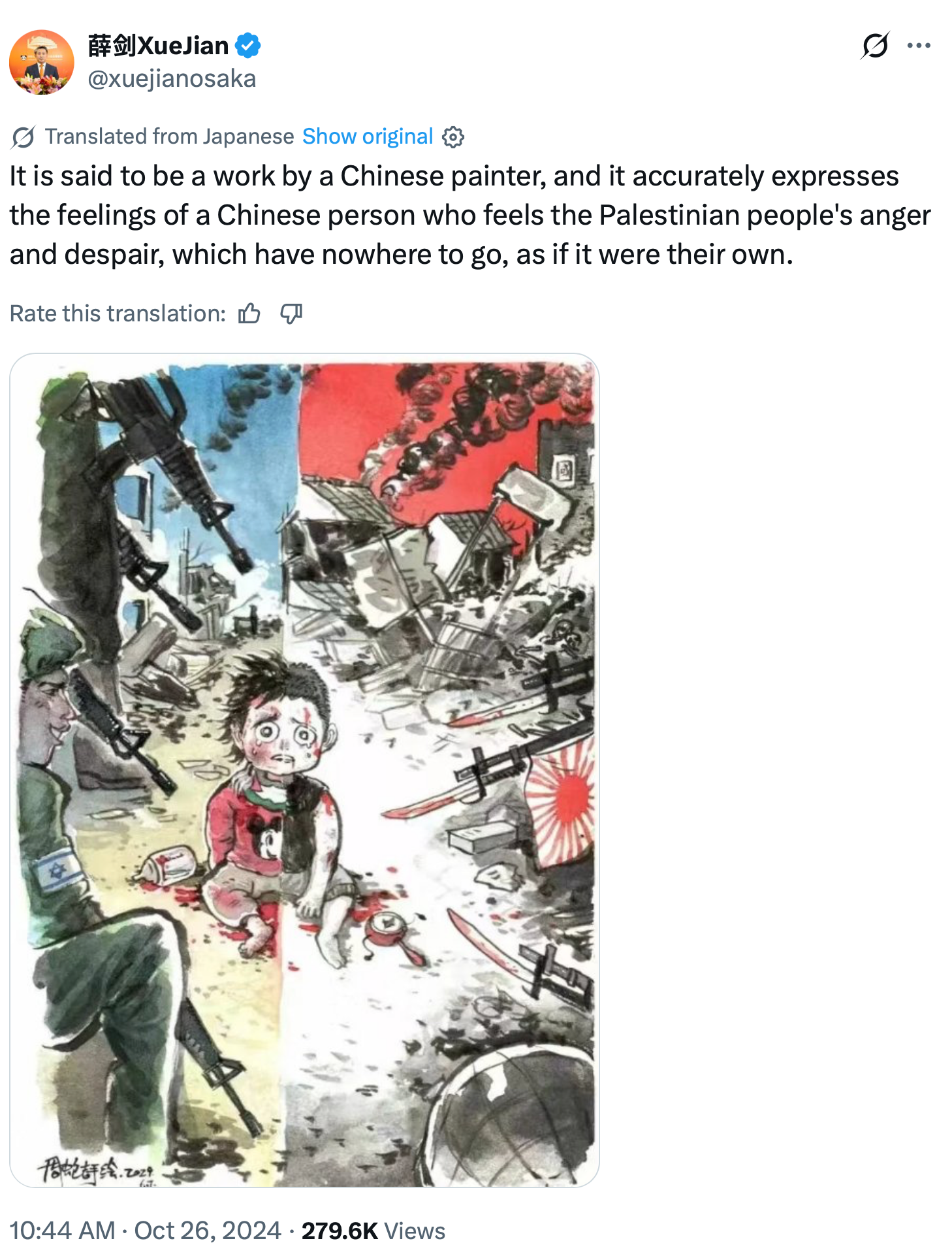
Source: Xue Jian (@xuejianosaka), “It is said to be a work by a Chinese painter, and it accurately expresses the feelings of a Chinese person who feels the Palestinian people's anger and despair, which have nowhere to go, as if it were their own,” X, October 26, 2024, https://x.com/xuejianosaka/status/1850186839510188330.
In the wake of the October 7 attack, Chinese social media depicted an invidious historic partnership between Jewish and Japanese aggression. For example, Chinese accounts revived conspiratorial versions of the wartime Fugu Plan, presenting Japanese discussions of Jewish settlement in Manchuria as evidence of deeper cooperation between Jews and Imperial Japan.[35] Other accounts drew parallels between Israeli soldiers and the Imperial Japanese Army. Xue himself circulated imagery comparing Israelis with Japanese troops and grotesque depictions of Israelis as killers of children (see image 4).[36]
Those comparisons give Xue’s attack on Israel particular force in Japan. Beijing has spent decades making the war against Imperial Japan central to its account of modern Chinese history. Nanjing, Manchuria, occupation, and Japanese militarism remain active political references in Chinese public life. By placing Israel beside Nazi Germany and Imperial Japan, Xue casts the Jewish state as another power whose claims of security conceal conquest and brutality.
The comparison allows Xue to attack the American alliance system through Israel. Washington’s relationships with Israel and Japan differ substantially, but both countries occupy important positions in American strategy. Israel receives extensive military and diplomatic support. The US-Japan security treaty anchors the American presence in East Asia, with tens of thousands of US military personnel stationed in Japan.[37]
Xue’s posts presented those relationships as sources of impunity. America finances Israel, in his telling, and allows it to disregard international restraints. American protection also gives Japan room to increase defense spending, acquire longer-range weapons, deepen military cooperation with Washington, and prepare for a possible Taiwan conflict. Chinese officials increasingly describe those Japanese policies as evidence of a return to “militarism.” In May 2026, Chinese spokeswoman Mao Ning similarly accused Japan of heading down a path of “neo-militarism,” citing increased military spending, long-range missile deployments, expanded weapons exports, and the development of counterstrike capabilities.[38]
Invoking Israel gives that argument a contemporary hue. Xue can point to Israeli military operations and suggest that American protection encourages allies to define ever wider uses of force as self-defense. For a Japanese audience, the implication reaches beyond the Middle East. Beijing can warn that Japan risks following the same course as it expands its military role under the US alliance.
The comparison also runs in reverse. Calling Israel another Imperial Japan attaches the moral weight of Chinese wartime memory to the Jewish state. Claiming that contemporary Japan may return to militarism then places two US partners inside the same historical story. One represents present aggression. The other carries the memory of past aggression.
Finally, the Taiwan dispute makes Xue’s broader argument explicit. After Xue threatened to cut off “that filthy neck,” Chinese officials invoked the Mukden Incident, a false-flag event in September 1931 that the Japanese military used as an excuse to invade Manchuria.[39]
That analogy serves China on several fronts. In the Middle East, Beijing can present Israel as an aggressive American client and appeal to Arab and Muslim audiences. Across the Global South, Israeli operations give Chinese officials another way to accuse Washington of applying international law selectively. In East Asia, the same language helps Beijing challenge Japan’s military normalization and portray the US-Japan alliance as a source of instability.
3. “Anti-Zionist” Sabotage Targets the Defense-Industrial Base
What Happened
United Kingdom court verdicts in June and August 2026 regarding the summer 2024 attack on a defense contractor facility near Bristol, England, shone a light on the nexus of Iranian and Russian state propaganda and anti-Israel activism and militancy in the West.
A militant current within Western anti-Zionist activism has attacked defense firms and military facilities because of their real or alleged ties to Israel. Several also serve Britain, NATO, Ukraine, and the US. Iranian and Russian state media publicize and defend these attacks, presenting them as resistance to a wider Western military system. The evidence shows a convergence of interests. It does not establish that Tehran or Moscow directs the activists.
At Elbit Systems’ Filton facility near Bristol, Palestine Action activists rammed a van through the gates in August 2024 and damaged 41 military assets at a cost of roughly £1.2 million.[40] Samuel Corner struck Sgt. Kate Evans with a sledgehammer, fracturing her spine. In June 2026, Justice Jeremy Johnson sentenced Corner and three others to prison and found a connection to terrorism in their offenses.[41] A group called People Against Genocide claimed responsibility for an April 2026 attack on UAV Tactical Systems near Leicester, England, where a van breached the gate and activists damaged the building. Counterterrorism police took over the investigation.[42]
The target list reaches beyond Israeli-owned firms. Palestine Action caused more than £1 million in damage at a Thales site in Glasgow, Scotland, including equipment connected to Britain’s submarine program.[43] In June 2025, activists entered RAF Brize Norton and damaged two Voyager aircraft used for aerial refueling and strategic transport in British and allied operations.[44]
Nor was Britain alone. Five activists went on trial in Stuttgart, Germany, in April 2026 over roughly €1 million in alleged damage at an Elbit facility in Ulm.[45] In Australia, counterterrorism authorities investigated a July 2025 arson attack on Lovitt Technologies, an F-35 supplier, after attackers burned three vehicles and warned the company to stop arming Israel.[46]
Press TV—an Iranian media organization that broadcasts in English, French, Hebrew, and Turkish—has treated such damage as a model for political action. After activists attacked Elbit’s headquarters in Bristol, in March 2025, the outlet praised the raid as a “brave act of solidarity,” carried the activists’ video, and repeated their pledge to dismantle Israel’s war machine “window by window, brick by brick.”[47] The next month, it featured Palestine Action cofounder Huda Ammori’s argument for direct action: if 1 percent of a 100,000-person march joined in, she contends, activists could shut most Israeli weapons factories in Britain.[48]
Press TV also aired supporter Nick Georges’s allegation that Israel controlled Prime Minister Keir Starmer, the police, and the armed forces, casting prosecutions of activists as evidence of Israeli influence over Britain.[49] At the end of 2025, the outlet credited Palestine Action with imposing financial losses on arms companies and placed the group’s actions within a campaign against the US-Israeli military alliance.[50] It called jailed activists “political prisoners” and portrayed attacks on Elbit and RAF Brize Norton as efforts to interrupt British support for Israel.[51]
That pattern continued in June 2026. After the sentences for the Filton attack, Press TV praised the raid as “courageous direct action.”[52] When Britain’s Court of Appeal upheld Palestine Action’s proscription, the outlet called the group “heroic.”[53] An official Iranian state-media outlet likewise accused London of misusing counterterrorism law, arguing that property destruction without an intent to kill or injure should not be classified as terrorism.[54]
Tehran’s frame extends well beyond Elbit. In May 2026, Press TV called for a global “resistance front” against a US-backed Israeli military system. Its list ran from Boeing, Lockheed Martin, and L3 Technologies to BlackRock, Vanguard, Google, and Amazon.[55] Treating all those institutions as parts of one targetable system would extend the campaign across the defense supply chain and into the finance and technology sectors.
Russian outlets give the campaign another channel. Sputnik interviewed Ammori during an Elbit factory occupation in 2021.[56] After Britain proscribed Palestine Action in 2025, it covered demonstrations supporting the group and organizers’ plans for mass civil disobedience.[57]
Following the Brize Norton breach, RT featured former British diplomat Craig Murray’s claim that the Voyager aircraft served foreign financial interests and Israel.[58] RT Arabic distributed footage of the damage and Palestine Action’s allegation that Britain participated in Israeli military operations. It later repeated the group’s claim that an Israeli lobby controlled the British response.[59]
An April 2026 RT commentary compared attacks on Elbit with resistance against Nazi infrastructure and portrayed Britain as a “Zionist police state.”[60] Russian coverage thus supplied moral approval for sabotage while shifting attention from attacks on British facilities to allegations of Israeli control.
Strategic Consequences
The first strategic risk is operational. A raid justified on the basis of the target’s connection to Israel can damage suppliers and military assets that support Britain’s submarine program, allied air operations, or the F-35 program. Defense contractors serve several militaries at once. The attackers claim to be acting against Israel, but they are aligned ideologically with the enemies of the West. Their sabotage can also impose costs on the wider Western alliance. A sustained campaign against shared suppliers imposes security and production costs well beyond the value of the property damaged.
Washington now treats the threat through counterterrorism authorities. On August 26, 2026, the Treasury Department sanctioned Palestine Action under Executive Order 13224, citing attacks on defense infrastructure, injuries to British law enforcement, intimidation of companies, and promotion of similar tactics abroad, including in the US.[61] The exposure extends to subcontractors, laboratories, and transport networks whose work crosses national defense programs and whose physical security varies widely.
The second risk is political. Iranian outlets praise the damage and portray imprisoned activists as victims. Russian outlets present British prosecutions as evidence of Israeli control. Neither state needs to direct a raid to exploit it. An attack planned by British radicals can damage allied military assets, win publicity from Tehran and Moscow, and circulate as proof that sabotage imposes costs on the West. That praise helps legitimize the method.
Endnotes
- Tamsin Paternoster and James Thomas, “From TikTok Videos to Political Claims: How Misleading Information Spread During the Ceuta Crisis,” Euronews, April 8, 2026, https://www.euronews.com/2026/08/04/from-tiktok-videos-to-political-claims-how-misleading-information-spread-during-the-ceuta-. ↑
- Sofia Ferreira Santos and Sarah Rainsford, “Spain's PM Blames Traffickers after 60,000 Migrants Reach Ceuta from Morocco,” BBC, July 31, 2026, https://www.bbc.com/news/articles/cx2kp639yx4o. ↑
- “The Weaponization of the Ceuta Border Crisis,” Combat Antisemitism Movement, August 2026, https://combatantisemitism.org/wp-content/uploads/2026/08/Ceuta-Border-Crisis-Report.pdf. ↑
- “Extremist Content Creators Spread Conspiracy Theories Blaming Israel for Spain’s Migration Crisis,” The Jerusalem Post, August 2, 2026, https://www.jpost.com/diaspora/antisemitism/article-904266. ↑
- Shira L. Bartov, “Online Influencers Spread Theory That Israel Orchestrated Moroccan Migrant Surge to Spanish Enclave,” South African Jewish Report, August 4, 2026, https://www.sajr.co.za/online-influencers-spread-theory-that-israel-orc…. ↑
- Forbidden HQ (@WearForbidden), “If we’re being honest about what’s going on in Spain:,” X, July 31, 2026, 2:14 p.m., https://x.com/WearForbidden/status/2083254892802593073. ↑
- Gustavo Petro (@petrogustavo), “The civilian invasion of Moroccans into Ceuta imitates the alliance that Franco made with the descendants of the ancient Caliphate of Córdoba,” X, August 2, 2026, 3:27 a.m., https://x.com/petrogustavo/status/2083816838736003324. ↑
- Israel recalled its ambassador from Madrid in May 2024 after Spain’s recognition of a Palestinian state; relations deteriorated further with Madrid’s 2025 arms-embargo measures and Israeli countermeasures. ↑
- Danny Danon (@dannydanon), “Spain, which never misses an opportunity to lecture Israel, has declared a state of emergency in Ceuta following the crisis over its immigration policy,” X, July 30, 2026, 7:17 p.m., https://x.com/dannydanon/status/2082968903957770527. ↑
- Nadia Helmy, “Ceuta Migration Crisis: Why Chinese Analysts Are Looking at Mossad,” Modern Diplomacy, August, 2, 2026, https://moderndiplomacy.eu/2026/08/02/ceuta-migration-crisis-china-moro…. ↑
- Lucas de la Cal, “Why Chinese Intelligence Believes Mossad May be Behind the Migration Crisis in Ceuta,” El Mundo, August 6, 2026, https://www.mundoamerica.com/news/2026/08/06/6a745659e85ece1e598b4590.h…. ↑
- Mohamed Ezzouak, “Fact Check: Is Chinese Intelligence Accusing Mossad of Being Behind the Ceuta Crisis?” Yabiladi, August 7, 2026, https://en.yabiladi.com/articles/details/200228/fact-check-chinese-inte…; Eduardo Zalovich, “Ceuta, Pekín y Jerusalén: un cuento chino,” El Debate, August 8, 2026, https://www.eldebate.com/internacional/20260808/ceuta-pekin-jerusalen-c…. ↑
- Sánchez visited Beijing on September 9–11, 2024. Spain abstained in the October 4, 2024, vote of EU member states on countervailing duties for Chinese battery electric vehicles. ↑
- “Spain and China Agree to Facilitate the Export of Spanish Products and Strengthen Cooperation in Science, Education and Culture,” La Moncloa, April 11, 2025, https://www.lamoncloa.gob.es/lang/en/presidente/news/paginas/2025/20250411-trip-to-china.aspx. ↑
- “Explainer: Why Is Ceuta a Focal Point of Europe’s Latest Migrant Crisis?” CGTN, August 2, 2026, https://news.cgtn.com/news/2026-08-02/Explainer-Why-is-Ceuta-a-focal-point-of-Europe-s-migrant-crisis--1Pht700EujK/p.html. ↑
- Zhao Yusha, “Ceuta Migrant Crisis Exposes Divisions Within Europe, Deepens Tensions Between Spain, the US: Chinese Experts,” Global Times, August 2, 2026. ↑
- “两天内5万非法移民涌上岸,休达危机背后历史恩怨与现实算计|907编辑部” [50,000 illegal immigrants flood ashore in two days: the historical grievances and real-world calculations behind the Ceuta crisis | 907 Editorial Department], The Paper, August 3, 2026, https://www.thepaper.cn/newsDetail_forward_33710645; Nan Boyi, “新闻蒸馏器|数万人突然涌入西班牙飞地:休达越境潮的三重推手与欧洲困局” [News distiller | Tens of thousands suddenly flood into the Spanish enclave: the three forces driving the Ceuta border-crossing surge and Europe’s dilemma], The Paper, August 3, 2026, https://m.thepaper.cn/newsDetail_forward_33708525; “休达移民危机震惊欧盟,未来或更倾向“边境外移”的治理主张” [The Ceuta migrant crisis shocks the EU; Europe may be more inclined in the future to favor “externalized border” policies], The Paper, August 3, 2026, https://www.thepaper.cn/newsDetail_forward_33708367. ↑
- “US Security Cooperation with Morocco,” US Department of State, January 20, 2025, https://www.state.gov/u-s-security-cooperation-with-morocco. ↑
- Jim Garamone, “US, Morocco Chart Defense Cooperation Through 2030,” Department of Defense News, October 2, 2020, https://www.war.gov/News/News-Stories/Article/Article/2369742/us-morocco-chart-defense-cooperation-through-2030/. ↑
- Judah A. Gross, “In Morocco, Gantz Signs Israel’s First-Ever Defense MOU with an Arab Country,” The Times of Israel, November 24, 2021, https://www.timesofisrael.com/in-morocco-gantz-signs-israels-first-ever-defense-mou-with-an-arab-country/. ↑
- Chinedu Okafor, “Morocco Is Opening Its Doors to Defence Giants from the World’s Most Polarizing Military Nation as Tensions Grow All Around It,” Business Insider Africa, September 26, 2026, https://africa.businessinsider.com/local/markets/morocco-is-opening-its-doors-to-defence-giants-from-the-worlds-most-polarizing/jf7gesh. ↑
- Policía Nacional (@policia), X, March 25, 2026: “Three detained in #Spain and #Marruecos in a simultaneous operation by @policia and the Moroccan DGST,” X, March 25, 2026, 8:43 a.m., https://x.com/policia/status/2036786135456702604; Oumaima Moho Amer, “Spain Hails Strong Security Ties with Morocco’s DGST,” Morocco World News, March 25, 2026, https://www.moroccoworldnews.com/2026/03/284299/spain-hails-strong-secu…. ↑
- Reuters, Germany Deploys Arrow Air Defence to Counter Russian Missile Threat,” December 3, 2025, https://www.reuters.com/business/aerospace-defense/germany-deploys-arrow-air-defence-counter-russian-missile-threat-2025-12-03/. ↑
- Steven Scheer and Lefteris Papadimas, “Israel Signs $3.5 billion Air Defence Deal with Greece,” Reuters, August 31, 2026, https://www.reuters.com/business/aerospace-defense/israel-signs-35-billion-air-defence-deal-with-greece-2026-08-31/. ↑
- Peter Foster and Andy Bounds, “EU Frets as China Builds an Industrial Base in Morocco,” Financial Times, May 31, 2026, https://www.ft.com/content/706c1db4-effa-4e53-9bdd-f66496407626. ↑
- Ministry of Foreign Affairs of Japan, “Situation Surrounding Israel’s Attack Against Iran (Statement by Foreign Minister Iwaya Takeshi,” news release, June 13, 2025, https://www.mofa.go.jp/press/statement/pressite_000001_01371.html. ↑
- Canaan Lidor, “Jerusalem Slams Chinese Diplomat’s Deleted Israel-Nazis Comparison,” Jerusalem News Syndicate, June 22, 2025, https://www.jns.org/israel-news/jerusalem-slams-chinese-diplomats-delet…. ↑
- Gilad Cohen (@GiladCohen_), “China’s Consul General in Osaka has crossed every conceivable line,” X, June 19, 2025, 6:55 a.m., https://x.com/GiladCohen_/status/1935652546456256603. ↑
- George Glass, US Ambassador to Japan (@USAmbJapan), “China’s consul general in Osaka, @xuejianosaka, displayed a shocking level of antisemitism, ignorance, and vulgarity in a now-deleted post that compared Nazi Germany with Israel,” X, June 24, 2025, 2:59 a.m., https://x.com/USAmbJapan/status/1937405320495550489. ↑
- Xue Jian (@xuejianosaka), “That filthy neck that barged in on its own—I’ve got no choice to cut it off without a moment’s hesitation,” X, November 8, 2025, https://x.com/xuejianosaka/status/1987168322170052963; Micah McCartney, “Chinese Diplomat Threatens to Cut Off Japan’s Leader Head,” Newsweek, November 10, 2025, https://www.newsweek.com/chinese-diplomat-threatens-behead-japans-pm-sanae-takaichi-11019624. ↑
- Micah McCartney, “Chinese Diplomat Threatens To Cut Off Japan’s Leader Head,” Newsweek, November 10, 2026, https://www.newsweek.com/chinese-diplomat-threatens-behead-japans-pm-sanae-takaichi-11019624. ↑
- Ministry of Foreign Affairs of Japan, “Situation Surrounding Israel’s Attack Against Iran.” ↑
- “ Israel Accuses Chinese State TV of ‘Blatant Anti-Semitism,’” Ynet Global, May 19, 2021, https://www.ynetnews.com/jewish-world/article/rJHVqUfFu. ↑
- Jordyn Haime, “Israel-China Relationship in Danger as State Media Blames Israel, US, and Jews for Conflict,” The China Project, October 19, 2023, ed. John Kuroski, https://thechinaproject.com/2023/10/19/israel-china-relationship-in-danger-as-state-media-blames-israel-u-s-and-jews-for-conflict/. ↑
- Morgan Dunn, “The Outrageous Story of Imperial Japan’s Plot to Import Jewish Refugees Based on an Anti-Semitic Hoax,” All That's Interesting, October 9, 2021, https://allthatsinteresting.com/fugu-plan; Jordyn Haime and Tuvia Gering, “Jewish Conspiracy Theories Find an Audience in China,” China Media Project, July 18, 2023, https://chinamediaproject.org/2023/07/18/jewish-conspiracy-theories-find-an-audience-in-china/. ↑
- Xue Jian (@xuejianosaka), “It is said to be a work by a Chinese painter, and it accurately expresses the feelings of a Chinese person who feels the Palestinian people’s anger and despair, which have nowhere to go, as if it were their own,” X, October 26, 2024, 10:44 a.m., https://x.com/xuejianosaka/status/1850186839510188330; Tuvia Gering, “Liberation Is an Inevitability of Life, from Palestine to Beijing, and Onward to the Whole World,” Discourse Power, June 26, 2025, https://discoursepower.substack.com/p/liberation-is-an-inevitability-of. ↑
- “About USFJ,” US Forces Japan, accessed September 28, 2026, https://www.usfj.mil/About-USFJ/. ↑
- “Chinese FM Rejects Japan’s Denial of ‘Neo-militarism,’ Emphasizing ‘What Japan Does Matters Far More Than What It Says,’” Global Times, May 26, 2026, https://www.globaltimes.cn/page/202605/1361968.shtml. ↑
- “No Tolerance for Sanae Takaichi’s Provocations Crossing the Line on the Taiwan Question, People’s Daily, November 4, 2025, https://world-app.people.cn/n1/2025/1114/c1002-40603281.html. ↑
- Simon Childs, “Palestine Action Activists Sentenced as Terrorists,” Novara Media, June 12, 2026, https://novaramedia.com/2026/06/12/palestine-action-activists-will-be-s…. ↑
- Tom Anderson, “First Filton 25 Defendants Sentenced as Terrorists,” The Bristol Cable, June 18, 2026, https://thebristolcable.org/2026/06/first-filton-25-defendants-sentence…. Corner received eight years and eight months; Head and Kamio six years each, less 45 days; Rajwani five years and eight months, less 45 days. ↑
- “Counter Terrorism Police Called In after Van Driven into Gate at Leicestershire Drone Factory,” ITV News, April 27, 2026, https://www.itv.com/news/central/2026-04-25/counter-terrorism-police-ca…. ↑
- “Pro-Palestinian Protesters Jailed for 1m Damage at Weapons Factory,” STV News, August 20, 2024, https://news.stv.tv/west-central/pro-palestinian-protesters-jailed-for-1m-damage-at-thales-weapons-factory-in-glasgow. ↑
- Deborah Haynes, “‘Absolutely Staggering’ Security Breach at RAF Base—As Activists Break in and Vandalise Aircraft,” Sky News, June 20, 2025, https://news.sky.com/story/pro-palestinian-activists-break-into-raf-base-and-vandalise-aircraft-13386065. ↑
- “Five Stand Trial in Germany over Attack on Israeli Defence Company Office,” Reuters, April 27, 2026, https://www.reuters.com/world/middle-east/five-stand-trial-germany-over-attack-israeli-defence-company-office-2026-04-27/. ↑
- “Police Investigate Video Claiming Responsibility for Arson Attack on Melbourne Business,” Australian Broadcasting Corporation News, July 14, 2025, https://www.abc.net.au/news/2025-07-14/police-investigate-video-lovitt-technologies-arson-attack/105529032. ↑
- Maryam Qarehgozlou, “‘Got Palestine Actioned’: Actionists Continue to Tear Down Israel’s Largest Arms Firm,” Press TV, March 17, 2025, https://www.presstv.co.uk/Detail/2025/03/17/744589/palestine-actioned-actionists-tear-down-israel-largest-arms-firm. ↑
- “We Bypass Politicians and Go Straight to Aggressors: Palestine Action Co-founder,” Press TV, April 19, 2025, https://www.presstv.ir/Detail/2025/04/19/746477/United-Kingdom-Palestin…; Huda Ammori, “Tactics of Disruption,” Sidecar (New Left Review), April 18, 2025, https://newleftreview.org/sidecar/posts/tactics-of-disruption. ↑
- “Protests at Old Bailey Palestine Action Court Hearing,” Press TV, May 4, 2025, https://www.presstv.co.uk/Detail/2025/05/04/747340/Protesters-outside-the-Old-Bailey-court-where-members-of-the-Palestine-Action-Group-will-appear-in-front-of-a-judge-in-what-legal-experts-call-a-critical-hearing. ↑
- Maryam Qarehgozlou, “The Year That Was: How Pro-Palestine Campaigns Disrupt the US-Israeli War Alliance in 2025,” Press TV, December 31, 2025, https://www.presstv.co.uk/Detail/2025/12/29/761491/the-year-that-was-pro-palestine-campaigns-disrupt-US-Israeli-war-machine-2025. ↑
- “The Plight of Palestine Action Hunger Strikers,” Press TV, December 30, 2025, https://www.presstv.co.uk/Detail/2025/12/30/761546/The-Palestine-Action-hunger-strikers,-incarcerated-for-over-a-year,-demand-immediate-bail,-fair-trials,-and-an-end-to-UK-contracts-with-Elbit-Systems-/. ↑
- “UK Judge Brands Palestine Action Activists ‘Terrorists’ for Storming Israeli Weapons Company,” Press TV, June 12, 2026, https://www.presstv.co.uk/Detail/2026/06/12/770332/UK-judge-connects-Pa…. ↑
- “UK Courts Whitewash Israeli Genocide in Gaza: Palestine Action Terror Ban Upheld,” Press TV, June 15, 2026, https://www.presstv.co.uk/Detail/2026/06/15/770515/UK-Palestine-Action-…. ↑
- “جهش بیش از ۶ برابری بازداشت حامیان فلسطین در انگلیس به بهانه قوانین تروریستی” [More than sixfold increase in the arrest of pro-Palestinian supporters in England under the pretext of terrorism laws], Islamic Republic News Agency, Azar 27, 1404 (December 17, 2025), https://www.irna.ir/news/86029337/جهش-۶۶%DB%B0-درصدی-بازداشت-حامیان-فلسطین-در-انگلیس-به-بهانه-قوانین. ↑
- Dina Y. Sulaeman, “Taking Iran’s Lead, a Global Resistance Front Is Needed Against US-Backed Israeli War Machine,” Press TV, May 24, 2026. ↑
- “Pro-Palestinian Protesters Shut Down Israeli Drone Factory in UK,” Sputnik, May 20, 2021, https://independentpress.cc/pro-palestinian-protesters-shut-down-israeli-drone-factory-in-uk/2021/05/20/. ↑
- Sputnik coverage, July–August 2025. ↑
- “متضامنون مع فلسطين يخربون طائرتين عسكريتين في قاعدة بريطانية (فيديو)” [Pro-Palestinian supporters vandalize two military aircraft at a British base (video)], RT Arabic, June 20, 2025, https://rtarabic.com/world/1685141-متضامنون-مع-فلسطين-يخربون-طائرتين-عسكريتين-في-قاعدة-بريطانية-فيديو/. ↑
- RT Arabic (آر تي عربية), June–July 2025. ↑
- Tarik C. Amar, “Britain is Turning into a Zionist Police State to Protect Israel,” RT, April 18, 2026, https://rtrunews.com/news/638628-britain-zionist-police-state-israel/. ↑
- US Department of the Treasury, “Treasury Takes Action Against Violent Far-Left Terrorist Networks,” news release, August 26, 2026, https://home.treasury.gov/news/press-releases/sb0616; Office of Foreign Assets Control, “Notice of OFAC Sanctions Action,” Federal Register, August 26, 2026, https://www.federalregister.gov/documents/2026/08/31/2026-17724/notice-…. ↑