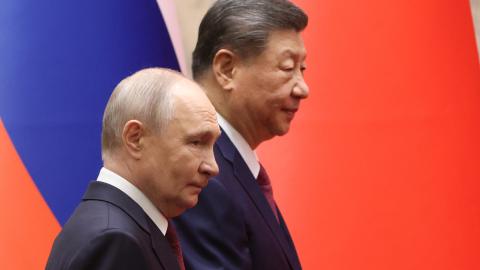












In this week’s episode of China Insider, Miles Yu reviews last week’s Donald Trump–Xi Jinping summit, and details the key highlights from the second dialogue between the two leaders this year. Next, Miles takes a closer look at United States–Japan relations following last week’s summit, and China’s emerging narrative against Japan. Finally, he follows up on China’s intensifying internal purges amidst continued economic slowdown, and what we can expect from the upcoming slate of purges at China’s fifth plenary meeting.
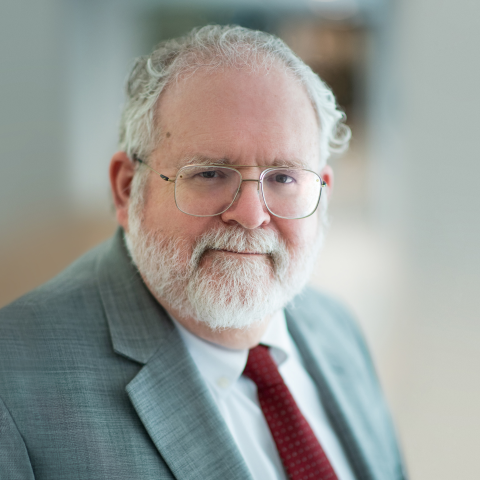
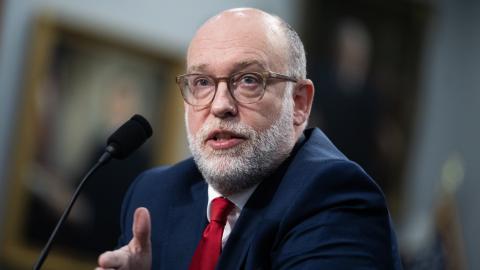
China Insider is a weekly podcast project from Hudson Institute’s China Center, hosted by China Center Director and Senior Fellow, Dr. Miles Yu, who provides weekly news that mainstream American outlets often miss, as well as in-depth commentary and analysis on the China challenge and the free world’s future.
Episode Transcript
This transcription is automatically generated and edited lightly for accuracy. Please excuse any errors.
Miles Yu:
Welcome to China Insider, a podcast from the Hudson Institute's China Center. I am Miles Yu, senior fellow and director of the China Center. Join me each week for our analysis of the major events concerning China, China threat, and their implications to the US and beyond.
Colin Tessier-Kay:
It's Tuesday, September 29th, and we have three topics this week. First, we circle back following the Trump-Xi Summit from last week and detail the outcomes and key highlights from the second dialogue between the two leaders this year. Next, we take a closer look at Japan following last week's summit and China's emerging narrative, including the status of US-Japan relations and the US's role in Asia. Finally, we follow up on China's intensifying internal purges amidst continued economic slowdown and what to expect from the upcoming slate of purges at China's fifth plenary meeting. But first, a quick celebratory note as this is the 200th episode of China Insider, and I just wanted to say congratulations to Miles for the milestone and continued success on the next 200 weekly conversations. Miles, how are you doing this week?
Miles Yu:
This was very good. I feel equally robust about this 200th episode, which is very good. I think [this] testifies to the resilience that we have and also to the continuous support from our listeners. I get a lot of feedback from people on a weekly basis. Well, thank you very much, and thank you for your support.
Colin Tessier-Kay:
Here, here, and cheers to you, and cheers to our listeners, and thank you for being with us for the 200 milestone, and we hope to have you with us for the next 200 more. So we jump right in. Up first today, we start with last week's summit between Presidents Trump and Xi and follow up on our conversation from last week. This was the second meeting this year between the leaders, following Trump's visit to Beijing back in May, and potentially additional meetings still technically yet to be confirmed later this year in Shenzhen at APEC and on the sidelines of the G20 Leaders' Summit in Miami. Miles, we spoke about several potential topics of discussion last week, [such as] trade, the Iran war, Taiwan. What were the key highlights from last week's meeting, and did the leaders manage to make progress or produce any outcomes on the trade relationship?
Miles Yu:
Well, there have been a lot of reports and analysis and feedback about the Trump-Xi summit in Washington, DC. It has almost become what we call a media event. In other words, the event itself really overshadows the substance of what the event was trying to accomplish. So it's very heavy on optics. On substance, very little. By the way, there's no joint statement; there is nothing signed as there was before between China and the United States. The United States-China relationship is always going through this kind of cyclical movement. In other words, people say there's progress, but it's progress without accomplishments.
The two countries constantly are engaged in a game of lion and fox. So they try to outsmart each other and outpower each other. This is no exception, despite all this hoopla, all this hospitality. So you might say it is a strategic stabilization without strategic reconciliation because the two nations have fundamentally incompatible visions for what world affairs are supposed to be. So that's my sort of overall take. On specifics... a Voice of America reporter put it to me very nicely. She said that there are four T's that are the essence of this US-China dialogue. One is trade; that's one T. Second is Taiwan, and then there's Tehran, that's Iran. And then there's technology, which is something new emerging after the May Trump-Xi meeting in Beijing, particularly during this rapid surge of AI in our daily life. So on trade, there was basically nothing new there.
Xi Jinping came to Washington to beg Trump to extend this tariff ceasefire that was imposed on China in May, and that ceasefire was supposed to expire on November 10th. So Trump was willing to give in a little bit. He gave China two months, until January 10th. President Trump's major argument is that China agreed to a lot of things, but they have not really implemented [any of those things]. So he gave a two-month grace period for China to behave, to fulfill its promises of continuous rare earth and critical mineral exports to the United States, and also to purchase a certain amount of American agricultural goods, as well as change its conditions so that Americans would have easier access to the Chinese market. None of that actually has become a reality. So this is one of the reasons why this talk is actually very brief. There was 90 minutes one-on-one, and then you add the interpretation time, which probably takes half of the time, and then you've got 45 minutes. That's far less time between the two, one-on-one, than the one-on-one between President Trump and the Japanese Prime Minister Takaichi the day before the Xi-Trump meeting, and afterwards, Trump's briefing to Prime Minister Takaichi right after Xi Jinping left town, which I'll talk about a little bit later.
In the end, I think we had a good party there. There was a lot of music playing, and the music was very, very interesting; I'll elaborate a little bit. There are a lot of very interesting tidbits there.
Ultimately, there's a fifth T that was a result: Truce. The ceasefire continues for two more months. I don't think there was any strategic issue resolved at all. It was just, "everybody, have a good time and party." But hey, it's Washington, DC. It's party time.
Colin Tessier-Kay:
That's a good point. And yeah, the two biggest outcomes seem to be, from this meeting at least, given its brevity, the fact that they were able to reach an extension on the trade truce and the moratorium on the export controls, as well as just a general stabilization of the relationship and continued conversations going forward. It was interesting too, leading up to the meeting, Secretary Bessent and US Trade Representative Jamieson Greer met with their counterparts in New York. They announced a framework for the Board of Trade mechanism specifically, which was something that came up back during the May meeting in Beijing. They mentioned progress on measurable trade in non-sensitive sectors. Following the summit, both sides said they reached consensus on lowering tariffs for, I believe, a $60 billion batch of non-sensitive goods. There wasn't a timeline for adoption, as you mentioned. And at the same time, the deadline for the broader trade accord was pushed into next year.
In general, Miles, do you think there should be any concern for the lack of movement on this front ahead of the midterm elections in the US for Trump?
Miles Yu:
I don't think there's anything [concerning the] midterm. China is basically, for [political discourse in] the United States, a dead horse. You don't beat the dead horse on issues like trade. I think... The funny thing is, you mentioned those numbers, right? That's basic American language. The White House put out the readout after the summit, and Washington, DC spoke an entirely different language: the language of numbers, deadlines, and implementations. You mentioned the January 10th deadline, this extension of two months of a ceasefire in tariffs. And China agreed to buy at least $17 billion worth annually in American agricultural purchases, mostly soybeans, and also restore market access for American beef and poultry — very specific. And 10 million metric tons of American coal for both 2027 and 2028, the next two years. And there was a tariff treatment for about $30 billion in goods in each direction and the concrete delivery of rare earth and critical minerals.
Now Xi Jinping and none of China's ministries actually have any mention of these kinds of special numbers. So, the Chinese spoke in the language of abstraction, peaceful coexistence, and the perennially disingenuous promise of win-win relations. So it's all very... kind of hot air. Americans are very concrete. Chinese are very abstract. So that is very interesting.
I mentioned a little earlier this pattern to this hoopla of the White House state dinner. I think the music director at the White House is a genius. Look at the pieces he chose to perform. By the way, all the performers are in the US military; they're military musicians, about 470 of them. And they performed... the most pronounced piece is from this runaway Broadway musical, Les Misérables. Now, in Les Misérables, there is a famous song called "Do You Hear the People Sing?" That song was a rousing rally for action, for defiance against repression. That song, "Do You Hear the People Sing," was literally the street anthem of 2019 and 2020 Hong Kong protesters against China. So this is very ironic: a song of protest featured in the White House as a piece of dinner music to honor the repressor of Hong Kong's freedom. There's also another piece. It's called The Moon Represents My Heart. That piece of music, everybody in the Chinese-speaking world would know, is immortalized by the Taiwanese pop star called Teresa Teng, "Deng Lijun" (鄧麗君).
Now, Teresa Teng was an international sensation. She was no ordinary singer or pop star. And Deng Lijun was a symbol of anti-communism from Taiwan. In her lifetime — she passed away a few decades ago — she was a symbol of Taiwan's resistance to communist rule. She refused to perform in China. She performed with Taiwanese soldiers, and she vocally supported the Tiananmen student protests. So to feature this piece of music in the White House dinner honoring Xi is kind of... very ironic. They performed a lot of several pieces by Puccini from his opera, Turandot, which is a Chinese-themed opera. But even that is very interesting. There's a very famous melody performed [in Turandot]. It's called "Jasmine Flowers," Moli Hua 茉莉花. Now, Moli Hua is a very old Chinese folk melody that was also incorporated into Puccini's Turandot. So if you listen to the famous opera Turandot, you will hear that piece of music called "The Jasmine Flower."
I think the subliminal message is very clear. That is, a very traditional Chinese piece of music is not related to Chinese communist music. That basically says that China is older and greater than the Chinese Communist Party. All these kinds of very subliminal digs, I think, are pretty telling to me.
Colin Tessier-Kay:
Yeah, that's certainly an interesting tip to note. And before we turn our focus to Japan here, there's a little bit more to the political pageantry. I'm keen to get your take on some of this because it's been interesting to track China's state media reporting on the summit since last week as well as most outlets seem to focus on, or at least are playing up, the notable welcome that Trump provided Xi on his arrival at the airport. They were keen to point out he was the first president to do so with a foreign leader since Kennedy, and the first, including a non-state leader, in 11 years. I think the most recent was the Pope's visit back in 2015. For the state dinner, the Chinese state media is further mentioning Trump's comments about how both he and Xi had never gotten along better. And the media has taken this as a domestic showcase to further Xi Jinping's status as a global diplomat and leader on par with great powers.
So Miles, what did you make of China's domestic messaging following the summit and any particular rhetoric that stood out to you as meaningful?
Miles Yu:
First of all, China's domestic rhetoric is purely 100% official. The Global Times, Xinhua, and the People's Daily, they all speak with the same tone. So it's not really that surprising. They say the US and China, jointly, are the keepers of the post-World War II international order. This is pure nonsense. China is the biggest interrupter of the post-World War II international order. On the other hand, Japan has been completely transformed into a peace-loving, law-abiding, active participant in international affairs. You might say that, in the Indo-Pacific region alone, the United States and Japan are the biggest players keeping the Indo-Pacific free and open. China is the opposite. It's very ironic to say that. By the way, as I mentioned earlier, China tried to split the United States-Japan alliance. It's always in a very comical way, which we'll talk about in the next segment. But I heard that just during the summit, Xi Jinping was taken by President Trump to the National Archives on 7th and Pennsylvania, which is not far from our broadcasting site here at Hudson.
He was shown, of course, the Constitution of the United States, the Declaration of Independence, the Bill of Rights, those foundational documents that make America a democracy. But among these displayed documents was also... there's a very peculiar treaty. It's called the 1951 San Francisco Peace Treaty. That was a treaty Japan signed with virtually every other country involved in the Asia-Pacific during World War II to surrender and to settle. What Japan settled was something entirely different: Taiwan.
Japan, in that treaty, gave up all its claims over Taiwan, but it did not give sovereignty [over Taiwan] back to China. Now, this is Communist China; this is 1951. So Communist China has already been established for more than two years. So this is the reason why all these signatories of the San Francisco Peace Treaty of 1951, including the United States and Japan, believe that Taiwan's status is unsettled by that treaty. This was the official line of the Japanese government because it did not give Taiwanese sovereignty back to China. Communist China utterly rejected the legitimacy of the 1951 San Francisco Peace Treaty. So for President Trump to show Xi Jinping this treaty... it is actually a very, very interesting point to make.
Colin Tessier-Kay:
Yeah, that is an interesting point there. And I think it's actually a perfect segue into the topic that we want to focus on here in Japan because... a little bit more to the backdrop. There's a particular element of the summit involving China's evolving Japan narrative that you touched upon, Miles, and US-Japan relations more broadly. At the summit, the following remarks by both President Trump and Xi have raised some concerns in Tokyo. Both leaders spoke to a shared history in World War II as allied partners with common interests, with Xi in particular continuing the notion at the state dinner, mentioning how they together fought shoulder-to-shoulder against Japanese militarist aggressors. The White House fact sheet, published on Saturday, further acknowledged that the US and China agreed to build a constructive relationship of strategic stability on the basis of respect, fairness, and reciprocity, citing the historical significance of the relationship.
Thus far, US-Japan relations remain strong. There hasn't been any real shift in the bilateral dialogue. There was a phone call between Takaichi and Trump following the summit, but there are some growing concerns in Tokyo surrounding this development. So Miles, help us unpack these developments and comments from the summit. How does this fit into China's Japan narrative?
Miles Yu:
Well, as I say, President Trump took the US-Japan relationship very, very seriously, and he believed Japan is the best partner of the United States in Asia-Pacific, period. President Trump and Japanese Prime Minister Takaichi got along famously well. As I mentioned earlier, the two met in New York during the UN General Assembly Conference just the day before Xi Jinping landed at Andrews Air Force Base. After Xi Jinping departed, the first foreign leader President Trump called was the Prime Minister of Japan. And he briefed her on the summit, and Prime Minister Takaichi wrote on her own social media accounts that President Trump, "Dear Donald," explained to her what went on at the summit. You don't get that kind of treatment if China succeeded, so I don't think Xi Jinping really succeeded. Now you talk about the narratives by the Chinese.
The Chinese narrative regarding Japan is completely ludicrous and also very, very silly. It's unconvincing at all, to be very, very charitable here. First of all, Xi Jinping said, "You know, the US and China fought a common enemy during World War II against Japan." True, but it was not the Chinese Communist Party. As a matter of fact, the Chinese Communist Party was very passive. They played virtually no significant role at all in the defeat of Japan. On the other hand, China may be, actually, the reason why Japan was partially successful in invading China in the first place, because it has something to do with the Soviet Union. The Chinese Communist Party listened to the Soviet Union, and Stalin was in charge. And throughout the whole war, the Soviet Union and Japan had the neutrality treaty, which was signed in April 1941. And that's why... the Chinese Communist Party very actively participating in the war against Japan in China would basically violate the Soviet peace neutrality pact with Japan.
And there are a lot of cables going back and forth between Mao's office in this Northern Chinese province of Shaanxi and Moscow. There are a lot of documents over there. See, I'm a historian of World War II, so I wrote a couple books about this. Nevertheless, this World War II narrative is kind of false. It's disingenuous, to say the least, because the credit should be given to the Nationalist-led Chinese government at the time. The invocation of the Flying Tigers is even more ridiculous. The Flying Tigers in China was [called so] before the war, before Pearl Harbor. After the war, after Pearl Harbor, [its name] was changed to the 14th Air Force of the United States Army Air Corps. And the 14th Air Force was led by a major general named Claire Chennault. Chennault was an ardent anti-communist. So this is very, very bizarre for the Chinese Communist Party to claim the credit of fighting Japan with the United States during World War II.
Secondly, the Chinese major narrative about Japan today, 2026, is that in Japan, there is a resurgence of militarism. This is absolutely crazy. This is absolutely just nonsense. Japan is one of the most peace-loving countries in the world for the last 70-plus years. Not a single shot was fired by Japan, anywhere at all. The Japanese constitution prohibited Japan from becoming a [militaristic] strong nation, period. If you look at the resurgence of militarism, it's China. China has fast-growing military spending, and the Chinese military is the largest in the world by personnel. And China is the most aggressive in the region. There's no country more aggressive against its neighbors in the entire Indo-Pacific than China. China today has territorial contentions with say South Korea, Japan, Taiwan, of course, Malaysia, Vietnam, India, Burma, and so it goes on. So that's why I think for China to say there is a resurgence of militarism in Japan, it sounds really, really silly.
It's not convincing at all. I think people would know that. The third major Chinese narrative about Japan is that it is the US and China, Communist China, who are leading the post-World War II international order. As I said earlier, this is also sheer nonsense because China is not a contributor to the post-World War II order led by the United States. China, on the other hand, is a destroyer and interrupter of that. All these three major narratives regarding Japan from Beijing are totally false, and I don't think it's going to be very, very successful. It makes China look ridiculous.
Colin Tessier-Kay:
Yeah, that's a good way to put it. And I think it'll be interesting to track to see how the relationship develops from here, as there's already been bilateral dialogue between the US and Japan, as you noted, to reaffirm the bilateral relationship going forward. But we shift to our final topic today as we follow up on another story that we've been tracking on China Insider related to Xi's ongoing purge campaign. The latest development surrounds the expulsions of General Zhang Youxia 張又俠 and longtime Xi ally General Liu Zhenli 劉振立 for alleged corruption and disloyalty, among several other mid-level and non-PLA purges. These actions have left only one active general, Zhang Shengmin 張升民, serving alongside Xi on the top military command body, which has now reduced the once-seven members of the CMC to now effectively just the two of them. This has caused concerns about the PLA's operational capacity and effectiveness as China positions itself for competition in the Indo-Pacific, while simultaneously, on the domestic front, China still faces significant economic challenges and is reportedly slated to dismiss even more significant numbers of CCP party members at the upcoming party plenum in October.
So Miles, with where things stand and where they're at in Xi's purge campaign, what has the impact been like on both China's military and economic capacity?
Miles Yu:
Well, the impact on the Chinese military is obvious. The entire high command has been decimated. There's no chain of command. Xi Jinping is the only one who is calling the shots. So there are no operational experts in his immediate circle. I mean, Zhang Youxia was a Politburo member, which is very high. He was a vice chairman of the Central Military Commission, which is the highest command authority in all of China. And General Zhang himself was the highest-ranking uniformed military officer. He was immediately below Xi Jinping in the military hierarchy. He's gone and you see there's no particular military figure in charge of the entire military. So the command is, to be very charitable, paralyzed. And General Liu Zhengli was also purged, officially expelled. These two people got in trouble last year, but now they're officially expelled from the Party, which is a very serious deal in China.
He was the equivalent of the Chairman of the Joint Chiefs in the United States. He was the Chief of the Joint Staff Department. This is a very high-ranking official. The charge against these two gentlemen, officially now, is that they committed the crime of deviation from the Party. You see, this is all very ideological. And also, they charged him with "forming cliques and factions," 搞團團伙伙. This is actually Xi Jinping's favorite phrase; this just sounds like him. [This was] because they are showing disloyalty and dishonesty to the Party. Well, who is the Party? Well, Party Secretary-General Xi Jinping himself, because he's the chairman of everything. And also, they were charged with violating political and organizational discipline. Now this is very interesting. This, I think, is a euphemism for their alleged collusion with a foreign agent. That's very serious: political and organizational discipline. [Other charges include] manipulating promotions, and accepting bribes, and all that kind of stuff.
But nothing is specific. They just say they accepted enormous sums of money. How much is enormous? So it's very, very hard to say. This is all kind of a very typical CCP purge thing. Now, there is also, very interesting, while all this is going on, there are two other issues that were very important in China last week. One is the large number of provincial mid-level Chinese Communist Party officials that were purged too. And this is actually very, very important. At the same time, the Chinese National Bureau of Statistics released a bunch of statistics about the Chinese economy, which is pretty grim, which is interesting. China, now, is on a binge of purges: political purges and military purges. In the meantime, its economy is getting worse. This is not just foreigners' guesswork. It's from the statistics provided by the Chinese National Bureau of Statistics.
According to this report from the Chinese official statistical bureau, from January to August this year, China's private investment went down by a staggering more than 10%. And its real estate development investment continued to go downhill. It dropped from January to August by 19.9%, let’s say 20%. That's an enormous drop. New sales of new homes dropped by 12%, and new home sales in terms of value dropped by 13%. So those numbers were pretty devastating.
Now, one interesting number, another one is unemployment. Unemployment: China says overall it's pretty low. It's single-digit, but the youth unemployment, according to China's official National Bureau of Statistics, is hovering around 18 to 19%. That's pretty high, but that's fake because economists from various universities, from overseas, foreign economists, estimate that the real unemployment among youths, people aged between 16 and 24, is hovering at about 50%, half of the nation.
So this is a time bomb. So that's why it's a pretty grim situation. In the meantime, you contrast that with this fancy state dinner in the White House, when at home, China basically is terrible...it's a very messy situation.
Colin Tessier-Kay:
Well, that brings us to our time for this week's conversation. Thank you, as always, to our listeners, and thank you, Miles, for your insight and expertise in this week's conversation. We'll check back in with you again next week.
Miles Yu:
Thank you very much. I'm looking forward to being with you again next week.