














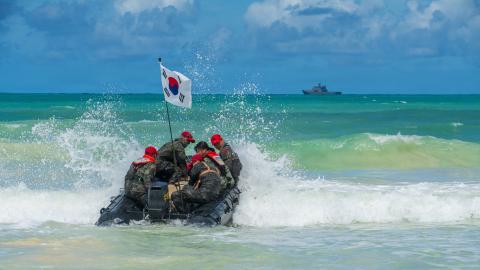
Confusing adversaries and allies is a basic foreign policy mistake. Leveraging enemies to attack friends is a deeper failure. President Trump committed both errors on Sunday when he announced that he was ordering the Pentagon to “substantially reduce the Joint Military Exercises” with South Korea. According to his post on social media, the president’s justifications were his “very good relationship” with Pyongyang’s dictator Kim Jong-un, and Seoul’s failure to help Washington in its war with Tehran.
Trump’s explanation contradicts his dismissal of Seoul five months ago: “WE NEVER DID” need South Korea’s help to reopen the Strait of Hormuz. Nor did America, in Trump’s telling, need anyone’s help. Now, months later, the president is revisiting a gambit he played in his first term: scaling down joint exercises with Seoul, apparently as an olive branch to Kim.
Trump may have legitimate reasons to be frustrated with South Korea. The liberal party in Seoul has an established track record of engagement with China, and has actively sought to weaken American sanctions on North Korea in years past. We should expect allies to act as allies.
It is equally true that America’s partners should expect the global hegemony to act predictably in its own interests. Regardless of Seoul’s behavior, Washington benefits when Pyongyang is hemmed in and deterred from adventurism and belligerence. More broadly, America’s interests demand that North Korea never unify the peninsula. For these reasons alone, military exercises with South Korea should persist.
Trump’s idiosyncratic view of international relations risks unwittingly empowering America’s enemies. To be sure, Kim is delighted by any indication of American weakness, and will move to exploit any daylight between Washington and Seoul. Of greater import is how Pyongyang’s northern neighbor views this move.
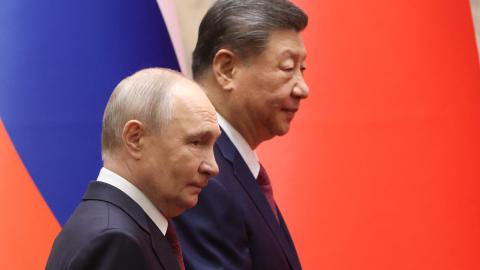
Xi Jinping has had ample opportunity to take the measure of Donald Trump. His first interaction with the president in 2017 consisted of Trump temporarily leaving the dining hall in Mar-a-Lago to order a strike on Syria. Trump’s choreographed bravado signaled strength and resolve to Xi, as did the president’s successful operation against Nicholas Maduro in his second term.
But Xi has also witnessed Trump’s fundamental rejection of traditional categories for America’s friends and enemies. Trump has accused Volodymyr Zelensky of starting the war with Russia. He heard Trump scold Taiwan earlier this year as he left Beijing, insisting that Taipei lower the temperature with China. He also took note of Trump’s delay of arms sales to Taiwan. And, of course, the whole world witnessed Trump’s repeated attempts last year to downgrade America’s alliance with South Korea.
Confusing allies and adversaries risks misallocating trust and threats, like a chef mistaking sugar for salt. Trump needs to maintain deterrence in East Asia. Two wars are already raging in Eastern Europe and the Middle East. In response to the latter, the Pentagon recently redeployed the USS George Washington from the Indo-Pacific to the Persian Gulf to relieve the USS Abraham Lincoln. No carriers are now in or near East Asia. Compounding this capability shortfall is the drawdown of Tomahawk missiles and other standoff platforms the Pentagon would need in a China scenario. Trump is coupling a numbers problem with a judgment problem.
These intersecting trends present Xi, and any other anti-American despot, with an easy response: follow Kim’s lead. Convince Trump that you’re “unthreatening and respectful,” and reap the windfall of unilateral concessions from America. As a bonus, the administration in Washington may blame America’s allies for being “hostile.” Trump already fell into these patterns with Taiwan earlier this summer. Xi will likely seek to pull the president further down this road.
To a point, the president’s frustrations with allies are understandable. More than any of his predecessors, Trump has called on America’s partners to do their part and contribute to their own security. For that, he deserves great credit. But nixing readiness exercises on the Korean Peninsula, with nuclear table stakes, smacks of poor judgment and misplaced optimism in the president’s own ability to untangle intractable challenges that go back to 1950. Ignoring the historical roots of the present is a quick ticket to catastrophe. The challenge of North Korea isn’t the lack of dealmaking presidents or petulant partners in Seoul, but Pyongyang’s Communist ideology, Washington’s failure to prevent its nuclearization, and haphazard policies that have oscillated from confrontation to conciliation.
Trump is unknowingly playing into that perverse pattern. By doing so, he is projecting weakness to Kim Jong-un’s northern neighbor and East Asia’s most powerful dictator. Canceling military exercises with South Korea is likely unfinished business from Trump’s first term. The day may come when the president sees the wisdom of his former advisors who counseled against doing so.