

















Good news is hard-fought and hard-won in the field of human rights. Whenever people ask about my time on Capitol Hill, my answer is always the same: you never forget the legislation you drafted that passed into law, and you never forget the political prisoners you fought to free — especially the ones who ultimately died in captivity. Those memories haunt me still, not only because of their tragic fate, but because of officials and staffers who perversely subordinated advocacy for prisoners to cooperation with their captors. (For those interested in the backstory here, I wrote about this in chapter six of Countering China’s Great Game.)
Even so, earlier this month the United States achieved a significant victory: the release of Pastor Jin “Ezra” Mingri from the People’s Republic of China (PRC). Beijing dropped all charges against the Christian minister, and he is reunited with his family in America. These developments transpired on the eve of Independence Day and crystallized our nation’s heritage and character on its 250th anniversary.
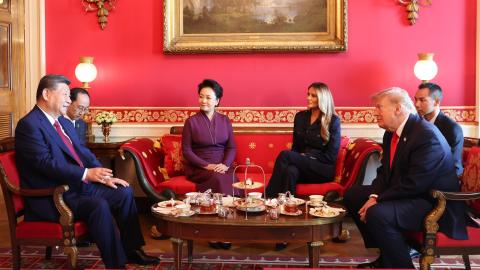
The speed with which Xi Jinping responded to President Donald Trump’s request mere months ago should not be lost on anyone. The episode should serve as a blueprint for policymakers concerned about the Chinese Communist Party (CCP) and the threat it poses to free societies. The party has feared the Chinese people for nearly 80 years because it lacks an internal source of political legitimacy. Since the days of Mao Zedong, the CCP has curtailed religious freedom and persecuted believers of various faiths because it cannot abide a higher authority or alternate source of truth. Totalitarian regimes fear the very things democracies value. It is not without reason that many more prisoners languish in China, among them Jimmy Lai, Gulshan Abbas, and eight of Pastor Jin’s fellow leaders at Zion Church.
For Christians, something deeper is at play. We believe that God is sovereign over all and working out His plans. At times, God uses the kingdoms of this earth to accomplish His purposes. The books of Daniel and Jeremiah in Scripture speak vividly of nations and leaders as instruments of judgment and combatants in spiritual warfare. But God also moves beneath the surface of great power competition and international politics. Consider the war described in Genesis 14 between nine different armies, five arrayed against four. It was the climax of an imperial conquest to crush rebellious colonies, and the final battle took place at the modern-day Dead Sea in Israel. The Mesopotamian kings slaughtered the rebels, plundered their cities, and took their people as captives. Among them was Lot, Abram’s nephew. Upon hearing the news, Abram led a small unit of 318 men, flanked the recently victorious armies in a nighttime raid, and rescued his family.
Christians are called to be the first responders at the fault lines of foreign policy. When great powers clash, vulnerable people slip through the shifting cracks. Like Abram, followers of Jesus respond to geopolitical instability by praying and advocating for these souls. Policymakers often treat human rights as a sideshow to more important considerations like trade flows, technology transfers, and the military balance. Such thinking reflects a lack of strategic creativity, but it also suggests a moral deficit. Political prisoners may complicate diplomatic agendas, but they are central to God’s agenda.
If America’s leaders embrace this truth in their advocacy for “the least of these,” even if it comes at a cost, they will discover a new kind of wealth, what former Ambassador Sam Brownback has called “spiritual capital.” Religious liberty redounds to the economic and social benefit of society, and it keeps foreign policy within moral bounds that contribute to national security. Is it wise to increase economic exposure to a Leninist regime that imprisons people of faith? Do these dependencies pressure policymakers to overlook and trade away the very values that make America what she is? Christians should be first to raise these questions and sound the alarm whenever any in Washington argue that the price of recovering political prisoners is too high. It didn’t stop Abram, and it shouldn’t stop us.
Meeting Pastor Jin shortly after his release will rank as one of the greatest privileges of my time in Washington. His freedom is good news that goes beyond headlines. It is the gospel incarnate: prisoners set free, the lost found, the ransomed redeemed. Advocating for political prisoners is geopolitically savvy because it is morally upright. The Trump administration should lean into this work with focus and fervor, and Christians should lead the way.