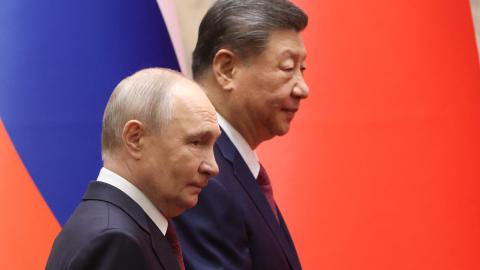





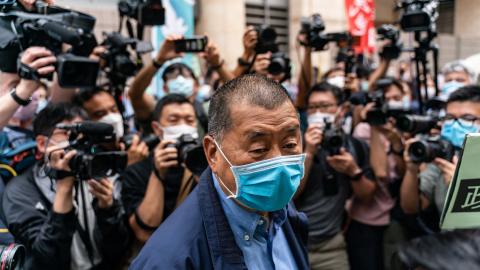
At the China summit in May, President Donald Trump asked Chinese Communist Party Secretary General Xi Jinping to release prisoners of conscience pastor Ezra Jin and Jimmy Lai. Only one of them, Jin, the founding head of China’s large evangelical Zion Church, was subsequently freed.
Trump said Xi, who is also China’s president, told him it would be “tough” to free Lai, the independent press founder who is serving a 20-year sentence for pro-democracy advocacy in Hong Kong. Our president should recognize that under China’s communist party system, these cases are only as tough as Xi makes them. The two heads of state are to meet again in September, in Washington, giving the president another shot at freeing Lai.
U.S. State Department officials call Jin’s release “unprecedented,” and the pastor himself told me it was a “miracle.” Typically, China grants diplomatic requests for a prisoner’s release when there’s a prisoner exchange or when the prisoner is very ill. Nobel Peace Laureate Liu Xiaobo, for example, died of cancer within weeks of receiving medical parole in 2017. Trump deserves much credit for rescuing Jin.
Because of Trump’s direct intervention, Xi ordered prison authorities on July 3 to have the pastor change out of his prison garb and taken from his crowded cell in Beihai’s detention center where he had been since his arrest last October. A large contingent of police put him on a train and filled the other seats of his train car to prevent any contact with the public. Jin understandably thought he was being transferred to a secret place of detention. Instead, he was put on an Air China flight to Los Angeles. After the plane door closed, the person seated next to him introduced himself as a U.S. consular official. He informed the pastor that when they landed, he would be a free man. Within hours, he and his jubilant family were reunited, and, giving praise to God, watched a Fourth of July fireworks display.
Last week, I attended a welcome party in Washington for Jin, where everyone was moved to hear about his ordeal and share in the joy of his family — his wife Anna Liu, daughter Grace, and son-in-law Bill Drexel, a Hudson Institute colleague. Prior to his release, they had not seen him for eight years.
The celebration also honored the pastor’s fearless defense of religious freedom. For years, Jin has resisted government pressure to incorporate Zion Church into the Three-Self Patriotic Movement, the CCP’s United Front group through which the party exerts control over Protestant churches. Zion’s unregistered church network grew to be among China’s largest with thousands of members in 40 cities. It is part of the tens-of-millions-strong Christian underground, among China’s few remaining independent civic society organizations. In 2018, after Jin refused to allow facial recognition cameras inside his church, the government confiscated Zion’s properties. He then used the internet to preach until his arrest last year for “illegal business operations.” He faced years in prison, apparently for posting his sermons online, which he told me were Scripture-based and strictly apolitical.
Jimmy Lai shares important similarities with Jin. He, too, was a prominent leader in his sphere of civic society, having taken peaceful, selfless stands to preserve freedom and democracy in Hong Kong. He is also a committed Christian as a lay Catholic leader, even generously funding the rebuilding of mainland Catholic churches that Mao Zedong desecrated. By placing God above all, and prioritizing biblical teachings over the sayings of Mao and Xi, both defied the CCP’s goal to monopolize ideology in China.
The difference between the two cases, we’re to believe, is that Lai was already convicted, albeit under Hong Kong’s vague national security law, by a court boasting a 100 percent conviction record, whereas Jin had not yet been tried. By calling Lai’s case “tough,” Xi implies that his hands are tied by Hong Kong’s separate governing system and independent judiciary. Yet, in 2020, Xi directed the CCP’s imposition of the security law in Hong Kong for the precise purpose of tightening CCP control over the island’s democratic institutions and curbing political free speech. The notion that he lacks the power to pardon Lai is laughable — he himself consolidated these powers.
As a key leader of the still vigorous Christian underground, Jin was no less threatening to the CCP than Lai, whose Hong Kong pro-democracy cause and media empire the CCP has already dismantled. New reports estimate that China has arrested more than 10,000 Christians over the last decade, including hundreds just before last Christmas. Its other tactics to repress Christianity include bulldozing thousands of churches, banning children from all churches, and rewriting the Bible. The CCP spent a year planning Jin’s arrest, his daughter Grace told me, and rounded up 27 other Zion leaders, eight of whom remain incarcerated. It has shuttered Zion churches and prohibits its services from going remote. Jin’s family said that, in Washington, they believe they were under CCP surveillance, their car’s tires were slashed while parked in their garage, and Chinese police called them with threats. For the CCP, the pastor was clearly a big fish despite not engaging in political issues.
Xi likely saw a political advantage in choosing the pastor for release. He is hoping it will induce complacency among American evangelicals at a time when China is cracking down on the Christian underground. A favored CCP text teaches that “a rising power should induce complacency in the old hegemon until the right moment,” as CCP expert Michael Pillsbury wrote. Releasing him on America’s 250th birthday was a nice touch.
President Trump should press Xi again to free Jimmy Lai. Determining who is imprisoned and who goes free is all part of a day’s work for the CCP secretary general. And rescuing China’s persecuted is undoubtedly important to American interests.