







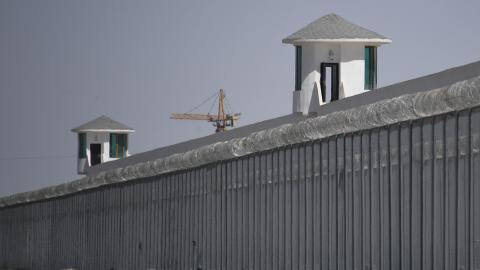
I will never forget the story of Mihrigul Tursun. At just a few months postpartum, Mihrigul had her triplets torn from her arms by the Chinese Communist Party and was interned in a reeducation camp simply because she is a Uyghur. She spent months at the camp, where she was subjected to various forms of torture. Upon her release, she begged to be reunited with her children and found that they were all hospitalized. What should have been a moment of relief turned quickly to horror. She was reunited with two of her three babies. Her third, a baby boy, she never saw alive again. She held his lifeless body and will likely never know how he died.
Mihrigul’s is but one of the many stories that Sam Brownback — former U.S. ambassador for international religious freedom who previously served as Kansas governor, senator, and representative — recounts in his latest book, China’s War on Faith. It is an intimate look into how the CCP violates personal freedoms of religion or belief. Rather than share a litany of facts about the CCP’s repression of its own people, Brownback allows individuals’ stories to speak for themselves. The picture they paint is one of a systematic war against people of all faiths. As my friend Frances Hui, a pro-democracy advocate from Hong Kong, says: “This is what authoritarianism does. . . . It strips away your power and your freedom — to think, to speak, to express yourself. It makes you feel powerless in every part of your life. Eventually, it tries to erase the parts of you that define who you are.”
The ability to worship freely is a sacred right, one the CCP distorts for its own purposes. Xi Jinping, in particular, intensified the persecution of people of all faiths through his campaign of Sinicization, effectively secularizing religious practice and making religion subservient to the party. If a Christian pastor can preach only a Gospel that advances the goals of the CCP, that is no Gospel at all. If a Muslim is banned from praying five times a day or wearing a head covering, that is hardly the practice of Islam. If the CCP appoints the Dalai Lama’s successor instead of following the traditional Tibetan rituals, the result is not Tibetan Buddhism.
That the CCP seeks to mold religious practice in its own image is an inherent violation of religious freedom. The stories in China’s War on Faith demonstrate this reality with clarity and poignancy. Every story featured is one of bravery. Each individual undertook immense personal risk to continue to practice his or her faith and share it with others.
Pastor Wang Yi, for example, is a bold advocate of the Gospel and preaches it with such purity that he called out Xi directly for being a sinner in need of a savior. Brownback recounts how Wang Yi, knowing that his boldness would likely cost him, spent months putting on weight expecting to lose it in prison. He also spent his spare time memorizing Scripture and hymns, knowing that he would likely be denied a Bible while behind bars. He was right. On December 9, 2018, he was detained. A year later, he was sentenced to nine years in prison for “inciting subversion of state power” and “illegal business activities.” He has two years left to serve. The church he led, Early Rain Covenant Church, released a statement after his detention, saying, “Without courage there is no love.”
Brownback is ecumenical in his coverage of the faith crisis in China. He covers the devotion of Protestant and Catholics Christians, Tibetan Buddhists, Falun Gong, and Uyghur Muslims. Each group has its own story of courage worthy of remembrance; each reminds us of the centrality of religious freedom. In his work as the ambassador for international religious freedom during President Donald Trump’s first term, Brownback sought to fundamentally transform U.S. foreign policy by making religious freedom a priority. He still does. Toward the end of the book, Brownback discusses what the U.S. can do today. He recommends, among other things, that the U.S. link progress on religious freedom to future trade deals with China: an apt suggestion for the Trump administration ahead of Xi’s upcoming visit to Washington.
Although China’s War on Faith focuses primarily on amplifying the voices and telling the stories of brave individuals across China, readers are also left with an impression of Brownback’s own profound faith. The author emphasizes individual power and perseverance, but there’s something more — a humility, a recognition that without Providence, there is no freedom. That Brownback chooses to end the book by giving glory to God is no accident: “God will play the lead role, but He won’t do it alone. We must each do our part, like the heroes I profiled have done theirs.”