











For a long time, Islamist rhetoric in Morocco has painted Europe as a kind of promised land, a place where welfare never runs out, chances are everywhere and prosperity comes easily. The objective has been to weaken trust in Morocco’s institutions and steer young people towards leaving.
Those currents have held power after the 2011 constitutional reforms tied to the Arab Spring. Their time in government produced a sluggish economy, unfulfilled promises and a public that steadily lost faith. Since then the pitch has barely changed. The same refrains keep coming back, while Morocco is framed as a failed state. Young Moroccans are urged towards jihad and a permanent stance of confrontation with the West. Year after year, the effort has been to drain the spirit out of an entire generation, to sell them on one bleak claim above all: their country has no future.
Whatever Morocco’s problems, the country is not collapsing. There is no war, no state failure, no institutional breakdown. Development is still moving through some of the biggest infrastructure and industrial efforts in modern Moroccan history.
The same ideological current also pushes a claim that Morocco is trying to “reclaim Muslim land” via Ceuta and Melilla. In reality, no Moroccan government has expressed such a demand to the UN. A Moroccan Islamist leader has argued publicly that the country “must eventually regain control of Ceuta and Melilla”.
By projecting that position on to the state, while brushing aside official statements and practice, Islamist activists manufacture a thin appearance of legitimacy for a campaign that aims to weaken state authority and amplify the message online for global support. Morocco’s ties with Israel and the US then get turned into a weapon as well, presented as proof that the government itself lacks legitimacy.
Morocco remains a developing country. Real social and economic difficulties persist. Still, describing the country as hopeless helps no one. In practice, that narrative mainly benefits two groups: people looking to justify illegal migration and those trying to strip the Moroccan state of legitimacy.
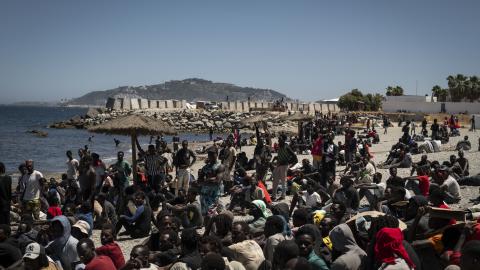
Contrary to the conspiracy talk that spreads online, Morocco gains nothing from uncontrolled crossings. What recently has happened looks far less like state orchestration and far more like online co-ordination and crowd movement. Facebook groups co-ordinated mass pushes towards the border cities while a curated stream of clips showed traffic police, whose authority extends only within narrow legal limits, alongside videos of cars and buses heading north. All of it was then repackaged into the claim that “Morocco is behind it”.
Missing from that online narrative were images of Moroccan security forces actively pushing back, deploying in Nador, Tangier and surrounding areas, and the fact Morocco itself suspended train service to slow the flow. Criminal networks sought to overwhelm the response by bribing people and urging the largest possible numbers to move simultaneously. In the end, Morocco mobilised the army across multiple cities.
The truth is that Morocco is itself under heavy migration pressure coming from the Sahel. In 2025 alone, authorities intercepted 73,640 attempted irregular crossings, and sub-Saharan nationals now account for nearly 60 per cent of foreign residents.
The chaos of recent days only worsens Morocco’s position rather than helps it: once the impression of an open or uncontrolled border spreads, it draws in even more refugees and irregular migrants, piling additional weight on to a burden that is already substantial.
Islamist voices now invert reality and accuse the Moroccan government of orchestrating the entire episode. Many non-government organisations, including those in Europe with ties to Islamist groups, have amplified the falsehood by branding Morocco a “Zionist proxy”. This ignores the fact Morocco’s position on Gaza does not favour Benjamin Netanyahu: Rabat repeatedly has condemned Israeli military operations and ceasefire violations, called for an immediate and lasting halt to the fighting, demanded unrestricted humanitarian access and insisted on a two-state solution with East Jerusalem as the capital of a Palestinian state.
The timing is also interesting: general elections are set for September and Islamist operators understand that border chaos, magnified on social media, can destabilise the incumbent narrative before the vote.
Morocco is further constrained by Spain’s policy choices under Spanish Prime Minister Pedro Sanchez. Effective migration management requires reciprocity. Morocco shoulders the burden of physical presence, patrols, interceptions and surveillance along the entire land and maritime perimeter. By contrast, Spain’s preventive spending is limited: Spain allocates roughly €60m ($98.7m) a year to measures aimed at preventing irregular arrivals while spending more than €1.8bn annually on reception and support for irregular migrants. A multi-year Spanish government plan of €711m for Ceuta and Melilla through 2026 directed the bulk of funds to education, social services and economic development, not pure border security.
This structural imbalance renders Spanish policy unsustainable as it provides more incentives to illegal crossings, not less. Morocco has no legal prerogative to extract individuals once they are inside Spanish territory, including Ceuta.
This latest episode primarily will benefit Islamists who want Europe to fail and Morocco, denounced in their rhetoric as a “Zionist” state, to fail alongside it. Every crisis that deepens polarisation, weakens European governments and reinforces the narrative of a failing Morocco advances the ideological project they have pursued for years.