











The war in Yemen, fueled by Iran’s ambitions for regional dominance, is entering a new phase. Mounting attacks from Islamic Revolutionary Guard Corps–backed Houthi forces and a Saudi-driven campaign to restore the authority of Yemen’s national government are colliding. This escalation carries significance beyond Yemen, as Tehran attempts to use the Houthi pressure on Bab al-Mandab and the Red Sea to complement its denial operations in the Strait of Hormuz, alongside its destabilization efforts targeting Gulf Arab nations.
Below, Can Kasapoğlu assesses this fast-developing situation.
An Operational Picture and Military Assessment
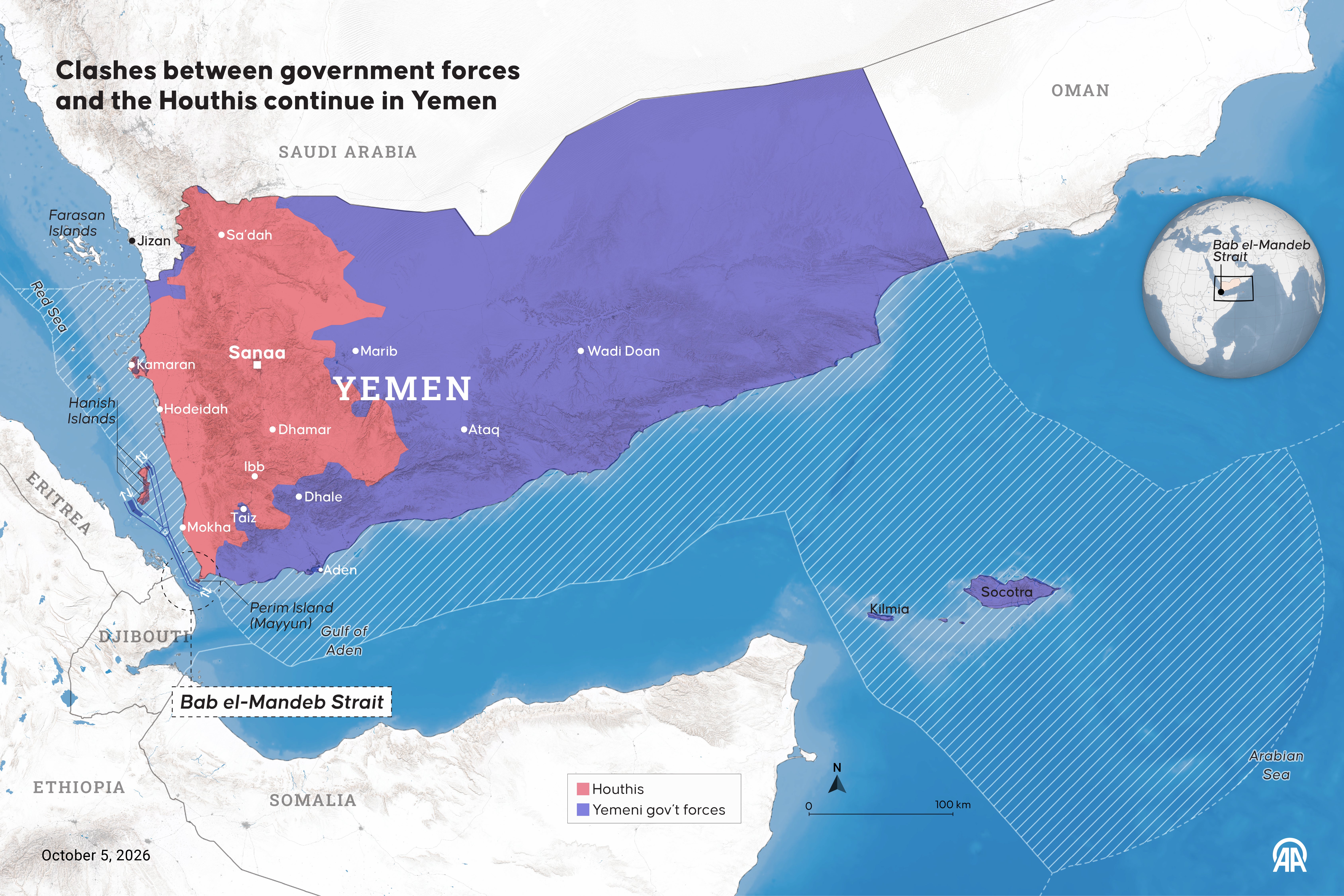
Map. Fighting in Yemen as of October 5, via Anadolu and Getty Images.
In a significant expansion of previously limited objectives, on October 5, Yemeni Presidential Council Head Rashad al-Alimi announced that government forces had launched military operations, dubbed the Dawn of Yemen, to extend state authority over the country’s remaining contested territory. The announcement came as the Kingdom of Saudi Arabia sharply intensified its strikes against Houthi targets. The strategic importance of the military action will depend on the concepts of operations (CONOPS) and the political-military decisions that the multi-actor, anti-Houthi coalition implements in the coming weeks.
As combat operations begin, the Houthis are fighting to keep the tactical initiative on the ground and prevent the collapse of their formations. Weeks after taking critical positions controlling Bab al-Mandab, the maritime chokepoint connecting the Red Sea to the Indian Ocean via the Gulf of Aden, the Houthis had been making a push for the city of Taiz when the Saudi-backed offensive was launched. The militia’s advance south of the city has even carried them onto the main road connecting Taiz to Aden, the de facto capital of the internationally recognized government of Yemen for more than a decade.
This advance has disrupted a critical connection between Taiz and government-held southern Yemen. Recent open-source footage shows Houthi fighters inside the residence of Sultan Saeed Abdullah al-Barakani, the Speaker of the House of Representatives, Yemen’s internationally recognized parliament. The pace of movement on the Taiz front underscores the intensity of the combat being waged over this crucial territory.
Yemen’s southwestern front is witnessing heavy fighting along two connected axes: the coast around Bab al-Mandab and the highlands controlling access to Taiz. On October 5, units from the anti-Houthi coalition, including the National Shield Forces and the Southern Giants Brigades, claimed that they were recapturing the Bab al-Mandab area and asserting control over territory in and around Dhubab, a strategic coastal town located on a Red Sea headland just north of the strait. These forces seek to reverse last month’s Houthi advances and expel the Iranian proxy from territory near the vital waterway.
The importance of Dhubab lies in its position along the approach to Bab al-Mandab. Control of this corridor can strengthen maritime security and threaten Houthi positions and supply routes. Even if the anti-Houthi coalition captures the contested city and its other objectives, however, its ultimate success will hinge on consolidating the positions it seizes. Another tactical flashpoint to track is Mokha. The Saudi-backed offensive claims control over the Red Sea port city, which would immensely help anti-Houthi forces secure the Bab al-Mandab coastline and the approaches to the critical maritime chokepoint. Our open-source intelligence tracking cannot independently confirm the definitive situation in the port city as of October 6, 2026. Given the current momentum, nonetheless, the anti-Houthi coalition’s tactical success would not be surprising.
Notably, an assessment of fighting in the country’s interior offers a different picture from the combat raging along the coast. As of this writing, Houthi forces continued to push to surround government troops in and around Taiz. The militia’s attacks last week damaged a culvert, rendering the Taiz-to-Aden road impassable. At the same time, on October 4, the Houthis made further advances into al-Turbah that strengthened the militia’s position there.
To support the Yemeni government’s offensive, Saudi-led forces have deployed roughly 100 aircraft and have conducted more than 320 strikes in the opening phase of the campaign. Though not a silver bullet on its own, the air component that Saudi Arabia provides is vital to the anti-Houthi effort. The Royal Saudi Air Force boasts a modernized inventory of approximately 360 frontline combat aircraft. These air warfare platforms predominately include Western fighters: F-15 Eagles, Eurofighter Typhoons, and Panavia Tornados, all of which are outfitted with precision-guided weapons and advanced electronic-warfare systems, with some variants equipped with active electronically scanned array (AESA) radar, a high-tech system that steers its radar beam electronically rather than by mechanically moving its antenna.
The Saudi Air Force, moreover, has received training from the United States and other North Atlantic Treaty Organization (NATO) members. This assistance provides the kingdom’s aircraft with logistics and maintenance capabilities that are stronger than many of its regional peers. Additionally, Riyadh possesses E-3 airborne warning and control system (AWACS) aircraft for long-range surveillance tasks and Link 16. Link 16 is a secure, jam-resistant military tactical data link network used by NATO and allied nations to share tactical information and track threats beyond the sensor range of most fighter jets. Together, Saudi Arabia’s aircraft, crews, sensors, and sustainment capabilities provide the kingdom with an integrated system that enhances its situational awareness and combat effectiveness.
But again, Saudi airpower alone can neither correct the chronic fragmentation of the anti-Houthi forces nor offer a viable replacement for effective ground warfare. Sustained success against the Houthis requires a unified command, coherent political objectives, and a concerted effort across multiple combat formations. Any military campaign needs well-defined postwar goals that shape kinetic action on the battleground. Without this foundation, even substantial battlefield momentum can prove difficult to sustain.
At this point, three defense intelligence questions loom large as the campaign takes shape:
- Are Houthi combat formations withdrawing or disintegrating? If they are withdrawing, along which lines are they pulling back?
- Where can they establish defensive lines to arrest the Saudi-backed offensive momentum?
- When will the offensive naturally culminate?
A collapse could accelerate territorial losses and further corner the Houthis. Yet, for the anti-Houthi forces, holding those gains will demand prepared defenses, operational depth, and reliable reinforcement and troop rotations.
The conventional setbacks may also push Tehran toward an aggressive asymmetric campaign against Saudi Arabia and the Gulf Arab states, which would combine mass missile and drone salvos with domestic terrorism. Iran could thus respond by extending the conflict beyond the ground its proxies have lost. On October 5, for example, the Houthis targeted Saudi Arabia’s King Abdullah bin Abdulaziz International Airport and Najran International Airport with long-range attacks. More of such incidents might further stress the kingdom in the coming weeks. As our previous writings highlighted, shifting the Iran-architected long-range strikes to Gulf Arab desalination plants would mark the most serious threat in the region.
Meanwhile, Riyadh has activated the newly established Mecca Pact with Türkiye and Pakistan, giving the trilateral partnership its first serious test in Yemen. On this front, the decisive question is, What will Ankara and Islamabad deploy: offensive drones, intelligence and electronic warfare support, air defenses, combat aircraft, or liaison officers at operational and strategic levels? Those choices will reveal the pact’s military trajectory in its debut.
Geopolitical Risk Assessment
As they respond to the latest government offensive, the Houthis and their Iranian patrons are unlikely to confine their response to Yemen. Policymakers should expect asymmetric escalation, including attempts to carry the fight back into Saudi Arabia and further connect Yemen’s ground war to the broader regional conflict.
The Houthis have prepared for this eventuality. In recent years, the militia has constructed subterranean sites for missile and drone operations on the model of Iran’s so-called missile cities, underground bunkers Tehran built with North Korean assistance. Because of these sites, destroying the Houthis’ launchers is difficult for Yemeni government and Saudi forces.
More important, available evidence indicates that Iran’s regional proxies are benefiting from increased operational interaction and a pattern of mutually reinforcing effects that pressure Saudi Arabia’s energy-export infrastructure. Last month, a drone strike on the kingdom’s East–West Pipeline exposed a vulnerability in a critical route for global oil supplies. Saudi Arabia uses the pipeline, which carries crude to the Red Sea without transiting the Strait of Hormuz, as a fallback option to work around disruptions at the Gulf’s principal maritime chokepoint. The East–West Pipeline also keeps the hydrocarbons flowing from the Middle East and global prices in check during any Hormuz escalation scenario.
The Saudi Foreign Ministry has stated that the drones that struck the pipeline originated in Iraq and blamed Iraqi militias for the attacks. Separate unverified reporting, citing militia commanders, has linked the strikes to an armed network directed by Colonel Hamed Abdollahi, a senior officer in Iran’s IRGC. He is implicated in several regional drone operations and is subject to Western sanctions for multiple alleged actions, including the attempted assassination of the Saudi ambassador to the US in 2011. Houthi personnel have also reportedly expanded their presence in Iraq, including by constructing an operational headquarters in an Iraqi militia stronghold, while other Iran-aligned groups have reportedly reactivated coordination mechanisms for staging attacks against Gulf Arab states.
These hostile efforts expand Saudi Arabia’s threat geometry. The country’s defensive architecture, already tasked with combating Iranian missiles and drones from the east and Houthi systems in Yemen, must now account for potential launch sites in Iraq. This imposes additional requirements on Riyadh for sensor coverage, early-warning systems, interceptor allocation, and command-and-control capabilities across a nationwide battlespace. The costs of this effort remain substantial even when incoming weapons are intercepted successfully, as Saudi Arabia and its partners have to continuously protect population centers, military installations, oil facilities, ports, pumping stations, and hundreds of miles of strategic pipelines against weapons approaching from multiple directions.
Moreover, the prospect of renewed Iranian attacks around the Strait of Hormuz puts the recovery of the region’s oil exports at risk, as mounting pressure in the Red Sea threatens the alternative routes that have helped sustain the Gulf Arab states throughout the latest conflict. Naval protection from US Central Command (CENTCOM) has helped Gulf oil shipments return to prewar volumes; reports over the weekend of October 3–4 indicate that September’s oil exports from Middle Eastern countries, excluding Iran, had even exceeded prewar levels. This rise has also occurred partially because producers have used Red Sea routes amidst persistent Iranian threats to Hormuz.
Yemen’s operations against the Houthis now cast uncertainty over those routes. On October 5, as fighting in Yemen intensified and unconfirmed reports circulated of a fresh Houthi attack on Saudi Arabia’s East–West Pipeline, Brent crude, a major crude oil blend that serves as the primary global pricing benchmark for international oil, was already trading at approximately $100 per barrel. On that same day, reporting from United Kingdom Maritime Trade Operations (UKMTO) indicated that the IRGC was threatening a tanker near the coast of Oman to withdraw or be attacked, and that the ship’s captain confirmed that the vessel had reversed course. This incident followed a separate UKMTO report, on October 4, of a possible attack on another tanker at Bab al-Mandab.
These incidents highlight how both the region’s main maritime outlet and the Gulf Arab states’ alternative export routes are vulnerable to Iran and its regional proxy network. If Yemen becomes a bargaining chip in negotiations between Washington and Tehran, the country’s future could be shaped by actors whose priorities lie elsewhere. As a result, the Yemeni government’s new Saudi-backed campaign may be its best near-term chance to forge a relatively stable country.