













In recent years, Americans have heard a string of top political figures declare that we should not fight “endless wars.” The phrase has punch. Shunning such wars sounds like common sense. But history often says otherwise.
Abraham Lincoln could not count on quick victory. The Civil War brought losses on a scale Americans had never experienced. Union generals repeatedly disappointed him. Political pressure mounted to end the bloodshed. Even Union battlefield success might have led to endless insurgencies in the South. Yet Lincoln understood that the bad consequences of folding — disunion and slavery — would outlast the war’s appalling costs.
Winston Churchill faced a long, grim vista in 1940. Adolf Hitler’s armies had overrun much of Europe. The Soviets still clung to their nonaggression pact with the Nazis, and the United States was not yet in the war. Britain stood virtually alone, without a schedule for victory or even the certainty of survival. Nevertheless, Churchill vowed Britain would fight for years, if necessary, even if its home islands were conquered. His persistence enabled eventual victory.
Although he could not win in Korea, President Dwight D. Eisenhower persisted until he secured a truce that U.S. troops still, more than 70 years later, have to guard. Decades of shaky peace have enabled South Korea to develop a democracy — an outcome many once thought improbable. The results benefited Americans, making them more prosperous and secure.
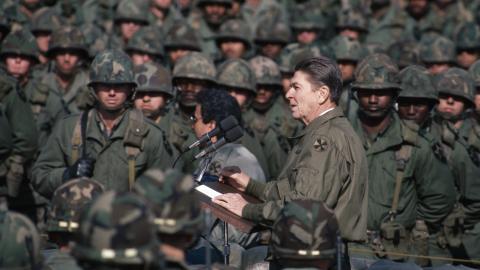
When Ronald Reagan became president in 1981, the Cold War had already lasted more than three decades. The United States had fought costly wars in Korea and Vietnam, placed military forces in vulnerable spots around the world and lived under the constant nerve-racking danger of nuclear conflict with the Soviet Union.
Yet Reagan, rather than display weariness, explained to Americans the conflict’s necessity and high purpose. He strengthened U.S. defenses, countered Soviet expansion and challenged Moscow’s control over Eastern Europe. He negotiated to advance American interests, not to stage signing ceremonies. He brought the Cold War to a successful end.
None of these leaders wanted endless sacrifice and risks, but none buckled for fear of them. Each understood that an enemy’s willingness to endure a long struggle does not make one’s own “endless” resistance foolish.
If it did, that would only encourage our foes. When listening to democracies’ fearful rhetoric about “endless war,” they like what they hear and adapt their strategies accordingly.
The right question is neither whether a war can be ended quickly nor whether perseverance demonstrates national strength. It is whether achievable aims justify the costs and risks, whether a successful approach is available and whether continuing the fight is preferable to other options.
History teaches that how a war is fought matters enormously. So does how it ends. In 1991, American forces expelled Saddam Hussein’s army from Kuwait, achieving their declared goal in weeks. Hussein remained in power, however, boasting that America feared him. President Bill Clinton’s efforts to contain Hussein’s persistent challenges dragged on, keeping the Arabian Peninsula inflamed, a condition exploited by Osama bin Laden. A short Persian Gulf War did not eliminate U.S. difficulties.
In launching the 9/11 attacks, bin Laden told supporters that the United States, having no stomach for a long, bloody fight, would retreat if hit. President George W. Bush could not promise a quick war; but, like Reagan, resolved to see a prolonged struggle through. Bush warned that preserving America’s free and open society against terrorist organizations with global reach would be a costly “generational conflict.”
Bush quickly removed Hussein in 2003, but then failed to quiet Iraq. Popular U.S. support for the war fell sharply until Bush adopted a better strategy — a counterinsurgency “surge,” which garnered many Iraqis’ support, reduced violence and soon enabled reductions in U.S. troop numbers. His successor, Barack Obama, decided that Iraq was stable enough and pursued a course that by the end of 2011 removed all remaining U.S. troops — only to see a vicious war erupt, resulting in the installation of a terrorist state in much of Iraq in 2014. This required U.S. forces to return and fight for three more years. Obama’s focus on ending an “endless war” had produced more war.
The wars in Afghanistan and Iraq generated political bitterness in the United States. So, today, has the war in Iran. But the Iranian regime’s half-century quest to bring “Death to America” has harmed thousands and aggravated regional instability. It put Iran on the verge of possessing nuclear weapons, a posture U.S. presidents of both parties have said was unacceptably risky for the region and the United States.
Reasonable Americans differ as to whether such wars are necessary, whether their objectives are sound, how competently they are fought and when they should end. Those are serious questions. But describing the wars as endless does not answer them. And fear of “endless war” is not a substitute for careful thought.