
















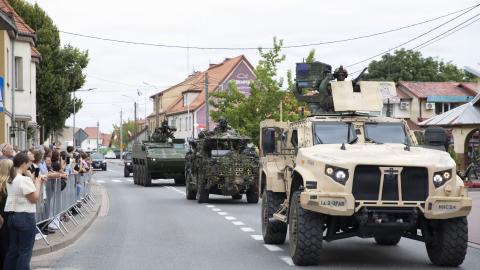
Since the start of 2026, two key pillars buttressing NATO deterrence have taken a hit. The first is the ongoing rapid and deep deterioration of US munitions stockpiles resulting from the war with Iran, and the second is the May announcement of immediate and substantial limitations on US contributions to NATO’s Force Model in the event of a future conflict.
Now, the Pentagon has launched a European force posture review. The Secretary of War will be briefed on a few sets of options for the size and distribution of US forces in Europe in early November, with the process ending in early December. President Donald Trump will then make the ultimate decision on accepting, amending or rejecting the department’s recommendation, no doubt with input from the National Security Council and State Department.
Periodically undertaking a clear-eyed review of America’s commitments in Europe is a prudent exercise. But considering the Kremlin’s increasingly active kinetic campaign against Europe, and a European rearmament that has not gained full steam, an honest review should conclude that the US must retain a robust force posture in Europe.
The reality is that there is little excess left to cut from the US presence in Europe without affecting capabilities. The 80,000 combined rotational and permanent troops currently deployed there are well below the average permanent American presence in Europe of approximately 94,000 since the Cold War ended.
The US has only three fighter wings permanently deployed to Europe and zero strategic bombers permanently deployed there. Most of the Navy already patrols the Pacific. A command-and-control ship in Italy and five destroyers in Spain are the only permanently based US surface vessels or submarines in Europe, and those destroyers have been consistently deployed to the eastern Mediterranean to take part in operations in the Middle East, limiting their ability to participate in exercises with NATO allies. (A sixth destroyer will arrive in October to augment US naval forces in the theater.)
Meanwhile, the war in Iran has only emphasized the crucial value of American basing and overflight rights in Europe. The Pentagon could not have sustained the length and lethality of strikes against the regime without this access from allies.
An often-overlooked fact: America’s basing in Europe is quietly heavily subsidized by European taxpayers and supports not only NATO deterrence and US extended power projection, but also political influence in Europe. This stationing also enjoys strong public support across the political spectrum in the US.
Do Not Encourage Russia
There is also this reality: The European posture review, which is likely to recommend some reductions in American presence, is being conducted at a sensitive time when Moscow appears to be willing to test just how far it can push NATO before the alliance fractures or admits a war with Russia is already underway.
A recent spate of attacks and plots against European infrastructure — including an airport attack in Germany directly attributed by Berlin to Moscow or an arson at a Polish drone factory, which Prime Minister Tusk stated is very likely a Russian act — show a clear pattern of escalation. America’s CIA chief recently visited Russia reportedly to carry a message dissuading Moscow from further adventurism into NATO. And Russia is no doubt closely tracking reports that US stockpiles in Europe of PAC-3 missile interceptor and ATACMS missile are “beyond critical.”
Replacing these high-end capabilities will take years. Those same time lags also hold true for replacing the reductions in American contributions to NATO’s Force Model, the troops and capabilities that could surge forward swiftly should a future conflict break out.
The structural changes from Europe’s rapid and considerable investments in defense, ushered in in no small part by President Trump, are significant and necessary. They are also not yet fully realized. While allies are working to fill the gaps, there are simply not enough capabilities, particularly high-end enablers, to replace those withdrawn on paper by the US earlier this year one-for-one. Weapons production, as the Pentagon is finding out in real time, takes years, not months.
Signaling significant limits on the cavalry that would come running over the hill in the event of a crisis in Europe — which is, effectively, what happened in May — places greater emphasis on the size and type of US capabilities already based there. Russia must remain convinced that America’s presence, combined with what firepower European NATO members would bring to a conflict, is enough not to risk a direct confrontation.
An alliance of 32 member states, NATO’s deterrence is sustained by a myriad of decisions and signals across many nations. Still, for Putin, the US is the nation that matters most; were he to come to the conclusion that America were so constrained as to not be able or willing to meaningfully intervene in defense of our allies, it could prompt him to roll the dice on a conventional attack against the alliance before European military rebuilding has gained critical mass.
Last month, Senate Armed Services Committee Chairman Roger Wicker, R-Miss., reiterated the danger of a hollowing out of US presence in Europe before Europe has adequately rebuilt its military strength, saying, “It will take time to translate this spending into military capability. The ongoing force posture review in Europe must account for this reality and for the risk that a wounded and failing Putin might seek to change his circumstances through opportunistic aggression in Europe.”
Congress, of course, will have a say in whatever America’s force posture looks like in Europe. The fiscal 2027 NDAA is likely to build upon the initial roadblocks introduced last year on the withdrawal of US forces in Europe beyond the 76,000-troop floor, with clearer restrictions and more onerous requirements further complicating any decision to substantially reduce the US footprint in Europe.
For now, the credibility of Europe’s rearmament still depends in no small measure on the US forces already there, and the determinations Washington makes about whether they stay.
Everyone with a vested interest in NATO security — including Moscow — will be watching this review closely. Let us hope those working on it remember what is at stake and get it right.