











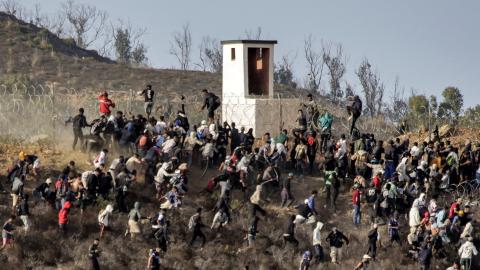



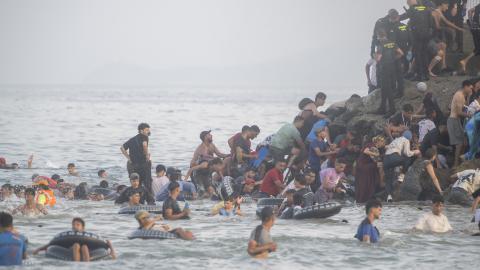
To understand why tens of thousands of Moroccan migrants just stormed into the Spanish territory of Ceuta, it is not enough to understand European open-border policies—you must also understand the dynamics in their country of origin.
Morocco is a semi-constitutional monarchy led by a king, who governs alongside an elected parliament where Islamist, secular, and nationalist parties compete for political influence. However, Islamist groups dedicated to challenging the legitimacy of the monarchy itself also operate within the country—largely because they believe the king does not conform to their interpretation of Islamic law and governance. Opposition intensified after Morocco normalized relations with Israel under the U.S.-brokered Abraham Accords. Although the government that signed the agreement was Islamist-led, many of the political actors involved later challenged normalization after they left office, capitalizing on Palestinian narratives after October 7 to mobilize domestic opposition.
For years, Islamist actors have sought to mobilize this discontent by weakening trust in Morocco’s institutions. According to their narrative, Morocco is a failed “Zionist” state, not worth anyone’s loyalty, not worth building up, and not worth investing in until the government is overhauled. Young Moroccans are urged toward jihad and a permanent stance of confrontation with the West—leading some to perpetrate terrorist attacks in Europe. Year after year, Morocco’s Islamists have tried to sell young people on one bleak claim above all: Their country has no future, and Islamist rule is the only viable salvation.
Of course, an Islamist party did lead the government from 2011 to 2021, and all it produced was a sluggish economy, unfulfilled promises, and a frustrated public. But the pitch never changed. And all the while, social media paints Europe as a kind of promised land, a place where immigrants are welcome, welfare never runs out, and prosperity comes easily. Spain’s decision in January to normalize the status of hundreds of thousands of illegal immigrants already in the country merely reinforced this perception.
Which brings us to the migration surge into Ceuta.
Ceuta and Melilla, two Spanish enclaves on the northern coast of Africa, have been under Iberian control for centuries. Ceuta was captured by Portugal in 1415 and passed to Spain in the 17th century, while Melilla came under Castilian control in 1497. Historically, both served as fortified ports guarding access to the Strait of Gibraltar and as hubs for Mediterranean and Atlantic trade. In the modern era, however, neither is comparable to the large transshipment and logistics hubs that dominate global maritime trade.
Morocco has never formally recognized Spanish sovereignty over the enclaves, but successive Moroccan governments refrained from actively pursuing territorial claims, leaving the status quo largely undisturbed for centuries. This is in contrast to Islamist actors in Morocco, who consider the territories to be part of historic Muslim land, and reclaiming them to be a religious imperative. “We are still required to work diligently for the return of Ceuta and Melilla to the homeland,” said the leader of the main Islamist party earlier this year.
That difference says a lot about the distance between Morocco’s actual foreign policy and the Islamist storyline built for ideological mobilization. Indeed, Thursday’s mass migration appears to be a product primarily of online coordination via Facebook groups, rather than, as some have suggested, actions by the state. In fact, Moroccan security forces reportedly tried to push back the migrants, while the government suspended train services to help stem the flow.
Morocco’s efforts to halt the migration should come as no surprise. The country gains nothing from uncontrolled crossings. Its day-to-day cooperation with Europe is consistently solid across the board, including strong migration frameworks with France and Germany, a bilateral partnership signed with Berlin in 2024, and, most recently, close operational coordination with the United States. Further, Morocco is itself under heavy migration pressure, particularly from its south. In 2025 alone, authorities intercepted 73,640 attempted irregular crossings, and sub-Saharan nationals now account for nearly 60 percent of foreign residents in the country. The chaos of the past several days only worsens Morocco’s position: Once the impression of an uncontrolled border spreads, it will draw in even more refugees.
More importantly, Morocco’s long-term strategic interests depend on a stable, prosperous, and cooperative Spain. Rabat has invested heavily in regional infrastructure and energy projects that rely on close bilateral coordination. The proposed Nigeria–Morocco Gas Pipeline, for example, would strengthen Spain’s role as a European energy gateway by expanding access to West African natural gas and further diversifying supplies beyond Russian imports. The same logic applies to electricity interconnections, trade through the Strait of Gibraltar, and preparations for the 2030 FIFA World Cup, which Morocco will co-host with Spain and Portugal. Disorder along the Ceuta border undermines those objectives. Morocco’s economic future depends on deeper integration with Europe, not confrontation with its closest European neighbor.
But, of course, Islamist voices are now accusing the Moroccan government of orchestrating the entire episode. This narrative has been fueled by the migrants themselves, who said in interviews that police waved them through. Meanwhile, commentators and officials in Spain have amplified the claim by saying that the Moroccan government may be acting at the behest of Israel to disrupt Spain. The timing is not a coincidence: Morocco’s general elections are set for September 23, and border chaos, magnified on social media, can destabilize incumbents. In fact, the Moroccan Ministry of the Interior has officially confirmed the existence of an online campaign encouraging people to attempt to reach Ceuta. According to the ministry, the campaign falsely claimed the border was open, that anyone who reached Ceuta would be allowed to remain, that those who swam across would face no legal consequences, and that entry was straightforward.
These tactics are intended to overhaul Morocco’s government—and they conveniently ignore the fact that Spain’s policies directly impedes Morocco’s ability to control the border. Morocco shoulders much of the burden of patrols, interceptions, and surveillance on its side of the border, which has been made even harder by the intensification of migration waves due to wars in Mali, Burkina Faso and Niger. Spain’s preventive spending, meanwhile, is limited: Spain allocates roughly €60 million per year ($69 million) to measures aimed at preventing irregular arrivals, while spending more than €1.8 billion annually (more than $2 billion) on reception and support for migrants. A multiyear Spanish government plan to dedicate €711 million ($821 million) to Ceuta and Melilla through 2026 directs the bulk of the funds to education, social services, and economic development—not to border security. Further, Spain’s Supreme Court recently ruled that people who swim to Ceuta cannot be turned back immediately and must be considered for asylum. This structural imbalance incentivizes rather than dissuades illegal crossings.
All of this leaves Morocco caught in a battle between actors who wish to see it fail. Contrary to the claims of Islamists, the country is not currently collapsing. Yes, it is a developing country with economic hardship—but there is no war, no state failure, no institutional breakdown. Indeed, some of the biggest infrastructure and industrial efforts in modern Moroccan history are underway: the extension of Africa’s first high-speed rail network, the expansion of Tanger Med (a massive industrial port and logistics hub), and large commitments in renewables and desalination. Morocco has also built one of Africa’s most advanced aerospace sectors, with over 150 companies employing about 25,000 skilled workers and bringing in close to $3 billion a year in exports. Safran, Boeing, Airbus, and other international manufacturers run major industrial sites in the country.
But, of course, this latest episode will only strengthen the Islamist narrative at Morocco’s expense. Informed spectators have a responsibility to understand these dynamics. Otherwise, the ideological agenda these radical groups have pursued for years will only continue to spread.