














Political-military activity around Belarus is heating up and may constitute what intelligence analysis calls weak signals: ambiguous background noise that can presage major strategic shifts. After reviewing this episode, which may mark a potential political-military turning point, the report turns to its regular battlefield assessment of the war in Ukraine.
Executive Summary
- Tensions over Belarus. Political and military machinations intensified over Belarus, as the likelihood of a Belarusian front against Ukraine—though still a low-probability, high-impact contingency—increased.
- Russian rhetoric intensifies. Russia signaled that its long-range salvos could reach “decision-making centers” in Kyiv, implicitly threatening allied diplomatic missions in the war-torn country.
- Ukrainian air strikes. Ukraine’s deep-strike campaign continued to inflict serious damage on Russia’s hydrocarbon infrastructure.
1. Concerning Developments in Belarus Raise Tensions
More than four years into Russia’s full-scale war on Ukraine, Kyiv is again focusing its attention on Belarus—not because Minsk is preparing to send large contingents of troops into the fray, but because Russia is increasingly using Belarus as a base for its own operations.
Ukrainian President Volodymyr Zelenskyy’s official reception of Sviatlana Tsikhanouskaya, Belarus’s exiled opposition leader, in Kyiv on May 25 was less a diplomatic courtesy than a calculated move to respond to this dynamic. Ukraine is warning the world that the regime of Belarusian dictator Aleksandr Lukashenko, while avoiding directly entering the war, is enabling Russia in ways that matter. Belarus currently serves Moscow as a rear base, a sanctions-evasion hub, a protected defense-industrial zone, and a source of Soviet-vintage military stocks. The country is now also a potential haven for Russian drone operations and nuclear signaling efforts.
This situation has been many years in the making. After Belarus’s fraudulent 2020 presidential election, Lukashenko emerged triumphant but isolated, weakened, and largely unrecognized by the West. The ensuing mass protest movement led by Tsikhanouskaya exposed his regime’s political vulnerabilities.
Lukashenko responded to these developments by increasing his country’s dependence on Russia. Russian President Vladimir Putin, a former Soviet-era spy chief, exploited this opportunity craftily. In November 2021, Russia and Belarus endorsed a set of 28 so-called Union State programs that, in practice, revived an integrationist agenda designed to harmonize the countries’ legal systems, align the two nations on energy, finance, customs, and tax policy, and shrink what remained of Belarusian sovereignty.
Since then, the territory of Belarus, already a launchpad for Moscow’s 2022 invasion of Ukraine, has evolved from a Russian staging ground to a source of strategic depth for the Kremlin. Ukrainian officials now argue that Russia may use Belarusian territory to support larger attacks against Ukraine and possibly against nations of the North Atlantic Treaty Organization (NATO). Minsk’s participation in Russian-led tactical nuclear drills has only sharpened that concern.
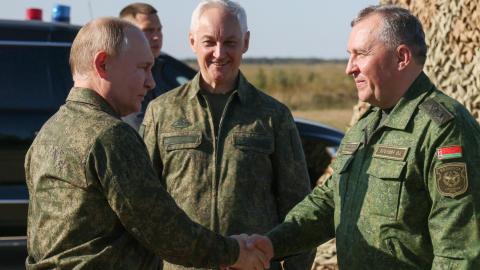
Available writings comparing Russian-controlled military activity in Belarus between January and May 2024 and January and May 2026 reveal a clear evolution in Belarusian drills and military signaling. The 2024 cycle involved mostly conventional readiness drills, with a layer of nuclear signaling. The cycle featured battalion- and brigade-level drills, air-defense and communications training, firing exercises, and the preparation of mechanized forces.
The 2026 cycle is different—and more dangerous. This year’s activity has prioritized survivability, dispersal, command continuity, layered air defense, and operational resilience. Repeated drills now involve radar-surveillance and electronic-warfare units combined with tactical and strategic surface-to-air missiles (SAMs), including Tor-M2, S-300, and S-400 variants. Airspace-monitoring tasks also suggest a more coherent effort to protect high-value assets and operational corridors. More important, the 2026 cycle of Russian military activity in Belarus suggests that the militaries have conducted command-and-control and staff training under dispersal and force-protection measures. Taken together, such activity provides a textbook smoking-gun indicator of wartime preparations.
Moreover, for the past three years Russian strategic forces have gradually absorbed the Belarusian state. In 2023, Putin announced plans to station Russian tactical nuclear weapons in Belarus and build a dedicated nuclear storage site there, after Belarusian crews had trained on the Russian Iskander system for potential nuclear missions. Independent monitors have not confirmed the deployment of Russian nuclear warheads to Belarus, but in 2024 Minsk adopted a new military doctrine that permitted the deployment and possible use of Russian tactical nuclear weapons on its territory.
Minsk called this move a step toward deterrence; in practice, it expanded Russian leverage near NATO’s borders while further reducing Belarusian autonomy. Integration between the two countries then deepened further. The arrival in Belarus of Russian MiG-31K aircraft carrying Kinzhal hypersonic missiles kept Ukraine’s air defenses on alert, while the December 2024 Treaty on Security Guarantees within the framework of the Union State paved the way for permanent Russian deployments and bases in Belarus.
The Belarusian military is not particularly strong on its own. But the Kremlin values the country for its location and its support systems. Before Moscow’s full-scale attack on Ukraine, Russian and Belarusian planners worked to make Belarus more conducive to hosting, moving, and supplying Russian troops by improving the country’s railways and establishing larger storage sites for supplies and gear for both countries’ troops. As a result, Russia can now enter Belarus more quickly than before, keep its forces there longer, and, if needed, use Belarus to attack further to the west or north.
Recent Hudson Institute assessments highlight that Belarus was more than a sideshow in Russia’s 2022 invasion plans. Moscow’s initial northern thrust on the city of Kyiv, initially aimed at decapitating the Ukrainian government, came from Belarusian territory; likewise the axis toward Bucha and Irpin, now synonymous with Russian atrocities. Additionally, Minsk has been accused of involvement in the abduction of Ukrainian children.
Today, Belarusian airspace still offers Russian drones and missiles a relatively safer corridor to access western Ukraine. The possibility of Lukashenko sending his own forces into Ukraine may seem remote, but Hudson Institute assessments underscore how Belarus, as Russia searches for ways to alter the battlefield momentum after four years of war, cannot be treated merely as a static rear area, but should be seen as a potential staging ground.
Ukraine is certainly taking the Belarusian threat seriously. Robert “Magyar” Brovdi, the commander of Ukraine’s Unmanned Systems Forces, recently warned Lukashenko that Kyiv has already identified its first 500 targets inside Belarus should a new Russian invasion be launched from the north.
2. Battlefield Assessment
Land warfare raged intensely last week, with Russian and Ukrainian forces often waging more than 200, and sometimes more than 260, tactical engagements each day. Kramatorsk, Huliaipole, Lyman, Oleksandrivka, Pokrovsk, Orikhiv, and Kostiantynivka saw heavy clashes.
Russian forces made territorial gains in the sector around Kostiantynivka. Pokrovsk, on the other hand, absorbed intense combat that resulted in minimal changes in territorial control. In southern Ukraine, the Ukrainian military’s drone strikes continued to disrupt Russian logistics routes, a trend that should be monitored closely in the coming weeks.
While ground activity increased, long-range strikes from both Russian and Ukrainian forces continued to shape the conflict. On the night of May 23–24, Russian forces launched one of the largest combined strikes of the war, firing 90 missiles and 600 drones against Ukraine. The attack involved a mix of loitering munitions and air-, sea-, and ground-launched missiles, and demonstrated Moscow’s ongoing goal of saturating Ukrainian air defenses through the size, variety, and timing of its strikes.
Kyiv was the main target of these Russian strikes, which reportedly involved one Oreshnik intermediate-range ballistic missile (IRBM) launched against the Bila Tserkva district. Russia also hit Ukraine with Kh-47M2 Kinzhal air-launched ballistic missiles, 3M22 Zircon missiles, Iskander ballistic missiles (including North Korean KN-23 variants), modified air-defense interceptors for ground attacks, Kh-101 air-launched cruise missiles, Iskander-K cruise missiles, and Kalibr naval cruise missiles.
According to initial reports from the Ukrainian Air Force, the country’s air-defense and electronic-warfare units intercepted or suppressed 604 aerial threats, including 55 missiles and 549 drones. As of the time of writing, several Russian drones remained in Ukrainian airspace. Confirmation of the final operational picture of these attacks awaits the confirmation of impact sites, missile failure rates, and post-strike damage assessments.
Political indicators also suggest that Russia may soon intensify its targeting of the city of Kyiv. On May 25, the Kremlin’s rhetoric shifted from post-strike justifications to explicit pre-strike signaling. Russian Foreign Minister Sergey Lavrov told United States Secretary of State Marco Rubio that Russian forces were preparing systematic strikes against facilities in Kyiv often used by Ukraine’s armed forces and the “decision-making centers” directing them. Lavrov also urged the US and other nations to evacuate their diplomatic personnel and citizens from the Ukrainian capital.
More than routine diplomacy, Lavrov’s words served as a coercive warning, and reflected Moscow’s attempts to normalize a strike campaign that is likely forthcoming. The Kremlin’s rhetoric aimed to frame any upcoming campaign as retaliatory in nature, to pressure Western embassies to lessen their presence in Ukraine, and to magnify the political-warfare effects of Russia’s repeated missile and drone salvos against Kyiv. In response, European diplomats voiced harsh criticisms of the Kremlin’s threat that Russian missile and drone salvos could place their diplomatic missions in harm’s way.
For its part, Ukraine responded to Russia’s long-range strikes by targeting the energy infrastructure that funds Moscow’s war machine. Ukraine also widened its campaign against Russian command, drone, logistics, fuel, and air-defense nodes in occupied Ukraine. On May 25 and overnight on May 25–26, Ukrainian forces struck Russian command posts in Ocheretyne, Donetsk Oblast, and Verkhnia Krynytsia in Zaporizhzhia Oblast.
Ukraine also targeted Russian ground-control stations near Nesterianka and Novohrodivka, a drone warehouse and logistics depot near Novopetrykivka, a logistics site in the city of Donetsk, and a railway fuel tanker near Debaltseve. Ukraine also confirmed the results from earlier deep strikes inside Russia: Moscow shut down the Syzran oil refinery after Ukrainian attacks on May 21, while a Ukrainian strike on May 25 damaged equipment and fuel tanks at the linear production and dispatch station in Yaroslavl.
As a result of these strikes, Russia began to weigh imposing restrictions on the export of diesel and jet fuel from the country. Interfax, a Russian news agency, reported that Russia’s refinery utilization rates fell to multi-year lows under intensifying Ukrainian pressure. The news service further reported that Russian oil companies, after a Tuesday meeting on the domestic fuel market chaired by Deputy Prime Minister Alexander Novak, had been advised to limit foreign sales of refined products. Interfax, citing several people familiar with the matter, reported that an export ban on diesel and jet fuel is now in the advanced stages of consideration, though no date has yet been set for implementing such a move.
3. What to Monitor in the Coming Weeks
Belarus is deliberately using fabricated claims of Ukrainian drone incursions to build a political case for possible military escalation. The Belarusian Security Council recently claimed that 166 drones entered Belarusian airspace over the past week, and that the country activated its air defenses 59 times. This claim is misleading, as many drones crossing into Belarus are not of Ukrainian origin, but Russian unmanned aerial vehicles (UAVs) diverted by electronic warfare. For now, a joint Russian-Belarusian attack remains a low-probability but high-impact scenario worth monitoring.