



















Executive Summary
- Battlefield assessment. Russia intensified its strikes against Ukraine’s energy and heating infrastructure ahead of winter. Significant changes in territorial control remain unlikely in the coming weeks despite mounting Russian casualties.
- Ukrainian strikes near North Africa. Ukrainian naval drone strikes off Libya underscored Kyiv’s growing expeditionary warfare capabilities, which are increasingly targeting Russia’s overseas military presence across North Africa and the Mediterranean the Caspian Sea region.
- What to look for in the coming weeks. Recent Russian violations of Polish airspace raise the prospect of another large-scale probing incursion with drones, echoing a similar incident in September 2025.
1. Battlefield Assessment
As winter approaches, the Russian military has intensified its efforts to strike energy and heating infrastructure across Ukraine. On November 25, a large-scale Russian strike forced a Ukrainian thermal power plant operated by DTEK, the country’s largest private energy company, to suspend electricity generation. The attack inflicted significant damage on the facility’s equipment and marked the third major Russian strike against DTEK’s thermal power-generation assets in November alone.
A Russian attack against Ukraine on November 20 forced another thermal power plant to cease operations. For operational security reasons, the company withheld the affected facility’s location and provided no timeline for restoring its electricity-generating capabilities. Russian long-range strikes also targeted Ukraine’s bridge networks across the Dnipro River.
The Russian military’s losses continued to rise, however, and on some days amounted to 2,000 personnel killed or seriously wounded in action. While Russia still holds the offensive initiative over Ukrainian forces, net territorial gains do not favor Moscow. Nonetheless, the battlefield geometry remained static, with no major changes in territorial control anticipated in the coming weeks.
2. Ukraine’s Campaign Against Russia Expands Its Reach
Ukraine expanded its drone-warfare campaign against Russia beyond the Black Sea, bringing the Mediterranean into the ambit of the conflict. On November 22, Ukrainian naval drones reportedly sank the Russian corvette Merkury and destroyed a Ka-27 attack helicopter off the coast of Benghazi, Libya. Ukrainian President Volodymyr Zelenskyy confirmed the operation on November 23.
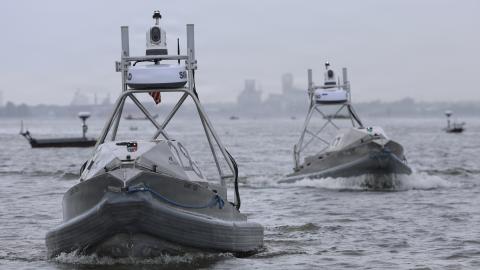
Conducted jointly by Ukraine’s Defense Forces and the Security Service of Ukraine, the operation involved seven domestically manufactured unmanned surface vessels (USVs). In a move that underscores the growing expeditionary dimension of the country’s robotic naval-warfare capabilities, Ukraine reportedly deployed the drones from a ship operating in the region. Open-source intelligence assessments indicate that the naval drone used in the strike was a Sargan-3000, known as the SeaWulf.
Ukraine has used the Sargan-3000 with increasing frequency as a drone-on-drone engagement platform in the naval warfare theater. In past engagements, the USV successfully targeted Shahed drones. The Sargan-3000 has a growing tally of kills against Russian naval drones.
Commissioned in 2023, the corvette Merkury was among the newest surface combatants in the Russian Navy’s fleet. Yet Russian defensive efforts reportedly failed to prevent its sinking. The Ukrainian operation also targeted the MV Angara, a Russian dry cargo vessel transporting military equipment.
The attack unfolded against the backdrop of increasingly pronounced Ukrainian efforts to disrupt Russian strategic interests in Libya. Politically fragmented since 2011, the North African nation remains divided between the internationally recognized government in Tripoli and its rival administration in eastern Libya, where General Khalifa Haftar exercises de facto military authority. In 2025, Kyiv and Tripoli reportedly concluded a clandestine agreement that permitted a Ukrainian military presence in western Libya and provided Kyiv with access to drone launch facilities.
Russian military bloggers have written extensively about this agreement and even claim that Ukrainian drone bases have established a presence in Libya. Russia, meanwhile, maintains a military footprint across eastern and southern Libya through its Africa Corps formations. These units operate in coordination with Khalifa Haftar’s forces and other allied actors on the continent.
Haftar’s administration has condemned the use of Libya’s territory, ports, and territorial waters for foreign military and logistics activities that could compromise the country’s sovereignty. The Tripoli-based government has issued a similar condemnation and has rejected what it views as efforts to transform Libyan waters into an arena for proxy warfare.
For its part, Ukraine’s Foreign Ministry maintains that Russian naval combatants and cargo vessels transporting military equipment in North Africa constitute legitimate military targets. Kyiv has simultaneously reaffirmed its respect for Libyan sovereignty and its interest in expanding bilateral cooperation with Tripoli.
From a military-strategic standpoint, Ukraine’s Benghazi operation represents a significant geographical expansion of Kyiv’s maritime interdiction campaign. The operation suggests that Ukraine is increasingly capable of contesting Russia’s military presence and overseas logistics networks well beyond the immediate theater of operations. As a result, Moscow now faces an emerging threat that extends from its naval combatants to the maritime infrastructure underpinning its military presence in Africa and the Mediterranean Sea.
Last week’s strike off Libya is not Ukraine’s first operation against Russian forces outside the immediate theater of conflict. In civil war–torn Sudan, Ukrainian special operations personnel have reportedly supported government forces against Russian-backed interests. In Mali, Ukraine has provided drone-training assistance to the Tuareg, who subsequently inflicted heavy losses on Russian mercenaries during a July 2024 battle at Tinzaouaten. In Syria, before the fall of the Iran- and Russia-backed Ba’ath dictatorship backed by Iran and Russia, reports suggest that Ukrainian intelligence operatives supplied approximately 150 first-person-view drones and deployed 20 specialist operatives to assist anti–Bashar al-Assad forces in late 2024, though Kyiv has disputed these claims.
Ukraine’s overseas efforts against Russian interests also possess a maritime dimension. In December 2025, Ukraine struck the Russian shadow-fleet tanker Qendil in the Mediterranean, more than 1,200 miles from Ukraine. In March 2026, Moscow accused Ukrainian naval drones launched from Libya of striking the Russian liquified natural gas carrier Arctic Metagaz, though Kyiv denied responsibility for this attack. These engagements preceded Ukraine’s recent operations against Russian naval assets in Benghazi.
Ukraine has also extended its extraregional campaign into the Caspian Sea, where Kyiv has targeted the maritime logistics connecting Iran and Russia. In August 2025, Ukrainian drones struck a Russian cargo vessel, Port Olya-4, that Kyiv determined was transporting Iranian drone components and ammunition. In July 2026, further Ukrainian strikes targeted a Russian missile boat and vessels allegedly carrying military supplies between Russia and Iran, while Tehran subsequently confirmed that a Ukrainian attack on an Iranian commercial vessel had killed one sailor. Together, these incidents underscore how Kyiv’s campaign against Russia’s military supply chains increasingly exposes Iranian assets to direct military action.
3. What to Look for in the Coming Weeks
On November 23, a Russian drone violated Poland’s airspace as Russia was conducting large-scale strikes against western Ukraine. The incident followed an earlier breach of Polish airspace involving Russian cruise missiles earlier that month. A large-scale Russian probing incursion into Polish airspace, likely involving drones similar to those used in the September 2025 incident, remains a plausible contingency in the coming weeks.