












Executive Summary
- Battlefield assessment. Russian airstrikes intensified and reached unprecedented levels in October, as Moscow launched over 8,700 drones and hundreds of missiles against targets in Ukraine.
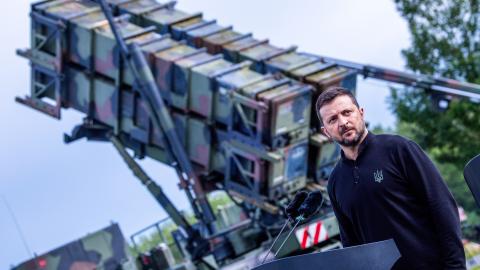
- Patriot missiles for Ukraine. Washington approved a $2.1 billion arms sale to Ukraine, including 500 Patriot PAC-3 interceptors, though long delivery timelines have prompted Kyiv to seek expedited shipments.
- Unrest near Kyiv. Up to 200 protesters confronted police near Kyiv over the Ukrainian government’s conscription practices, which raised questions about potential Russian efforts to exploit domestic instability in Ukraine.
1. Battlefield Assessment
According to the Ukrainian Air Force, Russia took its aerial campaign against Ukraine to unprecedented levels during October.
Over the course of just one month, Russia launched more than 4,000 jet-powered drones, 4,740 conventional unmanned aerial vehicles (UAVs), nearly 360 Banderol and Dan-T drone-missile hybrids, approximately 150 ballistic missiles, and 80 cruise and air-launched missiles at targets in Ukraine. On October 31 alone, the Russian military deployed 64 UAVs and an additional 430 unmanned aerial vehicles, including Shahed-type attack drones, Gerbera drones, and Parodiya decoys.
Russia staged its attacks from launch sites in Oryol, Kursk, Shatalovo, Bryansk, and Millerovo in Russia, as well as from occupied Donetsk in Ukraine. Ukrainian authorities reported Russian strikes at 16 different locations.
These figures underscore Moscow’s growing reliance on massed, mixed-speed aerial attacks designed to overwhelm Ukraine’s air defenses. Among the latest additions to Russia’s long-range arsenal is the Dan-T, a jet-powered loitering munition publicly unveiled at the El Alamein International Airshow in September 2026. The weapon resembles a compact cruise missile rather than a conventional Shahed/Geran UAV. According to Russian authorities, it has a 280-mile range, a 290-pound warhead, a launch weight of 590 pounds, and a top speed of 310 miles per hour.
Reportedly powered by a Russian-made MD-120 turbojet engine, the Dan-T can launch from multiple platforms, including Su-25SM3, Su-30SM, Su-34, and Su-57 combat aircraft, Mi-28 attack helicopters, and, most recently, ground-based launchers. The loitering munition also reportedly possesses upgraded electronics intended to strengthen its resilience against Ukrainian electronic-warfare efforts.
The military significance of the Dan-T extends beyond its specifications. By adapting an existing drone design, Russia could manufacture the weapon at substantially lower costs than conventional cruise missiles, potentially supporting production of the loitering munition at scale. The weapon’s combination of speed, range, and launch flexibility offers the Kremlin another option for striking Ukrainian targets and complicates Kyiv’s defensive planning.
Russia’s latest large-scale strikes against Ukraine’s energy infrastructure triggered emergency power outages and water supply disruptions across Kyiv and the surrounding area. Last week’s attacks, reportedly Moscow’s largest against Ukraine’s energy network this year, targeted power plants, substations, and transmission systems across the country. In Kyiv, home to roughly three million people, electricity and running water remained unavailable for hours in multiple districts. Ukraine’s national grid operator, Ukrenergo, implemented emergency blackouts as repair crews struggled to restore services.
The attacks underscore Moscow’s continuing campaign to degrade Ukraine’s critical infrastructure and strain its resilience ahead of winter. Russia’s ongoing strikes are stressing Ukraine’s defensive arsenal, too. Visuals from the battlespace show that Ukraine has dispatched the Yak-52 trainer aircraft equipped with machine gun teams to intercept Russian drones.
In the land-warfare dimension of the conflict, Russia suffered its worst month of personnel losses since the start of its full-scale invasion of Ukraine. According to Ukrainian President Volodymyr Zelenskyy, in October Moscow reportedly suffered 54,400 troops killed or seriously wounded in action. If accurate, these figures suggest that Russia is paying an increasingly steep human price for its offensive operations.
Finally, last week’s fighting brought a shift in territorial control that favored Ukraine. Though the overall battlefield geometry did not change, Zelenskyy said Ukrainian forces recaptured more territory than Russian forces took, for a net gain of roughly four square miles over the month. Taken together, these figures point to a widening gap between Russia’s battlefield losses and its territorial returns.
2. Despite a Deal for US Patriot Missiles, Ukraine Faces Urgent Defense Needs
On October 30, the US State Department authorized a possible $2.1 billion foreign military sale to the Ukrainian government for 500 Patriot PAC-3 Missile Segment Enhancement interceptors. Lockheed Martin is slated to be the principal contractor. The package, among the largest defensive arms sales approved for Ukraine under the second Trump administration, will be financed through Canadian, German, and Norwegian contributions under JUMPSTART (Joint Ukraine Multinational Program–Services, Training and Articles Rapid Timeline), and supplemented by Ukrainian funds backed by the European Union’s €90 billion Ukraine Support Loan. The transaction remains subject to US congressional review.
Despite the pledge’s significance, Ukraine’s immediate air-defense needs remain at odds with Washington’s procurement timeline. Deliveries under the newly approved package are reportedly scheduled to begin between late 2030 and late 2033. Moreover, the Patriot missiles Ukraine is set to receive have yet to be manufactured, leaving Kyiv exposed to Russia’s intensifying ballistic missile campaign while US production capacity struggles to meet battlefield demand.
Kyiv is pursuing alternative arrangements to meet its needs. Ukrainian officials are pressing the Trump administration to release interceptors from existing US inventories. They have suggested that Washington use newly manufactured missiles to replenish its stocks at a later date. In parallel negotiations, Kyiv is also seeking to move ahead of other customers in Lockheed Martin’s production queue. Another proposal would allow Ukraine’s European allies to transfer Patriot interceptors from their arsenals in exchange for replacement missiles after 2030.
Even with last week’s approved arms sale, Ukraine faces a military conundrum. Kyiv badly needs additional Patriot interceptors to counter Russian ballistic missile threats, but procurement approvals alone cannot meet the country’s immediate operational needs. Much will depend on how quickly Ukraine’s allies can mobilize existing inventories before new production becomes available.
3. What to Look For in the Coming Weeks
A confrontation on November 2 at a Ukrainian National Guard facility outside Kyiv, in which roughly 200 protesters clashed with security forces over the government’s treatment of mobilized men, exposed mounting tensions surrounding Ukraine’s conscription system. Ukrainian authorities suspect that provocateurs and Russia-linked information operations helped fuel the unrest, although Moscow’s involvement remains unverified. This report will monitor further anti-mobilization protests in Ukraine, the findings of the official investigation into last week’s confrontation, and whether Kyiv introduces reforms to prevent Russia from exploiting domestic grievances in ways that could undermine military recruitment efforts and public confidence in the armed forces.