








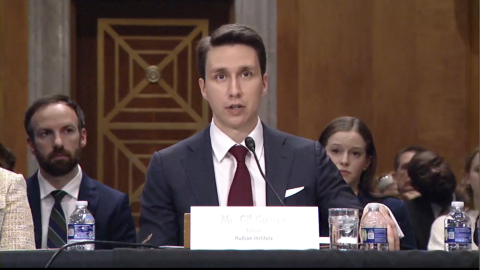
Gil Guerra testifies before the Senate Foreign Relations Committee Subcommittee on Western Hemisphere, Transnational Crime, Civilian Security, Democracy, Human Rights, and Global Women’s Issues on Nicaragua’s political crisis.
Written Testimony
Chairman Curtis, Ranking Member Kaine, and distinguished members of the subcommittee, thank you for the opportunity to testify before the subcommittee on the topic: “Nicaragua’s Political Crisis: Ortega’s Assault on Democracy.”
To determine how best to respond to Daniel Ortega and Rosario Murillo’s latest steps towards installing their family as the permanent owners of Nicaragua, we must first understand five related matters.
The first is what their proposed reforms to the constitution would do. The second is why the regime is pursuing these reforms now and whom they benefit. The third is how they coincide with the regime’s deepening ties to America’s adversaries. The fourth is why these developments merit a firm and persistent response. The fifth is why that response must be delivered quickly.
In this testimony, I will address each of these topics before turning to the role Congress can play in determining Nicaragua’s future.
What do the proposed 2026 constitutional reforms do?
In sum, they would add an extra year to election cycles as well as political tenure, give many incumbents, including the two co-presidents themselves, another year in office, and expand the state’s grounds for excluding its opponents from political life. I have prepared an English-language translation of the reforms, which is appended to my September 10 Hudson Institute analysis.[1]
If these reforms are adopted at the second approval session scheduled for January 18, 2027, Nicaragua’s current six-year election cycles would change to seven years. That would in turn move the general election from November 2027 to November 2028, keeping the current co-presidents and assembly in office until at least January 2029. A transitional clause would extend the existing terms of officials in 16 categories—including the army commander and police chiefs—to seven years.[2]
Other provisions would bar virtually anyone opposed to the regime from seeking public office or holding a leadership role in a political party. The grounds for being included in these bans include: using international funds to organize; expressing support for foreign action against the regime; proposing or backing blockades or sanctions against the state; and being a “traitor to the homeland,” which the regime’s laws define in predictably sweeping terms.[3]
If enacted, these reforms would further stifle political freedom in Nicaragua and place dissidents at even graver risk.
Why are these reforms being pushed now, and who benefits from them?
Given the increased pressure leftist authoritarian governments in Latin America are primed to face, why would the regime choose to draw attention to itself by undertaking another significant reform to the constitution to address matters that were ostensibly settled by last year’s rewrite?
The most obvious answer is that time forced the regime’s hand. As things stood before the reforms were announced, the regime was set to face an election in November 2027. The regime seems to know that it would lose any fair election, and it may have also wanted more time to prepare its strategy for handling opposition organizing around the next election.
Whatever the case may be, because a partial amendment must pass in two successive legislative sessions, the only way for the regime to postpone the 2027 election with a veneer of legitimacy was to initiate additional reforms this year.[4]
Another, simpler explanation is that the reform efforts are merely the latest step the regime has taken in its longstanding project of authoritarian consolidation in Nicaragua. As I have documented elsewhere, the regime has only ever moved towards greater and greater authoritarianism, and we should not be surprised when it continues to do so even under adversarial circumstances.[5]
The timing can also be explained by taking a closer look at who the beneficiaries of these changes are. The provisions on tenure cover a wide array of regime functionaries like elected officials, judges, electoral authorities, and army and police leadership; the reforms’ transitional provisions extend the terms of a wide group of incumbents in these positions.[6]
It seems to me that despite formally setting up Murillo for succession, the regime is still worried that Ortega’s death or incapacitation could surface internal fractures that would threaten its rule. The changes outlined in the reforms would give incumbent officials more time in office and thus a longer-term stake in Murillo’s eventual sole rule.[7]
The international turn against the regime has also been mitigated by its increasingly close ties to Russia and China. The regime’s hold over Nicaragua has allowed it to grant them vast concessions that would draw protests and scrutiny in any country with a free press, an independent legislature, and the right to assemble.[8] Moscow and Beijing, in turn, have acquired additional reasons to support the family’s permanent rule in Managua.
How do the reforms coincide with the regime’s deepening ties to America’s adversaries?
While the reforms themselves do not explicitly deal with Russia, China, and Iran, they nevertheless serve the regime’s strategy of drawing closer to this axis.
Here, Russia and China are the primary countries of concern since they have materially strengthened the regime’s position. Iran’s relationship with Nicaragua is significantly constrained by the limited capacity of both regimes. Although Ortega has praised the Iranian government and sent representatives to Ayatollah Ali Khamenei’s funeral, publicly verifiable cooperation between Nicaragua and Iran appears to be largely symbolic for now.[9]
The reforms themselves have some tangential benefit for Russia and China. For example, the article barring the “extraterritorial application” of foreign laws preserves “the application of agreements signed on behalf of the Nicaraguan State.” Managua has recently forged several such agreements with Moscow. Those include a 2025 pact against “abuses” of international justice that, by Russia’s account, lets either government block cooperation in cases it deems politicized, and extradition and prisoner-transfer treaties that were signed this June.[10]
In addition to formalized legal cooperation, the reforms also carry implications for the regime’s people-to-people ties with our adversaries. The transitional clause would boost figures who have been central to the regime’s relationships with China and Russia, such as Army commander Julio César Avilés and the two police chiefs.[11] Avilés has recently traveled to Beijing and Moscow for security talks.[12]
Police co-chief Francisco Díaz, meanwhile, has boasted that 500 Nicaraguan officers a year train with Russia’s Interior Ministry, including in “intelligence and counterintelligence,” and 400 train with China’s Ministry of Public Security, including in video surveillance and artificial intelligence.[13] The regime seems invested in deepening its security ties to Russia and China even as Murillo has stopped describing Russia as a security partner in her broadcasts since late 2025, presumably to try to fly under US radar.[14]
Officials responsible for granting China access to Nicaraguan resources would also be placed in office for longer terms. Since January 2024, the regime has granted Chinese-linked firms 80 of 102 new mining concessions, covering an area that spans about 10 percent of the country, or roughly the size of Connecticut.[15] Nearly every title has a lifespan of 25 years, and since March the titles have been issued by the office of the Procurator General.[16] Together, these terms make China’s economic stake in Nicaragua more secure.
The reforms also coincide with several troubling projects spearheaded by Russia and China in Nicaragua. In May, Russia ratified a military agreement with Nicaragua that allows it to provide security training and carry out ship and aircraft visits. In August, ten days before the National Assembly’s first vote on the reforms on September 1, the Ortega-Murillo regime opened a Chinese-built emergency-response center at Momotombo. The communications, data-processing, and monitoring capabilities of this facility could have dual-use purposes, though these remain speculative applications for now.[17]
Washington nevertheless maintains a commercial advantage over China and Russia in the Nicaraguan markets. The United States bought $4.96 billion of Nicaragua’s goods in 2025 compared to China’s $81 million and supplied about 59 percent of its oil import bill.[18] This imbalance gives the US a significant amount of economic leverage to wield.
Why do these developments merit a firm and persistent response?
The regime’s attempts to stomp out freedom in Nicaragua would merit a firm response under any circumstances, but they arrive alongside several troubling developments. One of these is that the regime’s repressive apparatus has only grown harsher. The independent register of political prisoners, which tallied 46 after January’s releases, refilled to 68 by September 24. A total of 31 of these prisoners have been subject to enforced disappearance; Miskitu leader Brooklyn Rivera died in state custody on May 30 after a prolonged enforced disappearance.[19]
The repression serves in part to quash potential dissent from inside the regime. According to civil society groups cited by the UN human rights office, at least 55 of the 243 people arbitrarily detained between June 2025 and June 2026 were government or ruling-party supporters or state officials, and UN investigators describe the aim as preventing “any replacement of the Government, especially from within.”[20]
Another reason the US should respond more stringently than it has in the past is that the regime has seemingly concluded that Washington will be too distracted or apathetic to mount a significant campaign against it. This assumption is not entirely unfounded. By my count, none of the American authorities on Nicaragua that were announced since October 2022 whose outcomes can be measured were carried out at the scope that was announced.[21]
The regime has also shrugged off previous designations. Díaz and Avilés were each reappointed to their posts after being sanctioned by the US, and less than a month after the Department of the Treasury sanctioned a Chinese-linked mining firm in April, the regime granted the firm a new concession of more than 95,000 acres. As of September 27, Treasury had made no new Nicaraguan designations since April 16, and by my count no European Union, British, Canadian, or Swiss sanctions list has added a Nicaraguan figure since January 2022.[22]
In order for conditions in Nicaragua to change, the United States has to convince the regime that it is willing to exert meaningful pressure on it. However, US policymakers should also be clear-eyed about what this pressure can accomplish. The constitutional reforms will almost certainly come into effect in January 2027 regardless of what form American and international pressure takes. If Washington’s campaign against the reforms is premised solely around blocking their implementation, the regime will be able to claim a victory once they pass.
Therefore, while the US and its allies should continue to demand the withdrawal of the reforms, they should also prepare for a new phase in our approach to Nicaragua that is built to last for as long as the regime does. We should begin that phase now.
Why must that response be delivered quickly?
The interval before the January vote presents an opportunity for Washington to convince the regime that the reforms will be met with significant resistance. There are 110 days between this hearing and the second vote, which Murillo has set for January 18. Regime officials will doubtless spend this time quietly considering the security of their positions, the value of their commercial interests, and the durability of the status quo under Murillo. The US can use this time to make Murillo seem like a bad long-term bet.[23]
If a comprehensive response is to be ready by January, Washington needs to start acting soon. As of the time of writing, the European Union’s Nicaragua sanctions will expire on October 15 unless renewed. The national emergency underlying our Nicaragua sanctions will expire unless continued by late November.[24]
The longer we wait, the more time China and Russia will have to secure resources and complicate a potential democratic transition. By my estimate, Chinese-linked mining holdings grew from about 588,000 acres in August 2024 to 3.88 million this month. In the first half of the year, the regime spent almost as much on the Punta Huete airport, which is financed with Chinese credit, as it did on its entire army. Between July and September, the airport’s Chinese contractor signed $210 million in contracts for a deepwater port at Bluefields, on the Caribbean coast.[25] Our response must meet the pace of Chinese and Russian inroads in Nicaragua.
Another reason to begin responding now is that, if we delayed, Nicaragua’s rising reserves could cushion the regime against the short-term consequences of international pressure. Nicaragua’s central bank reported that it held $9.99 billion in gross reserves at the end of August, up about 20 percent this year.[26]
What role can Congress play in determining Nicaragua’s future?
While the executive branch holds many of the tools a significant pressure campaign would require, Congress can supply durability, deadlines, and oversight that the American response has sometimes lacked. Congress can do this by taking the following actions:
1. Push for a gold import ban and strengthen it via statute. Gold is Nicaragua’s largest merchandise export outside the free zones and was worth nearly $2 billion in 2025. It is also arguably the sector most exposed to American policy: US imports in the first seven months of 2026 exceeded those of all of 2025, and since 2021 at least 99 percent of those imports have cleared customs at Miami International Airport.[27] The state’s formal take is only a 3 percent royalty, but targeting the sector as a whole would put pressure on rent captured by regime-linked concession holders and intermediaries.
Congress should urge Treasury to use the import authority it has at its disposal. Importers’ records put the United States and Canada at roughly a third each of Nicaragua’s 2025 gold exports and Switzerland at a quarter, so Congress should also encourage the State Department to seek matching restrictions in both countries.[28] Congress should also consider adding a provision to the Cruz–Kaine REFORMAR Act (S. 5369) that requires Treasury to restrict the US correspondent accounts of foreign banks that knowingly handle payments from Nicaraguan gold sales that benefit figures who enable corruption or repression in Nicaragua.[29]
2. Pass the REFORMAR Act before this Congress ends. Congress should consider some amendments to the REFORMAR Act as it makes its way through the legislative process. The act could be improved by expanding the scope of the World Bank clause, which currently names only the International Finance Corporation; setting a 90-day deadline for determinations on qualifying bipartisan requests that concern foreign suppliers and financiers; and capping national-interest waivers from the act’s provisions at 180 days. It should also add the release of all political prisoners, a definition of what counts as a release, and disclosure of the whereabouts of the disappeared to the conditions for permanently lifting the act’s provisions. Neither chamber’s defense bill mentions Nicaragua, so REFORMAR’s supporters should seek to add it to the defense bill in conference or to the year-end spending package. If this Congress expires before REFORMAR is passed, its supporters should plan to promptly reintroduce it in the next session.[30]
3. Use the Global Magnitsky Act on officials who would benefit from the reforms. The executive order that forms the basis for US sanctions on Nicaragua allows us to reach any Nicaraguan government official, but as of September 27, none of the four security chiefs installed since August 2024 appeared on any public US, EU, UK, or Canadian sanctions list that I could find.[31] A joint request from the chairman and ranking member of the full committee would oblige the president to determine within 120 days whether a named official is responsible for gross violations of human rights. Even if the committee acts promptly, any request that arrives at 120 days would arrive after the date of the second vote on January 18, so the committee should ask for action promptly. It is still possible for designation to arrive before the second vote; in 2018 Treasury designated both officials named in a bipartisan letter 30 days after it was sent.[32]
4. Fund and oversee the work of cutting the financial benefits of serving the regime. Pressure that leads to the replacement of a sanctioned minister or company will mean little if the source of the income can be easily restored. Congress should direct Treasury to identify the core benefit at stake in priority cases and follow it through changes in companies and personnel. It should fund efforts to obtain records from foreign banks with US correspondent accounts and request confidential briefings on the results. Congress should also ask Treasury to investigate whether senior officers use IPSM, the Army’s pension and investment institute, to conceal assets or evade sanctions, and to sanction those involved, including IPSM itself if sanctioned officials are found to effectively control it. Firms seeking relief must be made to prove that sanctioned insiders no longer own or profit from them.[33]
5. Require a standing account of Russian and Chinese support for repression. No statute currently requires a report on Russia’s activities in Nicaragua. (The RENACER Act’s requirement was a one-time report due in early 2022, before the current military agreement.)[34] Congress should require State and Treasury to identify the payments, equipment, and services that sustain the Russian Interior Ministry’s training center in Managua, which Treasury sanctioned in 2024 for supporting police repression. Chinese projects such as the Momotombo center warrant the same scrutiny of contracts, end users, and data access; if the evidence shows it is being used for repression, suppliers and financiers should face all applicable sanctions.[35]
6. Encourage the administration to secure allied commitments before the first deadlines pass. Despite the administration’s desire for more allied pressure on Nicaragua, the Nicaraguan army’s high command remains sanctioned by the United States alone.[36] Members can press the administration, and allied legislatures, for three commitments. First, the European Union should renew its sanctions before October 15. Second, given their aforementioned relationship to Nicaragua’s gold sector, Canada and Switzerland should examine the owners, buyers, refiners, and financial relationships that sustain regime-linked gold businesses. Third, State should work with Costa Rica and other willing governments at the October 2 OAS meeting to reject the democratic legitimacy of the extended mandates and of elections held under the exclusion rules.[37]
7. Encourage cooperation with US law enforcement and address transnational repression. The regime is clearly concerned with internal dissent. Congress should ask Treasury to promote the Financial Crimes Enforcement Network’s whistleblower program in Spanish among bankers, accountants, and intermediaries abroad.[38] It should also press Justice and Homeland Security to pursue threats of transnational repression on American soil.[39]
8. Fund Costa Rica’s security partnership. On September 4, Costa Rica’s president Laura Fernández indicated a willingness to have an expanded US military presence in Costa Rica, while noting that her legislature would have to approve any foreign force.[40] Nicaraguan exiles in Costa Rica are in need of protection. In June 2025, Roberto Samcam, a retired Nicaraguan Army major and regime critic, was shot and killed in his home in San José in a killing that has the characteristics of a contract hit.[41] If a proposal is presented to it, Congress should be prepared to fund measures that provide American assistance to Costa Rica for the transport, supplies, and maintenance that joint anti-crime, border-security, and crisis missions require, along with rapid threat referrals for exiles.[42]
Washington should seek a negotiated, peaceful end to the Ortega–Murillo regime, but the Pentagon can give civilian leaders concrete options for a kinetic response in the event of regime attacks on Americans or partners, cross-border aggression, or mass violence towards protestors. Congress can make clear that it expects to authorize any use of force in advance, circumstances permitting.
9. Aim trade and financing tools at the regime rather than at Nicaraguan workers. By my count, the Central American Bank for Economic Integration, where the United States does not have voting power, has supplied every new multilateral loan approved for Nicaragua’s government since 2023. Congress should direct State to work through the bank’s member governments, as legislation this committee reported in 2024 proposed, and to oppose specific new discretionary loans while allowing for some basic-needs loans.[43]
While American remittances to ordinary Nicaraguan households should be allowed to continue, Congress should ask Treasury to explore the effects of barring those sent to senior officials and commanders.[44] It should also press the Office of the US Trade Representative to prepare modifications to its existing Section 301 action that address the reforms, and to act promptly if they are ratified.[45] Broader restrictions on trade preferences or fuel should remain visible escalation options, timed and scoped with Nicaraguan opposition figures so that any shortages primarily serve to bring about the end of the regime.[46]
10. Match oversight with resources. Congress should ask the president to name a senior official to direct a coordinated pressure campaign on Nicaragua through the National Security Council.[47] It should also be prepared to fund any demonstrated gaps in dissident protection, independent media, evidence preservation, and financial investigations; and use the year-end package to require a report on the sanctions status of each senior official whose term the reforms would extend.[48]
Conclusion
The regime has committed itself to these reforms because it knows that it cannot win a fair election and seeks to give an even wider array of officials a longer-term stake in its authoritarian project. These reforms will push Nicaragua further down the path of becoming China and Russia’s principal ally in the hemisphere, and make it harder for future democratic governments to disentangle themselves from America’s adversaries.
The US response, which Congress plays a vital role in shaping, should be swift and unequivocal: Nicaragua belongs to its people, and the United States will not rest until it is returned to them.
- Gil Guerra, “What Nicaragua’s Latest Authoritarian Reforms Really Mean—and How Washington Should Respond,” Hudson Institute, September 10, 2026, appendix, https://www.hudson.org/foreign-policy/what-nicaraguas-latest-authoritarian-reforms-really-mean-how-washington-should-gil-guerra; National Assembly of Nicaragua, “Ley de Reforma Parcial a la Constitución Política de la República de Nicaragua” [Law of partial reform of the political constitution of the Republic of Nicaragua], first approval, September 1, 2026, La Gaceta, no. 163 (September 2, 2026): 8874–77, https://www.lagaceta.gob.ni/la-gaceta-no-163-miercoles-02-de-septiembre-de-2026. ↑
- National Assembly, “Reforma Parcial,” 8875–77, arts. 3–7. ↑
- National Assembly, “Reforma Parcial,” 8875–76, art. 2; National Assembly of Nicaragua, Law No. 1055, Ley de Defensa de los Derechos del Pueblo a la Independencia, la Soberanía y Autodeterminación para la Paz (December 21, 2020), art. 1. ↑
- National Assembly, “Reforma Parcial,” 8874 (citing Constitución Política, art. 180); “Exposición del Doctor Gustavo Porras en el Proceso de Consulta de Reformas Constitucionales con la Juventud y Estudiantes” [Presentation by Dr. Gustavo Porras on the consultation process of constitutional reforms with youth and students], El 19 Digital, August 28, 2026, https://www.el19digital.com/articulos/ver/181304-exposicion-del-doctor-gustavo-porras-en-el-proceso-de-consulta-de-reformas-constitucionales-con-la-juventud-y-estudiantes. ↑
- Gil Guerra, “Daniel Ortega Strikes a Final Blow Against Democracy,” The Dispatch, July 27, 2026, https://thedispatch.com/article/daniel-ortega-nicaragua-elections-democracy/; Guerra, “What Nicaragua’s Latest Authoritarian Reforms Really Mean.” ↑
- National Assembly, “Reforma Parcial,” 8875–77, arts. 3–4, 7; “La reforma constitucional en Nicaragua extiende a siete años miles de mandatos públicos” [Nicaragua’s constitutional reform extends thousands of public mandates to seven years], Infobae, August 1, 2026, https://www.infobae.com/nicaragua/2026/08/01/la-reforma-constitucional-en-nicaragua-extiende-a-siete-anos-miles-de-mandatos-publicos/; Gil Guerra, “Trends in the Military & Police Forces,” Data for US-Nicaragua Policy, https://nicaragua-research.com/military-police/. ↑
- Government of Nicaragua, Constitución Política de la República de Nicaragua, consolidated text, La Gaceta, no. 32 (February 18, 2025), arts. 120–24, https://faolex.fao.org/docs/pdf/nic127516.pdf; Report of the Group of Human Rights Experts on Nicaragua, A/HRC/61/56 (United Nations Human Rights Council, February 6, 2026), para. 12, https://docs.un.org/en/A/HRC/61/56; Guerra, “Trends in the Military & Police Forces,” https://nicaragua-research.com/military-police/#purges. ↑
- Gil Guerra, “The State of Nicaragua’s Gold Sector,” Data for US-Nicaragua Policy, https://nicaragua-research.com/gold/#china; Gil Guerra, “Russian, Chinese, & Iranian Influence,” Data for US-Nicaragua Policy, https://nicaragua-research.com/russia-china-iran/; Human Rights Situation in Nicaragua: Report of the United Nations High Commissioner for Human Rights, A/HRC/63/58 (United Nations Human Rights Council, August 13, 2026), paras. 4, 15, https://docs.un.org/en/A/HRC/63/58. ↑
- “Palabras del Comandante Daniel, Copresidente de Nicaragua, acto central en conmemoración del 47 aniversario de fundación del Ejército de Nicaragua” [Remarks by Comandante Daniel, co-president of Nicaragua, at the central event commemorating the 47th anniversary of the founding of the Army of Nicaragua], El 19 Digital, September 2, 2026, https://www.el19digital.com/articulos/ver/181575-palabras-del-comandante-daniel-copresidente-de-nicaragua-acto-central-en-conmemoracion-del-47-aniversario-de-fundacion-del-ejercito-de-nicaragua; “Compañera Rosario Murillo en Multinoticias” [Comrade Rosario Murillo in Multinoticias], El 19 Digital, July 2, 2026, https://www.el19digital.com/articulos/ver/179004-companera-rosario-murillo-en-multinoticias-02-07-26; Guerra, “Russian, Chinese, & Iranian Influence,” https://nicaragua-research.com/russia-china-iran/#fig-iran. ↑
- National Assembly, “Reforma Parcial,” 8875, art. 1; “Aprobamos acuerdo con Rusia para la protección de nuestros ciudadanos ante resoluciones ilegítimas de la justicia internacional” [We approve agreement with Russia to protect our citizens from illegitimate resolutions of international justice], National Assembly of Nicaragua, July 10, 2025, https://noticias.asamblea.gob.ni/aprobamos-acuerdo-con-rusia-para-la-proteccion-de-nuestros-ciudadanos-ante-resoluciones-ilegitimas-de-la-justicia-internacional/; Ministry of Justice of the Russian Federation, [International treaties on mutual protection of citizens from abuses in international justice ratified], news release (in Russian), January 30, 2026, https://www.minjust.gov.ru/ru/events/51108/; Ministry of Justice of the Russian Federation, [International treaties signed with the Republic of Nicaragua on extradition and transfer of sentenced persons], news release (in Russian), June 5, 2026, https://minjust.gov.ru/ru/events/51286/. ↑
- National Assembly, “Reforma Parcial,” 8875–77, arts. 4, 7; Guerra, “Trends in the Military & Police Forces,” https://nicaragua-research.com/military-police/. ↑
- “Compañera Rosario Murillo en Multinoticias,” El 19 Digital, September 17, 2025, https://www.el19digital.com/articulos/ver/168698-companera-rosario-murillo-en-multinoticias-17-09-25 (meeting with Zhang Youxia in Beijing); “Compañera Rosario Murillo en Multinoticias,” El 19 Digital, September 22, 2025, https://www.el19digital.com/articulos/ver/168857-companera-rosario-murillo-en-multinoticias-22-09-25 (meeting with Defense Minister Andrei Belousov in Moscow). ↑
- “Acto central en conmemoración del 46 aniversario de fundación de la Policía Nacional” [Central event commemorating the 46th anniversary of the founding of the National Police], El 19 Digital, September 2025, https://www.el19digital.com/articulos/ver/169007-acto-central-en-conmemoracion-del-46-aniversario-de-fundacion-de-la-policia-nacional. Translation is the author’s. ↑
- Gil Guerra, “Patterns in Murillo’s Broadcasts,” Data for US-Nicaragua Policy, https://nicaragua-research.com/murillo/; Guerra, “Russian, Chinese, & Iranian Influence,” https://nicaragua-research.com/russia-china-iran/#fig-murillo. ↑
- Guerra, “The State of Nicaragua’s Gold Sector,” https://nicaragua-research.com/gold/#china; Gil Guerra, “Methodology,” Data for US-Nicaragua Policy, https://nicaragua-research.com/methods/; Christine Murray, Camilla Hodgson, Janina Conboye, and Aditi Bhandari, “Gold-Rich Nicaragua Hands Chinese Miners Rights to a Tenth of Its Land,” Financial Times, September 27, 2026, https://www.ft.com/content/452648fd-90d6-450f-9739-073f5b6a0d18. ↑
- National Assembly of Nicaragua, Law No. 1275, La Gaceta, no. 27 (February 12, 2026); National Assembly, “Reforma Parcial,” 8877, art. 7(2); Guerra, “The State of Nicaragua’s Gold Sector,” https://nicaragua-research.com/gold/#china. ↑
- Federal Law of the Russian Federation No. 117-FZ, May 2, 2026, https://publication.pravo.gov.ru/document/0001202605020002; “瞿瑜辉大使在尼加拉瓜国家应急响应系统 (莫陌通博中心) 启用仪式上的讲话” [Qu Yuhui’s remarks at the inauguration of Nicaragua’s National Emergency-Response System (Momotombo Center)], Chinese Embassy in Nicaragua, August 25, 2026, https://ni.china-embassy.gov.cn/sgxw/202608/t20260825_12009511.htm; Guerra, “Russian, Chinese, & Iranian Influence,” https://nicaragua-research.com/russia-china-iran/. ↑
- US Census Bureau, USA Trade Online, US imports from Nicaragua, 2025, https://usatrade.census.gov; Central Bank of Nicaragua, Informe Anual 2025 [Annual report 2025], 78, https://www.bcn.gob.ni/sites/default/files/2026-05/Informe%20Anual%202025.pdf; UN Comtrade, US exports of mineral fuels (HS 27) to Nicaragua, 2025, https://comtradeapi.un.org/public/v1/preview/; “Guerra en Medio Oriente dispara la factura petrolera de Nicaragua en marzo” [War in the Middle East drives up Nicaragua’s oil bill in March], Infobae, June 7, 2026, https://www.infobae.com/nicaragua/2026/06/07/guerra-en-medio-oriente-dispara-la-factura-petrolera-de-nicaragua-en-marzo-sube-683-en-un-mes/. The 59 percent share is the author’s calculation from these sources. ↑
- Mecanismo para el Reconocimiento de Personas Presas Políticas, “Actualización del Mecanismo, septiembre 2026” [Mechanism update, September 2026], September 24, 2026, https://www.memoriayjusticia.com/wp-content/uploads/2026/09/Actualizacion-mecanismo-sep26.pdf; Group of Human Rights Experts on Nicaragua, “The Anatomy of State Cruelty”: Enforced Disappearance and Death in Custody in Nicaragua, A/HRC/63/CRP.3 (United Nations Human Rights Council, September 21, 2026), paras. 151, 165–67, 207–8, https://www.ohchr.org/sites/default/files/documents/hrbodies/hrcouncil/sessions-regular/session63/a-hrc-63-crp-3-en-21.pdf; Gil Guerra, “Trends in Political Imprisonment,” Data for US-Nicaragua Policy, https://nicaragua-research.com/political-prisoners/. ↑
- Human Rights Situation in Nicaragua, A/HRC/63/58, paras. 20, 23; Report of the Group of Human Rights Experts on Nicaragua, A/HRC/61/56, para. 12. ↑
- Office of the US Trade Representative, “Notice of Determination and Request for Comments Concerning Action Pursuant to Section 301,” 90 Fed. Reg. 48511 (October 23, 2025), https://www.federalregister.gov/documents/2025/10/23/2025-19635/notice-of-determination-and-request-for-comments-concerning-action-pursuant-to-section-301; Office of the US Trade Representative, “Notice of Implementation of Action: Nicaragua’s Acts, Policies, and Practices Related to Labor Rights, Human Rights, and the Rule of Law,” 90 Fed. Reg. 60850 (December 29, 2025), https://www.federalregister.gov/documents/2025/12/29/2025-23892/notice-of-implementation-of-action-nicaraguas-acts-policies-and-practices-related-to-labor-rights; “Enviado de Trump advirtió que impondrá sanciones al oro nicaragüense por el despojo a una empresa estadounidense” [Trump envoy warned he will impose sanctions on Nicaraguan gold over the seizure of a US company], Infobae, March 17, 2026, https://www.infobae.com/nicaragua/2026/03/17/enviado-de-trump-advirtio-que-impondra-sanciones-al-oro-nicaraguense-por-el-despojo-a-una-empresa-estadounidense/; US Department of the Treasury, “Treasury Sanctions Government Officials, Nicaraguan Regime-Linked Gold Firms, and Individuals Involved in Seizing US-Owned Property,” news release, April 16, 2026, https://home.treasury.gov/news/press-releases/sb0451; Executive Order No. 13851, 83 Fed. Reg. 61505 (November 29, 2018), § 1(b)(i), as added by Executive Order No. 14088, 87 Fed. Reg. 64685 (October 26, 2022), § 4, https://www.federalregister.gov/documents/2022/10/26/2022-23433. For example, proposed duties of up to 100 percent were set at zero for 2026, a warning of gold-sector sanctions became designations of individual firms, and the 2022 import-ban authority remains unused. ↑
- “Recent Actions,” Office of Foreign Assets Control, accessed September 27, 2026, https://ofac.treasury.gov/recent-actions; “Recent Actions,” Office of Foreign Assets Control, May 22, 2020, https://ofac.treasury.gov/recent-actions/20200522; Treasury, “Treasury Sanctions Government Officials, Nicaraguan Regime-Linked Gold Firms”; Procuraduría General de Justicia, Dirección General de Minas, Acuerdo No. 025-PGJ-DGM-2026, La Gaceta, no. 82 (May 11, 2026); Council of the European Union, “Nicaragua: Council Extends Restrictive Measures for Another Year,” news release, September 29, 2025, https://www.consilium.europa.eu/en/press/press-releases/2025/09/29/nicaragua-council-extends-restrictive-measures-for-another-year; Gil Guerra, “Impact of Previous Legislation,” Data for US-Nicaragua Policy, https://nicaragua-research.com/nica-act/; Guerra, “Trends in the Military & Police Forces,” https://nicaragua-research.com/military-police/. ↑
- “Compañera Rosario Murillo en Multinoticias,” El 19 Digital, August 31, 2026, https://www.el19digital.com/articulos/ver/181436-companera-rosario-murillo-en-multinoticias-31-08-26. ↑
- Council of the European Union, “Council Extends Restrictive Measures”; “Continuation of the National Emergency With Respect to the Situation in Nicaragua,” Federal Register, November 24, 2025, https://www.federalregister.gov/documents/2025/11/24/2025-21030/continuation-of-the-national-emergency-with-respect-to-the-situation-in-nicaragua. ↑
- Guerra, “The State of Nicaragua’s Gold Sector,” https://nicaragua-research.com/gold/#china; Informe de Ejecución Presupuestaria Enero–Junio 2026 [Budget execution report, January–June 2026] (Ministry of Finance and Public Credit of Nicaragua, 2026), cuadro 34, https://www.hacienda.gob.ni/wp-content/uploads/2026/08/Informe-de-Ejecucion-Presupuestaria-Enero-Junio-2026.pdf; CAMCE, Shenzhen Stock Exchange filings 2026-048, 2026-053, and 2026-058, July 16 and September 18, 2026. ↑
- Indicadores Monetarios de agosto 2026 [Monetary indicators for August 2026] (Central Bank of Nicaragua, September 2026), https://www.bcn.gob.ni/sites/default/files/2026-09/Indicadores%20Monetarios%20de%20agosto%202026.pdf. ↑
- Guerra, “The State of Nicaragua’s Gold Sector,” https://nicaragua-research.com/gold/. Figures for 2026 are preliminary. ↑
- Executive Order No. 13851, § 1(b)(i), as added by Executive Order No. 14088, § 4; Guerra, “The State of Nicaragua’s Gold Sector,” https://nicaragua-research.com/gold/. ↑
- Restoring Electoral Fairness and Opposition Rights through Mandates for Accountability Act of 2026 (REFORMAR Act), S. 5369, 119th Cong. (2026) (introduced), https://www.govinfo.gov/content/pkg/BILLS-119s5369is/html/BILLS-119s5369is.htm. ↑
- Nicaragua Human Rights and Anticorruption Act of 2018 (NICA Act), Pub. L. No. 115-335, § 4, https://www.govinfo.gov/content/pkg/PLAW-115publ335/html/PLAW-115publ335.htm; “BILLSTATUS-119s5369,” GovInfo, https://www.govinfo.gov/bulkdata/BILLSTATUS/119/s/BILLSTATUS-119s5369.xml; REFORMAR Act, §§ 4, 6; H.R. 8800, 119th Cong. (2026) (engrossed in House); S. 4784, 119th Cong. (2026) (reported in Senate). ↑
- Executive Order No. 13851, § 1(a)(iii); Guerra, “Trends in the Military & Police Forces,” https://nicaragua-research.com/military-police/. ↑
- Global Magnitsky Human Rights Accountability Act, 22 U.S.C. § 10102, (d), (j), https://uscode.house.gov/view.xhtml?req=granuleid:USC-prelim-title22-section10102&num=0&edition=prelim; Letter from members of the US House of Representatives and Senate to President Donald J. Trump on Global Magnitsky sanctions against Nicaraguan officials, June 5, 2018, https://www.cruz.senate.gov/files/documents/Letters/20180605_Global_Magnitsky_Nicaragua.pdf. ↑
- “FAQ 398. Does OFAC Consider Entities Over Which One or More Blocked Persons Exercise Control, but of Which They Do Not Own 50 Percent or More in the Aggregate, to Be Blocked Pursuant to OFAC’s 50 Percent Rule?,” Office of Foreign Assets Control, August 11, 2020, https://ofac.treasury.gov/faqs/398; REFORMAR Act, § 7; Guerra, “Trends in the Military & Police Forces,” https://nicaragua-research.com/military-police/. ↑
- Reinforcing Nicaragua’s Adherence to Conditions for Electoral Reform Act of 2021 (RENACER Act), Pub. L. No. 117-54, §§ 5–10, https://www.govinfo.gov/content/pkg/PLAW-117publ54/html/PLAW-117publ54.htm. ↑
- US Department of the Treasury, “Treasury Sanctions Nicaragua-Based Russian Institution and Gold Companies,” news release, May 15, 2024, https://home.treasury.gov/news/press-releases/jy2339; “Qu Yuhui’s remarks at the inauguration of Nicaragua’s National Emergency-Response System”; Executive Order No. 13851, § 1(a)(iv). ↑
- US Department of State, “US Participation in Special Meeting at the OAS Permanent Council on Nicaragua,” media note, August 5, 2026, https://www.state.gov/releases/office-of-the-spokesperson/2026/08/u-s-participation-in-special-meeting-at-the-oas-permanent-council-on-nicaragua; Guerra, “Impact of Previous Legislation,” https://nicaragua-research.com/nica-act/. ↑
- Council of the European Union, “Council Extends Restrictive Measures”; “El Consejo Permanente de la OEA confirma una reunión de cancilleres sobre Nicaragua para el 2 de octubre” [OAS Permanent Council confirms a meeting of foreign ministers on Nicaragua for October 2], Infobae, September 23, 2026, https://www.infobae.com/nicaragua/2026/09/23/el-consejo-permanente-de-la-oea-confirma-una-reunion-de-cancilleres-sobre-nicaragua-para-el-2-de-octubre/; Charter of the Organization of American States, arts. 61–63, https://www.oas.org/en/sla/dil/inter_american_treaties_A-41_charter_OAS.asp. ↑
- “Whistleblower Program,” Financial Crimes Enforcement Network, accessed September 10, 2026, https://www.fincen.gov/whistleblower-program. ↑
- “FBI Dallas Brings Awareness to Transnational Repression, Urges Public to Report Incidents to Law Enforcement,” Federal Bureau of Investigation, April 13, 2026, https://www.fbi.gov/contact-us/field-offices/dallas/news/fbi-dallas-brings-awareness-to-transnational-repression-urges-public-to-report-incidents-to-law-enforcement. ↑
- Alvaro Murillo, “Costa Rica President Says US Ground Forces Would Help National Security,” Reuters, September 4, 2026, https://www.reuters.com/world/americas/costa-rica-president-us-forces-would-be-beneficial-national-security-2026-09-04. ↑
- Report of the Group of Human Rights Experts on Nicaragua, A/HRC/61/56, para. 29. ↑
- 10 U.S.C. § 333, (a)–(g), https://www.govinfo.gov/link/uscode/10/333; 10 U.S.C. § 284, (a), (c), (h), https://www.govinfo.gov/link/uscode/10/284. ↑
- 22 U.S.C. § 262d, (a), (c), (e)–(g), https://www.govinfo.gov/link/uscode/22/262d; S. 1881, 118th Cong. (2024) (reported), https://www.govinfo.gov/content/pkg/BILLS-118s1881rs/html/BILLS-118s1881rs.htm; Guerra, “Impact of Previous Legislation,” https://nicaragua-research.com/nica-act/. ↑
- US Department of the Treasury, “Treasury Department Announces 2023 De-Risking Strategy,” news release, April 25, 2023, https://home.treasury.gov/news/press-releases/jy1438. ↑
- Office of the US Trade Representative, “Notice of Implementation of Action,” 90 Fed. Reg. 60850; 19 U.S.C. § 2417, https://www.govinfo.gov/link/uscode/19/2417. ↑
- Office of the US Trade Representative, “Notice of Determination and Request for Comments Concerning Action Pursuant to Section 301” (proposing the suspension of CAFTA-DR benefits); UN Comtrade, US-reported exports to Nicaragua of mineral fuels (HS 27), 2025. ↑
- Executive Order No. 13851, § 1; Executive Order No. 14088, §§ 2–5. ↑
- Consolidated Appropriations Act, 2026, Pub. L. No. 119-75, div. F, § 7045(i) (at least $15 million for Nicaraguan democracy and religious-freedom programs), https://www.govinfo.gov/content/pkg/PLAW-119publ75/html/PLAW-119publ75.htm. ↑